Introduction
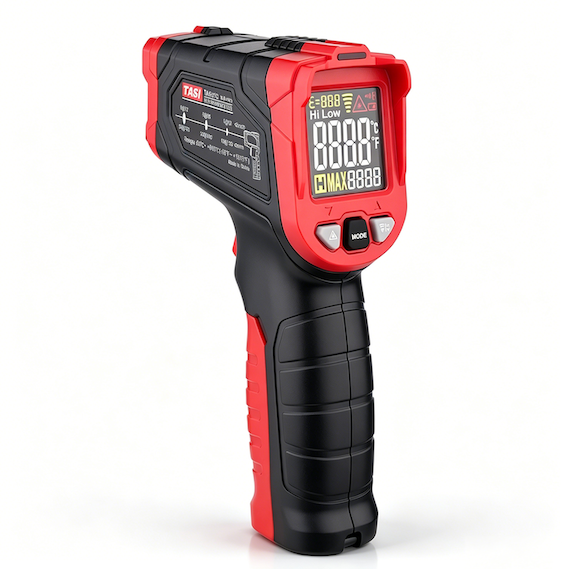
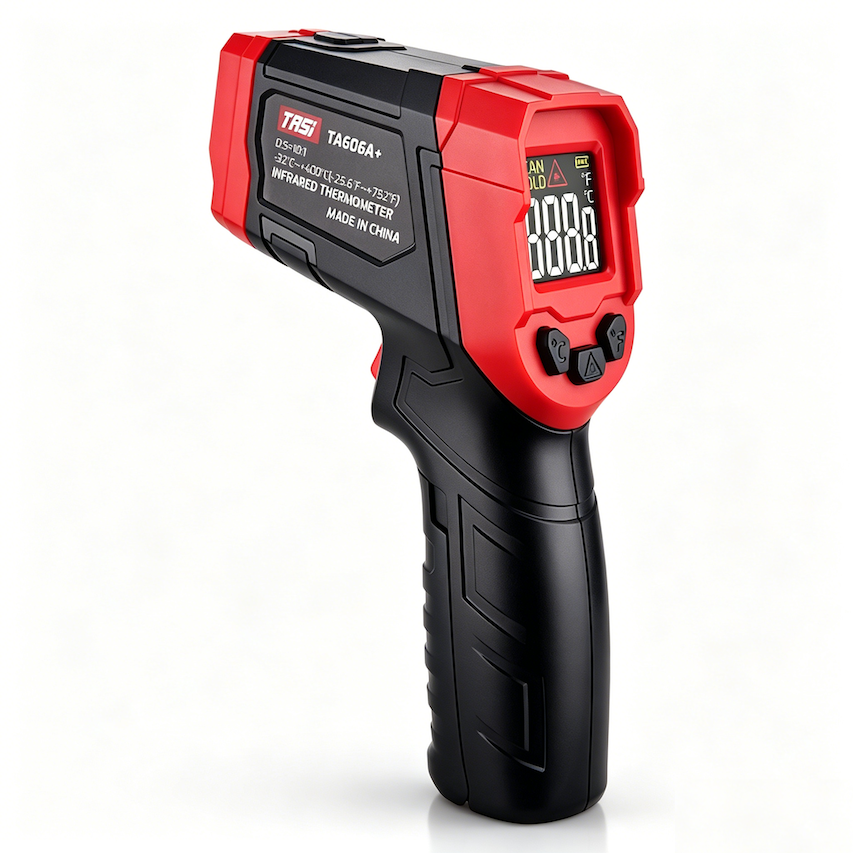
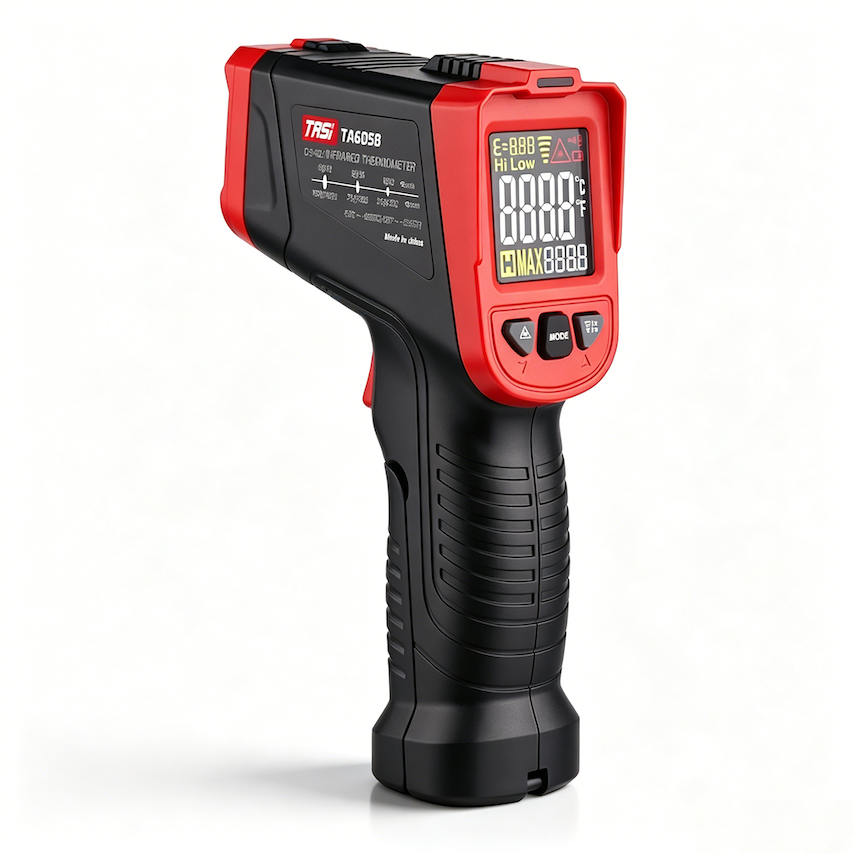
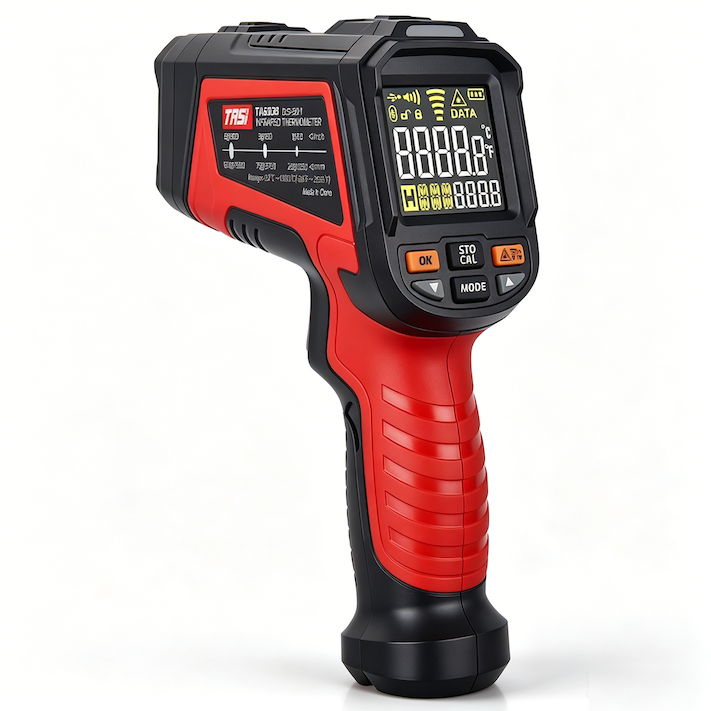
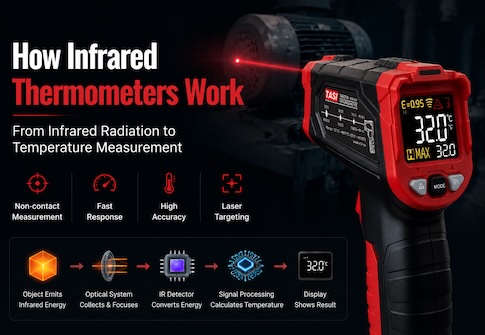
An infrared thermometer measures temperature without contacting the target. It detects infrared radiation emitted from the target surface and converts the received radiation into a temperature value. As long as there is a sufficiently clear infrared transmission path between the target and the instrument, temperature measurement is generally possible.
In a steam-rich environment, however, infrared radiation emitted by the target must pass through the vapor or steam layer before reaching the thermometer. Atmospheric water vapor, suspended droplets, and radiation emitted by the steam itself can all influence the signal received by the instrument.
Therefore, an infrared thermometer is not necessarily unusable in a steam environment, but measurement reliability depends strongly on steam density, path length, and the overall measurement conditions.
Key Points
● Normal humid air usually does not prevent short-distance infrared temperature measurement.
● Dense visible steam or mist generally has a much greater effect than ordinary high humidity.
● Infrared radiation from the target may be absorbed or attenuated by water vapor and droplets, while the steam itself also emits infrared radiation.
● The denser the steam and the longer the optical path through it, the more difficult it becomes to determine the true target surface temperature.
● If steam obscures the target, the displayed value may represent the combined effect of the target, steam layer, and surrounding background radiation.
● Condensation on the infrared thermometer lens can cause even more significant measurement errors.
Why Water Vapor Can Affect Infrared Temperature Measurement
An infrared thermometer does not directly measure distance or air temperature. Its optical system receives infrared radiation within a defined spectral range.
In relatively clean, transparent air, infrared radiation from the target can reach the thermometer with limited interference, so the effect of the air itself is usually small.
When the optical path contains a significant amount of water vapor, visible steam, mist, or suspended droplets, the situation changes.
● Part of the infrared radiation from the target may be absorbed by water vapor or droplets.
● Suspended droplets may scatter and attenuate part of the radiation.
● Steam and droplets have their own temperature and therefore emit infrared radiation.
● The total signal reaching the detector may no longer originate solely from the target surface.
Steam therefore does more than simply “block” the target. It changes the radiative transmission conditions between the target and the infrared thermometer.
High Humidity and Visible Steam Are Not the Same Condition
In practical applications, it is important to distinguish between high relative humidity and the presence of dense visible steam.
In a humid environment, the air may contain a considerable amount of water vapor. However, if the measuring distance is short and the line of sight to the target is clear, many infrared temperature measurements can still be performed normally.
For example, when measuring the surface temperature of equipment housings, pipes, or walls in a humid indoor environment, water vapor is often not the dominant source of error provided that no visible steam obstructs the target.
The situation is different when white steam, mist, or continuously discharged vapor is present in front of the target.
The infrared thermometer must then observe the target through a continuously changing layer of steam. Variations in steam density, temperature, and flow can cause the displayed temperature to fluctuate or deviate from the actual surface temperature.
Denser Steam Generally Causes Greater Measurement Error
The influence of steam on infrared measurement is not simply a matter of “affected” or “unaffected.” The magnitude of the effect depends on the measurement conditions.
Significant errors are more likely when:
● Dense or continuous steam is present between the target and the thermometer.
● The steam visibly obscures the target surface.
● The measuring distance is long, increasing the optical path through the steam.
● The target temperature differs substantially from the steam temperature.
● Steam density changes continuously, causing unstable infrared transmission.
● Large quantities of fine droplets are suspended in the measurement path.
For example, if the temperature of equipment behind a steam pipe is measured through a dense layer of visible steam, being able to see the equipment with the human eye does not mean that an infrared thermometer can determine its true surface temperature accurately.
A medium that transmits visible light does not necessarily transmit infrared radiation in the same way.
The Displayed Temperature May Not Be the True Target Surface Temperature
A common misconception is that an infrared thermometer always measures only the object behind the steam.
In reality, when steam is dense, the radiation received by the thermometer may contain contributions from the target surface, the steam layer itself, and reflected radiation from the surrounding environment.
The displayed temperature may therefore be a calculated result based on a combination of these radiation components.
For this reason, even if the thermometer shows a stable reading through dense steam, that reading should not automatically be interpreted as the true surface temperature of the target.
If the steam and target are at similar temperatures, the error may be difficult to recognize. When their temperatures differ substantially, abnormal readings are usually easier to identify.
Why Measuring Distance Matters
In a steam environment, the effective measuring distance should generally be kept as short as practical.
One reason is that the longer the distance, the longer the infrared radiation must travel through the steam. This increases the possibility of absorption, attenuation, and other transmission effects.
The distance-to-spot ratio (D:S) of the infrared thermometer must also be considered. As measuring distance increases, the measurement spot becomes larger. If the target does not fully cover the measurement area, radiation from surrounding surfaces, background objects, or intervening steam may also contribute to the reading.
Therefore, while maintaining safe operating conditions:
● Position the thermometer as close to the target as practical.
● Make sure the target is significantly larger than the measurement spot.
● Select a measurement position with the least possible steam in the optical path.
● Avoid long-distance measurements through dense, extensive steam whenever possible.
Under these conditions, improving the measurement geometry is often more effective than simply changing the emissivity setting.
Lens Condensation Can Be More Serious Than Water Vapor in the Air
Condensation on the infrared optical lens requires particular attention in hot, humid, or steam-rich environments.
If a cold infrared thermometer is brought into a warm, humid area, or if the instrument remains exposed to steam for an extended period, moisture may condense on the optical window.
Once a water film or droplets form on the lens, an additional medium is introduced between the target and the infrared detector. This can significantly interfere with infrared transmission.
Possible symptoms include:
● Readings that are noticeably higher or lower than expected.
● Continuously changing readings when measuring the same target.
● Unusual differences between nearby measurement points.
● Slower response or difficulty obtaining a stable reading.
If visible moisture or condensation appears on the lens, measurement should be stopped. The optical surface should be handled according to the instrument instructions and allowed to return to a clean, dry condition before measurement resumes.
How to Improve Measurement Reliability in a Steam Environment
If infrared measurement must be performed in a steam environment, several practical measures can reduce the influence of steam.
● Choose a position where there is as little steam as possible between the target and the thermometer.
● Keep the measuring distance as short as practical while maintaining safe working conditions.
● Use temporary gaps in the steam flow to measure the target when its surface is clearly visible.
● Avoid measurement paths directly crossed by continuously discharged steam.
● Make sure the target fully covers the infrared measurement spot.
● Confirm that the emissivity setting is appropriate for the target surface.
● Protect the infrared optical window from condensation.
● For critical applications, take multiple readings and evaluate their repeatability.
If dense steam cannot be avoided and the result is used for critical process control, equipment diagnostics, or safety-related decisions, a single non-contact infrared reading should not be relied upon without additional verification.
Applications Requiring Particular Caution
Some industrial environments naturally contain large amounts of steam and therefore require additional care when using an infrared thermometer.
Examples include:
● Steam pipes and valves.
● Boilers and heat-exchange equipment.
● Food steaming and high-temperature cleaning processes.
● Hot-water tanks and thermal processing equipment.
● Paper, textile, and other high-temperature, high-humidity production areas.
● HVAC, humidification, and industrial steam systems.
In these applications, the first consideration should be whether a clear and stable infrared optical path exists between the thermometer and the target, rather than simply whether the target is visible to the human eye.
FAQ
Can an infrared thermometer measure an object through steam?
It should not be assumed that an infrared thermometer can simply “see through” steam. Low concentrations of water vapor over a short distance may still allow useful measurements, but dense steam can absorb and attenuate infrared radiation from the target while also contributing its own radiation.
Can an infrared thermometer still be used in very humid air?
Usually, yes. High humidity alone is not the same as dense visible steam. If the target is clearly visible, the measuring distance is short, and there is no condensation on the lens, many routine infrared measurements can still be performed normally.
Why does the temperature fluctuate when measuring through steam?
Steam density, temperature, and flow conditions can change continuously. These variations alter infrared transmission between the target and the thermometer, causing the received radiation and displayed temperature to change.
If I can see the target, does that mean infrared measurement will be accurate?
No. Human vision uses visible wavelengths, while infrared thermometers operate within specific infrared spectral bands. A medium that is relatively transparent to visible light may behave differently in infrared wavelengths.
Is a shorter measuring distance better in steam environments?
Generally, yes, provided that all safety requirements and instrument operating limits are respected. A shorter distance reduces the optical path through steam and also helps keep the measurement spot smaller. However, steam should not be allowed to discharge directly onto the thermometer or lens.
Can I continue measuring if there is condensation on the lens?
It is not recommended. Condensation directly affects the transmission of infrared radiation into the instrument and may cause significant errors. Measurements should resume only after the optical surface is clean and dry.
Conclusion
An infrared thermometer can be used to measure objects in environments containing water vapor, but the reliability of the result depends mainly on the infrared transmission path between the target and the instrument.
In normally humid air, over a short distance and with a clear target, the influence of water vapor is often limited. Dense visible steam, suspended droplets, or a long steam-filled optical path can significantly absorb and attenuate infrared radiation from the target. Radiation from the steam itself may also contribute to the measurement and cause the displayed temperature to differ from the true target surface temperature.
When using an infrared thermometer in a steam environment, particular attention should therefore be paid to steam obstruction, measuring distance, target size relative to the measurement spot, emissivity, and lens condensation. For critical measurements where dense steam cannot be avoided, the reliability of the infrared reading should be carefully evaluated and, when necessary, verified using an alternative temperature measurement method.