Introduction
Yes. Condensation or fogging on the lens, optical window, or protective window of an infrared thermometer can affect the amount of infrared radiation reaching the detector and may therefore introduce measurement errors.
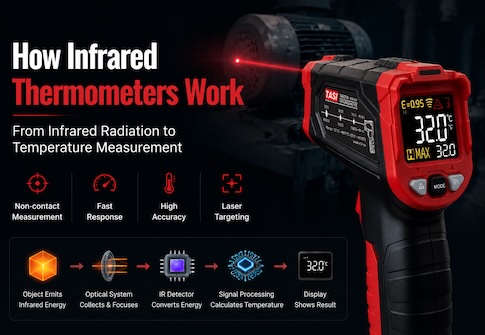
An infrared thermometer does not directly “read” the temperature of an object. Its optical system collects infrared radiation emitted by the target surface, and the instrument calculates temperature from the detected radiation. If moisture forms on the optical surface, an additional medium is introduced between the target and the detector, which can interfere with normal infrared transmission.
This issue is particularly common when an instrument is moved from a cold environment into a warm and humid area, used around cold storage facilities, operated outdoors in winter, or exposed to rapid changes in temperature and humidity.
Key Points
● Condensation on the optical window can alter the infrared energy reaching the detector and cause measurement errors.
● Typical symptoms include readings that are too low, unstable values, slower apparent response, and poor repeatability.
● Lens fogging is commonly caused by rapid temperature changes combined with high ambient humidity.
● Accurate measurements should not be performed while visible condensation or water droplets remain on the optical window.
● Allow the instrument to approach ambient temperature and confirm that the optical window is completely clear before measurement.
● Clean the optical surface only with suitable soft materials and according to the manufacturer's maintenance instructions.
Why Does Lens Condensation Affect Infrared Temperature Measurement?
The optical system of an infrared thermometer collects infrared radiation from the target surface and directs it toward the infrared detector.
Under normal conditions, radiation from the target passes through the optical path as intended. When microscopic water droplets form on the lens or optical window, part of this radiation may be absorbed, reflected, or scattered. As a result, the amount of infrared energy reaching the detector can change.
Because the thermometer calculates temperature based on the detected radiation signal, any additional attenuation in the optical path may cause the displayed temperature to differ from the actual target surface temperature.
It is also important to note that infrared thermometers may use optical materials or coatings designed for specific infrared wavelength ranges rather than ordinary visible-light glass. A thin layer of condensation that appears minor to the eye may still have a significant effect on infrared transmission.
Will Condensation Always Make the Reading Too Low?
Not necessarily, although a low reading is one of the more common results.
If condensation reduces the amount of target radiation reaching the detector, the instrument may interpret the weaker signal as a lower target temperature.
However, the direction and magnitude of the error can also depend on target temperature, ambient temperature, optical window temperature, moisture thickness, spectral response, and reflected background radiation. It is therefore not correct to assume that condensation always causes a fixed negative error.
The more important point is that visible condensation means the normal optical measurement conditions have been disturbed. Even if the displayed value appears reasonable, it should not be regarded as a reliable high-accuracy result until the optical path is clear again.
What Symptoms Can Appear When the Lens Is Fogged?
Typical symptoms include:
● The measured temperature is noticeably lower than expected.
● The displayed value fluctuates during repeated measurements.
● Measurements at the same location show poor repeatability.
● The instrument appears to respond more slowly than usual.
● The displayed temperature changes as condensation gradually forms or disappears.
● Readings return toward normal after the optical window becomes clear.
If these symptoms occur together with visible moisture or fogging on the optical window, condensation should be ruled out before assuming that the instrument has developed an accuracy problem.
Why Does an Infrared Thermometer Suddenly Fog Up?
Lens fogging is usually caused by condensation.
When the temperature of the lens, optical window, or instrument housing is below the dew point of the surrounding air, water vapour can condense on the colder surface and form microscopic droplets.
Typical situations include:
● Moving the instrument from cold outdoor conditions into a warm, humid indoor environment.
● Taking the thermometer out of a cold room, refrigerated storage area, or freezer environment and using it immediately.
● Storing the instrument near an air-conditioning outlet before moving it into a humid area.
● Using the thermometer in rain, mist, steam, or other high-humidity environments.
● Operating the instrument where its temperature differs significantly from the surrounding air temperature.
For example, an infrared thermometer that has remained in a cold environment for an extended period may develop condensation almost immediately after entering a warm, humid area, even when the ambient temperature itself is not unusually high.
Can the Thermometer Be Used Immediately After Leaving a Cold Room?
In most cases, this is not recommended.
In addition to visible condensation on the lens, the detector, optical components, and internal electronics may not yet have reached thermal equilibrium with the new environment.
Infrared thermometers normally specify an allowable operating temperature range. However, being within that range does not necessarily mean the instrument will provide its best accuracy immediately after a large environmental transition.
After moving the instrument from a cold room, refrigerated warehouse, vehicle, or cold outdoor environment into a warmer area, allow sufficient time for the thermometer to acclimatise.
The required stabilisation time depends on the temperature difference, humidity, instrument construction, and the manufacturer's instructions. At minimum, the optical window should be completely clear and free of visible condensation before accurate measurements are taken.
What Is the Difference Between External and Internal Fogging?
Fogging on the outside surface of the optical window is generally external condensation. Once environmental conditions stabilise, this moisture may evaporate naturally.
If moisture is confirmed inside the instrument, on the inner side of the optical window, or on internal optical components, the situation requires greater attention.
A properly sealed instrument should not regularly develop visible internal condensation under normal operating conditions. Repeated internal fogging may indicate an issue related to sealing, environmental protection, temperature cycling, or moisture trapped inside the enclosure.
● Light external condensation: Allow the instrument to stabilise naturally before use.
● Persistent internal condensation: Do not disassemble the instrument yourself; inspection or service may be required.
● Repeated internal fogging: Check whether the instrument's environmental protection and operating conditions are appropriate for the application.
What Should You Do If the Lens Fogs Up?
First, stop any measurement where accuracy is important.
Place the thermometer in a stable environment and allow it to approach ambient temperature naturally. As the optical surface warms above the dew point, condensation will normally disappear.
If visible water droplets remain on the optical window, follow the manufacturer's maintenance instructions and use clean, soft materials suitable for optical surfaces.
Important precautions include:
● Do not repeatedly rub the optical window with rough paper or abrasive materials.
● Do not use sharp objects to remove moisture or contamination.
● Do not apply unknown cleaning agents or solvents.
● Do not use high-temperature airflow to force rapid defogging.
● Do not perform precision measurements while the optical surface remains wet.
Infrared optical windows may use specialised materials or surface coatings. Incorrect cleaning can scratch or damage the optical surface and permanently affect measurement performance.
Can the Lens Be Wiped with a Finger?
It is not recommended.
Fingers can leave oils, perspiration, and other contaminants on the optical surface. These deposits can reduce cleanliness and may alter infrared transmission.
Even without condensation, grease, dust, and other contamination can interfere with the infrared optical path.
For this reason, avoid touching the optical window directly. When cleaning is necessary, follow the maintenance procedure specified for the instrument.
How Can Lens Condensation Be Reduced?
The most effective approach is to minimise rapid changes in temperature and humidity.
● After moving the instrument from a cold environment into a warm, humid area, do not immediately perform precision measurements.
● Allow the instrument to warm gradually inside its carrying case, storage container, or another relatively enclosed environment where appropriate.
● Avoid long-term storage in high-humidity conditions.
● In mist, steam, rain, or humid industrial environments, observe the instrument's environmental protection rating and operating limitations.
● Before measurement, inspect the lens or infrared optical window for moisture and contamination.
● In applications with repeated hot-to-cold transitions, include acclimatisation time as part of the normal measurement procedure.
For industrial applications requiring good repeatability, stable target conditions alone are not sufficient. The instrument's optical window and internal temperature should also be reasonably stable.
Can Dust on the Lens Cause Similar Problems?
Yes, depending on the level of contamination.
Condensation, dust, grease, and other deposits have different causes, but all of them may interfere with the infrared radiation travelling through the optical path.
A small amount of dust may not immediately create a significant error. However, increasing contamination can reduce infrared transmission and affect long-term measurement consistency.
For applications requiring good accuracy and repeatability, the optical window should therefore be inspected regularly.
Infrared measurement accuracy depends not only on emissivity, measuring distance, distance-to-spot ratio, measuring angle, and target size. The cleanliness and condition of the optical window are also important and are often overlooked.
How Can You Determine Whether Condensation Is Causing the Error?
The measurement environment and the condition of the instrument can provide useful indications.
● Check the optical window for visible fogging, water droplets, or moisture marks.
● Determine whether the instrument has recently experienced a significant temperature change.
● Wait until the optical surface is completely clear and repeat the measurement on the same target.
● Keep the measuring distance, angle, and emissivity setting unchanged when comparing results.
● If the readings return to normal after the thermometer has acclimatised and the condensation has disappeared, moisture was likely one of the main causes.
If the optical window is clear and the instrument has stabilised but readings remain abnormal, other factors should also be checked, including emissivity settings, measuring distance, target size, reflected background radiation, optical contamination, and instrument calibration.
FAQ
Can an infrared thermometer still be used if there is only slight fogging on the lens?
A value may still be displayed, but it should not be relied upon for accurate measurement. Even a thin moisture layer can alter infrared transmission.
Can condensation damage an infrared thermometer?
Short-term external condensation does not necessarily mean the instrument is damaged. However, liquid water entering the enclosure or prolonged exposure to excessive humidity can affect reliability. Always observe the product's environmental protection and operating specifications.
Why are the readings still unstable when the lens already looks clear?
The internal temperature of the instrument may not yet have stabilised, or a microscopic moisture film may remain on the optical surface. Emissivity and reflected background radiation should also be considered.
Can a hair dryer be used to remove condensation quickly?
Direct high-temperature airflow is generally not recommended. Rapid heating may create additional thermal stress or measurement instability. Natural acclimatisation to the surrounding environment is preferable.
What should be considered when using an infrared thermometer outdoors in winter?
In addition to the specified operating temperature range, pay particular attention to condensation when moving the thermometer from cold outdoor conditions into a warm indoor environment. Allow the optical window to clear and the instrument to acclimatise before performing accurate measurements.
Conclusion
Condensation on an infrared thermometer lens can affect measurement because moisture on the optical surface changes the transmission of infrared radiation to the detector. This may result in inaccurate, unstable, or poorly repeatable readings.
When fogging occurs, precision measurements should be suspended. Allow the thermometer to acclimatise naturally, confirm that the optical window is completely clear, and clean it only using appropriate methods.
For users working frequently in cold storage, outdoor environments, humid areas, or locations with repeated temperature transitions, including instrument acclimatisation and optical-window inspection in the normal measurement procedure can significantly reduce avoidable infrared measurement errors.