Introduction
Infrared thermometers are widely used for outdoor equipment inspection, building diagnostics, HVAC maintenance, electrical inspection and industrial temperature measurement. A common question is whether they can still operate correctly in strong ambient light or direct sunlight.
In general, infrared thermometers can be used in bright light and sunlight. Visible light is not the primary signal detected by most handheld infrared thermometers, so strong illumination does not simply cause the instrument to lose its temperature measurement capability.
However, sunlight can still influence the measurement conditions. It may heat the target surface, change the surface temperature distribution, increase reflected-radiation effects, particularly on low-emissivity surfaces, and make the laser aiming point difficult to see.
For this reason, outdoor infrared measurements should distinguish between two questions: whether the instrument can measure, and whether the displayed temperature accurately represents the thermal condition you intend to evaluate.
Key Points
● Most standard handheld infrared thermometers can be used under normal bright-light and outdoor sunlight conditions.
● Visible light is generally not the primary measurement signal of an infrared thermometer and does not normally disable infrared temperature measurement.
● Direct sunlight may heat the target surface, meaning the measured value represents the surface temperature under current solar exposure.
● Low-emissivity, highly reflective surfaces such as polished metals are more susceptible to reflected environmental radiation.
● Strong sunlight can make the laser aiming point difficult to see, but the laser point is not the actual infrared measurement spot.
● Outdoor measurements should also consider measurement distance, distance-to-spot ratio (D:S), emissivity, measurement angle and the instrument's specified operating temperature range.
Does Bright Light Directly Interfere with an Infrared Thermometer?
For most conventional handheld non-contact infrared thermometers, bright visible light does not normally prevent temperature measurement.
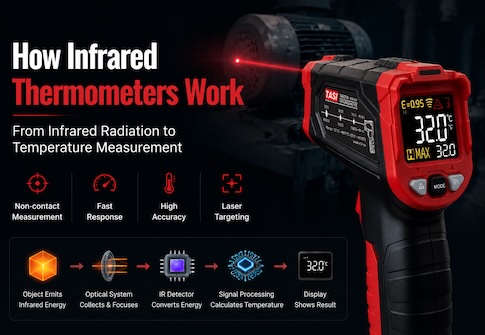
An infrared thermometer detects infrared radiation emitted by the target surface. Its optical system collects this radiation and directs it to an infrared detector, while the internal electronics and algorithms convert the detected radiation into a temperature reading.
Many handheld thermometers intended for ambient, industrial and moderate-temperature applications operate within a defined long-wave infrared spectral range rather than the visible-light spectrum.
Therefore, office lighting, industrial lighting and ordinary daylight do not normally affect an infrared thermometer in the same way that excessive light can overexpose a conventional camera.
Different infrared temperature instruments may, however, use different spectral response ranges. Short-wavelength infrared pyrometers designed for high-temperature applications may behave differently under certain optical conditions. The instrument specifications and operating instructions should therefore always be followed.
Why Can Measurements Still Change in Sunlight?
Although sunlight may not directly interfere with the detector, it can significantly alter the thermal condition of the target and its surroundings.
The most obvious effect is solar heating. For example, one side of a metal enclosure may be exposed to direct sunlight while another side remains shaded. The two surfaces can develop substantially different temperatures.
If the infrared thermometer then displays different readings, this does not necessarily indicate measurement error. The surfaces may genuinely be at different temperatures.
This effect is common on building façades, roofs, vehicles, outdoor piping, electrical enclosures and industrial machinery.
If the purpose of the measurement is to identify heat generated by equipment operation, solar heating must therefore be considered as an additional thermal input. Otherwise, temperature rise caused by sunlight may be mistaken for abnormal equipment heating.
Why Are Reflective Metal Surfaces More Difficult to Measure in Sunlight?
Stainless steel, aluminium, copper, galvanized metal and polished metallic surfaces commonly have relatively low emissivity and high reflectivity.
The infrared radiation received by the instrument may therefore include more than radiation emitted by the target itself. Low-emissivity surfaces can reflect infrared radiation from surrounding objects into the thermometer.
Outdoor measurement environments can include radiation from the sky, nearby buildings, machinery, people and other hot or cold objects.
As a result, the measured temperature of reflective metal may read higher or lower than expected or may change when the viewing angle changes, even though the thermometer itself is functioning normally.
● Avoid measuring mirror-like or highly polished areas whenever possible.
● Where practical, select oxidized, painted or otherwise higher-emissivity areas.
● For measurements requiring greater reliability, a suitable high-emissivity tape, coating or validated surface treatment may be used as a reference area, provided it is suitable for the temperature involved.
● Do not attempt to compensate for unknown reflected radiation simply by repeatedly changing the emissivity setting, as an incorrect emissivity value can introduce additional error.
Why Is the Laser Point Difficult to See in Sunlight?
This is one of the most common difficulties when using an infrared thermometer outdoors.
Many handheld infrared thermometers use a red laser to help indicate the approximate aiming position. Indoors, the laser point is usually easy to see. Under intense sunlight, however, the ambient brightness may greatly reduce the visual contrast between the red laser and the target surface.
This is primarily an aiming visibility issue, not necessarily a temperature measurement problem.
It is also important to understand that the laser point is generally only an aiming aid. It does not represent the full infrared measurement area.
The actual measurement spot is determined by the optical system, measurement distance and D:S ratio.
As measurement distance increases, the measurement spot normally becomes larger. Even if the laser point is positioned correctly on the target, the reading may still include surrounding surfaces if the target is smaller than the actual measurement spot.
Is a Temperature Measured in Direct Sunlight a Real Temperature?
That depends on what is meant by “real temperature.”
If an object has been exposed to sunlight for some time, solar radiation has become part of its thermal condition. The infrared thermometer may therefore be correctly measuring the actual surface temperature under those conditions.
However, if the purpose is to determine the temperature that would exist without solar heating, direct sunlight becomes an additional variable.
Typical examples include:
● Evaluating abnormal heating in electrical equipment.
● Comparing operating temperature rise between two machines.
● Inspecting the thermal condition of building materials.
● Assessing surface temperature changes caused by fluid inside a pipe.
For these applications, it is preferable to compare targets under similar lighting and environmental conditions or to measure shaded areas. If direct sunlight is temporarily blocked, sufficient time may also be required for the surface temperature to stabilize.
Simply shading a previously sun-heated surface and measuring it immediately does not recreate its pre-sunlight condition, because absorbed heat is not removed instantly.
How Can Measurement Reliability Be Improved Outdoors?
Reliable outdoor infrared measurements require attention to the environment, target surface and instrument setup.
● Determine whether the target is exposed to direct sunlight and whether solar heating affects the measurement objective.
● Compare targets under similar sunlight, environmental and measurement conditions whenever possible.
● Pay particular attention to emissivity and reflected background radiation when measuring metallic or other low-emissivity surfaces.
● Use an appropriate measurement angle. Where practical, measure approximately perpendicular to the surface rather than at a steep angle.
● Follow the specified D:S ratio and maintain a measurement distance that ensures the target fully covers the measurement spot.
● If the laser is difficult to see, shortening the distance may improve aiming and reduce spot size.
● Ensure that the thermometer itself remains within the manufacturer's specified operating ambient temperature range.
● Avoid leaving the instrument for extended periods in direct sunlight, on a vehicle dashboard or in other excessively hot locations.
● For comparative or trend measurements, keep distance, angle, measurement position, emissivity setting and environmental conditions as consistent as possible.
Can Leaving the Instrument in Direct Sunlight Affect Measurement?
Yes, it can.
Using an infrared thermometer outdoors and leaving the instrument itself exposed to intense sunlight for an extended period are different situations.
Infrared thermometers contain infrared detectors, temperature compensation circuitry and other electronic components. They are designed to operate within a specified ambient temperature range, and internal compensation can correct for normal environmental temperature variation within that range.
However, prolonged exposure to direct sunlight, a hot vehicle interior or another excessively hot environment may raise the instrument temperature beyond its normal operating conditions. This can reduce measurement stability or exceed the specified operating limits.
If the thermometer has also been moved between environments with substantially different temperatures, allowing sufficient time for the instrument to acclimatize before precision measurements is recommended.
Does Bright Light Always Cause the Reading to Be Too High?
No. It is not correct to assume that bright light always causes an infrared thermometer to read high.
If sunlight has genuinely increased the target surface temperature, the higher reading may accurately represent the current condition.
For low-emissivity, reflective surfaces, reflected environmental radiation may cause the indicated value to shift either higher or lower. The direction and magnitude of the effect depend on target temperature, reflected background temperature, surface condition, viewing angle and instrument settings.
When a reading changes under sunlight, consider the following:
● Has the target surface actually been heated by the sun?
● Is the target a low-emissivity material?
● Has the measurement angle changed?
● Does the target fully cover the infrared measurement spot?
● Are the sunny and shaded areas genuinely at different temperatures?
These factors should be evaluated before concluding that the instrument is producing an incorrect reading.
FAQ
Can an infrared thermometer be used outdoors in direct sunlight?
Yes. Most handheld infrared thermometers can be used outdoors under normal sunlight conditions. However, solar heating, reflected radiation, laser visibility and the instrument's own operating temperature should be considered.
Does sunlight directly interfere with the infrared sensor?
For common long-wave handheld infrared thermometers, visible sunlight is generally not the primary measurement signal. Sunlight is more likely to affect the result indirectly by heating the target or changing the surrounding radiation environment.
Why can I not see the laser point in sunlight?
Strong ambient light reduces the visual contrast of the red laser point. This does not necessarily affect the infrared detector, but it can make precise aiming more difficult.
Why is the temperature different between a sunny area and a shaded area?
Solar radiation adds heat directly to exposed surfaces. As a result, the sunlit surface may genuinely be significantly warmer than the shaded area.
Is measuring metal less reliable in sunlight?
Reflective metals such as polished stainless steel, aluminium and copper are more sensitive to reflected environmental radiation because of their low emissivity. Outdoor conditions can therefore make these measurements more challenging.
Should I measure from a shorter distance outdoors?
If strong sunlight makes the laser difficult to see, reducing the distance may improve aiming. It also reduces the measurement spot size, making it easier to ensure that the target fully covers the measured area. The instrument's D:S specification should still be followed.
Conclusion
Infrared thermometers can generally operate normally in bright light and sunlight. Visible light alone does not normally disable infrared temperature measurement.
The more important consideration is how sunlight changes the measurement conditions.
Solar radiation can heat the target surface, low-emissivity materials can reflect surrounding infrared radiation, strong light can reduce laser visibility, and prolonged solar exposure can raise the temperature of the instrument itself.
For reliable outdoor measurements, consider solar heating, emissivity, reflected background radiation, measurement distance, spot size, measurement angle and the instrument's specified operating temperature range.
When these factors are properly controlled, an infrared thermometer can provide reliable measurements in most normal outdoor bright-light conditions.