Introduction
Factory lighting is not simply about making a workspace “bright enough.” Appropriate lighting directly affects an operator’s ability to identify components, read instruments, inspect product defects, operate machinery, and perform maintenance safely and efficiently.
Different manufacturing environments involve different visual tasks. General material handling and rough processing usually require relatively moderate lighting, while precision assembly, electronics manufacturing, quality inspection, and other detailed operations generally require higher illuminance levels.
In China, industrial lighting design may refer to the current GB 50034-2024 Standard for Lighting Design of Buildings, which came into effect on August 1, 2024 and replaced GB 50034-2013. For specific industrial projects, applicable industry standards, production processes, equipment configurations, and project specifications should also be considered.
Key Takeaways
● There is no single illuminance value suitable for every factory workshop. Required lighting levels should be determined according to the specific visual task and production process;
● General production areas are often evaluated within an approximate range of 150–300 lx, while machining and assembly areas generally require higher illuminance;
● Precision assembly, product inspection, and small-detail visual tasks may require approximately 500–1000 lx or higher;
● Workshop lighting evaluation should not rely on a single measurement point. Average illuminance, uniformity, glare, color rendering, and flicker should also be considered;
● Illuminance should be measured on the actual working plane, using a suitable digital lux meter and multiple measurement points.
What Is an Appropriate Illuminance Level for a Factory Workshop?
The required illuminance level in a factory mainly depends on the size of the visual target, task precision, contrast, duration of work, and safety requirements.
For areas used primarily for material handling, simple production, or large-component operations, workers generally need to identify relatively large objects and equipment positions. These tasks usually do not require very high illuminance.
Machining, assembly, instrument reading, wiring inspection, and quality control involve smaller visual details and therefore require higher lighting levels.
For this reason, industrial lighting should normally be designed by dividing the factory into functional zones rather than applying the same illuminance level throughout the entire facility.
Typical Factory Workshop Illuminance Reference Ranges
The following values are intended as practical reference ranges for preliminary industrial lighting evaluation and planning. Final project design and acceptance should follow applicable national standards, industry standards, design specifications, and actual production requirements.
| Area or Task Type | Recommended Illuminance Reference |
|---|---|
| Internal factory passageways and simple circulation areas | 100–150 lx |
| Raw material storage and general warehouse areas | 100–200 lx |
| Material handling, washing, and simple production tasks | 150–200 lx |
| General production and rough processing | 200–300 lx |
| General machining areas | 300–500 lx |
| General assembly lines | 300–500 lx |
| Detailed machining and assembly | 500–750 lx |
| Precision assembly areas | 500–1000 lx |
| Product appearance inspection and quality control | 750–1000 lx |
| Very fine visual tasks | 1000 lx or higher |
These values should be understood as engineering reference ranges rather than universal mandatory standard values.
Electronics manufacturing, automotive production, precision engineering, semiconductor manufacturing, food processing, pharmaceutical production, laboratories, and other specialized environments may have additional industry-specific lighting requirements.
Why Do Different Production Areas Require Different Illuminance Levels?
Illuminance requirements are closely related to the visual difficulty of a task.
The smaller the object, the lower the contrast, and the greater the precision required, the higher the lighting quality generally needs to be.
For example:
● Large-component handling mainly requires workers to identify equipment, materials, and traffic routes;
● General machining requires observation of machining positions, scales, tools, and workpiece surfaces;
● Assembly work requires operators to identify component positions, holes, fasteners, and assembly conditions;
● Electronic assembly may require inspection of small components, solder joints, and circuit details;
● Quality inspection may require detection of scratches, cracks, color differences, burrs, or other small defects.
It is therefore normal for different areas within the same factory to use lighting levels such as 200 lx, 300 lx, 500 lx, or even above 1000 lx.
Illuminance Reference for General Production Areas
For packaging, material handling, simple assembly, general machine operation, and large-component processing, an illuminance level of approximately 200–300 lx can often be used as an initial reference.
Although these areas generally do not require extremely high illuminance, workers should still be able to clearly identify machinery, workpieces, control panels, passageways, and safety signs.
In large workshops, lighting uniformity is particularly important. A workspace should not be very bright directly beneath a luminaire while becoming noticeably darker between fixtures or around equipment.
Illuminance Reference for Machining Workshops
Lathes, milling machines, grinders, drilling machines, and other machining equipment require operators to continuously observe cutting areas, workpiece surfaces, tool positions, and machine conditions.
For general machining, approximately 300–500 lx can be used as a practical reference.
Where small components, high-precision machining, fine scale reading, or complex machine operation is involved, illuminance may need to be increased to approximately 500–750 lx.
In many cases, combining general workshop lighting with localized task lighting is more effective than increasing the illuminance of the entire building.
Illuminance Reference for Assembly Workshops
Assembly lighting requirements depend strongly on component size and assembly accuracy.
General mechanical assembly may typically use approximately 300–500 lx. More detailed assembly work can require approximately 500–750 lx, while electronic components, small parts, or high-precision assembly may require approximately 750–1000 lx.
For precision assembly benches, localized task lighting can further improve visibility.
However, task lighting should be positioned carefully to avoid excessive glare, reflection, and strong shadows.
Illuminance Reference for Product Inspection and Quality Control
Product appearance inspection, dimensional inspection, defect detection, and quality control are visually demanding tasks.
Typical illuminance levels for these areas may be approximately 750–1000 lx.
When workers need to detect very small scratches, cracks, burrs, printing defects, or surface imperfections, even higher lighting levels may be necessary.
Lighting direction, color rendering, and surface reflectance should also be considered.
For quality inspection areas, simply increasing brightness is not sufficient. The lighting system must support clear and accurate visual recognition.
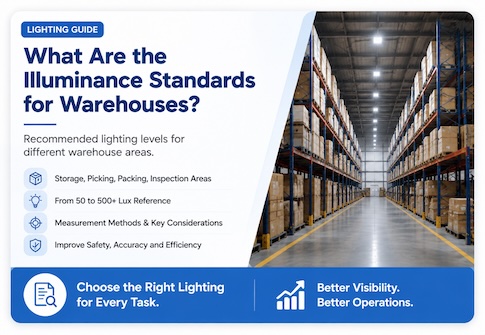
How Much Illuminance Is Needed in Factory Warehouses and Passageways?
Warehouses generally do not require the same illuminance level as production or precision assembly areas.
General storage areas may typically use approximately 100–200 lx.
Where workers frequently read product labels, model numbers, barcodes, or perform sorting tasks, the lighting level should be increased according to the visual task.
Internal factory passageways are primarily used for pedestrian and material movement and should be designed according to actual safety and operational conditions.
Tall shelving, machinery, or stored materials can block light. Therefore, even when average floor illuminance appears adequate, lower rack levels or local working areas may still be too dark.
Why Should Workshop Lighting Not Be Evaluated at Only One Point?
Illuminance varies significantly across a workspace.
For example, measurements along the same production line could show:
● Directly below a luminaire: 650 lx;
● Between two luminaires: 380 lx;
● Beside a machine: 260 lx;
● At the center of a workbench: 520 lx.
If only the brightest point beneath a luminaire is measured, the overall lighting condition may be incorrectly assessed.
Professional illuminance evaluation therefore requires multiple measurement points and should consider both average illuminance and the distribution of light across the work area.
Where Should Factory Workshop Illuminance Be Measured?
The measurement position should correspond to the actual working plane.
If workers perform tasks on a horizontal workbench, illuminance should be measured at the actual work surface height.
If the visual task occurs on a machine control panel, vertical inspection surface, or other operating plane, measurements should be taken at that actual visual task plane.
It is generally inappropriate to place a lux meter on the floor and use that value as the illuminance of a workstation.
In China, GB/T 5700-2023 Methods of Measurement for Lighting specifies general requirements, measurement instruments, and methods for lighting measurements and came into effect on July 1, 2024.
How to Measure Illuminance in a Factory Workshop
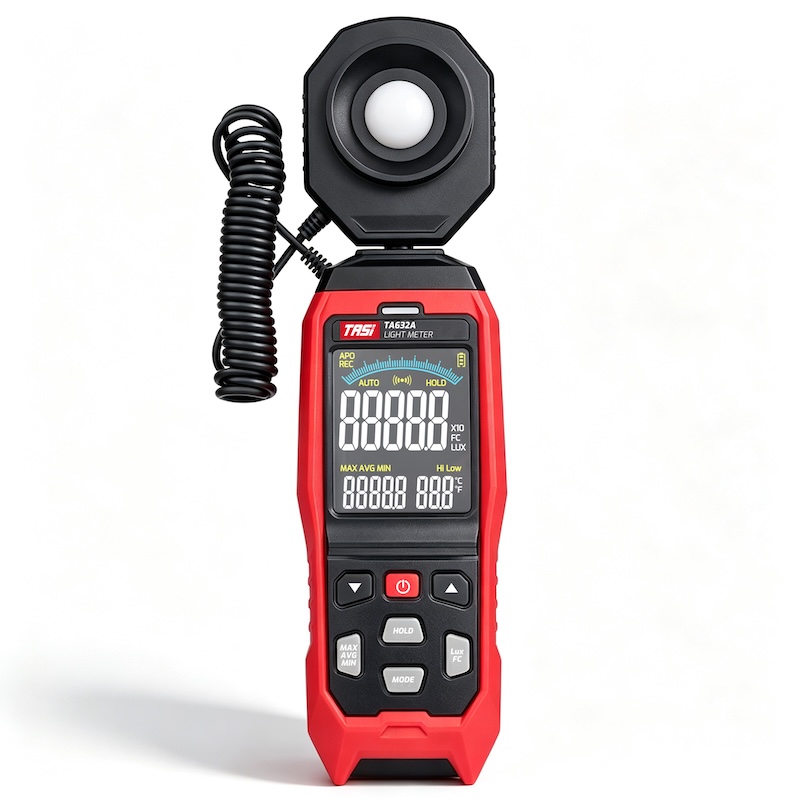
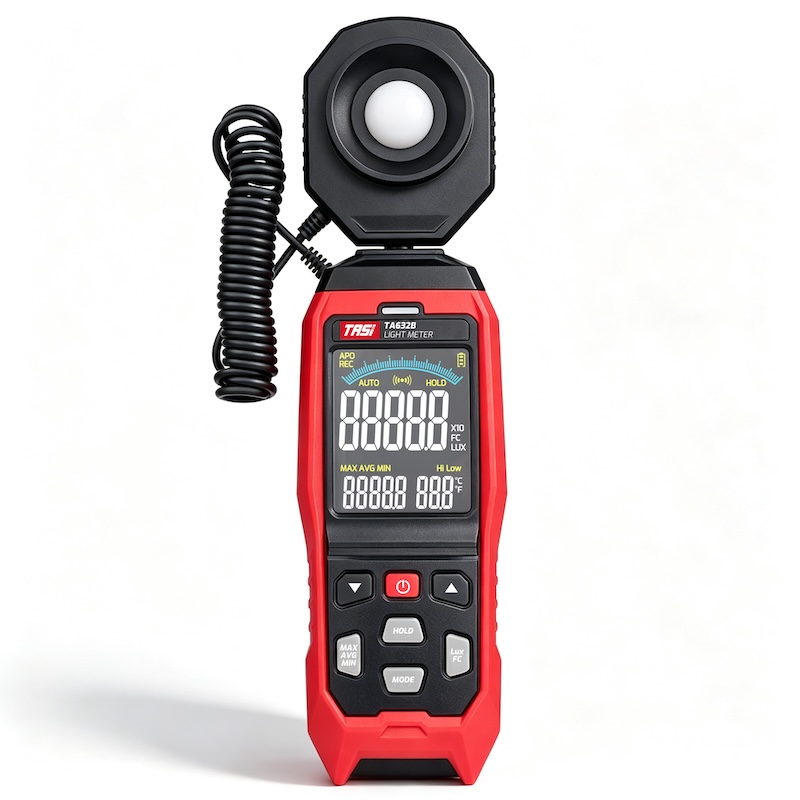
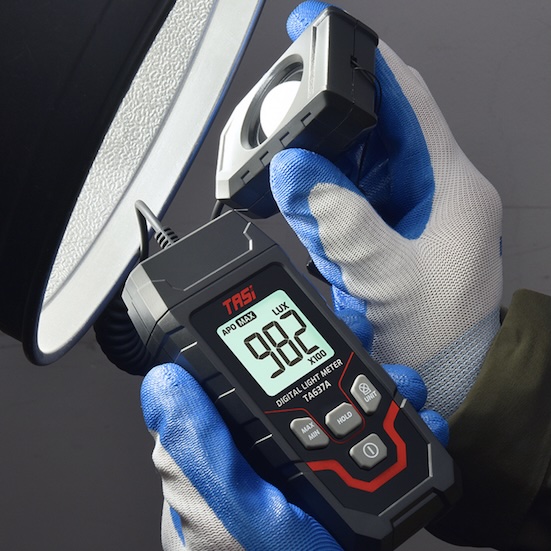
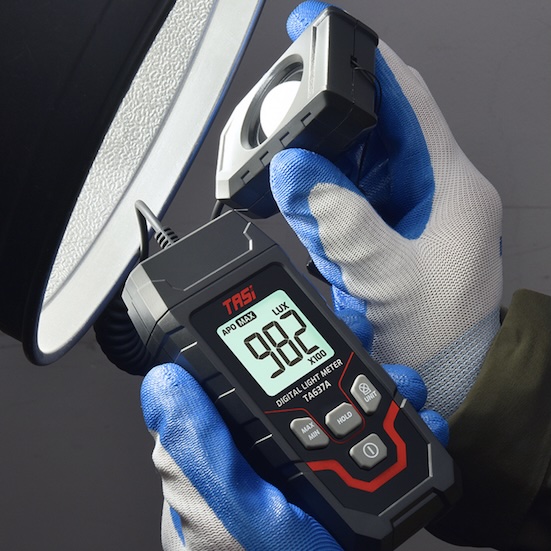
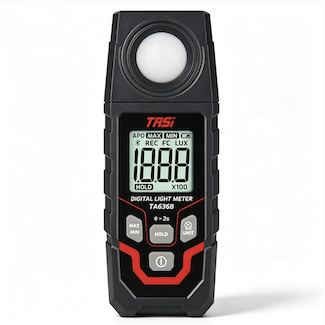
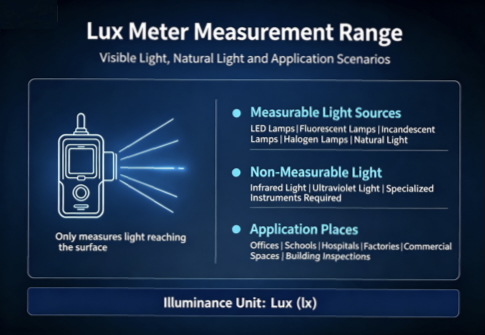
A digital lux meter is commonly used for factory lighting measurements.
A typical measurement procedure includes:
● Divide the production area according to floor area, luminaire layout, and working zones;
● Determine the actual working plane or reference measurement plane;
● Position the lux meter sensor appropriately at the measurement point;
● Avoid blocking the sensor with the operator, equipment, or other objects;
● Allow the reading to stabilize before recording the value;
● Complete measurements at multiple points according to the selected measurement grid;
● Compare individual readings and calculate or evaluate average illuminance where required.
For formal engineering inspection, measurement methods should comply with applicable standards and project requirements.
What Should Be Considered When Measuring Workshop Illuminance?
Factory lighting measurements can be influenced by sensor position, daylight, equipment obstruction, and operator technique.
During measurement, the following points should be considered:
● Ensure the lighting system has reached normal stable operating conditions;
● Do not allow the operator or surrounding objects to block the sensor;
● Orient the sensor according to the actual measurement plane;
● Do not measure only directly below luminaires;
● Record any obstruction caused by equipment, shelves, or production lines;
● When evaluating artificial lighting separately, minimize the influence of changing daylight conditions;
● For repeated measurements, maintain consistent measurement conditions whenever possible.
When measurement results are used in formal inspection reports, the measuring instrument should meet the required performance criteria and have valid calibration or verification status as applicable.
Does Meeting the Lux Requirement Mean the Lighting Is Fully Compliant?
Not necessarily.
Illuminance is only one of several important lighting performance indicators.
Even if a working plane reaches 500 lx, excessive glare, flicker, strong brightness contrast, or heavy shadows may still reduce visual comfort and work efficiency.
A complete industrial lighting evaluation may also consider:
● Average illuminance on the working plane;
● Illuminance uniformity;
● Glare control;
● Color rendering performance;
● Flicker and visual stability;
● Shadows caused by equipment and personnel;
● Luminaire maintenance and light depreciation.
Industrial lighting design should therefore focus on overall lighting quality rather than illuminance alone.
What Causes Insufficient Illuminance in Factory Workshops?
Even when a lighting system was properly designed at the beginning, actual illuminance may decrease over time.
Common causes include:
● Light output depreciation after long-term LED or lamp operation;
● Dust, oil, or contamination accumulating on luminaires and diffusers;
● Industrial pollution reducing light transmission;
● New machinery or storage racks blocking existing lighting;
● Changes to production line layouts;
● Damaged or failed luminaires;
● Changes in working-plane height or position;
● Existing lighting no longer meeting the requirements of upgraded production processes.
For this reason, workshop illuminance should be checked periodically rather than measured only during initial commissioning or acceptance.
How Can Insufficient Factory Illuminance Be Improved?
If measurements show that workshop illuminance is insufficient, simply adding more luminaires is not always the best solution.
Depending on site conditions, improvements may include:
● Cleaning luminaires and covers to restore light output;
● Replacing aged, degraded, or damaged light sources;
● Adjusting luminaire positions and beam directions;
● Optimizing spacing between luminaires;
● Adding localized task lighting at production lines or workbenches;
● Reducing large shadowed areas caused by equipment and shelving;
● Reassessing illuminance requirements after production process changes;
● Repeating multi-point lux measurements after improvements are completed.
For precision production and inspection areas, localized task lighting is often more effective and energy-efficient than increasing the lighting level throughout the entire workshop.
Why Should Long-Term Maintenance Be Considered in Factory Lighting Design?
Lighting calculations during the design stage represent expected performance under defined conditions.
Actual factory environments change over time.
Dust, oil mist, high temperatures, vibration, and long operating hours can all affect luminaire performance.
A workshop that meets lighting requirements when newly commissioned may no longer maintain the same illuminance several years later.
Factories can therefore include illuminance measurement as part of facility maintenance or routine safety inspections.
Periodic measurements help identify areas where lighting has deteriorated and support timely cleaning, repair, replacement, or system optimization.
Frequently Asked Questions
How many lux does a typical factory workshop need?
General factory production areas can often be evaluated at approximately 200–300 lx. Machining and assembly areas commonly require around 300–500 lx, while precision assembly and quality inspection areas may require 500–1000 lx or higher. The final requirement should be determined according to the specific process and applicable standards.
Is 300 lx enough for a machining workshop?
For some general machining operations, 300 lx may be acceptable as a basic reference. However, tasks involving small components, fine scales, detailed surface observation, or precision machining generally require higher illuminance and may also benefit from localized task lighting.
What illuminance level is recommended for an assembly line?
General assembly lines may typically use approximately 300–500 lx. More detailed assembly may require around 500–750 lx, while electronics or high-precision assembly may require higher illuminance.
Why do product inspection areas require higher illuminance?
Quality inspection often involves identifying scratches, burrs, cracks, surface defects, dimensional details, or other small features. Higher illuminance and better overall lighting quality can improve visual recognition and inspection accuracy.
Should factory illuminance be measured at floor level?
Usually not. Measurements should be taken at the actual visual task plane. Workbench tasks should be measured at the work surface, while machine panels or vertical inspection areas should be measured at the relevant operating plane.
Is higher illuminance always better?
No. Excessive illuminance can increase energy consumption and may create glare, reflections, or excessive brightness contrast. Good industrial lighting should balance sufficient illuminance with uniformity, glare control, color rendering, and energy efficiency.
Why can lux readings vary greatly within the same workshop?
Variations may be caused by luminaire spacing, mounting height, equipment obstruction, shelving, luminaire aging, and the position of the measurement point relative to the light source. Multi-point measurement is therefore essential.
How often should factory workshop illuminance be measured?
There is no single inspection interval suitable for every factory. The measurement frequency can be determined according to operating conditions, lighting maintenance schedules, production layout changes, and internal safety management requirements. Re-measurement is also recommended after lighting replacement, production line changes, or noticeable reductions in brightness.
Conclusion
Factory workshop illuminance should be determined according to the actual production task rather than applying one fixed lux value to all industrial environments.
General production, machining, assembly, precision manufacturing, quality inspection, and warehouse areas have different visual requirements and should therefore be evaluated separately.
In addition to illuminance values, industrial lighting evaluation should also consider illuminance uniformity, glare, color rendering, flicker, equipment obstruction, and long-term light depreciation.
By using a digital lux meter and applying appropriate multi-point measurement methods, factories can obtain reliable lighting data to support workplace improvement, equipment maintenance, energy-efficient lighting management, and safer production operations.