Introduction
School classrooms are important learning environments where students spend extended periods reading, writing, viewing the blackboard, and using teaching materials. Insufficient illuminance can make visual tasks more difficult, while poor uniformity, excessive glare, or inadequate blackboard lighting can also reduce visual comfort.
For this reason, classroom lighting should not be evaluated simply by judging whether the room appears “bright enough.” Professional illuminance measurement should be carried out on desk surfaces, blackboard surfaces, and across the overall classroom lighting area.
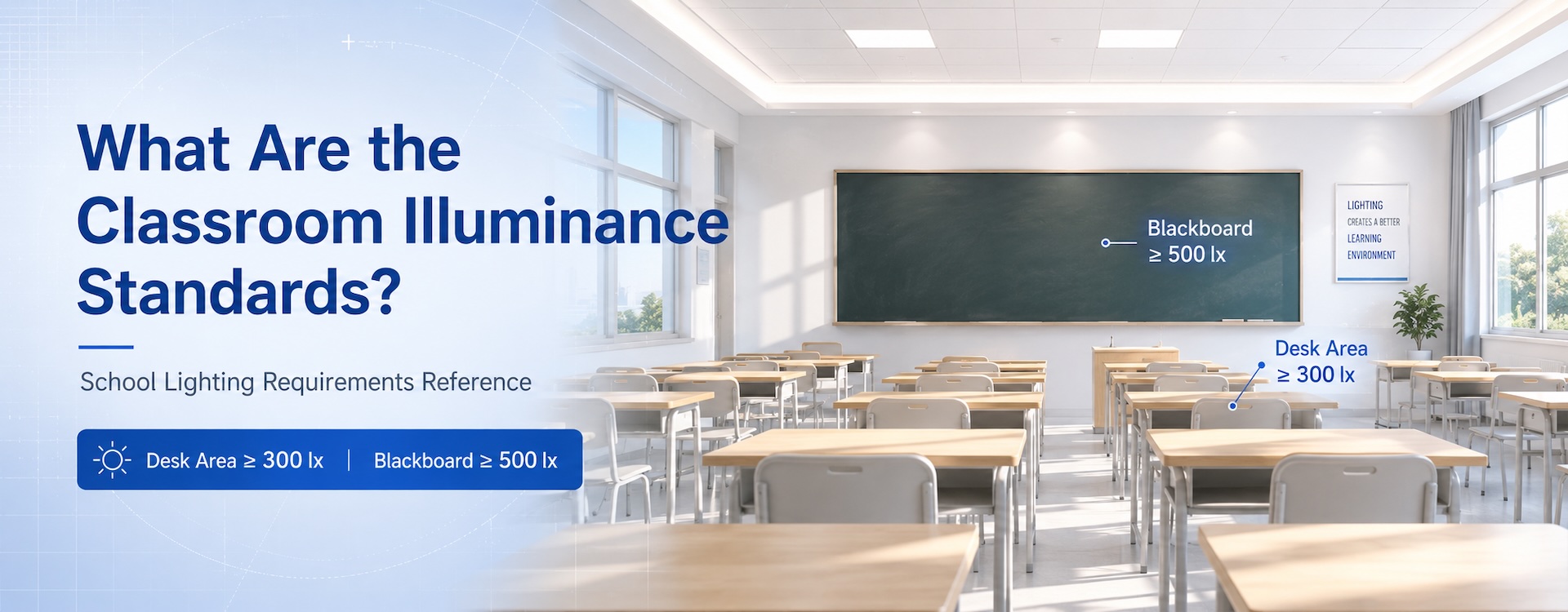
Under the current Chinese classroom lighting requirements, the maintained average illuminance on classroom desks should be at least 300 lx, while the maintained average illuminance on the blackboard should be at least 500 lx. Illuminance uniformity, glare, color temperature, and color rendering should also be considered.
Key Points
● Maintained average illuminance on classroom desks should be at least 300 lx;
● Desk illuminance uniformity should be at least 0.7;
● Maintained average illuminance on the blackboard should be at least 500 lx;
● Blackboard illuminance uniformity should be at least 0.8;
● The Unified Glare Rating (UGR) for classroom lighting should generally not exceed 19;
● Classroom lighting assessment should consider not only average illuminance, but also uniformity, glare, color temperature, and color rendering;
● Illuminance measurements should be taken at multiple points using a suitable lux meter rather than relying on a single desk measurement.
What Is the Recommended Illuminance Standard for School Classrooms?
For ordinary primary and secondary school classrooms, the desk surface and blackboard are the two most important visual task areas. Because they serve different purposes and are located on different planes, their illuminance requirements are different.
| Measurement Item | Recommended Requirement | Main Purpose |
|---|---|---|
| Maintained average illuminance on desks | ≥300 lx | Supports reading, writing, and general classroom learning |
| Desk illuminance uniformity | ≥0.7 | Reduces excessive brightness differences between seating areas |
| Maintained average illuminance on blackboard | ≥500 lx | Improves visibility of text, diagrams, and written content |
| Blackboard illuminance uniformity | ≥0.8 | Maintains consistent illumination across the board |
| Unified Glare Rating (UGR) | ≤19 | Helps control uncomfortable glare from luminaires |
Therefore, simply stating that “the classroom lighting standard is 300 lx” is incomplete.
More precisely, 300 lx applies mainly to the horizontal desk working plane, while the blackboard requires a higher maintained average illuminance of at least 500 lx.
Why Should Desk Illuminance Be at Least 300 lx?
Students perform continuous near-visual tasks at their desks, including reading, writing, calculations, and viewing printed learning materials.
When illuminance is too low, text, lines, and graphical details become more difficult to distinguish. This issue becomes particularly noticeable on cloudy days, during late afternoon classes, or in classrooms with limited natural daylight.
However, classroom lighting should not simply be made as bright as possible.
Excessively bright luminaires, poor optical design, or strong reflections from desk surfaces can create uncomfortable glare and reduce visual comfort.
A suitable classroom lighting system should therefore achieve a balance between adequate illuminance, good uniformity, and effective glare control.
Why Does Blackboard Illuminance Need to Reach 500 lx?
Viewing a blackboard is different from reading at a desk.
The blackboard is a vertical visual task surface located at the front of the classroom, and students may need to observe small text, formulas, drawings, or diagrams from several meters away.
If the classroom relies only on general ceiling lighting without properly designed blackboard lighting, several problems may occur:
● The center of the blackboard is bright while the edges remain dark;
● The upper and lower areas of the board have noticeably different illuminance levels;
● The teacher’s body creates shadows while writing;
● Strong reflections appear on the blackboard surface;
● Students seated at the rear of the classroom have difficulty reading smaller writing.
For this reason, dedicated blackboard lighting is commonly used to provide sufficient and uniform vertical illuminance across the board.
What Is Maintained Average Illuminance?
When discussing classroom lighting standards, it is important to understand the term maintained average illuminance.
It does not simply refer to the illuminance measured immediately after new luminaires are installed.
Lighting output can gradually decrease due to lamp aging, LED lumen depreciation, dust accumulation, dirt on optical surfaces, and other maintenance-related factors.
For example, a newly renovated classroom may initially measure 350 lx on the desk surface. However, if the lighting system experiences significant lumen depreciation over time, the illuminance may eventually fall below the required 300 lx level.
Therefore, lighting design should take maintenance factors into account, and classroom illuminance should be checked periodically.
What Is Classroom Illuminance Uniformity?
Meeting the required average illuminance does not necessarily mean that the entire classroom is properly illuminated.
For example, if several measurement points show 600 lx, 500 lx, 320 lx, and 120 lx, the calculated average may appear acceptable while part of the classroom remains noticeably dark.
Illuminance uniformity is commonly expressed as:
Illuminance Uniformity U₀ = Minimum Illuminance Emin ÷ Average Illuminance Eavg
For ordinary classrooms:
● Desk illuminance uniformity should be at least 0.7;
● Blackboard illuminance uniformity should be at least 0.8.
A higher uniformity value means that the difference in illuminance between different areas is smaller.
Lighting quantity, luminaire spacing, mounting height, light distribution, classroom geometry, and desk arrangement can all affect uniformity.
What Other Lighting Parameters Should Be Considered?
A classroom is a long-duration visual working environment. In addition to illuminance and uniformity, several other lighting parameters should be considered.
● Unified Glare Rating (UGR): Classroom lighting should generally maintain a UGR of no more than 19 to help reduce uncomfortable glare caused by high-luminance luminaires.
● Color Temperature: Classroom lighting should use a suitable correlated color temperature. Under the currently applicable Chinese classroom lighting standard, approximately 3300 K to 5500 K is recommended.
● Color Rendering Index: Classroom light sources should generally provide a color rendering index of at least Ra 80.
● Brightness Distribution: Excessive contrast between desks, the blackboard, windows, walls, and luminaires should be avoided so that students can comfortably shift their line of sight between different visual tasks.
Professional classroom lighting assessment should therefore not rely solely on a single Lux value.
How Should Classroom Illuminance Be Measured?
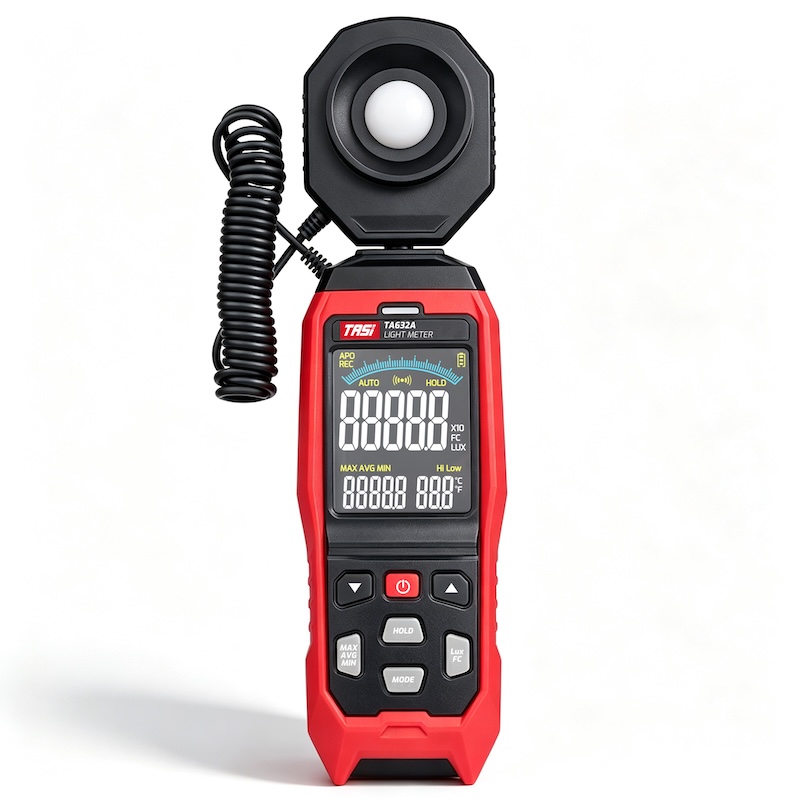
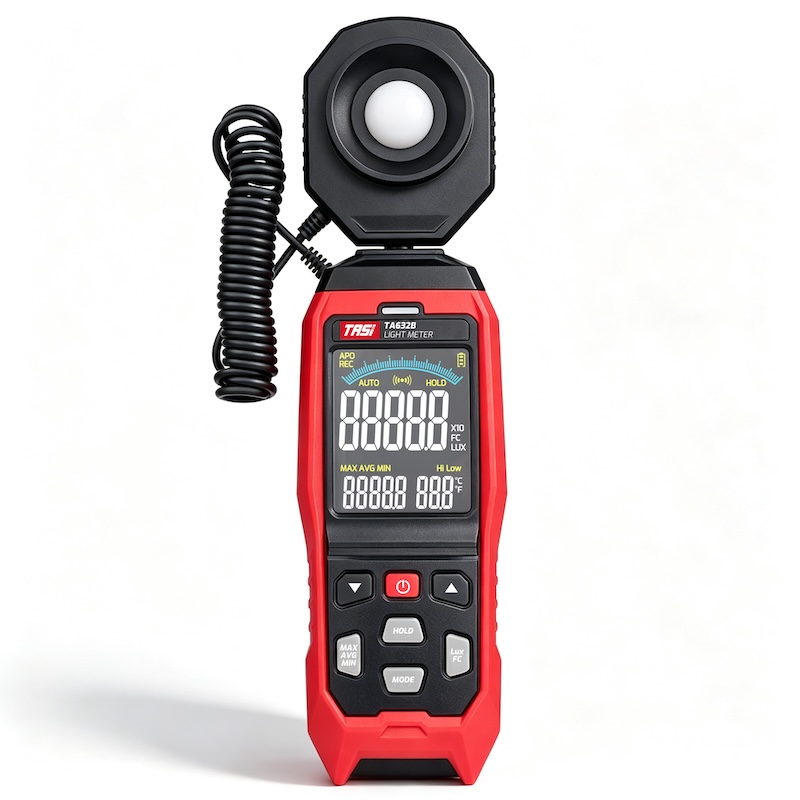
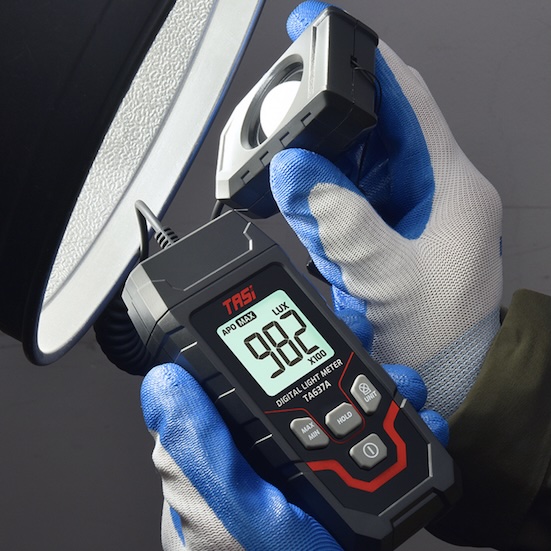
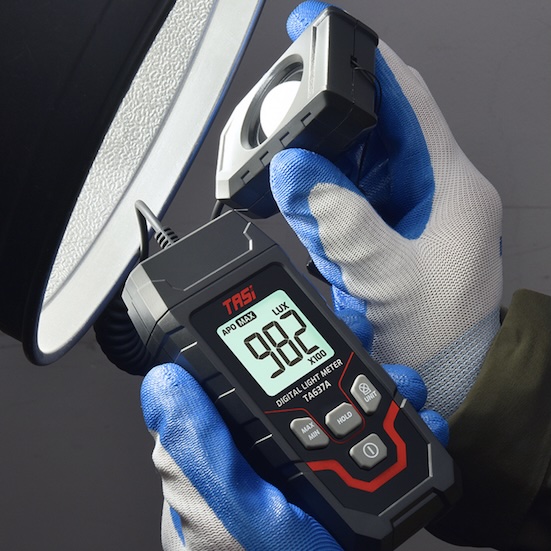
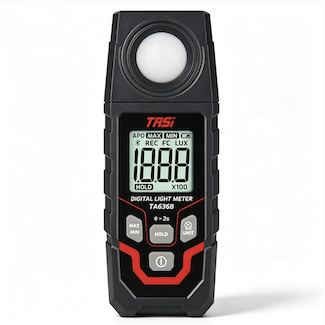
Classroom illuminance is normally measured using a professional digital lux meter.
When measuring desk illuminance, multiple measurement points should be selected across the classroom rather than taking a single reading in the center of the room.
A typical measurement process includes:
● Ensure that the classroom lighting system is operating normally and has reached stable output;
● Control or record the influence of daylight and other external light sources according to the test requirements;
● Divide the classroom into appropriate measurement areas;
● Position the lux meter sensor correctly on the specified working plane;
● Keep the sensor surface correctly oriented;
● Avoid blocking the sensor with the operator’s body or hands;
● Record the illuminance value at each measurement point;
● Calculate the average illuminance, minimum illuminance, and illuminance uniformity;
● Measure blackboard illuminance separately on the vertical blackboard plane.
For professional acceptance testing or third-party inspection, measurement points and testing conditions should follow the applicable standards and project requirements.
Why Is One Measurement in the Center of the Classroom Not Enough?
This is one of the most common mistakes in classroom lighting inspection.
The center of the room is often relatively bright because ceiling luminaires are usually distributed across the central area. However, locations close to walls, windows, rear rows, or between luminaires may have significantly lower illuminance.
A single center reading of 500 lx does not prove that the entire desk working plane meets the 300 lx requirement.
A proper assessment requires multiple measurement points so that average illuminance, minimum illuminance, and uniformity can be evaluated together.
What Should Be Considered When Measuring Classroom Illuminance?
To improve measurement accuracy and repeatability, the following points should be considered:
● The lux meter should be in good working condition and calibrated or verified when required;
● The sensor should remain stable and correctly oriented;
● The operator should avoid casting shadows on the sensor;
● Do not cover or touch the light-sensitive sensor surface during measurement;
● Do not select only high-illuminance points directly beneath luminaires;
● Desk surfaces and blackboard surfaces should be measured separately;
● The same measurement method should be applied consistently across comparable classrooms;
● Measurement time, lighting conditions, measurement positions, and results should be recorded for future comparison.
For professional inspection, a digital lux meter with suitable cosine response, spectral response, measuring range, and accuracy should be selected.
Common Causes of Insufficient Classroom Illuminance
Low classroom illuminance is not always caused simply by low lamp wattage.
Common causes include:
● Insufficient number of luminaires;
● Poor luminaire layout;
● Incorrect mounting height or spacing;
● Lumen depreciation after prolonged use;
● Dust accumulation on luminaires;
● Large classroom area without sufficient lighting capacity;
● Insufficient dedicated blackboard lighting;
● Unsuitable luminaire light distribution;
● Excessive spacing between luminaires;
● Changes in the reflectance of walls, ceilings, or interior finishes.
When classroom lighting fails an illuminance test, measurement data should be analyzed to identify the actual cause rather than simply installing higher-power luminaires.
Can Classroom Illuminance Be Too High?
Yes.
Higher illuminance does not automatically mean better lighting quality.
If high-output luminaires are used without appropriate optical control, they may create excessive glare, reflections, and strong brightness contrasts.
For example, high-luminance LED surfaces may be directly visible in students’ field of view, while glossy desks or boards may produce reflected glare.
The objective of classroom lighting design should therefore be to provide a sufficient, uniform, comfortable, and stable visual environment, rather than simply maximizing the Lux value.
How Often Should Classroom Illuminance Be Checked?
Lighting output can change over time due to LED aging, contamination, maintenance conditions, and changes in the classroom environment.
Periodic inspection is therefore recommended as part of school facility maintenance.
Additional measurements are particularly useful when:
● The classroom lighting system has been renovated or replaced;
● The number or position of luminaires has changed;
● The blackboard or teaching area has been relocated;
● Teachers or students report noticeably dark areas;
● Luminaires have been in service for an extended period;
● The classroom is undergoing lighting acceptance testing or a special inspection.
Regular measurements help identify changes in illuminance and uniformity before they significantly affect the classroom lighting environment.
What Should Be Noted About the New GB 7793-2025 Standard?
Schools, lighting contractors, and testing organizations should also pay attention to changes in the applicable national standard.
As of August 16, 2026, GB 7793-2010, Hygienic Standard for Day Lighting and Artificial Lighting for Middle and Elementary School, remains the currently applicable Chinese national standard.
The new mandatory national standard GB 7793-2025 has already been published and will take effect on November 1, 2026, when it will fully replace GB 7793-2010.
Therefore:
● Projects inspected before November 1, 2026 should determine the applicable standard according to the actual project and regulatory requirements;
● Projects implemented after November 1, 2026 should verify the requirements of GB 7793-2025;
● Projects currently under planning or construction but scheduled for acceptance after the new standard takes effect should consider the updated requirements in advance.
Technical standards may be revised over time, so project-specific requirements should also be checked against local education, health, building lighting, and acceptance regulations.
How to Choose a Lux Meter for Classroom Lighting Measurement
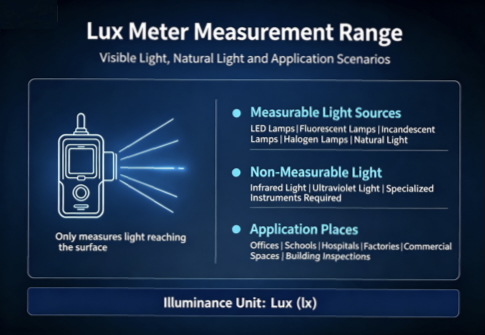
Classroom lighting measurement generally involves illuminance levels ranging from several hundred Lux upward, so the measuring instrument should provide both a suitable measuring range and appropriate optical response characteristics.
Key selection factors include:
● Suitability for visible-light illuminance measurement;
● A measuring range that covers typical classroom lighting levels;
● Good cosine response;
● Spectral response reasonably matched to the photopic response of the human eye;
● Adequate resolution and measurement stability;
● Convenient operation for multi-point measurements;
● Calibration or traceability capability when required for professional testing.
For school lighting engineering, building acceptance, and professional environmental measurement, a stable and reliable digital lux meter is recommended.
FAQ
What is the minimum recommended illuminance for classroom desks?
Under the currently applicable Chinese classroom lighting requirements, the maintained average illuminance on classroom desks should be at least 300 lx, with an illuminance uniformity of at least 0.7.
What illuminance is required on a classroom blackboard?
The maintained average illuminance on the blackboard should be at least 500 lx, with an illuminance uniformity of at least 0.8.
Does a classroom automatically comply if desk illuminance reaches 300 lx?
No. The 300 lx requirement mainly refers to maintained average desk illuminance. Blackboard illuminance, illuminance uniformity, glare, and other lighting parameters should also be evaluated.
Why can a classroom fail even if the center measures 500 lx?
Because a single point does not represent the entire classroom. Areas near walls, corners, or between luminaires may have much lower illuminance, resulting in poor average illuminance or uniformity.
Is blackboard illuminance measured in the same way as desk illuminance?
The measuring principle is the same, but the working plane is different. Desk illuminance is measured on a horizontal plane, while blackboard illuminance is measured on a vertical plane.
Is higher classroom illuminance always better?
No. Excessively bright lighting may increase glare and reflections. Classroom lighting should provide adequate illuminance while maintaining good uniformity and visual comfort.
What instrument is used to measure classroom illuminance?
A digital lux meter is normally used. For professional inspection or engineering acceptance, the instrument should provide suitable accuracy, spectral response, and cosine response characteristics.
Conclusion
For ordinary school classrooms, two illuminance values are especially important:
Maintained average illuminance on classroom desks should be at least 300 lx, while blackboard illuminance should be at least 500 lx.
However, classroom lighting quality cannot be evaluated using these two values alone. Desk and blackboard illuminance uniformity, glare, color temperature, color rendering, and overall brightness distribution should also be considered.
For classroom lighting renovation, engineering acceptance, or routine inspection, illuminance should be measured at multiple points using a suitable digital lux meter.
With GB 7793-2025 scheduled to take effect on November 1, 2026, schools, lighting contractors, and testing organizations should also monitor the updated requirements and ensure that future lighting design, renovation, and inspection work complies with the applicable standard.