Introduction
Warehouse lighting may appear simple, but in practice it supports a wide range of tasks, including storage, identification, picking, counting, forklift movement, packing, and shipping. Because these tasks differ significantly, warehouse lighting should not be defined by a single lux value for the entire space.
In real applications, lighting requirements depend on warehouse type, stored goods, shelf height, work processes, and the visual demands of each operating area. For this reason, warehouse illuminance should be evaluated by zone and by actual use conditions rather than by a single overall figure.
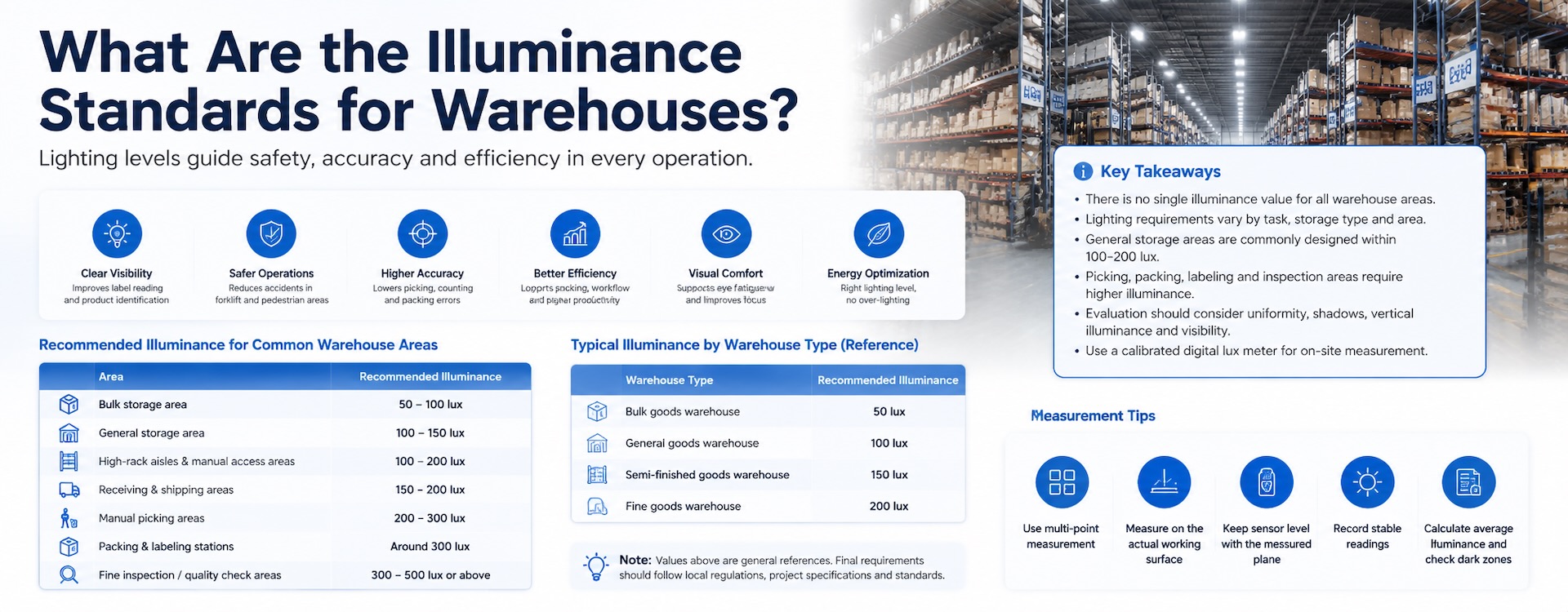
Key Takeaways
● There is no single illuminance value that applies to all warehouse areas.
● Lighting requirements vary depending on storage type and visual task.
● General warehouse areas are commonly designed within the range of 50 to 200 lux.
● Picking, packing, labeling, and inspection areas usually require higher illuminance.
● Warehouse lighting evaluation should consider not only illuminance values, but also uniformity, shadows, vertical illuminance, and operational visibility.
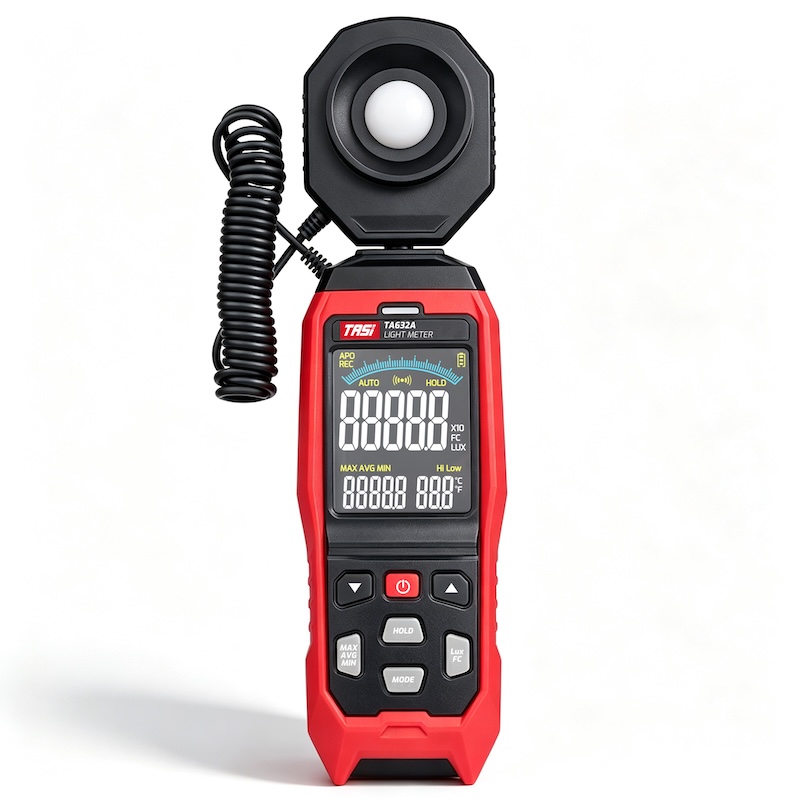
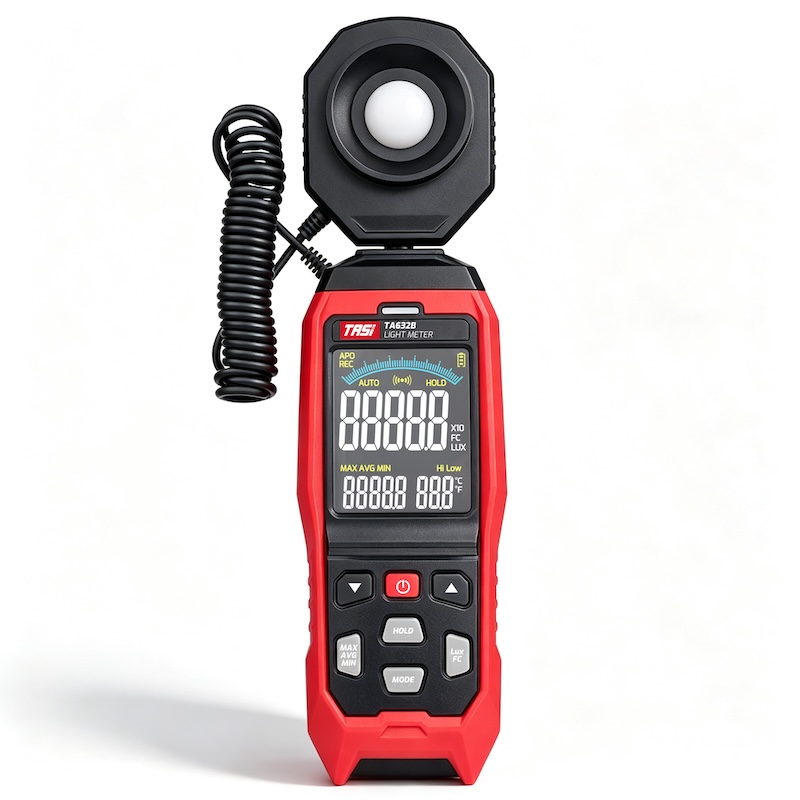
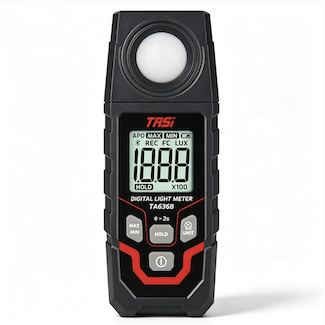
● A calibrated digital lux meter should be used for on-site measurement.
What Are the Illuminance Standards for Warehouses?
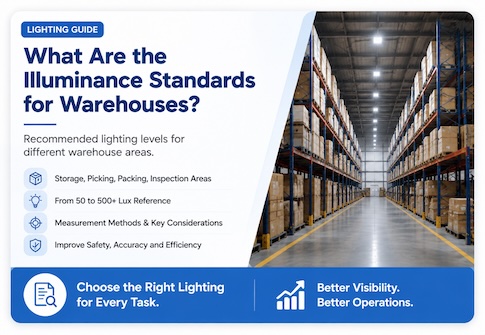
Warehouse illuminance levels generally increase as the visual task becomes more demanding. In practical lighting design, common reference values for warehouse areas are as follows:
| Warehouse Type | Recommended Illuminance |
|---|---|
| Bulk goods warehouse | 50 lux |
| General goods warehouse | 100 lux |
| Semi-finished goods warehouse | 150 lux |
| Fine goods warehouse | 200 lux |
In general, 100 to 200 lux is a common range for standard warehouse storage areas. Lower illuminance may be acceptable for large, easily identifiable goods, while higher illuminance is usually necessary for small items, labels, barcodes, or detailed manual tasks.
However, these values are only general references. Modern warehouses often include not only storage areas, but also receiving, sorting, picking, packing, and inspection zones. In such cases, lighting should be selected according to the actual visual task in each area.
Why Do Different Warehouse Areas Require Different Illuminance Levels?
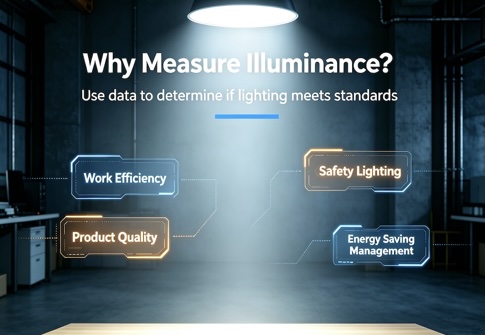
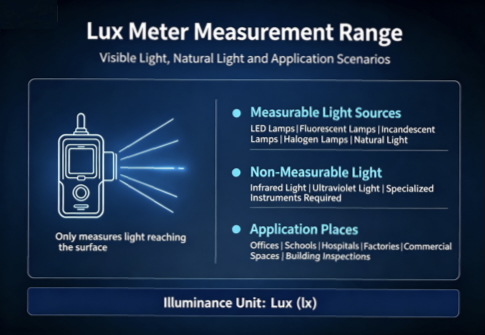
Illuminance is measured in lux (lx) and indicates how much light falls on a surface.
The illuminance requirement of a warehouse depends mainly on what workers need to see clearly.
For example, large pallets, machinery, or oversized cartons are easy to identify and therefore require relatively lower lighting levels. In contrast, small components, product labels, shelf codes, and barcodes require better visual clarity and therefore higher illuminance.
As the visual task becomes more detailed, the required illuminance generally increases.
Recommended Illuminance for Common Warehouse Areas
In practice, a warehouse is rarely a single-function space. In addition to storage zones, it may include aisles, receiving areas, dispatch zones, picking stations, packing stations, and inspection areas.
The following values can be used as practical design and evaluation references:
| Area | Recommended Illuminance |
|---|---|
| Bulk storage area | 50–100 lux |
| General storage area | 100–150 lux |
| High-rack aisles and manual access areas | 100–200 lux |
| Receiving and shipping areas | 150–200 lux |
| Manual picking areas | 200–300 lux |
| Packing and labeling stations | Around 300 lux |
| Fine inspection or quality check areas | 300–500 lux or above |
A key point is that storage areas and work areas should not be treated the same way. Even if a space belongs to a warehouse, if it is used for barcode scanning, order verification, packing, or product checking, its lighting should match the actual visual task instead of relying on standard storage-area values.
Why Is Horizontal Illuminance Alone Not Enough in High-Rack Warehouses?
Many modern warehouses use high shelving systems with narrow aisles. In such environments, luminaires are often mounted at considerable height, and shelving structures create shadows and uneven light distribution.
As a result, measuring only the illuminance on the floor or on a horizontal plane may not accurately reflect actual lighting quality.
In high-rack warehouses, it is also important to consider:
● Vertical illuminance on rack faces;
● Brightness differences between upper and lower shelf levels;
● Illuminance variation between aisle centers and shelf edges;
● Shadows caused by stored goods and shelving structures;
● Visibility of labels, shelf codes, and barcodes.
Therefore, warehouse lighting should be assessed based on real working conditions, not only by a single horizontal measurement value.
Is Higher Illuminance Always Better?
No.
Higher illuminance can improve visibility, but excessive lighting does not necessarily mean better lighting quality. Over-lighting may increase energy consumption and can also lead to glare, strong contrast, and visual discomfort.
A well-designed warehouse lighting system should consider:
● Whether illuminance meets task requirements;
● Whether lighting distribution is reasonably uniform;
● Whether obvious dark zones exist;
● Whether glare affects workers or vehicle operators;
● Whether shadows between racks reduce visibility;
● Whether routes for people and forklifts can be identified clearly;
● Whether energy use is reasonable and efficient.
In short, illuminance is important, but it should be considered together with lighting quality and operational safety.
Where Should Warehouse Illuminance Be Measured?
Measurement positions should correspond to the actual visual task or working surface being evaluated.
For ordinary storage areas, horizontal illuminance is commonly measured on the relevant reference plane. However, in practical warehouse applications, measurement should be adapted to actual use:
● General storage areas: measure on the specified reference plane;
● Walkways and forklift routes: floor-level visibility may also be relevant;
● Picking tables: measure on the actual work surface;
● Packing stations: measure on the packing surface;
● High racks: add vertical illuminance measurements on rack faces;
● Barcode or label reading areas: measure on the actual observation surface.
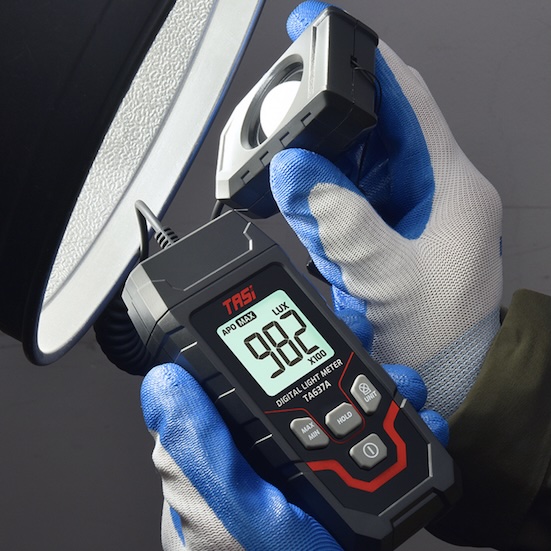
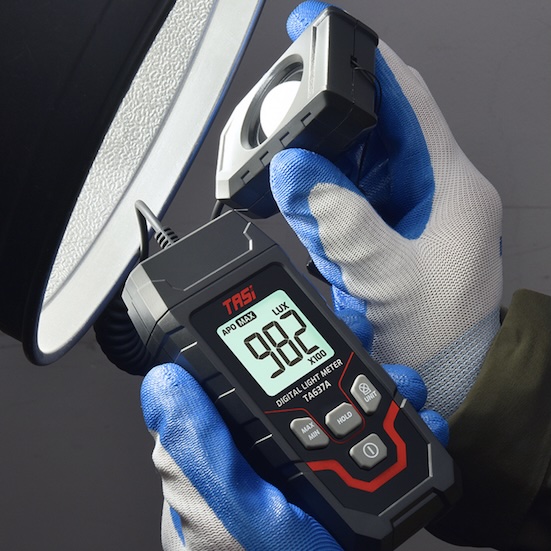
In other words, the lux meter sensor should be positioned to simulate the real working surface, rather than being placed randomly.
How to Measure Warehouse Illuminance with a Lux Meter
Warehouse lighting is usually evaluated using a multi-point measurement method.
A typical process is as follows:
● Divide the warehouse into measurement zones based on size and layout;
● Distribute measurement points evenly within each zone;
● Place the lux meter sensor on the required reference plane;
● Keep the sensor surface aligned with the measured plane;
● Avoid shading the sensor with the operator’s body or other objects;
● Wait until the reading becomes stable, then record the value;
● Record all measurement points;
● Calculate the average illuminance and identify any low-light areas.
The average illuminance can be calculated as:
Average Illuminance = Total of All Measured Values ÷ Number of Measurement Points
For example, if 10 points are measured and the total is 1,280 lux, then:
1,280 ÷ 10 = 128 lux
This value can then be compared with the target requirement for that warehouse area.
Why Is Single-Point Measurement Not Enough?
Warehouses are typically large spaces, and light distribution is strongly influenced by luminaire spacing, rack layout, storage density, and structural obstructions.
A reading taken directly below a luminaire may be relatively high, while areas between racks or near lower shelf levels may be much darker.
For example, the same warehouse area may show:
● 220 lux directly under a luminaire;
● 150 lux in the middle of an aisle;
● 90 lux near shelf edges;
● 60 lux at lower rack levels.
If only the highest point is recorded, the result will not reflect the actual lighting conditions across the warehouse. That is why warehouse illuminance should always be evaluated using multiple representative measurement points.
What Factors Affect Warehouse Illuminance?
Actual warehouse illuminance can vary significantly even when the installed lighting power is similar.
Common influencing factors include:
● Warehouse ceiling height;
● Mounting height of luminaires;
● Number and spacing of luminaires;
● Luminous output and beam distribution;
● Rack height and layout;
● Storage density;
● Reflectance of walls, ceilings, and floors;
● Dust accumulation on luminaires;
● Lumen depreciation over time;
● Daylight contribution;
● Measurement position and measurement height.
For this reason, on-site measurement is generally more reliable than estimating lighting performance based only on lamp wattage.
Problems Caused by Insufficient Warehouse Illuminance
Insufficient lighting can reduce visibility of goods, labels, and surroundings, which may result in:
● Difficulty identifying product models or labels;
● Poor barcode or shelf code readability;
● Higher picking and counting error rates;
● Reduced visibility for forklift operators;
● Dark zones at lower shelf levels;
● Increased visual fatigue for workers;
● Lower operational efficiency and safety.
Areas used for detailed work, such as fine goods storage, picking, packing, or inspection, should not rely only on minimum ambient lighting.
Key Points to Note During Warehouse Illuminance Testing
To obtain meaningful results, measurements should be taken under normal operating conditions whenever possible.
Recommended precautions include:
● Allow the lighting system to reach stable operating condition before measurement;
● Switch on the luminaires that are normally used in the evaluated area;
● Avoid blocking the sensor during measurement;
● If daylight is present, decide in advance whether it should be included in the evaluation;
● Keep the sensor clean;
● Use the same measurement method and height at each point;
● In high-rack warehouses, measure both horizontal and vertical illuminance when necessary;
● Record dark spots or abnormal areas, not just average values;
● Use a calibrated lux meter when formal reporting or compliance verification is required.
FAQ
What is a typical lux level for a warehouse?
For general warehouse storage areas, a typical range is 100 to 200 lux. However, the actual requirement depends on the warehouse type and the tasks performed in the area.
What is the recommended illuminance for a general goods warehouse?
A common reference value for a general goods warehouse is 100 lux.
How much illuminance is recommended for a fine goods warehouse?
A fine goods warehouse typically requires around 200 lux. If detailed inspection or label reading is involved, higher illuminance may be necessary.
Is 300 lux too bright for a warehouse?
Not necessarily. For basic storage areas, 300 lux may be higher than required, but for picking, packing, barcode scanning, and inspection areas, it is often appropriate.
Should warehouse illuminance be measured on the floor or on the work surface?
It depends on the purpose of the evaluation. Storage areas are usually measured on the reference plane, while picking, packing, labeling, and inspection areas should be measured on the actual working surface.
Why does a warehouse still feel dark even if the lux value is acceptable?
This may be caused by poor uniformity, shadows from shelving, low surface reflectance, glare, or insufficient vertical illuminance. A compliant average lux value does not always guarantee good visual conditions.
Why is multi-point measurement necessary?
Because warehouse lighting distribution is rarely uniform. Multiple measurement points provide a more realistic assessment of average illuminance and local dark areas.
Can warehouse illuminance be measured during the daytime?
Yes, but daylight may affect the result. The evaluation method should be defined in advance to ensure the measured data are relevant and comparable.
Conclusion
Warehouse illuminance standards should not be defined by a single value. They should be selected according to the warehouse type, working area, and actual visual task.
As a practical reference:
● Bulk goods warehouse: 50 lux;
● General goods warehouse: 100 lux;
● Semi-finished goods warehouse: 150 lux;
● Fine goods warehouse: 200 lux.
For areas used for picking, packing, barcode identification, or quality inspection, higher illuminance is generally required.
In practical assessment, a digital lux meter should be used for multi-point measurement, while also considering average illuminance, lighting uniformity, vertical illuminance, and local dark zones. Only by combining measurement data with real operating conditions can warehouse lighting be properly evaluated.
Note: This article is intended for technical reference in warehouse lighting design, on-site evaluation, and routine inspection. For specific projects, final requirements should always be based on applicable local regulations, project specifications, and relevant standards.