Introduction
Lighting is an important environmental factor affecting work, education, manufacturing, and everyday activities. In offices, factories, schools, hospitals, laboratories, warehouses, and commercial buildings, lighting determines more than whether a space simply “looks bright.” It also affects the ability to read information, identify objects, perform detailed tasks, and recognize potential hazards.
However, the human eye adapts readily to changes in light levels. As a result, changes in illumination are not always perceived accurately, and visual judgment alone cannot determine whether the actual lighting level is appropriate.
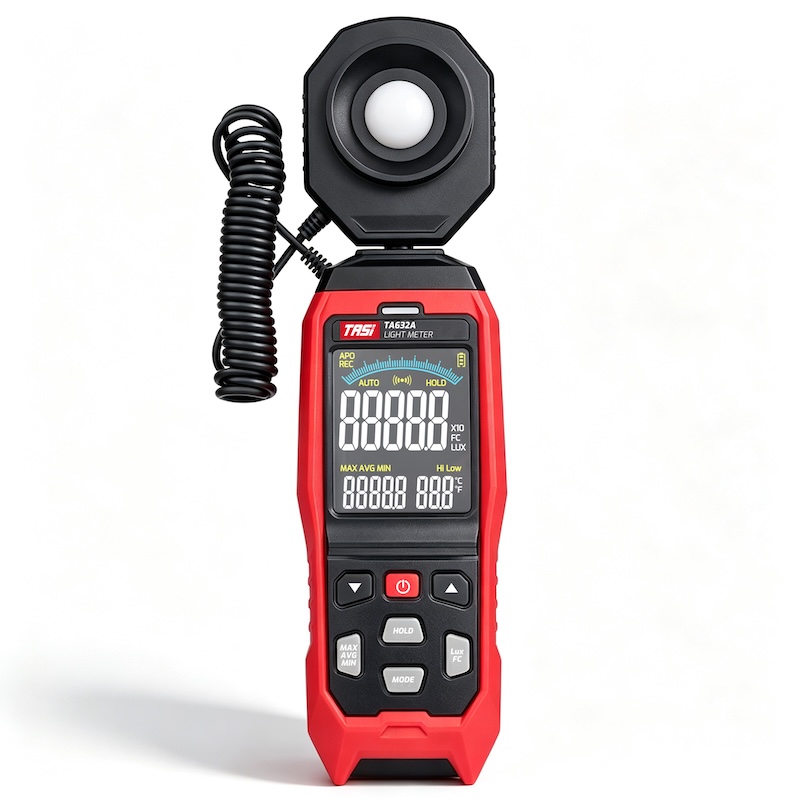
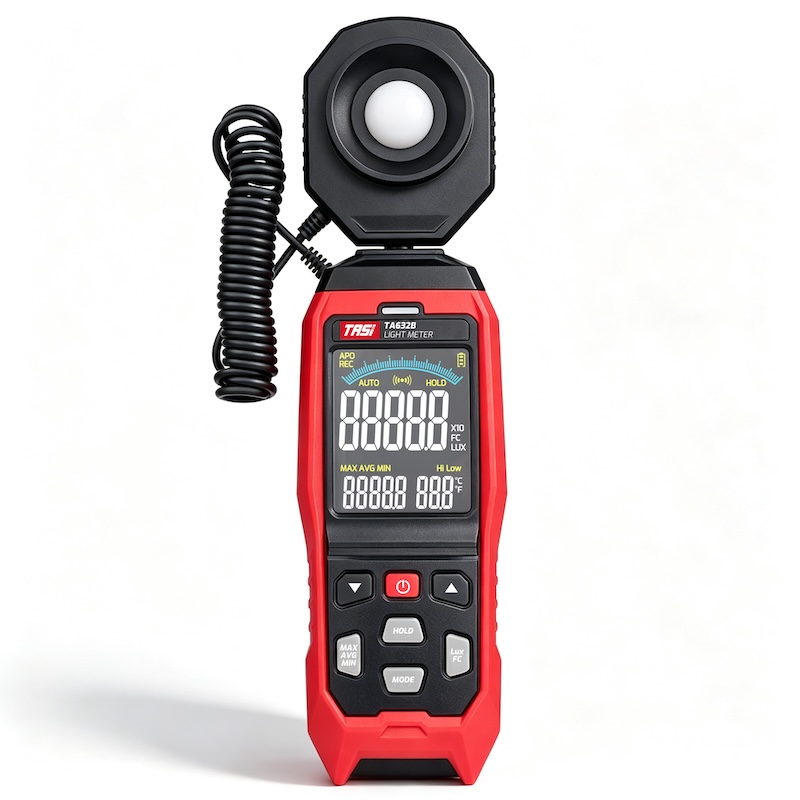
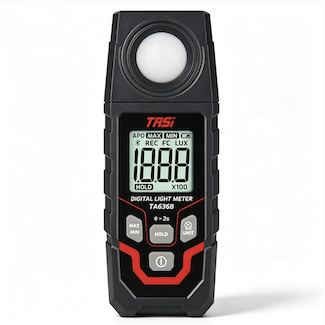
A digital lux meter converts subjective impressions into measurable and recordable data. By measuring illuminance at a work surface or specified location, users can determine whether the lighting meets design requirements, operational needs, or applicable lighting standards and obtain reliable information for lighting adjustment, maintenance, and environmental improvement.
Key Takeaways
● Illuminance describes the luminous flux received per unit area and is commonly expressed in lux (lx).
● The human eye adapts to different light levels, making visual judgment alone unreliable for evaluating actual illuminance.
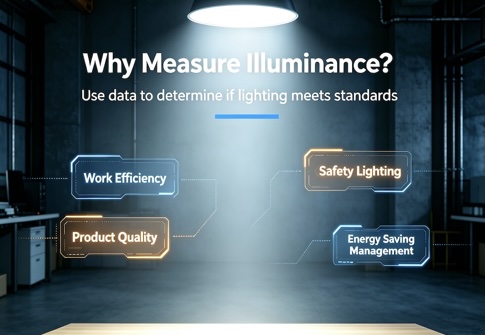
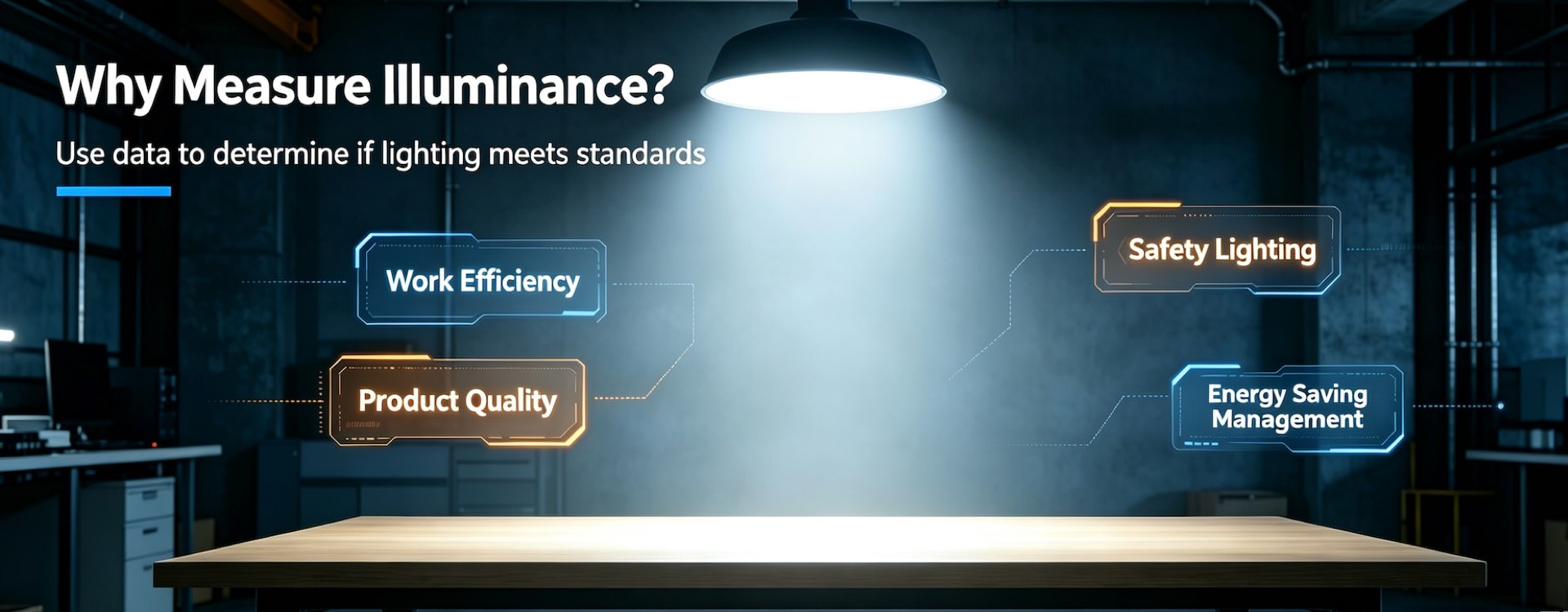
● Illuminance measurement can support productivity, workplace safety, visual comfort, and product quality.
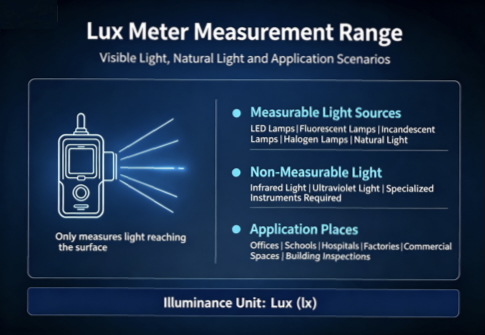
● Offices, factories, schools, hospitals, warehouses, laboratories, and commercial facilities are among the environments where illuminance measurement may be required.
● Multi-point measurement can identify localized dark areas even when the average illuminance appears acceptable.
● Reliable illuminance data also supports lighting maintenance and energy optimization.
What Is Illuminance Measurement?
Illuminance is the amount of luminous flux incident on a surface per unit area. It describes how much light reaches a particular surface and is measured in lux (lx).
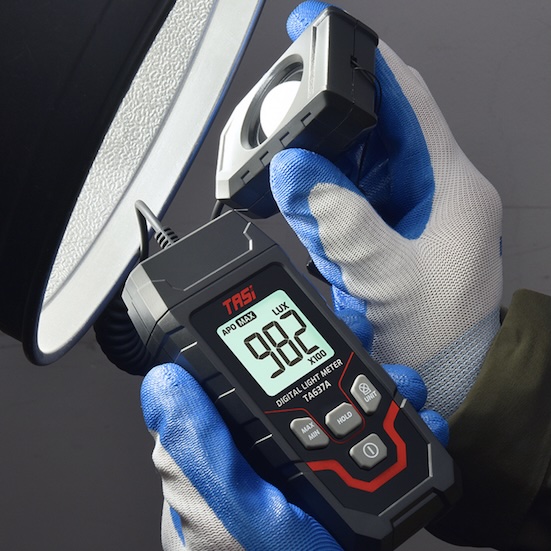
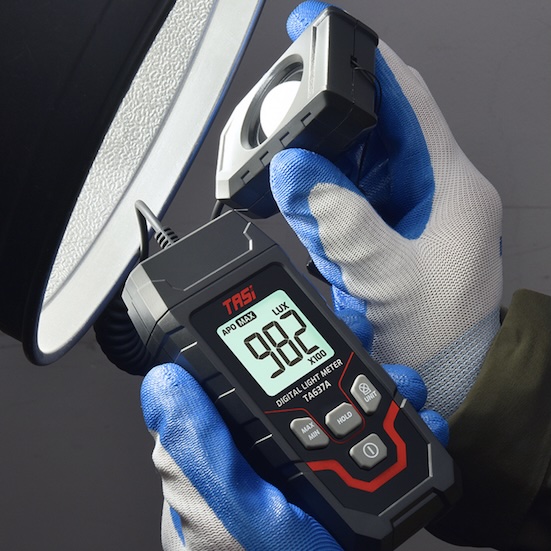
Illuminance is commonly measured with a digital lux meter. The instrument uses a light sensor to detect incident light and converts it into an illuminance reading.
Within the same room, illuminance may vary considerably between areas directly beneath luminaires, the center of a workbench, corners, or locations shaded by equipment. Therefore, illuminance measurement is not simply about determining whether lighting is present, but about establishing how much light actually reaches the relevant working plane and whether it is distributed appropriately.
Measurement results should be evaluated according to the purpose of the space, the visual task, the measurement plane, and applicable standards or project requirements. A single illuminance value cannot be applied to every environment.
Why Can Illuminance Not Be Judged by Eye Alone?
The human visual system adapts to different lighting conditions. When a person moves from a bright environment into a darker one, vision gradually adjusts. The same process occurs when moving into brighter surroundings.
This adaptation is useful in everyday life, but it makes it difficult to estimate actual illuminance accurately.
For example, two offices may both appear reasonably bright even though their measured work-plane illuminance differs considerably. Similarly, a room may look bright overall while shelving, machinery, or structural elements create localized low-light areas.
A lux meter provides objective measurement data and reduces the uncertainty associated with subjective visual assessment.
Why Is Illuminance Measurement Important?
Improve Work Efficiency
Appropriate illuminance helps personnel identify text, instruments, components, and other work targets more clearly, reducing unnecessary visual effort and repeated checking.
Insufficient illuminance may result in:
● Greater difficulty reading documents or displays;
● More time required to identify small objects;
● Reduced concentration and work efficiency;
● Increased operating errors;
● Faster onset of visual fatigue.
In offices, laboratories, assembly areas, and inspection stations, suitable illuminance can significantly improve working conditions.
Improve Workplace Safety
Insufficient lighting can reduce the ability to recognize obstacles, equipment status, and hazardous areas.
For example:
● Poor stairway or walkway lighting may increase the risk of trips and falls;
● Insufficient warehouse lighting can make picking and material handling more difficult;
● Workers may find it harder to identify abnormal equipment conditions;
● Maintenance tasks become more difficult in poorly illuminated areas.
Illuminance measurement helps identify localized lighting deficiencies and provides a basis for repositioning, adding, cleaning, or replacing luminaires.
Support Product Quality Control
Many manufacturing and inspection processes require personnel to identify fine details, surface defects, color variations, or assembly conditions.
Typical applications include:
● PCB and electronic component inspection;
● SMT production and assembly;
● Precision machining;
● Metal component inspection;
● Surface quality inspection;
● Printing and packaging inspection;
● Precision assembly.
If illuminance is insufficient or uneven, small scratches, missing parts, incorrect assembly, or other defects may be more difficult to detect. Illuminance is therefore an important environmental parameter in many quality-control processes.
Improve Visual Comfort
Higher illuminance is not always better. Insufficient light can increase visual strain, while excessive illumination combined with glare, reflections, or large brightness differences may also reduce visual comfort.
Measuring actual illuminance and assessing it together with luminaire layout, glare, and uniformity can help create a more comfortable lighting environment.
Verify Lighting Design and Installation Performance
During lighting design, target illuminance values are normally selected according to the intended use of each area. After installation, however, luminaire position, mounting height, surface reflectance, room layout, and equipment may affect the actual result.
On-site measurement can help confirm:
● Whether actual illuminance reaches the design target;
● Whether significant differences exist between areas;
● Whether work-plane illuminance meets operational requirements;
● Whether a lighting retrofit has achieved the intended result.
Identify Lighting System Degradation
Light output may decrease over time due to lamp or LED aging, dirt accumulation, contaminated covers, or other factors.
Simply checking whether a luminaire still operates does not indicate whether its lighting performance remains adequate.
Periodic illuminance measurements make it possible to identify changes over time and support decisions on cleaning, maintenance, or replacement.
Reduce Unnecessary Energy Consumption
Insufficient lighting needs correction, but excessive lighting is also undesirable.
If measured illuminance is substantially higher than operational requirements, there may be opportunities to optimize luminaire quantity, power, layout, or control strategy.
Illuminance measurement can support evaluation of:
● Whether luminaires should be added or reduced;
● Whether luminaire positions are appropriate;
● Whether lighting zones can be optimized;
● Whether dimming or intelligent controls are suitable;
● Whether artificial lighting can be reduced when sufficient daylight is available.
Illuminance data therefore helps determine not only whether a space is bright enough, but also whether lighting energy is being used efficiently.
Where Is Illuminance Measurement Needed?
Different environments involve different visual tasks and therefore different lighting requirements.
● Offices: Evaluate desks, meeting areas, and general workspaces to support reading and computer-based work.
● Manufacturing facilities: Check production lines, operating areas, and walkways to support safe and efficient work.
● Precision manufacturing areas: Provide suitable lighting for precision machining, assembly, and inspection.
● Schools and classrooms: Evaluate desks, boards, and teaching areas.
● Libraries: Check reading tables, shelving areas, and public spaces.
● Hospitals and healthcare facilities: Assess lighting according to the different needs of treatment, nursing, and circulation areas.
● Laboratories: Provide suitable lighting for observation, instrument operation, and sample handling.
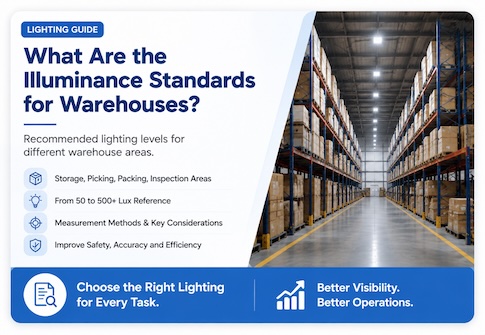
● Warehouses and logistics centers: Check racks, picking areas, loading zones, and aisles.
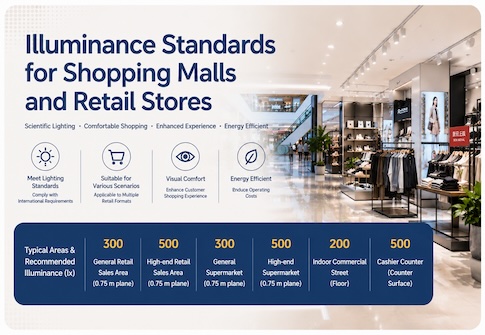
● Retail stores and shopping centers: Evaluate general areas, shelves, and product displays.
● Hotels: Assess guest rooms, corridors, reception areas, and public spaces.
● Parking facilities: Evaluate vehicle routes, entrances, exits, and pedestrian areas.
● Construction sites: Check lighting for nighttime work, equipment operation, and temporary walkways.
● Sports facilities: Evaluate lighting for training, competitions, and spectator areas.
● Museums and exhibition spaces: Balance display lighting with preservation requirements.
● Photography and film environments: Check light distribution to support lighting setup.
● Greenhouses and plant-lighting environments: Use illuminance measurement as a reference for visible-light distribution. Professional horticultural lighting assessment may require additional optical parameters and dedicated instruments.
Why Is Multi-Point Illuminance Measurement Important?
A single measurement only represents one location and cannot describe the entire space.
For example, the center of a warehouse may meet the target illuminance while lower shelf areas or corners remain significantly darker. In an office, areas near windows may receive much more light than workstations farther away.
For larger spaces, multiple measurement points should therefore be selected according to the area and working zones.
Multi-point measurement can help determine:
● Actual illuminance at different locations;
● Average illuminance across the area;
● Differences between maximum and minimum values;
● Whether significant dark spots exist;
● Whether lighting distribution is sufficiently uniform.
Compared with a single reading, multi-point measurement provides a much more representative assessment of the overall lighting environment.
How Is Basic Illuminance Measurement Performed?
A digital lux meter is commonly used for on-site illuminance measurement.
The basic procedure generally includes:
● Switch on the lux meter and confirm that it is operating correctly;
● Select the appropriate range or measurement mode where required;
● Position the light sensor at the relevant working plane;
● Avoid shading the sensor with the operator's body, hands, or nearby objects;
● Wait for the reading to stabilize and record the result;
● In larger areas, repeat measurements at predetermined locations;
● Compare the results with design criteria, internal requirements, or applicable lighting standards.
Sensor orientation, measurement height, changes in ambient light, and obstruction by the operator should also be considered. Consistent measurement conditions are important when comparing readings from different locations.
When Should Illuminance Be Measured?
Illuminance measurement is useful not only for new installations but throughout the operating life of a lighting system.
Typical occasions include:
● After completion of a new building or lighting installation;
● After production lines or work areas have been rearranged;
● After luminaires have been replaced or a lighting retrofit has been completed;
● When work tasks or visual requirements change;
● When certain areas appear noticeably darker or unevenly lit;
● After long periods of luminaire operation to evaluate lumen depreciation;
● Before and after energy-saving lighting projects;
● During periodic environmental inspections or internal facility assessments.
Measurements at different stages provide a more objective understanding of lighting performance and reduce reliance on waiting until personnel subjectively feel that an area has become too dark.
FAQ
Why use a lux meter instead of a smartphone?
Smartphone ambient-light sensors are primarily designed to support automatic screen-brightness control rather than professional illuminance measurement. Sensor position, spectral response, calibration, and measurement range can vary significantly between devices. A dedicated digital lux meter is recommended when measurements need to be recorded, compared, or evaluated against defined requirements.
Is higher illuminance always better?
No. Appropriate illuminance depends on the visual task. Insufficient light may make objects difficult to identify, while excessive light combined with glare, reflections, or large brightness contrasts can reduce visual comfort and waste energy.
Is one measurement point enough for a room?
Usually not. Larger rooms and work areas often have significant variations in lighting distribution. Multiple measurement points are normally required to evaluate average illuminance and overall uniformity.
When should illuminance be measured again?
Re-measurement is appropriate after luminaire replacement, refurbishment, changes in equipment layout, lighting-system modifications, or when localized dark areas become noticeable. Critical working environments may also require periodic measurement according to internal management procedures.
Are illuminance and luminance the same?
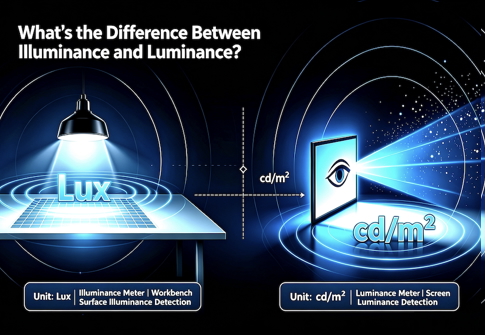
No. Illuminance describes the amount of light incident on a surface and is usually measured in lux. Luminance describes the brightness of a surface in a particular viewing direction. They are different photometric quantities.
Who typically uses a digital lux meter?
Digital lux meters are widely used in lighting engineering, building inspection, industrial maintenance, occupational environment assessment, schools, hospitals, laboratories, logistics facilities, retail lighting, and other applications where objective illuminance data is required.
Conclusion
The main purpose of illuminance measurement is to convert the subjective impression of whether a space “looks bright enough” into measurable, recordable, and comparable data.
In offices, factories, schools, hospitals, warehouses, laboratories, and commercial buildings, appropriate illuminance supports visual performance, workplace comfort, operational safety, and product quality.
Illuminance measurement can also identify luminaire degradation, localized insufficient lighting, poor uniformity, and excessive illumination, providing useful data for maintenance, commissioning, and energy optimization.
Whether evaluating a new lighting installation or maintaining an existing one, standardized illuminance measurement with a digital lux meter is an important method for understanding actual lighting conditions.