Introduction
Office lighting is not simply about making a workspace appear bright. Appropriate lighting conditions can directly affect visual comfort, work efficiency, and the overall quality of the working environment.
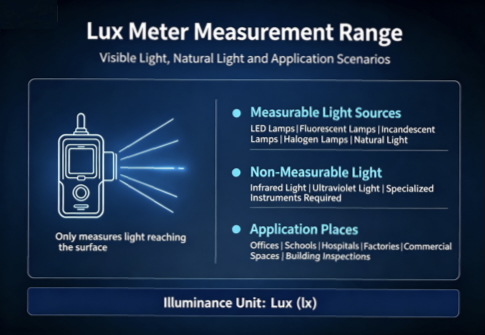
In lighting design, building inspection, workplace assessment, and facility maintenance, illuminance is commonly used to evaluate the amount of light reaching a work surface. Illuminance is generally measured in lux (lx).
So, how many lux should an office have? Should the same illuminance level be applied throughout an entire office?
In practice, different office areas involve different visual tasks and therefore may require different lighting levels. This article introduces typical illuminance ranges for common office environments and explains how to measure and evaluate office lighting using a digital lux meter.
Key Points
After reading this article, you will understand:
● Typical illuminance levels recommended for offices;
● Common lux ranges for workstations, meeting rooms, reception areas, corridors, and other office spaces;
● Why different office areas require different illuminance levels;
● The potential effects of insufficient or excessive illuminance;
● How to measure office illuminance with a digital lux meter;
● Important considerations when conducting office lighting measurements.
What Is Office Illuminance?
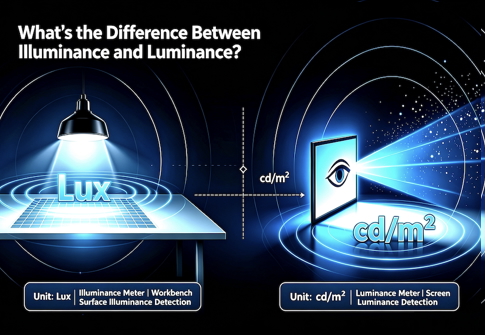
Office illuminance refers to the amount of luminous flux received per unit area on a work surface. It is normally expressed in lux (lx).
1 lux = 1 lumen/m²
For example, when evaluating lighting at an office workstation, the important parameter is the amount of light actually reaching the desk surface—not simply the wattage or lumen output of the luminaires.
Even when identical luminaires are installed, measured illuminance can vary considerably due to installation height, luminaire spacing, room layout, surface reflectance, daylight, and other environmental factors.
What Illuminance Level Is Recommended for Offices?
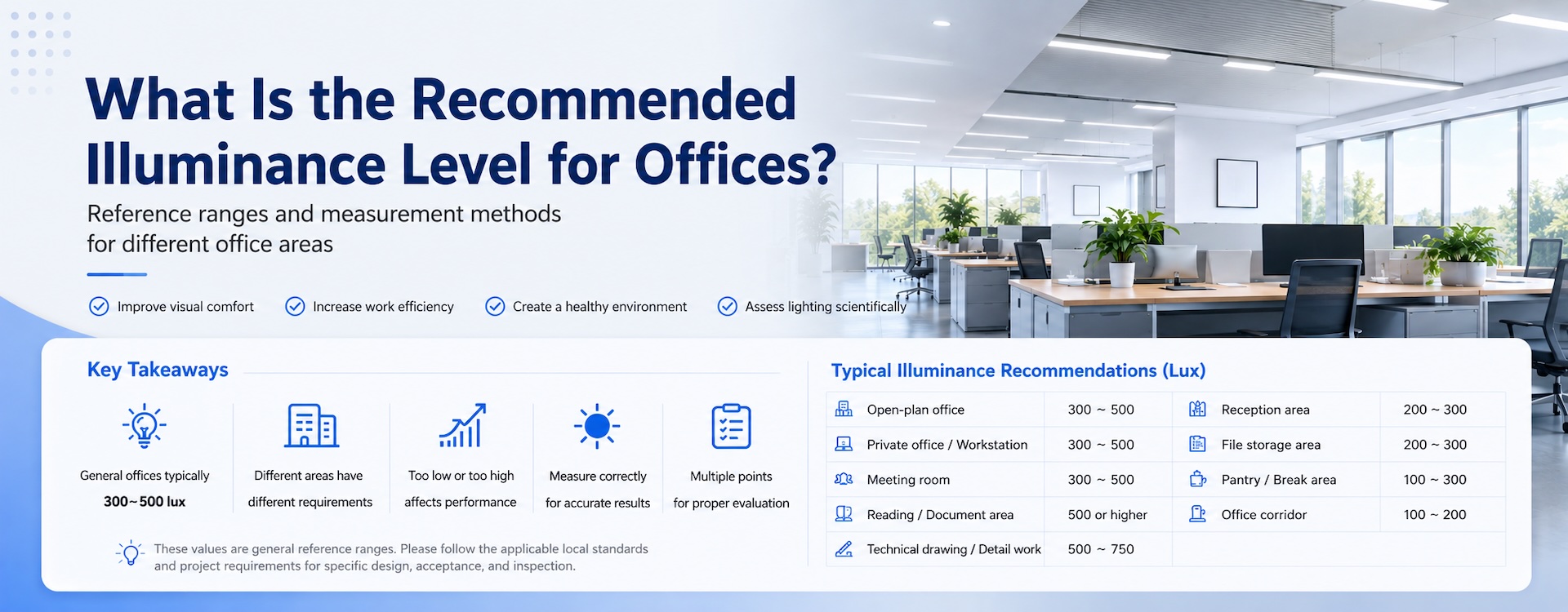
For general office work, 300–500 lux is a commonly referenced illuminance range for the working plane.
Tasks involving extended reading, technical drawing, detailed document processing, design work, or other visually demanding activities may require higher illuminance.
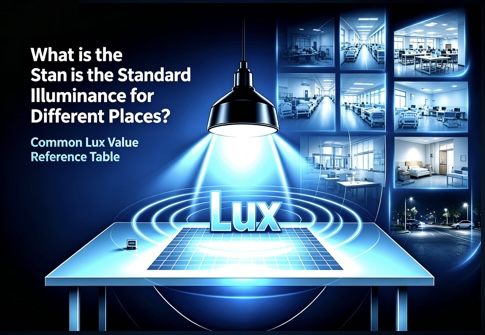
Typical reference values for office environments include:
| Office Area | Typical Illuminance Range |
|---|---|
| Open-plan office | 300–500 lux |
| Private office | 300–500 lux |
| Computer workstation area | 300–500 lux |
| Meeting room | 300–500 lux |
| Reading and document processing area | Around 500 lux or higher |
| Technical drawing / detailed work area | 500–750 lux |
| Reception area | 200–300 lux |
| File storage area | 200–300 lux |
| Pantry / break area | 100–300 lux |
| Office corridor | 100–200 lux |
Note: These values are general engineering references and should not be interpreted as mandatory requirements applicable to every country, region, or project. Lighting design, building acceptance, and occupational assessments should follow the applicable local regulations, lighting standards, and project specifications.
Why Do General Offices Typically Require Around 300–500 Lux?
Typical office tasks include reading, writing, computer work, document processing, and meetings.
Because many of these activities are performed continuously for several hours, office lighting should provide sufficient illumination while maintaining visual comfort, reasonable uniformity, and effective glare control.
Appropriate illuminance can help:
● Improve the visibility of documents, text, and office equipment;
● Reduce visual strain during prolonged reading and writing;
● Provide suitable lighting conditions across work surfaces;
● Improve visual comfort between different areas of the office;
● Create a more stable lighting environment for prolonged office work.
For this reason, professional office lighting evaluation should not rely solely on whether a single measurement point reaches a specified lux value. Illuminance uniformity, glare, color temperature, color rendering, and daylight should also be considered.
Why Do Different Office Areas Require Different Illuminance Levels?
An office consists of several functional areas rather than one uniform working environment.
Open-plan workstations are primarily used for computer work and document processing, while meeting rooms, reception areas, corridors, break areas, and technical workspaces involve different visual requirements.
In general, the more visually demanding the task, the higher the illuminance level that may be required.
For example:
● Computer workstations require stable and reasonably uniform general lighting;
● Areas used for reading printed documents should provide good text visibility;
● Technical drawing, design, and detailed inspection tasks may require higher illuminance;
● Corridors and break areas primarily support circulation and general activities and therefore usually require lower illuminance than workstations.
Office lighting should therefore be evaluated according to the specific function of each area.
Is Higher Office Illuminance Always Better?
No.
Higher illuminance does not necessarily mean better office lighting. Excessive illuminance combined with poor luminaire positioning or inappropriate brightness distribution can reduce visual comfort.
Potential problems include:
● Reflections on computer monitors and glass surfaces;
● Direct or reflected glare;
● Excessive brightness differences within the workspace;
● Unnecessary energy consumption;
● Visual discomfort during prolonged work.
The objective of office lighting design is therefore not simply to maximize lux levels. It is to provide appropriate, uniform, comfortable, and energy-efficient lighting for the intended visual tasks.
What Happens If Office Illuminance Is Too Low?
When work surface illuminance is consistently below the level required for the visual task, employees may need to make greater visual effort when reading, writing, or identifying small details.
Potential problems include:
● Reduced visibility of text and fine details;
● Lower comfort during reading and document processing;
● Noticeable brightness differences across workstations;
● Increased potential for visual fatigue;
● Reduced efficiency during visually demanding tasks.
Regular illuminance checks can be particularly useful in offices with limited daylight, during nighttime operation, or where luminaires have experienced significant light output depreciation over time.
How to Measure Office Illuminance
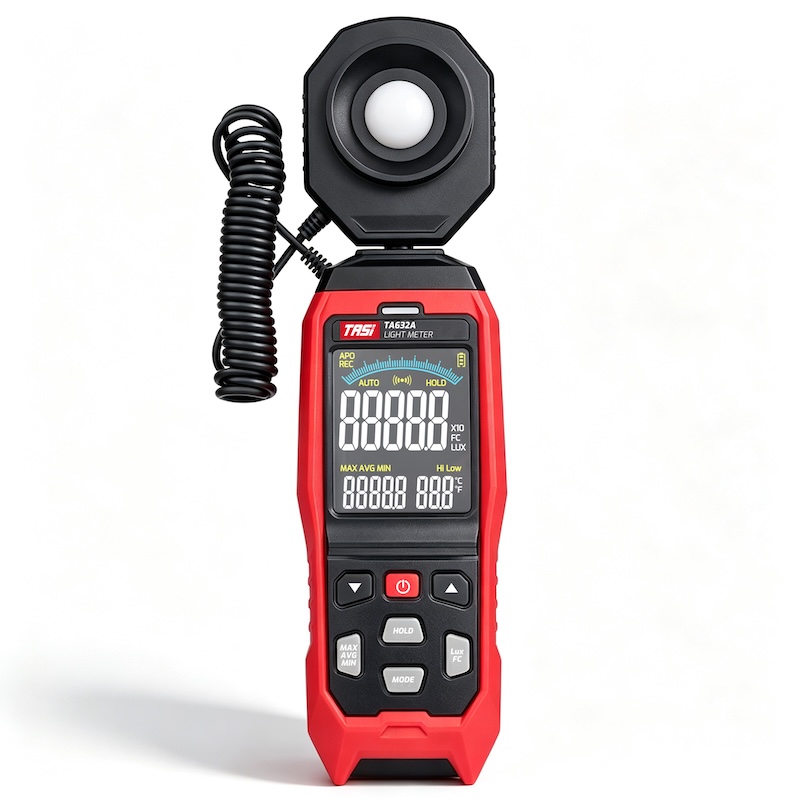
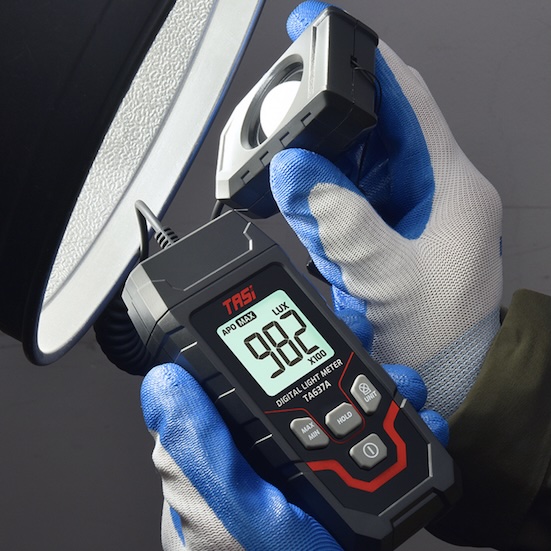
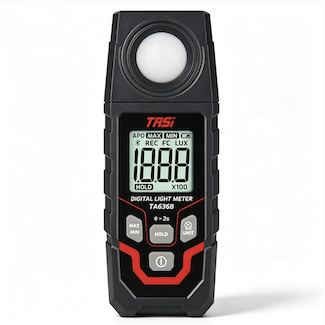
Office illuminance is commonly measured using a digital lux meter.
Measurements should be conducted under conditions that represent the normal use of the office whenever possible.
A typical measurement procedure includes:
● Switch on the lighting normally used in the office;
● Keep blinds or shading systems in their normal position if actual working conditions are being evaluated;
● Set the lux meter to the lux measurement mode;
● Position the light sensor horizontally on the work surface being evaluated;
● Ensure that the sensor is not shaded by the operator, instrument, or nearby objects;
● Allow the reading to stabilize and record the measurement;
● Repeat measurements at several representative locations.
When evaluating workstation lighting, measurements should focus on the actual working plane, rather than only measuring directly beneath a luminaire where illuminance may be highest.
Why Should Office Illuminance Be Measured at Multiple Points?
Light is rarely distributed perfectly evenly throughout an office.
Workstations near windows may receive significant daylight, while interior areas, corners, spaces between luminaires, or areas obstructed by furniture may have considerably lower illuminance.
A single measurement therefore cannot accurately represent the lighting conditions of an entire office.
For larger spaces, multiple measurement points can be arranged across the work area.
Average illuminance can be calculated as:
Average Illuminance = Sum of Illuminance at All Measurement Points ÷ Number of Measurement Points
In addition to average illuminance, low-illuminance areas and differences between measurement points should also be evaluated to determine whether the lighting distribution is appropriate.
What Should Be Considered When Measuring Office Illuminance?
To improve measurement reliability, consider the following:
● Confirm that the lux meter is operating correctly before measurement;
● Avoid shading the sensor with your hand, body, or other objects;
● Keep the sensor surface aligned with the actual working plane;
● Do not measure only directly beneath luminaires;
● Use multiple measurement points in larger office areas;
● Record the measurement time, location, and lighting status;
● Consider the influence of daylight where natural light is significant;
● For formal building acceptance or compliance testing, follow the measurement conditions, measurement grid, and calculation methods specified by the applicable standard.
Does Daylight Affect Office Illuminance Measurements?
Yes.
Workstations near windows can receive substantial daylight. As a result, illuminance measurements may vary considerably depending on the time of day, weather conditions, season, and position of blinds or shading systems.
If the objective is to evaluate the actual combined lighting conditions experienced by office users, measurements can be performed under normal operating conditions.
If the objective is to evaluate the performance of the artificial lighting system independently, daylight should be controlled as required by the applicable measurement standard.
For better measurement records, it is advisable to document:
● Measurement date and time;
● Weather and daylight conditions;
● Position of blinds or shading systems;
● Status of artificial lighting;
● Measurement location and working-plane height.
This information improves the comparability of measurements taken at different times.
How Can Insufficient Office Illuminance Be Improved?
If measurements show that certain areas have insufficient illuminance, the cause should first be identified rather than simply adding more luminaires.
Possible improvements include:
● Adjusting luminaire positions or beam directions;
● Adding task lighting where additional illuminance is required;
● Cleaning luminaires, diffusers, and optical components;
● Replacing lamps or luminaires affected by significant lumen depreciation;
● Optimizing workstation and furniture layouts;
● Making better use of available daylight;
● Improving lighting uniformity and reducing excessively dark areas;
● Controlling glare and reflections while maintaining the required illuminance.
After improvements have been made, illuminance should be measured again to verify the actual results.
Office Lighting Evaluation Should Not Rely on Lux Alone
Lux is an important parameter for office lighting assessment, but it is not the only factor that determines lighting quality.
A professional evaluation may also consider:
● Illuminance uniformity;
● Glare control;
● Luminance distribution;
● Color rendering;
● Color temperature;
● Daylight utilization;
● Reflections on display screens;
● Lighting energy consumption.
For example, an office may achieve an average illuminance of 500 lux while some workstations receive only 200 lux and others exceed 800 lux. Although the average value appears acceptable, the space may still have significant lighting uniformity problems.
Office lighting should therefore be evaluated by combining illuminance measurements with other relevant lighting parameters.
Frequently Asked Questions
How many lux are normally required for an office?
For general office work, approximately 300–500 lux is a commonly referenced range for the working plane. The actual requirement should be determined according to the visual task and applicable local lighting standards.
How many lux are recommended for computer workstations?
Approximately 300–500 lux is commonly used as a reference for general computer-based office work. Screen reflections and luminaire glare should also be carefully controlled.
Is 500 lux sufficient for an office?
For many general office activities, including reading, writing, document processing, and computer work, 500 lux is a commonly used lighting level. Technical drawing and other visually demanding tasks may require higher illuminance.
Is higher illuminance always better in an office?
No. Excessive illuminance can increase glare, screen reflections, visual discomfort, and energy consumption. Appropriate office lighting should balance illuminance, uniformity, glare control, and visual comfort.
Where should office illuminance be measured?
Measurements should normally be taken on the actual working plane where reading, writing, computer work, or other visual tasks are performed. Larger offices should be evaluated using multiple measurement points.
Should daylight be included when measuring office illuminance?
It depends on the purpose of the measurement. Daylight may be included when evaluating actual working conditions. When assessing the artificial lighting system independently, daylight should be controlled according to the applicable measurement procedure.
Can a smartphone be used to measure office illuminance?
Smartphone applications may provide a basic indication or trend, but sensor characteristics and calibration can vary significantly between devices. For lighting design, engineering inspection, acceptance testing, or applications requiring reliable measurement data, a professional digital lux meter is recommended.
Conclusion
For general office environments, 300–500 lux is a commonly referenced illuminance range for the working plane. Areas used for reading, technical drawing, detailed document processing, or other demanding visual tasks may require approximately 500–750 lux or higher.
However, office lighting quality cannot be determined by a single lux value alone.
In practical assessments, illuminance should be measured at representative points across different functional areas using a digital lux meter. Illuminance uniformity, glare, daylight, luminaire arrangement, and the specific visual task should also be considered.
For building lighting design, project acceptance, or occupational environment assessment, the applicable local regulations, lighting standards, and technical specifications should always take precedence when determining specific illuminance requirements.