Introduction
Shopping malls, supermarkets, specialty stores, and various retail spaces are typical applications for commercial lighting. Unlike ordinary office environments, retail lighting not only needs to provide sufficient visibility but also plays an important role in product display, customer guidance, brand presentation, and shopping atmosphere.
Insufficient illuminance may make product details, labels, and colors difficult to recognize, while excessive illuminance can cause glare, visual discomfort, and unnecessary energy consumption. Therefore, retail lighting design should consider different functional areas, such as sales floors, product display areas, aisles, and cashier counters.
This article introduces recommended illuminance levels for shopping malls and retail stores, and explains important considerations for commercial lighting design and illuminance measurement.
Key Points
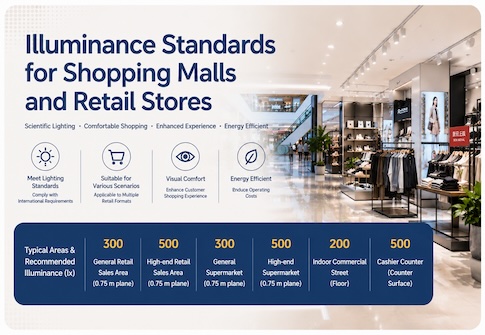
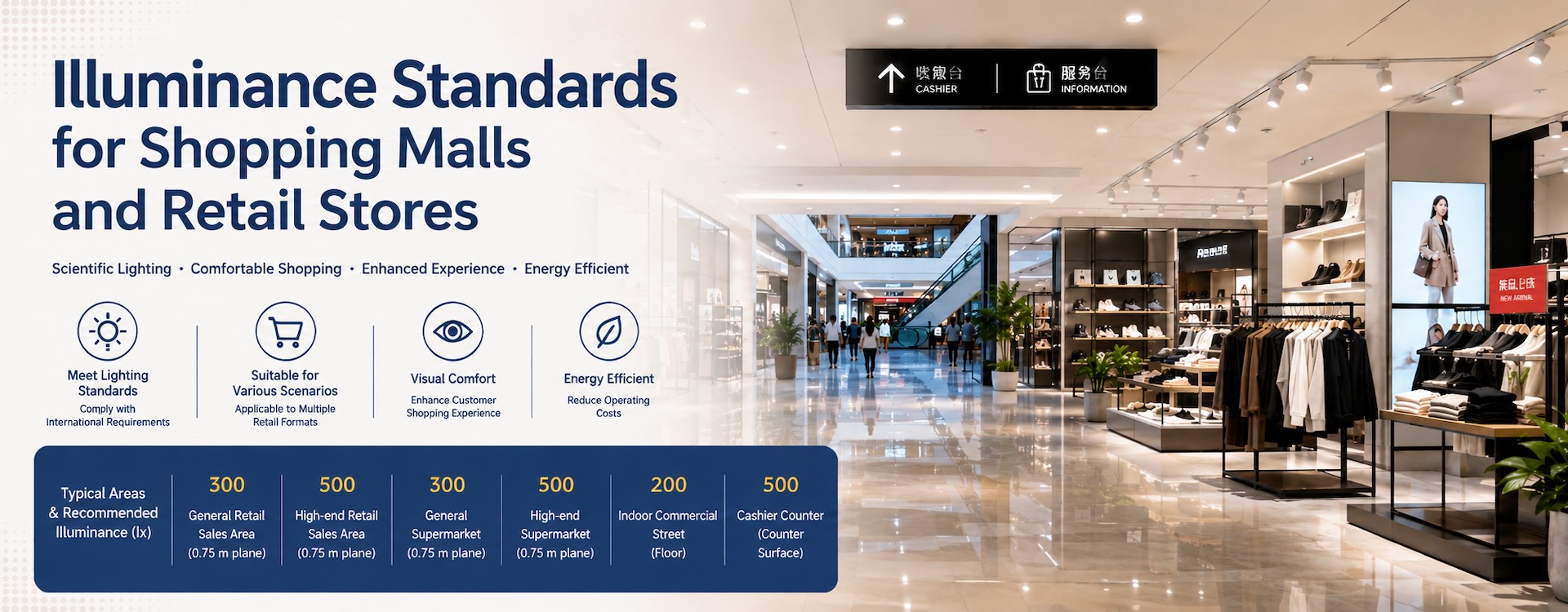
● General retail store sales areas typically require 300 lx illuminance.
● High-end retail store sales areas typically require 500 lx illuminance.
● General supermarket sales areas typically require 300 lx illuminance.
● High-end supermarket sales areas typically require 500 lx illuminance.
● Specialty store sales areas typically require 300 lx illuminance.
● Indoor commercial streets typically require 200 lx illuminance.
● Cashier counters require higher illuminance, with a recommended value of 500 lx.
● Retail lighting should not only focus on illuminance but also consider uniformity, glare control, color rendering, accent lighting, and product presentation effects.
Why Is Proper Illuminance Important for Retail Stores?
Lighting in commercial spaces serves two main purposes: providing visibility and enhancing product presentation.
For customers, appropriate illuminance helps them clearly identify products, colors, prices, labels, and surrounding spaces. For retailers, lighting is also an important tool for improving product attractiveness and strengthening brand identity.
Improving Product Visibility
Adequate illuminance allows customers to clearly view product appearance, details, labels, and textures. This is especially important for products with high visual requirements, such as clothing, jewelry, cosmetics, and electronic products.
Creating a Comfortable Shopping Environment
Proper lighting reduces dark areas and provides customers with a stable visual environment when browsing products, moving between shelves, and completing purchases.
Highlighting Featured Products
Retail lighting usually combines general lighting with accent lighting to create visual hierarchy. Display counters, promotional areas, new products, and featured items can be emphasized through targeted lighting.
Balancing Energy Efficiency
Higher illuminance does not always mean better lighting quality. Excessive lighting may increase glare and energy consumption. Effective commercial lighting should achieve a balance between visual comfort, product presentation, and energy efficiency.
Illuminance Standards for Shopping Malls and Retail Stores
Different retail environments have different lighting requirements. The recommended illuminance levels vary depending on the function and usage of each area.
| Area | Reference Plane | Recommended Illuminance (lx) | UGR | U₀ | Ra |
|---|---|---|---|---|---|
| General retail store sales area | 0.75 m horizontal plane | 300 | 22 | 0.60 | 80 |
| General indoor commercial street | Floor surface | 200 | 22 | 0.60 | 80 |
| High-end retail store sales area | 0.75 m horizontal plane | 500 | 22 | 0.60 | 80 |
| High-end indoor commercial street | Floor surface | 300 | 22 | 0.60 | 80 |
| General supermarket sales area | 0.75 m horizontal plane | 300 | 22 | 0.60 | 80 |
| High-end supermarket sales area | 0.75 m horizontal plane | 500 | 22 | 0.60 | 80 |
| Warehouse supermarket | 0.75 m horizontal plane | 300 | 22 | 0.60 | 80 |
| Specialty store sales area | 0.75 m horizontal plane | 300 | 22 | 0.60 | 80 |
| Farmers market | 0.75 m horizontal plane | 200 | 25 | 0.40 | 80 |
| Cashier counter | Counter surface | 500 | — | 0.60 | 80 |
The recommended values above are used to evaluate the average maintained illuminance of the corresponding reference plane. Actual lighting design should also consider store positioning, product categories, architectural layout, and customer experience requirements.
Illuminance Requirements for General Retail Stores
General retail store sales areas typically require 300 lx illuminance, measured on a horizontal plane 0.75 m above the floor.
This level is suitable for most everyday retail environments and provides sufficient lighting for customers to browse products, read basic information, and move comfortably through the store.
In practical applications, general lighting is usually combined with additional accent lighting for shelves, display counters, and featured products instead of simply increasing overall brightness.
Illuminance Requirements for High-End Retail Stores
High-end retail stores typically require 500 lx illuminance.
Premium commercial spaces often place greater emphasis on product materials, colors, textures, and visual presentation, such as luxury fashion stores, boutique stores, and high-end home furnishing shops.
In addition to higher illuminance, these environments require careful consideration of color rendering, glare control, lighting direction, and the relationship between ambient lighting and accent lighting.
Meeting the illuminance requirement alone does not guarantee excellent product presentation. High-quality retail lighting depends on a combination of illuminance, color performance, and lighting design.
Supermarket Illuminance Standards
General supermarkets typically require 300 lx, while high-end supermarkets typically require 500 lx.
Supermarkets contain a large variety of products arranged on shelves. Customers need sufficient lighting to read product packaging, prices, expiration dates, and product information.
In supermarket lighting design, vertical illumination on shelves is particularly important. Even when horizontal illuminance meets requirements, poorly illuminated shelves may still affect product visibility.
Therefore, lighting layouts should be designed according to shelf arrangement and viewing direction.
Specialty Store Illuminance Standards
Specialty store sales areas typically require 300 lx illuminance.
However, specialty stores usually have stronger brand presentation requirements. Additional accent lighting is often used for mannequins, display walls, showcases, and featured products.
For example:
● Clothing stores may emphasize mannequins and display areas.
● Jewelry stores may highlight showcases.
● Electronics stores need balanced lighting for both product presentation and screen viewing.
Therefore, 300 lx should be considered as a basic reference value rather than a fixed brightness requirement for every location.
Indoor Commercial Street and Public Area Lighting
General indoor commercial streets typically require 200 lx, while high-end indoor commercial streets typically require 300 lx.
Commercial streets mainly support customer movement, navigation, and connection between stores. They generally do not require the same lighting level as product display areas.
A reasonable brightness difference between public areas and stores can help guide customer attention toward entrances and merchandise displays.
Cashier Counter Illuminance Requirements
Cashier counters typically require 500 lx illuminance.
Cashiers perform detailed visual tasks, including scanning products, confirming prices, processing payments, and handling receipts. Higher illuminance helps improve operational efficiency and reduce visual fatigue.
Lighting design should also avoid reflections and glare on screens, glass surfaces, and glossy materials.
Do Product Display Areas Need Higher Illuminance?
Product display areas do not simply require higher brightness.
Effective retail lighting creates visual contrast between general lighting and accent lighting. Display shelves, promotional areas, showcases, and featured products can be highlighted through directional lighting.
However, excessive brightness differences may cause visual discomfort. If the entire store is already very bright, additional accent lighting may have limited visual impact.
Therefore, product display lighting should focus on creating appropriate brightness levels and visual hierarchy rather than only increasing lux values.
Retail Lighting Should Consider More Than Illuminance
Lux is an important parameter for evaluating retail lighting, but it is not the only factor.
Illuminance Uniformity
Uniformity describes how evenly light is distributed across an area. Retail spaces should avoid large dark zones, as uneven lighting can negatively affect customer experience.
Glare Control
Improper fixture installation, excessive brightness, or reflective surfaces may create glare. Special attention should be given to glass displays, mirrors, screens, and glossy products.
Color Rendering
Color appearance is critical in retail environments. High color rendering performance helps customers accurately perceive product colors, especially for clothing, cosmetics, jewelry, and food products.
Color Temperature
Color temperature affects the atmosphere and product appearance. Different retail categories may use different color temperatures, but lighting within the same area should remain visually consistent.
How to Measure Illuminance in Shopping Malls and Retail Stores?
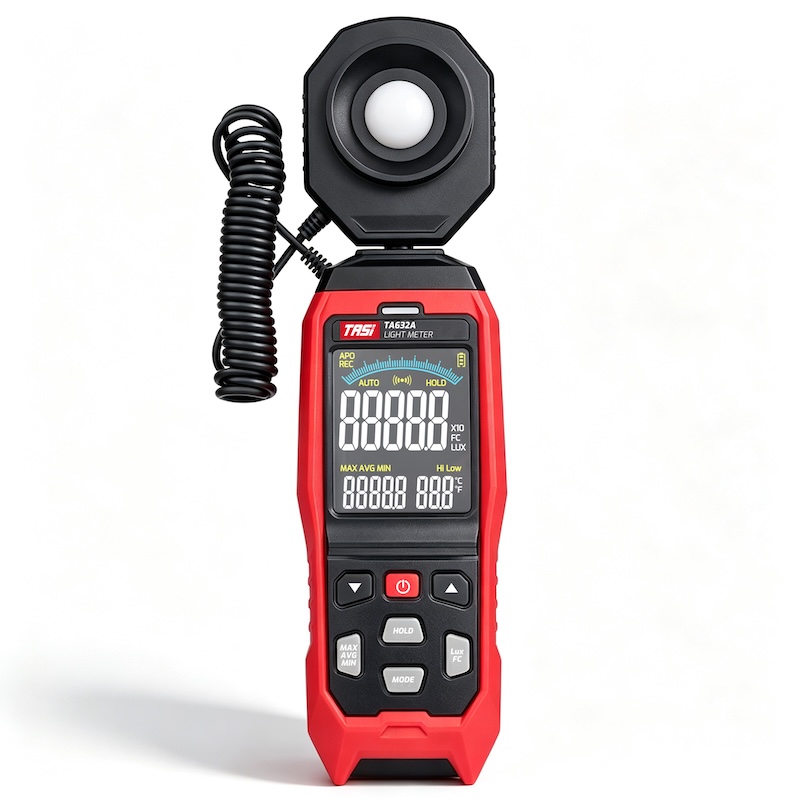
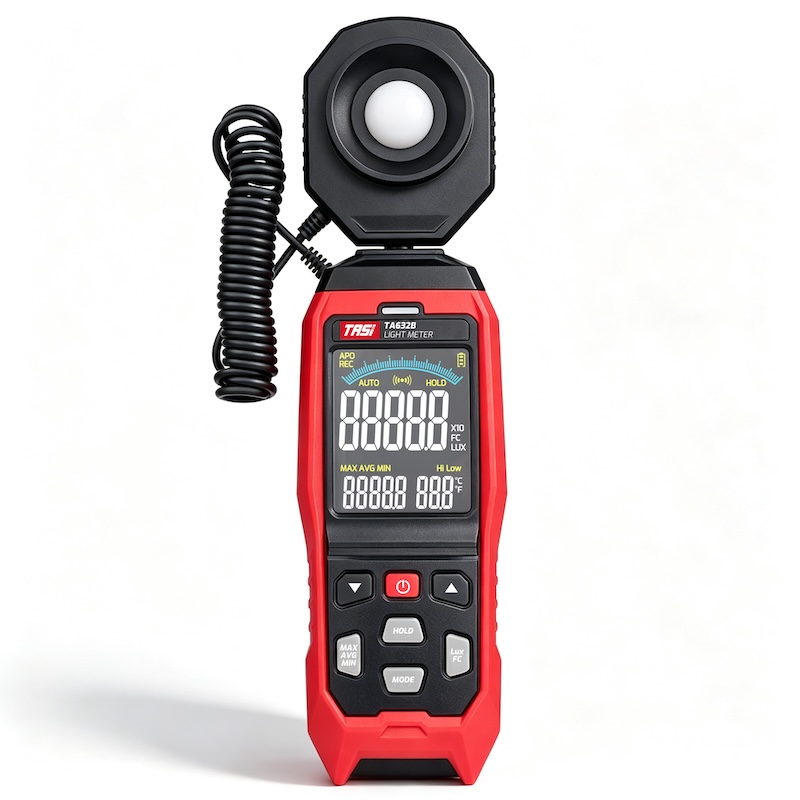
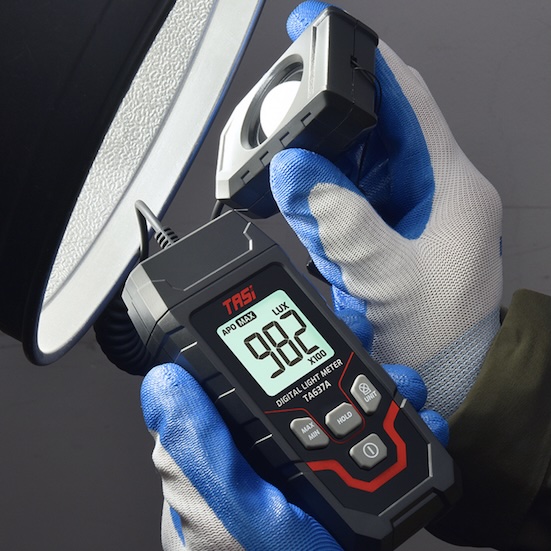
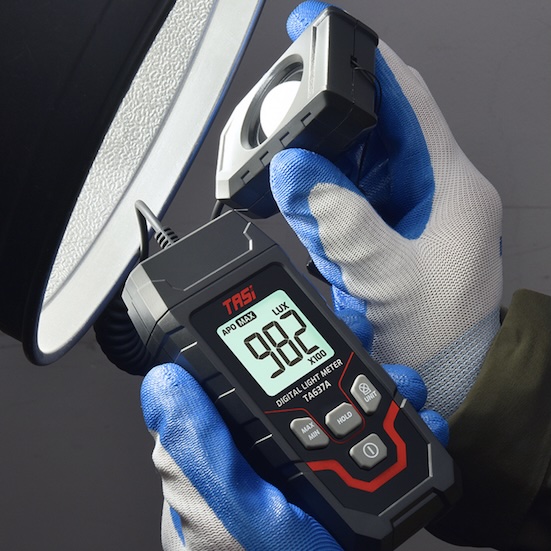
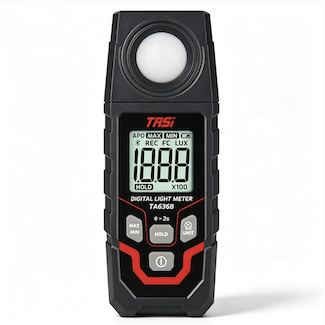
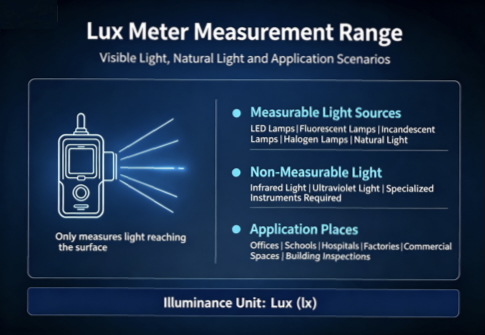
A digital lux meter is commonly used to measure illuminance in retail environments.
Define Measurement Areas
Divide the store into functional zones, such as sales floors, shelves, display areas, aisles, and cashier counters.
Determine the Reference Plane
For most sales areas, measurements are taken on a horizontal plane 0.75 m above the floor. Commercial streets are measured at floor level, while cashier counters are measured on the actual working surface.
Use Multiple Measurement Points
Large commercial areas should be measured using multiple points. A single measurement cannot accurately represent the overall lighting condition.
Position the Sensor Correctly
The lux meter sensor should be placed on the correct reference plane and should not be blocked by the operator or other objects.
Measure Under Normal Lighting Conditions
Measurements should be performed with the normal lighting system operating under stable conditions.
Common Mistakes When Measuring Retail Illuminance
Measuring Only One Location
Large stores may have significant differences between areas. One measurement point cannot represent the entire space.
Measuring Directly Under Lighting Fixtures
The area directly below a fixture usually has higher illuminance and may cause inaccurate evaluation.
Ignoring Measurement Height
Different areas have different reference planes. Sales areas, commercial streets, and cashier counters should not be measured at the same height.
Blocking the Sensor
Incorrect positioning of the operator may reduce the amount of light reaching the sensor.
Only Checking Maximum Illuminance
Lighting quality should be evaluated based on average illuminance, minimum illuminance, and distribution uniformity rather than the highest value alone.
Why Does Retail Illuminance Decrease Over Time?
Actual illuminance may decrease after a lighting system has been used for a period of time.
Common causes include:
● Reduced light output due to aging fixtures;
● Dust accumulation on lamps and optical components;
● Failed or switched-off lighting fixtures;
● Changes in shelf arrangement;
● New structures blocking light;
● Changes in fixture direction;
● Incorrect measurement methods.
Regular illuminance testing helps identify lighting problems and maintain a comfortable shopping environment.
Is Brighter Retail Lighting Always Better?
No.
Higher illuminance can improve visibility within a certain range, but excessive brightness does not always improve customer experience.
Over-lighting may result in:
● Increased glare;
● Poor visual balance;
● Customer and employee visual fatigue;
● Reduced product presentation quality;
● Higher energy consumption;
● Increased maintenance costs.
Effective retail lighting should distribute light according to different functional requirements rather than simply maximizing brightness.
Recommendations for Retail Illuminance Testing
For new construction, renovation projects, and daily store maintenance, retailers can establish standardized illuminance measurement procedures.
● Define different functional areas, including sales floors, aisles, display zones, and cashier areas;
● Measure according to the correct reference plane;
● Use multiple measurement points for large spaces;
● Record average illuminance, minimum illuminance, and lighting distribution;
● Perform measurements under normal operating conditions;
● Use a properly maintained digital lux meter;
● Check fixtures, dust, aging, and obstructions in areas with insufficient lighting;
● Re-test after changing lighting layouts or product displays.
A standardized measurement process provides reliable data for lighting acceptance, maintenance, and optimization.
Conclusion
Lighting in shopping malls and retail stores must satisfy multiple requirements, including visibility, product presentation, customer comfort, and energy efficiency.
Typical retail areas require approximately 300 lx, while high-end retail spaces and cashier counters may require around 500 lx depending on their function. Indoor commercial streets generally require lower illuminance levels, while product display areas may use additional accent lighting to enhance visual impact.
When evaluating retail lighting, illuminance should not be considered alone. Factors such as uniformity, glare control, color rendering, lighting distribution, and spatial brightness relationships should also be considered.
By using a digital lux meter and following proper measurement procedures, retailers can accurately evaluate lighting performance and improve commercial environments.
FAQ
What is the recommended illuminance level for shopping malls?
General retail sales areas typically require around 300 lx, while high-end retail stores may require around 500 lx depending on the application.
Is 300 lx enough for a retail store?
For general retail stores and specialty shops, 300 lx is a common reference value. Additional accent lighting may be used to improve product presentation.
What is the illuminance standard for supermarkets?
General supermarkets typically require 300 lx, while high-end supermarkets may require 500 lx.
How much illuminance does a cashier counter need?
Cashier counters typically require around 500 lx because employees need to perform detailed visual operations.
Do commercial streets need the same brightness as stores?
No. Commercial streets mainly support customer movement and navigation, so they generally require lower illuminance than product display areas.
Why does a store still look dark even when illuminance meets the standard?
Visual perception is affected by many factors, including surface reflectance, lighting distribution, color temperature, glare, and contrast between different areas.
Where should illuminance be measured in a retail store?
Measurements should be taken according to the function of each area. Sales floors are generally measured at a 0.75 m horizontal plane, while cashier counters are measured on the actual working surface.
Does higher illuminance always improve product presentation?
Not necessarily. Product presentation depends on the balance between general lighting, accent lighting, color rendering, and lighting direction rather than brightness alone.