Introduction
In lighting design, building inspection, industrial applications and everyday lighting, terms such as illuminance, luminance and luminous flux are frequently used. Because all three relate to how we describe light, they are often confused, although each represents a different photometric quantity.
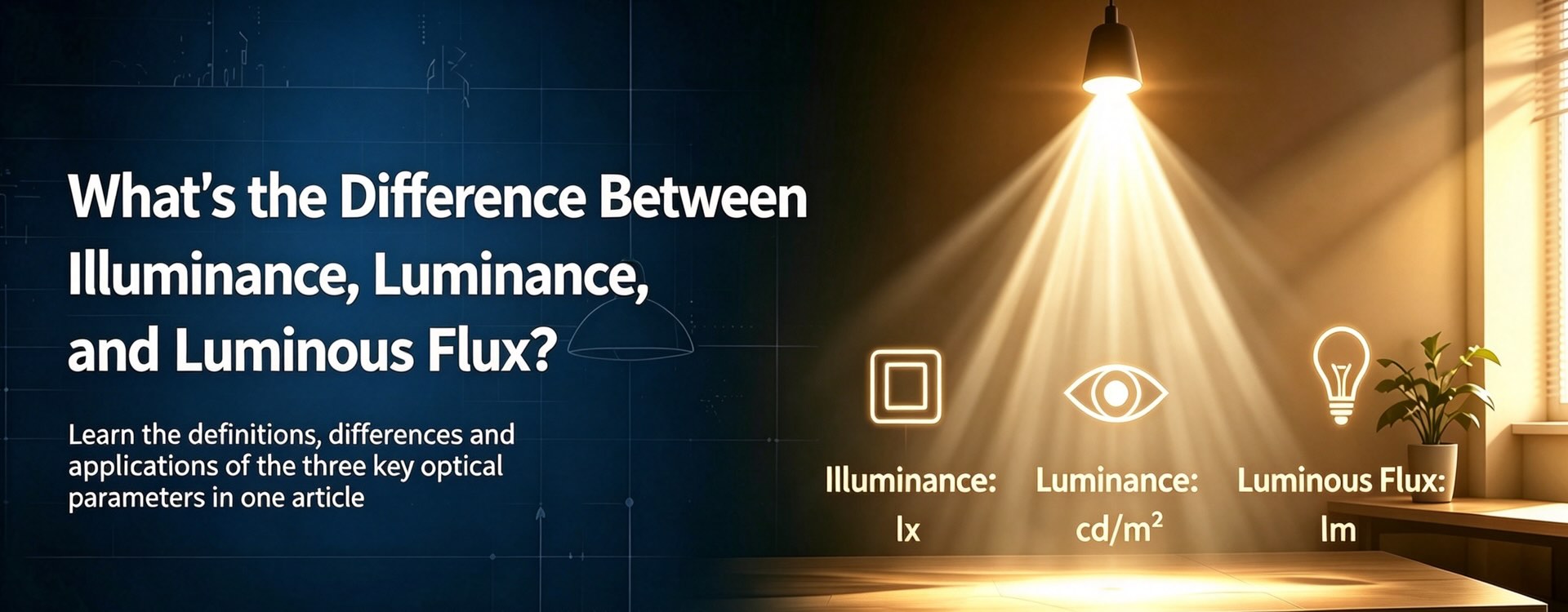
In simple terms, luminous flux describes how much visible light a source emits; illuminance describes how much light reaches a surface; and luminance describes how bright a luminous or reflecting surface is in a particular direction.
Understanding these differences is fundamental to lighting design, lighting assessment, luminaire performance analysis and accurate measurements with a lux meter.
Key Points
● Luminous flux represents the total visible light output of a source and is measured in lumens (lm).
● Illuminance represents the luminous flux received per unit area and is measured in lux (lx).
● Luminance describes the brightness of a luminous or reflecting surface in a specified direction and is measured in candela per square metre (cd/m²).
● Luminous flux primarily describes light-source output, illuminance evaluates light reaching a surface, and luminance characterizes the directional brightness of a surface.
● A digital lux meter measures illuminance, not luminous flux or luminance.
What Is Luminous Flux?
Luminous flux is a photometric quantity that represents the total amount of visible light emitted by a light source, weighted according to the sensitivity of the human eye.
In practical terms, luminous flux indicates how much visible light a lamp or luminaire produces.
Its unit is the lumen (lm).
For example, an LED bulb may be rated at 800 lm, while an industrial luminaire may provide 10,000 lm or more. These values describe the light output of the source itself rather than the illuminance received at a particular working surface.
A higher luminous flux generally means that the source produces more visible light. However, lumen output alone does not determine whether a room or work area will be sufficiently illuminated. Actual lighting conditions are also influenced by beam distribution, mounting height, distance, room dimensions and surface reflectance.
What Is Illuminance?
Illuminance describes the luminous flux received per unit area. It is one of the principal quantities used to evaluate how much light actually reaches a surface.
Illuminance is measured in lux (lx):
1 lx = 1 lm/m²
This means that when one square metre of surface receives one lumen of luminous flux uniformly, the illuminance is 1 lux.
Unlike luminous flux, illuminance is strongly influenced by the position of the light source relative to the illuminated surface. The same luminaire may produce very different illuminance levels depending on distance, mounting height and beam direction.
For example, a lamp positioned close to a desk may produce 500 lx. If the distance between the lamp and the desk is increased significantly, the illuminance on the desk will decrease even though the luminous flux of the lamp remains unchanged.
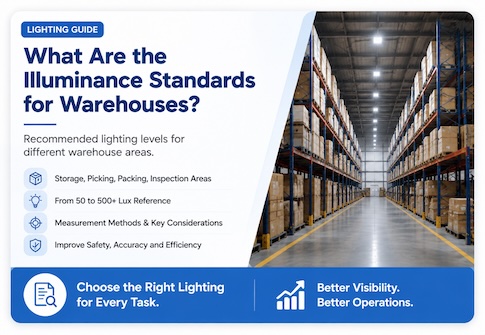
For this reason, lighting assessments in offices, schools, factories, warehouses and commercial buildings usually focus on illuminance at the relevant working plane or target area.
How Is Illuminance Measured?
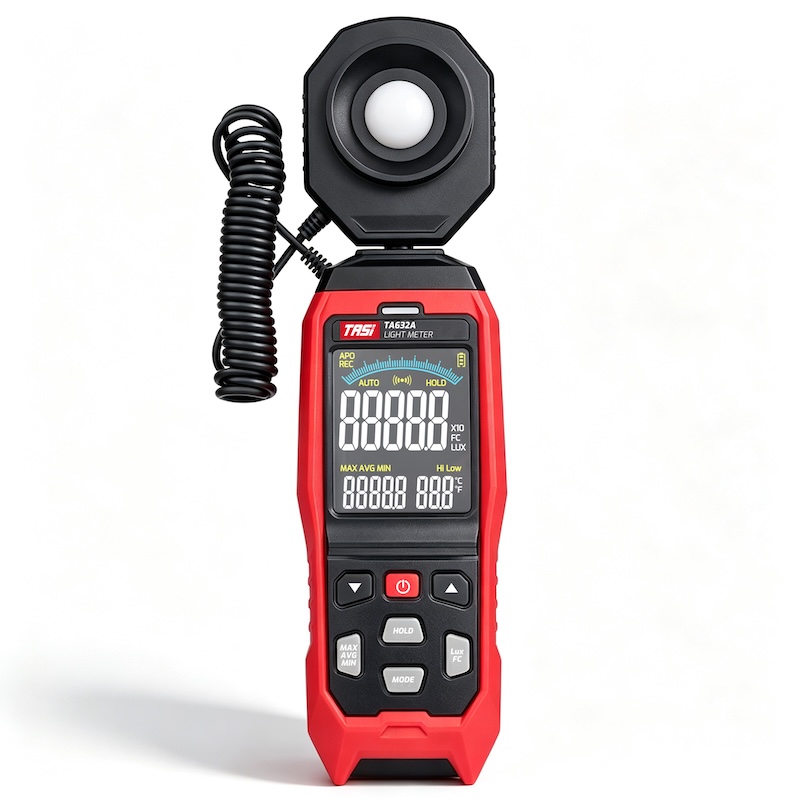
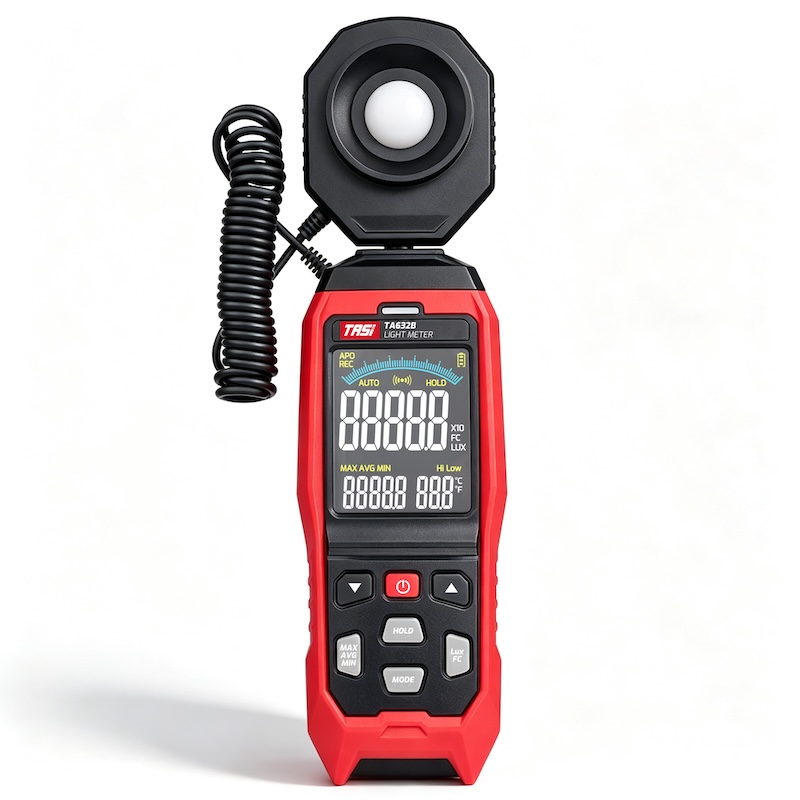
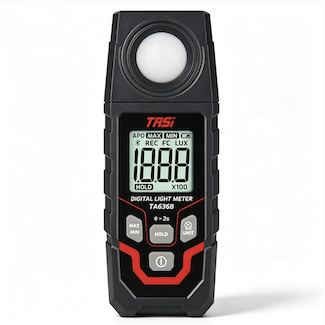
Illuminance is normally measured with a lux meter, also called an illuminance meter.
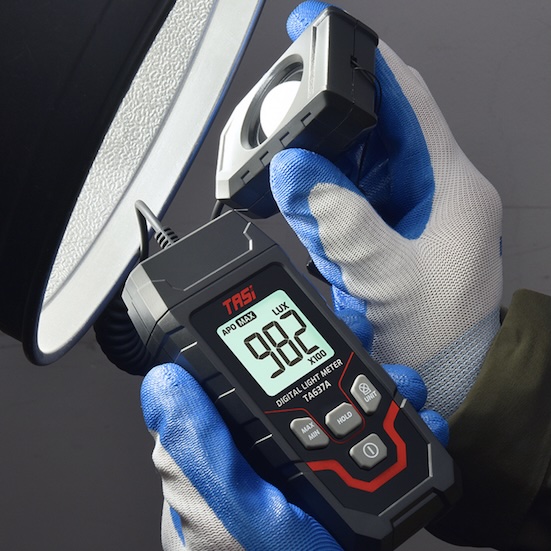
A digital lux meter uses a light-sensitive sensor to detect incident light at the measurement point and converts the detected signal into an illuminance reading, usually expressed in lux.
When measuring illuminance:
● Position the sensor at the actual working plane or location to be evaluated.
● Orient the sensor according to the intended receiving surface and measurement method.
● Avoid shading the sensor with the operator, instrument or other objects.
● Allow the reading to stabilize before recording the result.
● For multi-point measurements, use consistent positions and procedures.
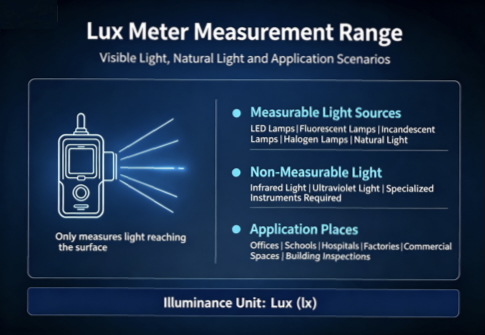
A conventional lux meter measures illuminance in lux. It does not directly measure total luminous flux in lumens or luminance in cd/m².
What Is Luminance?
Luminance describes the photometric brightness of a luminous or reflecting surface in a specified direction.
Its unit is candela per square metre (cd/m²).
Luminance is commonly used for displays, illuminated signs, instrument panels and reflecting surfaces. Unlike illuminance, it is directional and is closely associated with how bright a surface appears when viewed from a particular direction.
For example, a white surface and a black surface may both receive an illuminance of 500 lx, but their luminance values can differ substantially because their reflectance characteristics are different.
A white surface normally reflects a larger proportion of incident light, whereas a black surface absorbs more of it. As a result, two surfaces exposed to the same illuminance may appear very different in brightness.
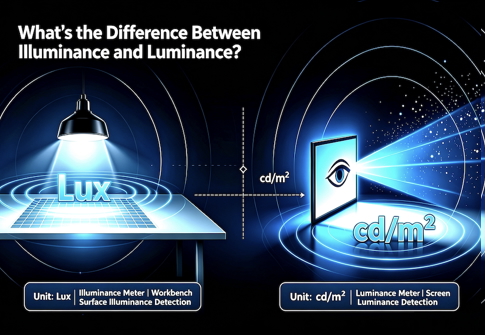
What Is the Difference Between Illuminance and Luminance?
The main difference is the quantity being evaluated.
Illuminance concerns light arriving at a surface. Measuring whether an office desk receives 500 lx, for example, means measuring the amount of light incident on that desk.
Luminance concerns light emitted or reflected by a surface in a particular direction. It is therefore relevant when evaluating displays, illuminated surfaces or the apparent brightness of objects.
A surface with high illuminance does not necessarily have proportionally high luminance. Surface color, reflectance, texture and viewing direction can all affect luminance.
Illuminance, Luminance and Luminous Flux Compared
| Parameter | Luminous Flux | Illuminance | Luminance |
|---|---|---|---|
| Main meaning | Total visible light output | Light received by a surface | Directional brightness of a surface |
| Measurement object | Light source or luminaire | Illuminated surface | Luminous or reflecting surface |
| Unit | lm | lx | cd/m² |
| Typical instrument | Integrating sphere / photometric system | Lux meter | Luminance meter |
| Typical application | Luminaire performance | Environmental lighting assessment | Display and surface brightness |
A simple way to remember the difference is:
● Luminous flux (lm): how much light the source emits.
● Illuminance (lx): how much light reaches the target surface.
● Luminance (cd/m²): how bright the surface is in the viewing direction.
How Are Luminous Flux, Illuminance and Luminance Related?
Although they describe different properties, the three quantities are related in practical lighting applications.
Under otherwise identical conditions, increasing the luminous flux of a luminaire will generally increase the illuminance on the target surface. For example, a 1,000 lm luminaire will typically provide more light than a 500 lm luminaire when the optical distribution and installation conditions are the same.
Illuminance is also strongly affected by distance and light distribution. As the distance between a light source and the illuminated surface increases, the amount of light reaching a unit area generally decreases. Real luminaires also have specific intensity distributions, so actual illuminance cannot be determined from luminous flux and distance alone.
When illuminance on a surface increases, the amount of reflected light will generally increase as well. However, the resulting luminance also depends on the surface reflectance and viewing direction. Two surfaces receiving the same illuminance therefore do not necessarily have the same luminance.
Why Is Illuminance Commonly Used for Environmental Lighting Assessment?
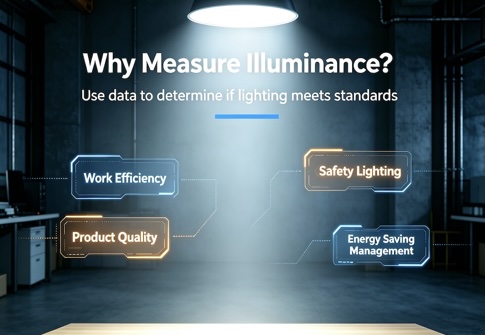
In offices, schools, factories, warehouses and commercial buildings, the practical question is usually whether a particular area receives enough light for the intended visual task.
Typical examples include:
● Is the office work surface adequately illuminated?
● Is there sufficient light on a production line to identify components and controls clearly?
● Are classroom desks and teaching areas appropriately illuminated?
● Do warehouse aisles provide sufficient lighting for safe work?
All of these questions concern the amount of light arriving at a particular surface. Illuminance is therefore one of the most widely used quantities in environmental lighting assessment.
This is why digital lux meters are commonly used for building inspection, industrial maintenance, workplace lighting evaluation and lighting-system commissioning.
How to Choose the Correct Photometric Measurement
The correct parameter depends on what needs to be evaluated.
For offices, factories, schools, warehouses and similar spaces, illuminance (lx) is normally measured with a lux meter to determine whether the target area receives sufficient light.
For evaluating the total visible light output of an LED lamp, luminaire or other light source, luminous flux (lm) is the relevant quantity. Such measurements typically require a professional photometric system, such as an integrating sphere system.
For evaluating the directional brightness of displays, LED panels or luminous and reflecting surfaces, luminance (cd/m²) is normally measured with a luminance meter.
A single measuring instrument therefore cannot replace every type of photometric measurement. Identifying the correct quantity and measurement object is essential before selecting an instrument.
FAQ
What is the difference between illuminance and luminance?
Illuminance represents luminous flux incident on a surface and is measured in lux (lx). Luminance describes the directional brightness of a luminous or reflecting surface and is measured in cd/m².
Does higher luminous flux always mean higher illuminance?
Not necessarily. Under identical conditions, greater luminous flux generally produces higher illuminance, but actual values also depend on beam distribution, mounting height, distance, angle and environmental conditions.
What is the difference between lux and lumen?
A lumen (lm) measures luminous flux from a source, while lux (lx) measures luminous flux received per unit area. One lux equals one lumen per square metre.
Why can the same lamp appear different in different rooms?
Room dimensions, mounting height, wall and floor colors, surface reflectance and luminaire distribution can all affect illuminance distribution and visual perception.
Does a lux meter measure luminance or illuminance?
A standard digital lux meter measures illuminance, normally in lux or foot-candles. Luminance requires a dedicated luminance meter.
Why are lamps rated in lumens while lighting inspections use lux?
Lumens describe the total light output of a lamp or luminaire, whereas lux describes how much light actually reaches a surface. Lumens are therefore useful for light-source specifications, while lux is commonly used for environmental lighting assessment.
Can a lux meter measure luminous flux?
A conventional lux meter cannot directly measure the total luminous flux of a source. Luminous flux measurements normally require a dedicated photometric system such as an integrating sphere.
Can a lux meter measure display luminance?
A conventional lux meter is designed for incident illuminance and does not replace a luminance meter for accurate display measurements in cd/m².
Conclusion
Illuminance, luminance and luminous flux are different photometric quantities that describe different aspects of light.
● Luminous flux (lm) describes the total visible light output of a source.
● Illuminance (lx) describes luminous flux received per unit area.
● Luminance (cd/m²) describes the directional brightness of a luminous or reflecting surface.
For environmental lighting assessments, illuminance is one of the most commonly measured quantities. Digital lux meters are therefore widely used to evaluate work planes and target areas in offices, schools, factories, warehouses and commercial buildings.
For total light output or surface brightness measurements, other photometric quantities and dedicated instruments are required. Understanding the differences between luminous flux, illuminance and luminance helps users evaluate lighting performance correctly and choose the appropriate measurement method.