Introduction
Illuminance is one of the most important parameters used to evaluate lighting conditions and is generally expressed in lux (lx). Whether in offices, schools, hospitals, factories, warehouses, shopping centers, laboratories, or other indoor environments, appropriate illuminance levels are essential for visual comfort, work efficiency, safety, and effective lighting performance.
Different spaces require different illuminance levels because their functions, visual tasks, occupancy patterns, and safety requirements vary considerably. Therefore, when carrying out lighting design, project acceptance, workplace inspections, or routine lighting assessments, a single Lux value should not be applied to every environment.
It is also important to understand that lighting requirements and standards vary by country, region, industry, and application. The values provided in this article are intended as general reference ranges for understanding typical illuminance levels. They should not replace applicable local regulations, building codes, professional lighting standards, or project specifications.
Key Points
● Illuminance is generally measured in lux (lx) and is a key parameter for evaluating lighting conditions;
● Offices, schools, hospitals, factories, warehouses, and other environments have different illuminance requirements;
● General office work areas commonly use illuminance levels of approximately 300–500 lx, while detailed visual tasks may require significantly higher levels;
● Lighting quality should not be evaluated from a single measurement point alone; average illuminance, minimum illuminance, uniformity, glare, and color rendering may also need to be considered;
● Lighting standards may specify maintained illuminance, average illuminance, or illuminance on a defined task surface, so the applicable definition should always be confirmed before measurement;
● Actual projects should always follow applicable local regulations, national standards, industry standards, and project design requirements.
What Is an Illuminance Standard?
An illuminance standard defines lighting requirements for a particular space, workplace, or visual task. Illuminance is normally expressed in lux (lx) and represents the amount of luminous flux received per unit area.
1 lx = 1 lm/m²
In other words, when a luminous flux of one lumen (lm) is uniformly distributed over an area of one square meter, the illuminance is one lux.
The purpose of illuminance standards is not simply to make an environment as bright as possible. Instead, appropriate lighting should balance visual performance, comfort, safety, energy efficiency, and the intended function of the space.
For example, a corridor is mainly used for circulation and generally involves limited detailed visual tasks. An office requires continuous reading, writing, and computer work, while precision assembly or inspection may involve identifying very small components or surface defects.
For this reason, suitable illuminance levels vary considerably between applications.
What Are the Common Lighting and Illuminance Standards?
Different countries and regions have established their own standards and recommendations for workplace and building lighting. Professional lighting design and measurement should therefore be based on the standards applicable to the location and type of project.
Common lighting standard systems and technical references include:
● China: National and industry standards for architectural and workplace lighting;
● Europe: EN 12464-1 and other standards relating to lighting of indoor workplaces;
● International: Relevant ISO and CIE standards and technical publications;
● North America: Lighting recommendations and technical guidance published by the Illuminating Engineering Society (IES);
● Specific industries may also have dedicated requirements for hospitals, schools, roads, sports facilities, industrial production areas, laboratories, and other specialized environments.
Different standards may define measurement planes, maintained illuminance, uniformity, glare limitations, color rendering, and measurement conditions differently.
Therefore, Lux values should not be compared independently without understanding the technical conditions to which those values apply.
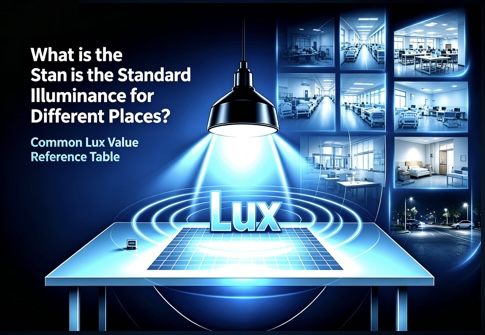
Typical Illuminance Levels for Common Indoor Environments
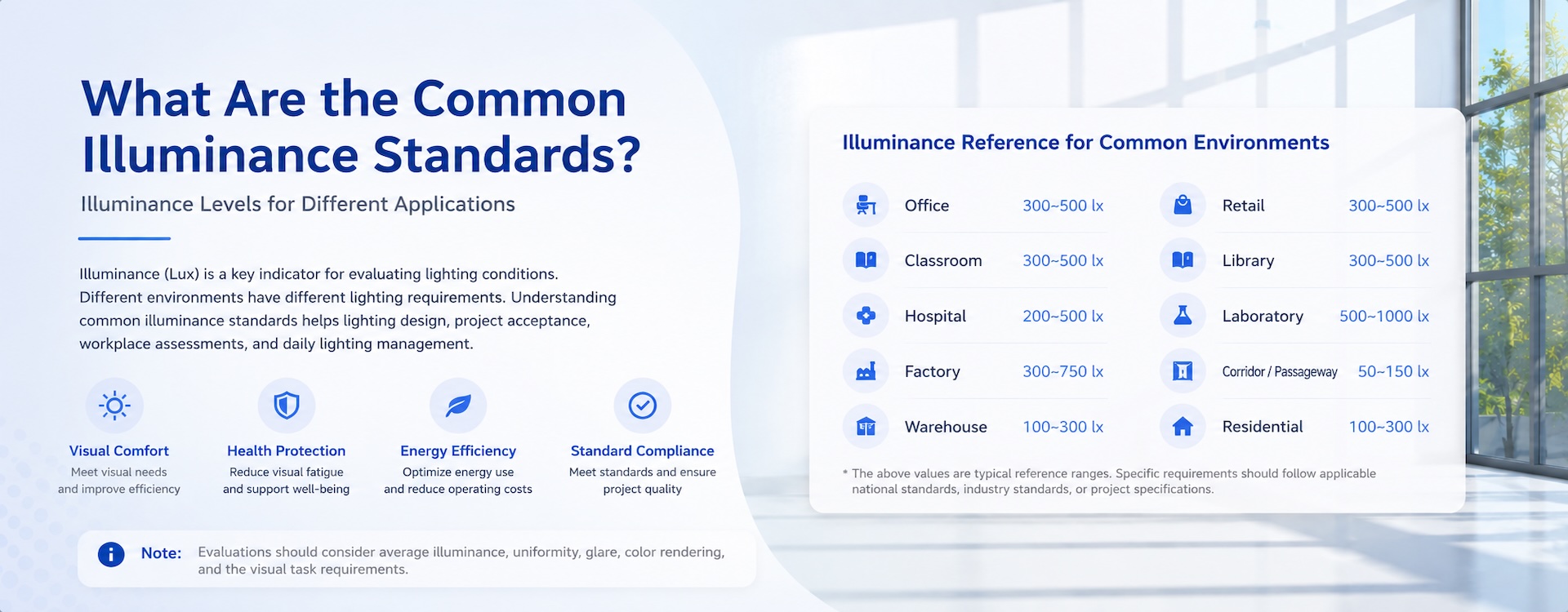
The following values provide a general indication of commonly used illuminance levels for different indoor applications. Actual projects should comply with applicable local standards and design specifications.
| Space / Area | Typical Illuminance | Typical Application |
|---|---|---|
| Corridors and passageways | 50–150 lx | General circulation |
| Stairways | 100–150 lx | Stairs and circulation areas |
| Reception areas | 200–300 lx | Reception and waiting |
| General offices | 300–500 lx | Reading, writing, computer work |
| Meeting rooms | 300–500 lx | Meetings and document reading |
| Drawing and detailed office work | 500–750 lx | Drawings and detailed documents |
| General classrooms | 300–500 lx | Reading, writing, teaching |
| Library reading areas | 300–500 lx | Reading and information retrieval |
| Laboratories | 300–750 lx | Laboratory work and observation |
| General warehouses | 100–200 lx | Storage and general handling |
| Picking and packing areas | 200–300 lx | Picking and label identification |
| General production areas | 300–500 lx | General machining and production |
| Precision assembly areas | 750–1500 lx | Precision assembly and inspection |
| General retail areas | 300–500 lx | Product display and customer activity |
| Hospital public areas | 100–300 lx | Circulation and waiting |
| Medical examination areas | 500–1000 lx or higher | Examination and clinical tasks |
These values should be treated as typical reference ranges rather than universal compliance limits. Specialized environments such as hospitals, laboratories, and precision manufacturing facilities may have more detailed requirements depending on the specific visual task.
What Is the Typical Illuminance Level for an Office?
Offices are among the most common environments in which illuminance measurements are performed.
For general offices, open-plan workspaces, and areas used for reading, writing, and computer work, typical illuminance levels are approximately:
300–500 lx
Tasks involving engineering drawings, detailed documents, product inspection, or other demanding visual work may require 500–750 lx or higher.
However, office lighting quality should not be evaluated solely by increasing the Lux value. Excessive illuminance, poor uniformity, reflections, and glare from luminaires or windows may also reduce visual comfort.
A comprehensive office lighting assessment may therefore consider illuminance uniformity, glare, color temperature, color rendering, and the influence of daylight.
What Is the Typical Illuminance Level for Schools and Classrooms?
School lighting must support prolonged visual activities such as reading, writing, viewing teaching boards, and using digital displays.
Typical reference levels include:
● General classrooms: approximately 300–500 lx;
● Reading rooms: approximately 300–500 lx;
● Laboratories: approximately 300–750 lx;
● Art rooms, drawing rooms, and other areas involving detailed visual tasks: approximately 500–750 lx or higher.
In educational environments, attention should also be paid to illuminance on desk surfaces and to uniformity across different seating positions.
If the front of a classroom is well illuminated while the rear remains significantly darker, achieving the required Lux level at only a few points does not necessarily indicate satisfactory overall lighting conditions.
What Is the Typical Illuminance Level for Hospitals?
Hospitals include waiting areas, patient rooms, nurses' stations, examination rooms, treatment rooms, and specialized medical areas. Because visual tasks differ significantly between these spaces, their lighting requirements also vary.
Typical reference levels include:
● Corridors and circulation areas: approximately 100–200 lx;
● Waiting areas: approximately 200–300 lx;
● Nurses' stations and general working areas: approximately 300–500 lx;
● Examination and treatment areas: approximately 500–1000 lx or higher;
● Areas involving detailed medical procedures may require specialized lighting with substantially more stringent requirements.
Hospitals are specialized environments. Lighting design and acceptance testing should therefore comply with applicable healthcare building, lighting, and industry standards rather than relying solely on general reference values.
What Is the Typical Illuminance Level for Factories and Industrial Areas?
Industrial lighting requirements depend heavily on the type and precision of the work being performed.
Simple material handling and equipment inspection generally require less light than electronic assembly, dimensional inspection, surface defect detection, or precision machining.
Typical reference levels include:
● General work areas: approximately 200–300 lx;
● General machining and assembly: approximately 300–500 lx;
● Detailed assembly: approximately 500–750 lx;
● Precision assembly and quality inspection: approximately 750–1500 lx;
● Extremely demanding visual tasks may require more than 1500 lx.
Industrial lighting measurements should also consider shadows caused by machinery and whether operators themselves block the primary light source during normal working activities.
Measurement locations should therefore represent actual visual conditions as closely as possible.
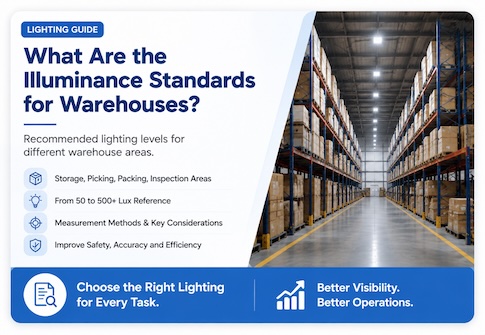
What Is the Typical Illuminance Level for Warehouses?
Warehouse illuminance requirements depend on the frequency of personnel activity, the need to identify goods, and the type of work performed.
General storage areas usually require relatively low illuminance. Higher levels may be necessary where workers frequently pick goods, read labels, package products, or perform inventory operations.
Typical reference levels include:
● General storage areas: approximately 100–200 lx;
● Storage aisles: approximately 100–200 lx;
● Picking areas: approximately 200–300 lx;
● Packing and label-reading areas: approximately 200–500 lx.
In high-rack warehouses, vertical illumination on storage racks may also be important. High floor-level illuminance does not necessarily provide adequate visibility for labels and products stored on vertical surfaces.
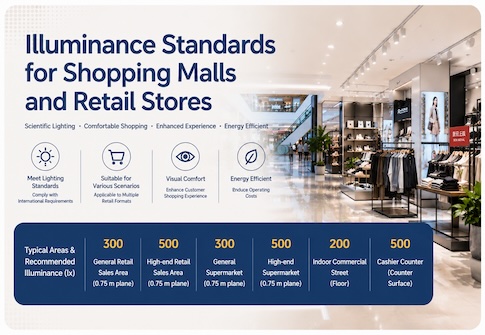
What Is the Typical Illuminance Level for Retail and Commercial Spaces?
Commercial lighting serves several purposes, including basic visibility, product presentation, atmosphere, and visual guidance.
Typical reference levels include:
● General commercial areas: approximately 200–300 lx;
● General retail areas: approximately 300–500 lx;
● Highlighted product displays: 500–1000 lx or higher may be used;
● Checkout and service areas: approximately 300–500 lx.
Retail spaces often combine ambient and accent lighting. As a result, local illuminance on highlighted products may be considerably higher than the surrounding area.
Lighting quality in commercial environments should therefore be assessed according to the function of the space, visual contrast, product presentation, and overall customer experience rather than a single Lux value.
What Is the Typical Illuminance Level for Residential Spaces?
Residential lighting generally places greater emphasis on comfort, functionality, and flexibility between different activities.
Typical reference levels include:
● Living room ambient lighting: approximately 100–300 lx;
● Bedroom ambient lighting: approximately 50–200 lx;
● Desks and reading areas: approximately 300–500 lx;
● Kitchen worktops: approximately 300–500 lx;
● Bathroom mirror areas: approximately 200–500 lx.
Residential lighting does not necessarily need to provide the same illuminance throughout an entire room. For example, a living room may use relatively soft ambient lighting while a reading area uses a table lamp or other task lighting to provide higher local illuminance.
Why Do Illuminance Requirements Vary Between Different Environments?
One of the primary factors determining illuminance requirements is the difficulty of the visual task.
When objects are smaller, contrast is lower, or greater operational precision is required, higher illuminance levels are generally necessary.
Factors affecting illuminance requirements include:
● Level of visual detail required;
● Duration of the visual task;
● Size of the object being viewed;
● Contrast between the object and its background;
● Age and visual needs of occupants;
● Availability of daylight;
● Workplace safety requirements;
● Function and industry of the space.
Therefore, it is incorrect to assume that 500 lx is suitable for every workplace.
For example, 500 lx may be sufficient for routine office work but inadequate for precision inspection of small electronic components.
Is Higher Illuminance Always Better?
No.
Insufficient illuminance can make visual tasks difficult and contribute to visual fatigue. However, excessively high illuminance does not necessarily result in better lighting.
Excessive lighting may cause:
● Glare;
● Reflections on computer screens or glossy surfaces;
● Visual discomfort;
● Excessive brightness contrast;
● Unnecessary energy consumption.
Professional lighting design does not aim for the highest possible Lux value. Instead, it aims to provide appropriate, uniform, comfortable, and efficient illumination for the intended visual task.
What Is the Difference Between Average Illuminance and Point Illuminance?
This is an important consideration in professional illuminance measurement.
If a measurement of 500 lx is taken only at the center of a room, it does not mean that the average illuminance of the entire room is 500 lx.
Professional assessments generally use multiple measurement points arranged according to a defined grid.
Average illuminance can be calculated as:
Eavg = (E₁ + E₂ + E₃ + … + Eₙ) ÷ n
Where:
● Eavg = average illuminance;
● E₁–Eₙ = illuminance measured at individual points;
● n = number of measurement points.
For example, consider nine measurements taken in an office:
| Measurement Point | Illuminance |
| 1 | 460 lx |
| 2 | 480 lx |
| 3 | 510 lx |
| 4 | 490 lx |
| 5 | 520 lx |
| 6 | 500 lx |
| 7 | 470 lx |
| 8 | 450 lx |
| 9 | 480 lx |
The average illuminance is approximately: 484 lx
When determining whether a space complies with a lighting requirement, the applicable standard should be checked to determine whether the relevant criterion is point illuminance, average illuminance, minimum illuminance, maintained illuminance, or another specified parameter.
What Is Illuminance Uniformity?
In addition to average illuminance, illuminance uniformity is an important parameter for evaluating lighting quality.
A commonly used expression is:
U₀ = Emin / Eavg
Where:
● U₀ = illuminance uniformity;
● Emin = minimum illuminance within the measurement area;
● Eavg = average illuminance.
For example, if the average illuminance in a work area is 500 lx and the minimum illuminance is 300 lx:
U₀ = 300 ÷ 500 = 0.60
A space may have a relatively high average illuminance while still containing noticeably dark areas.
For this reason, average illuminance and uniformity should normally be considered together when evaluating professional lighting conditions.
At What Height Should Illuminance Be Measured?
The correct measurement height depends on the actual task plane. Illuminance should not automatically be measured at floor level in every environment.
For example:
● Offices: measurements are generally taken on the desk or working plane;
● Classrooms: measurements are generally taken on student desk surfaces;
● Factories: measurement height depends on the actual workstation or equipment task plane;
● Warehouses: measurement positions may relate to aisles, shelving, or picking surfaces;
● Corridors: measurements should be taken on the plane specified by the applicable standard.
Before carrying out standardized measurements, always check the applicable requirements for measurement height, measurement grid, and task plane.
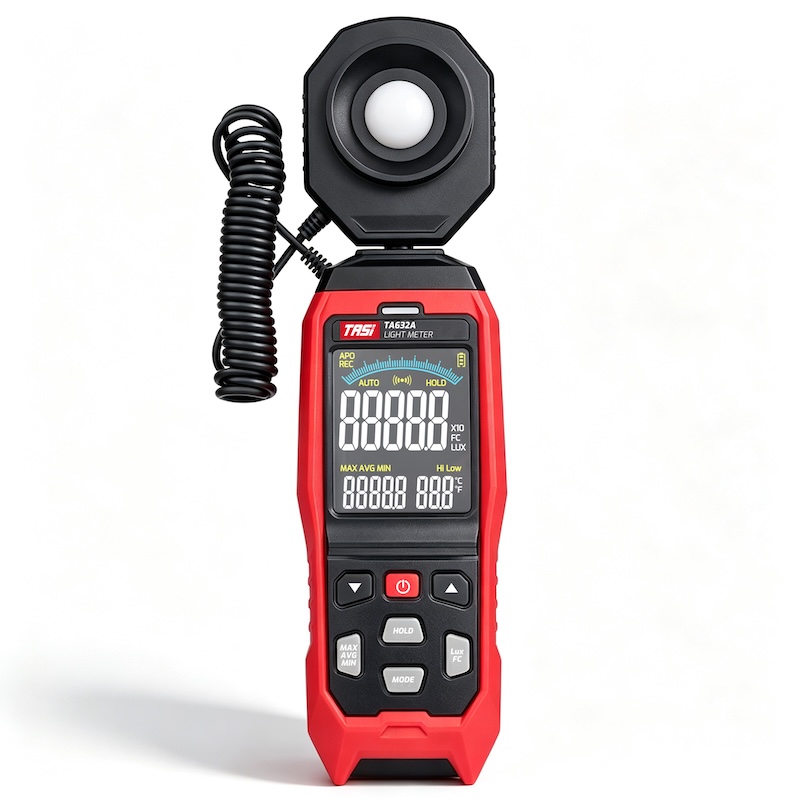
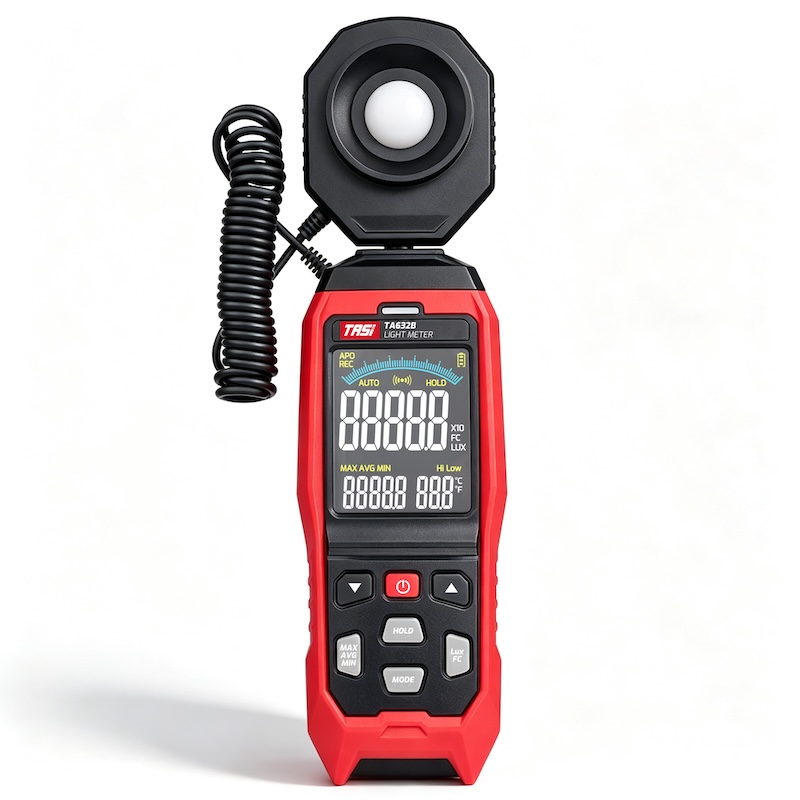
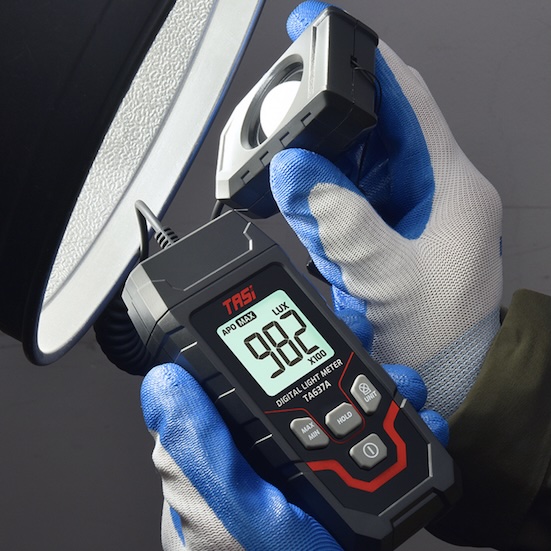
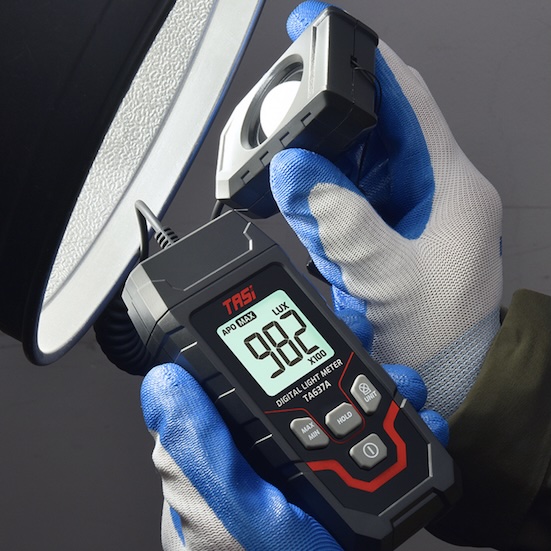
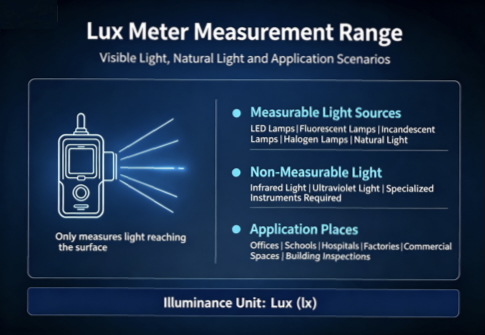
How Can a Lux Meter Be Used to Check Illuminance?
A typical professional illuminance measurement procedure includes the following steps:
● Identify the applicable national standard, industry standard, or project specification;
● Define the measurement area and task-plane height;
● Establish a measurement grid and measurement points according to the applicable requirements;
● Switch on the lighting system and allow the light sources to reach stable operating conditions;
● Position the lux meter sensor on the specified measurement plane;
● Keep the sensor surface oriented according to the measurement requirements;
● Avoid blocking the sensor with people, equipment, or other objects;
● Record the Lux value at each measurement point;
● Calculate average illuminance, minimum illuminance, and any other required parameters;
● Compare the results with the applicable standard or project specification.
If the measured value is close to a compliance limit, the accuracy and calibration status of the instrument, measurement location, and environmental conditions should be reviewed carefully.
What Should Be Considered When Measuring Illuminance?
Even when the same lux meter is used, differences in measurement technique can produce significantly different results.
For reliable measurements:
● Keep the light sensor clean;
● Avoid blocking incident light with hands, the operator's body, or equipment;
● Prevent the operator's shadow from falling on the sensor;
● Do not change the sensor angle unnecessarily;
● Allow the lighting system to stabilize before measurement;
● Record daylight conditions, artificial lighting status, and blind or curtain positions where relevant;
● Measure at multiple representative locations;
● Do not use a single measurement point to represent an entire room;
● Professional measurements should use a lux meter with suitable accuracy and valid calibration status.
For measurements used in formal reports, it is also advisable to record the measurement date, time, environmental conditions, instrument model, instrument identification number, calibration information, and measurement locations.
Why Do Lux Values Vary Across the Same Room?
This is normal.
Indoor illuminance distribution is affected by many factors, including:
● Distance from luminaires;
● Luminaire installation height;
● Light distribution characteristics;
● Reflectance of walls and ceilings;
● Windows and daylight;
● Furniture and equipment;
● Occupants;
● Aging and depreciation of light sources.
Areas directly below or close to luminaires generally receive higher illuminance, while room edges and areas between luminaires may receive less light.
For this reason, professional lighting assessments generally use grid-based multi-point measurements rather than relying on a single reading taken in the center of the room.
Does Daylight Affect Illuminance Measurements?
Yes. Daylight can have a substantial effect on measurement results.
For example, a workstation near a window may receive more than 1000 lx during a sunny afternoon, while the same location may receive only 300–500 lx at night under artificial lighting.
When testing the performance of an artificial lighting system or conducting project acceptance measurements, the influence of daylight should therefore be controlled according to the applicable standard.
If the objective is to evaluate actual combined lighting conditions, daylight may be included, but relevant conditions should be recorded, including:
● Measurement time;
● Weather conditions;
● Position of curtains, blinds, or shading systems;
● Operating status of artificial lighting.
This information improves the comparability of measurements taken at different times.
Are Illuminance Standards the Same in Every Country?
No.
Different countries and regions may use different standards for building lighting, workplace lighting, and specialized applications. Even for similar spaces, recommended or required illuminance levels, maintained illuminance, measurement procedures, uniformity criteria, and glare limits may differ.
For international projects, export markets, and multinational workplaces, it is therefore not appropriate to apply the illuminance requirements of one country universally.
A more appropriate procedure is to:
● Identify the country or region where the project is located;
● Determine the type of building or workplace;
● Identify the applicable current standard;
● Confirm whether the specified value refers to average, maintained, minimum, or another type of illuminance;
● Perform measurements according to the procedures defined by that standard.
Frequently Asked Questions (FAQ)
1. How many Lux are recommended for an office?
General office environments commonly use approximately 300–500 lx. Tasks involving technical drawings, detailed documents, or demanding visual work may require 500–750 lx or higher. Applicable local lighting standards should always take precedence.
2. What is the typical illuminance level for a classroom?
General classrooms commonly use approximately 300–500 lx. In addition to average illuminance, lighting uniformity across student desks and adequate lighting of teaching surfaces should also be considered.
3. How many Lux are required in a factory?
It depends on the work being performed. General work areas may use approximately 200–300 lx, general machining and assembly approximately 300–500 lx, and precision assembly or inspection approximately 750–1500 lx or higher.
4. What is the typical illuminance level for a warehouse?
General storage areas commonly use approximately 100–200 lx. Picking, packing, and label-reading areas may require approximately 200–500 lx depending on the task.
5. Is 500 Lux suitable for every workplace?
No. Although 500 lx is common in many office and general work environments, different visual tasks require different illuminance levels. Precision inspection may require considerably more light, while corridors generally require much less.
6. Is a higher Lux value always better?
No. Insufficient lighting can impair visibility, but excessive illuminance may cause glare, reflections, visual discomfort, and unnecessary energy consumption. Lighting should be appropriate for the intended visual task.
7. Why are multiple measurement points required?
Light is not distributed uniformly throughout a room. Multiple measurement points allow average illuminance and uniformity to be evaluated, providing a more representative assessment of overall lighting conditions.
8. Can a smartphone replace a professional lux meter?
A smartphone may be useful for basic comparisons or approximate observations, but sensor characteristics, placement, and software algorithms vary between devices. Professional lighting assessment, project acceptance, laboratory testing, and quality inspection should use a dedicated lux meter with defined specifications and appropriate calibration.
9. Can LED lighting be measured with a standard lux meter?
Yes, but the instrument's spectral response, cosine response, and measurement accuracy should be considered. Professional LED lighting measurements should use an illuminance meter suitable for the required measurement conditions.
10. Should illuminance be measured during the day or at night?
It depends on the purpose of the measurement. If the artificial lighting system itself is being evaluated, daylight should be controlled according to the applicable standard. If actual combined lighting conditions are being assessed, daylight may be included, but the measurement time, weather conditions, and lighting status should be recorded.
Conclusion
Illuminance standards provide an important basis for evaluating lighting quality in buildings and workplaces, but there is no single Lux value that is suitable for every environment.
Offices, schools, hospitals, factories, warehouses, commercial spaces, and residential environments all involve different functions and visual tasks and therefore require different lighting conditions.
Professional lighting evaluation should also go beyond a single measurement point or maximum Lux reading. Measurements should be taken on the appropriate task plane and at multiple representative points so that average illuminance, minimum illuminance, and illuminance uniformity can be evaluated together with factors such as glare, color rendering, daylight, and the actual visual task.
For project acceptance, occupational environment testing, architectural lighting assessment, and professional laboratory measurements, a lux meter with appropriate specifications and valid calibration should be used. Applicable national standards, local regulations, industry standards, and project design specifications should always be regarded as the final basis for compliance.