Introduction
Indoor lighting directly affects visual comfort, work efficiency, and operational safety. Whether in offices, schools, hospitals, factory workshops, laboratories, warehouses, or commercial buildings, appropriate lighting conditions should be provided according to the actual requirements of the space.
However, the human visual system has a strong ability to adapt to different lighting environments. After entering a darker or brighter space, the eyes gradually adjust to the prevailing light level. As a result, it is often difficult to determine accurately by visual perception alone whether the actual illuminance in an indoor space meets the intended design or application requirements.
A Digital Lux Meter converts the light incident on a specified surface into quantifiable illuminance data and displays the result in units such as Lux (lx). It is an important measurement instrument for indoor lighting inspection, building lighting acceptance, workplace environment assessment, and lighting system maintenance.
However, indoor illuminance measurement is not simply a matter of placing a lux meter in a room and reading a value. Factors such as the measurement plane, measurement height, measurement point location, sensor orientation, daylight, obstruction by personnel, and the operating condition of the lighting system can all affect the final measurement result.
This article systematically explains how to measure indoor illuminance correctly, including multi-point measurement, average illuminance calculation, measurement records, and common error-control methods, helping you obtain more accurate, reliable, and comparable illuminance data.
Key Points
After reading this article, you will understand:
● What indoor illuminance measurement is;
● Why indoor illuminance needs to be measured;
● What preparations should be made before indoor illuminance measurement;
● How to determine the correct measurement plane and measurement height;
● How to arrange indoor illuminance measurement points;
● How to position the lux meter sensor correctly;
● How to calculate average indoor illuminance;
● How to evaluate minimum illuminance and illuminance uniformity;
● How to reduce measurement errors caused by daylight, personnel obstruction, and other factors;
● How to establish a standardized indoor illuminance measurement procedure.
What Is Indoor Illuminance?
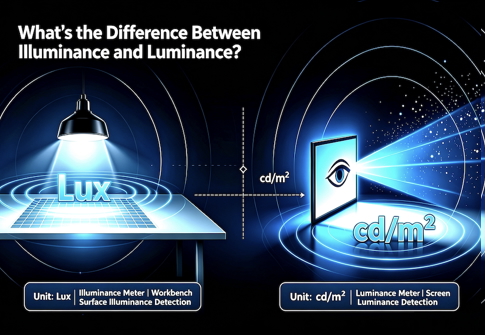
Illuminance refers to the luminous flux received by a surface per unit area. Its SI unit is the lux (Lux, lx).
The basic relationship for illuminance can be expressed as: 1 lx = 1 lm/m²
In other words, when a luminous flux of 1 lumen (lm) is uniformly distributed over an area of 1 square meter, the average illuminance on that surface is 1 Lux.
It is important to note that illuminance does not describe how “bright” a luminaire itself is. Instead, it describes how much light is actually received by a specified surface.
For example:
● In offices, illuminance is typically evaluated on the desk or work surface;
● In classrooms, illuminance is commonly evaluated on desktops, blackboards, or other teaching areas;
● In factories, illuminance is typically evaluated on production equipment, assembly benches, or actual operating work surfaces;
● In laboratories, illuminance is generally evaluated on laboratory benches;
● In warehouses, illuminance may be evaluated on floors, shelving, or actual working areas;
● In commercial spaces, illuminance may be evaluated on floors, counters, and product display surfaces.
Therefore, before conducting indoor illuminance measurements, it is first necessary to define the area to be evaluated and the actual measurement plane.
Why Is It Necessary to Measure Indoor Illuminance?
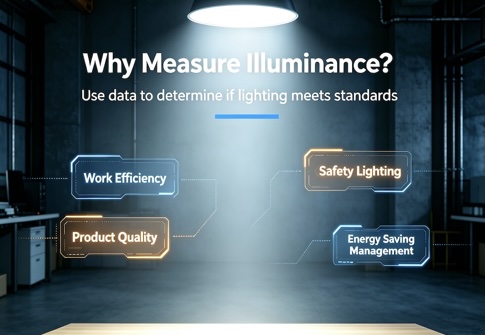
Appropriate indoor lighting provides suitable visual conditions for work, study, production, and everyday activities.
Insufficient illuminance may make visual tasks more difficult and negatively affect detailed work. Excessive illuminance, on the other hand, may result in unnecessary energy consumption and may also contribute to glare and unwanted reflections.
Professional indoor illuminance measurement can provide quantitative data for the following applications:
● Verification of building lighting design;
● Lighting acceptance inspection for building projects;
● Office lighting environment assessment;
● Lighting inspection in classrooms and educational spaces;
● Lighting inspection in factory production areas and workstations;
● Lighting assessment in hospitals and medical work areas;
● Laboratory workplace lighting inspection;
● Lighting inspection in warehouses and logistics work areas;
● Lighting management in shopping malls, hotels, and public buildings;
● Evaluation of luminaire aging and lighting system maintenance;
● Comparison of lighting performance before and after LED lighting upgrades;
● Building energy-saving and lighting optimization projects.
Compared with relying only on visual perception, illuminance measurement converts actual lighting conditions into measurable, recordable, and comparable data.
What Instrument Is Required to Measure Indoor Illuminance?
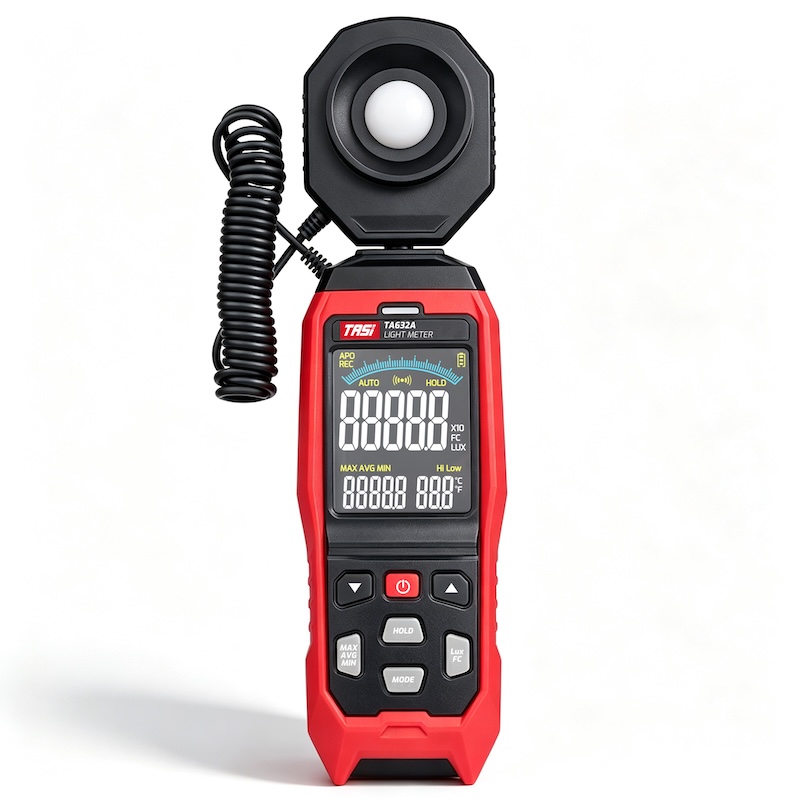
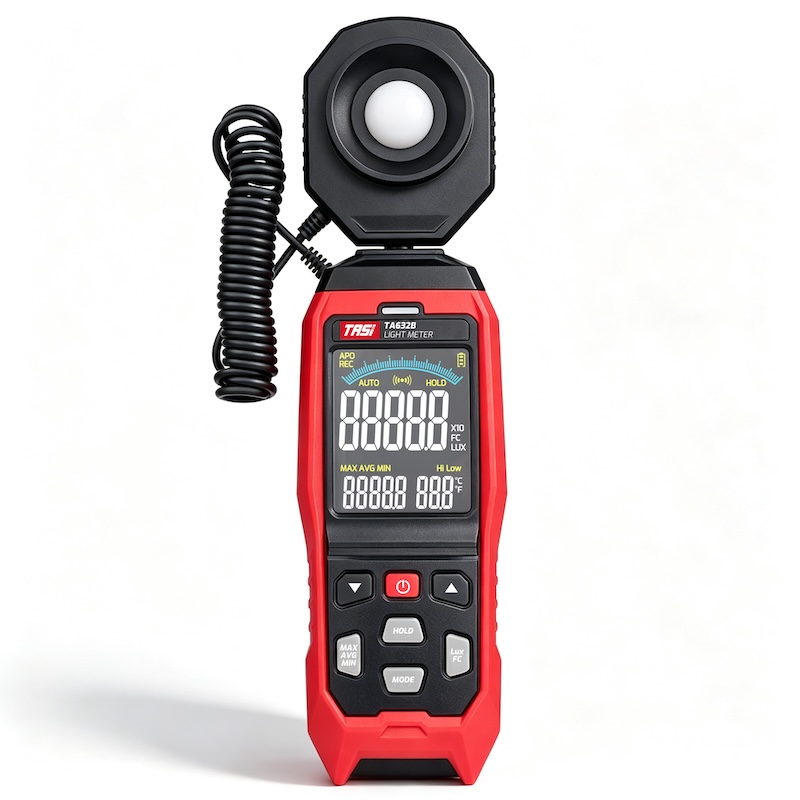
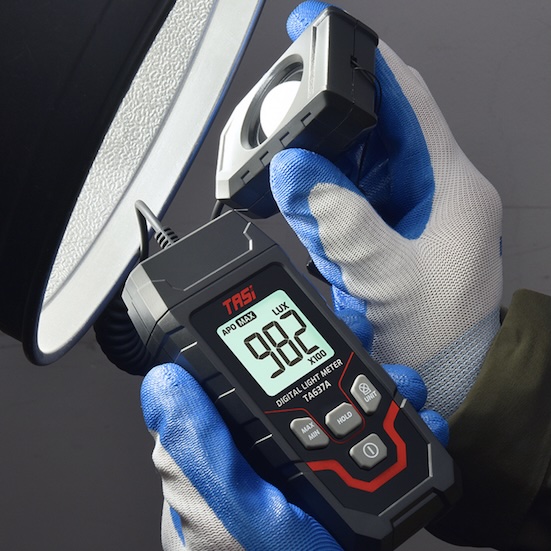
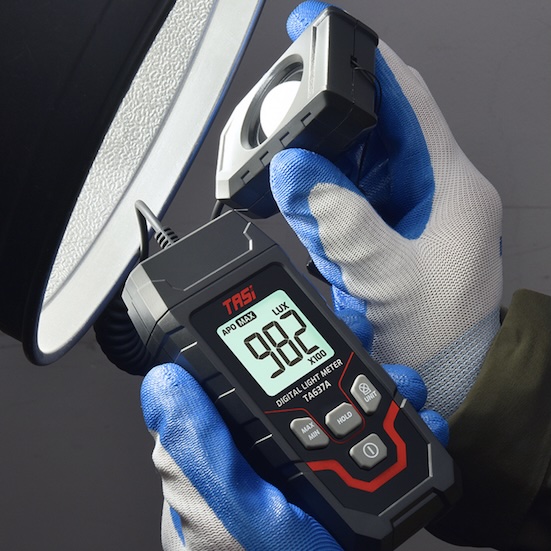
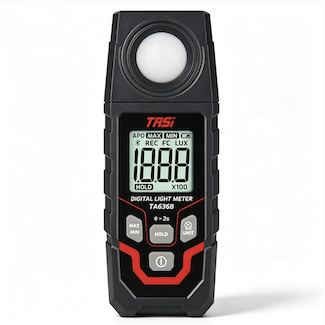
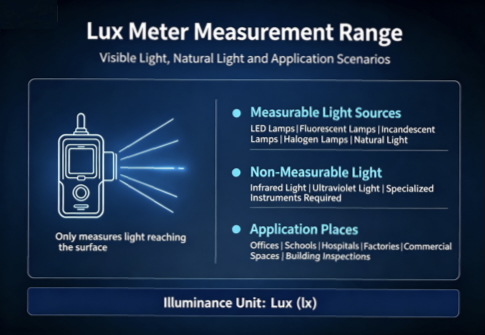
Indoor illuminance is typically measured using a Digital Lux Meter.
A lux meter uses an optical sensor to receive visible light incident on the photosensitive surface. The light signal is converted into an electrical signal, processed by the instrument’s internal circuitry and processing system, and ultimately displayed in units such as Lux or Foot-candle (fc).
For professional indoor lighting measurement, it is recommended to consider the following characteristics of the lux meter:
● Whether the measurement range covers the expected illuminance level;
● Whether the measurement accuracy meets the inspection requirements;
● Whether the spectral response appropriately matches the photopic response of the human eye;
● Whether the cosine response is suitable for measuring light incident from different angles;
● Whether the resolution is appropriate for the application;
● Whether automatic or manual range switching is supported;
● Whether practical functions such as Data Hold and MAX/MIN are available;
● Whether the instrument supports data logging or data transmission;
● Whether the instrument is in an appropriate calibration condition.
If the measurement results are to be used for formal engineering acceptance, quality management, or standards compliance assessment, the selected instrument should also meet the applicable performance and calibration requirements specified by relevant standards or project specifications.
What Preparations Should Be Made Before Measuring Indoor Illuminance?
Before beginning formal measurement, the measuring instrument and the on-site lighting environment should first be checked.
It is particularly important to ensure that the sensor surface of the lux meter is clean. Dust, oil, or other contamination on the photosensitive surface may reduce the amount of light reaching the sensor and may therefore cause the measured value to be lower than the actual illuminance.
After switching on the lux meter, check the following:
● Whether the battery level is sufficient;
● Whether the instrument display is operating normally;
● Whether the Lux or fc unit is set correctly;
● Whether the measurement range is appropriate;
● Whether the remote sensor connection is functioning correctly;
● Whether the sensor surface is clean;
● Whether the instrument displays any abnormal warning or indication;
● Where required, whether the calibration status has been confirmed.
If artificial lighting is being measured, ensure that the luminaires to be tested are operating normally and have reached a sufficiently stable operating condition for measurement.
It is also recommended to record the measurement date, time, location, luminaire operating condition, and daylight conditions in advance to provide a basis for subsequent analysis.
At What Height Should Indoor Illuminance Be Measured?
The measurement height for indoor illuminance is not fixed and should be determined according to the actual application, visual task, and object being evaluated.
In general, the sensor surface should be positioned as close as possible to the actual working plane that needs to be evaluated.
Typical measurement planes for indoor environments may include:
| Application Typical Measurement Plane | |
|---|---|
| Office | Desk surface or actual work plane |
| Classroom | Desktop or specified teaching work plane |
| Laboratory | Laboratory bench surface |
| Factory workshop | Actual production or operating work plane |
| Commercial space | Floor, counter, or product display surface |
| Warehouse | Floor, shelving, or actual work surface |
| Corridor and passageway | Floor or plane specified by the applicable standard |
| Equipment operating area | Plane corresponding to the actual visual task |
If an area does not have a clearly defined fixed work plane, the measurement height should be determined according to applicable local lighting standards, building design requirements, or project specifications.
Therefore, the correct principle is not to apply one fixed measurement height to all environments, but rather to determine the measurement plane according to the actual visual task.
How Should the Lux Meter Sensor Be Positioned Correctly?
When measuring illuminance on a horizontal work surface, the lux meter sensor should be placed steadily at the designated measurement position, with the photosensitive surface aligned with the work plane being evaluated.
For example, when measuring illuminance on an office desk, the sensor can be placed at the designated point on the desk, with the photosensitive surface kept horizontal and facing upward.
In general, the sensor should not be intentionally pointed directly toward a particular luminaire in order to obtain a higher reading.
Indoor light normally consists not only of direct light from luminaires, but also of reflected light from walls, ceilings, floors, furniture, and other surfaces. The purpose of illuminance measurement is to determine the total light actually received by the specified measurement plane.
During measurement, avoid the following:
● Covering or shading the sensor with your hand;
● Standing between the main light source and the sensor;
● Tilting the sensor;
● Moving the sensor while taking a reading;
● Placing clipboards, tools, or other objects close to the sensor;
● Artificially changing the original reflective conditions in the measurement area.
If vertical illuminance needs to be measured, the orientation of the sensor should be adjusted according to the actual evaluation plane.
How Should Indoor Illuminance Measurement Points Be Arranged?
If the objective is to evaluate the lighting condition of an entire indoor space, measuring only one location is usually insufficient.
Differences in luminaire position, mounting height, light distribution, furniture layout, surface reflection, and daylight can all result in variations in illuminance between different areas.
Therefore, a more standardized approach is to establish multiple representative measurement points within the area being evaluated.
A common method is to divide the measurement area into a number of regular grids and perform measurements at representative positions within each grid.
For example:
● Divide the room into several sections along its length;
● Divide the room into several sections along its width;
● Create a regular measurement grid;
● Establish a measurement point within each grid area;
● Measure each point in a consistent sequence;
● Record the illuminance value at each measurement point separately.
For larger offices, factory workshops, classrooms, warehouses, or commercial buildings, an appropriate number of additional measurement points should be used to make the results more representative.
The exact number, spacing, and arrangement of measurement points should preferably be determined according to applicable national standards, industry standards, project specifications, or customer technical requirements.
How Should Each Measurement Point Be Measured Correctly?
Once the measurement points have been defined, each point should be measured using a consistent method.
First, position the lux meter sensor at the designated measurement point and ensure that the photosensitive surface is oriented correctly.
After positioning the sensor, the operator should move away from any location that may affect the light reaching the sensor, in order to avoid shading caused by the body or other objects.
Wait until the displayed reading becomes stable or representative before recording the measurement result.
Each measurement point should be measured under conditions that are as consistent as possible:
● The same measurement plane;
● The same sensor orientation;
● The same luminaire operating condition;
● The same daylight control conditions;
● The same data-reading method.
Only when the measurement conditions remain substantially consistent can data from different measurement points be meaningfully compared.
How Is Average Indoor Illuminance Calculated?
After obtaining illuminance data from multiple measurement points, the average illuminance of the measured area can be calculated.
If all measurement points represent equal areas, a simple arithmetic average can be used:
Eavg = (E₁ + E₂ + E₃ + …… + Eₙ) ÷ n
Where:
● Eavg: Average illuminance;
● E₁, E₂……Eₙ: Illuminance values at each measurement point;
● n: Number of measurement points.
For example, nine measurement points are established in an office:
| Measurement Point | Measurement Result |
|---|---|
| P1 | 468 Lux |
| P2 | 492 Lux |
| P3 | 510 Lux |
| P4 | 455 Lux |
| P5 | 486 Lux |
| P6 | 501 Lux |
| P7 | 442 Lux |
| P8 | 470 Lux |
| P9 | 496 Lux |
Adding all measurement values together and dividing by 9 gives: Average illuminance Eavg ≈ 480 Lux
Compared with a single-point measurement, multi-point average illuminance generally provides a more objective representation of the overall lighting level in an area.
It should be noted that if different measurement points represent different surface areas, the applicable measurement method should be consulted to determine whether an area-weighted calculation is required rather than using a simple arithmetic average.
Why Should Minimum and Maximum Illuminance Also Be Considered?
Average illuminance reflects the overall lighting level of an area, but it does not fully describe how light is distributed throughout the space.
For example, an office may meet the required average illuminance while some locations near corners, behind equipment, or farther away from luminaires remain noticeably darker.
Therefore, when evaluating indoor illuminance, it is usually useful to record:
● Average illuminance Eavg;
● Minimum illuminance Emin;
● Maximum illuminance Emax.
These values provide a more complete understanding of the actual lighting distribution within the space and help identify localized areas that may be excessively dark or bright.
What Is Illuminance Uniformity?
Illuminance uniformity is used to evaluate how evenly light is distributed within a given area.
In some lighting evaluation systems, it can be expressed as the ratio of minimum illuminance to average illuminance: U₀ = Emin ÷ Eavg
For example: the minimum illuminance in an indoor area is 350 Lux, while the average illuminance is 500 Lux.
Then: U₀ = 350 ÷ 500 = 0.70, indicating that the minimum illuminance is approximately 70% of the average illuminance.
It should be noted that the definition, calculation method, and required limits for illuminance uniformity may vary between countries, regions, building types, and lighting standards.
Therefore, for formal engineering inspection or standards compliance assessment, the applicable lighting standard or project specification should be used as the primary reference.
How Should Indoor Illuminance Be Measured When Daylight Is Present?
Indoor areas located near windows, glass curtain walls, or skylights may be significantly affected by daylight.
Even when the artificial lighting system remains unchanged, measurements taken in the same office may vary considerably between morning and afternoon, or between sunny and cloudy conditions.
Therefore, the purpose of the measurement should be clearly defined before testing.
If the objective is to evaluate the artificial lighting system itself, the influence of daylight should be reduced or controlled as much as possible according to the applicable measurement method.
If the objective is to evaluate the combined illuminance produced by daylight and artificial lighting under actual operating conditions, daylight may be retained, but the relevant environmental conditions should be recorded.
It is recommended to record:
● Measurement date;
● Exact measurement time;
● Weather conditions;
● Curtain or shading-system status;
● Artificial lighting operating status;
● Main direction of incoming daylight.
This information helps ensure that measurements taken on different dates or at different times remain understandable and comparable.
Why Should Personnel Avoid Shading the Sensor During Measurement?
The human body can both block and reflect light.
When the operator stands between a luminaire and the sensor, the body may cast a shadow and reduce the amount of light reaching the sensor, resulting in a lower measured value.
At the same time, light-colored clothing, walls, clipboards, and other highly reflective objects may alter the local lighting conditions around the sensor.
Therefore, when taking readings, avoid:
● Blocking the main light source with the body;
● Placing an arm close to the sensor;
● Blocking light with a clipboard;
● Allowing other personnel to stand close to the measurement point;
● Moving furniture or equipment temporarily and changing the original reflective conditions.
For a digital lux meter with a separate sensor, the sensor can be positioned at the measurement point while the operator remains at an appropriate distance and reads the value from the main unit.
Why Does Illuminance Vary at Different Locations in the Same Room?
Indoor illuminance is rarely distributed perfectly evenly throughout a space.
Differences in illuminance between locations are normal and may mainly be caused by the following factors:
● Different luminaire installation positions;
● Different distances between luminaires and the measurement plane;
● Different luminaire light distribution angles;
● Variations in luminaire output;
● Different reflectance values of walls, floors, and ceilings;
● Obstruction caused by furniture, equipment, or building structures;
● Daylight entering through windows;
● Different levels of luminaire aging;
● Dust or contamination on luminaire surfaces;
● Luminaire failure or reduced light output.
Therefore, one of the key purposes of multi-point measurement is to identify actual illuminance differences between areas rather than relying on a single Lux value.
Is It Necessary to Wait for the Reading to Stabilize?
Yes. After moving the sensor to a new measurement point, it is not recommended to record the value immediately while the displayed reading is still changing noticeably.
The reading should be allowed to stabilize before it is recorded.
The actual stabilization time depends on the response speed of the lux meter, the light source type, and the measurement environment. Therefore, it is generally not appropriate to specify one fixed waiting time for all measurements.
If the displayed value continues to fluctuate within a small range, the reading may be observed for a period of time and a stable or representative value recorded according to the applicable measurement method.
For dimmable lighting, periodically varying light sources, or other dynamic lighting environments, a measurement method appropriate to the specific application should be used.
Standard Operating Procedure for Indoor Illuminance Measurement
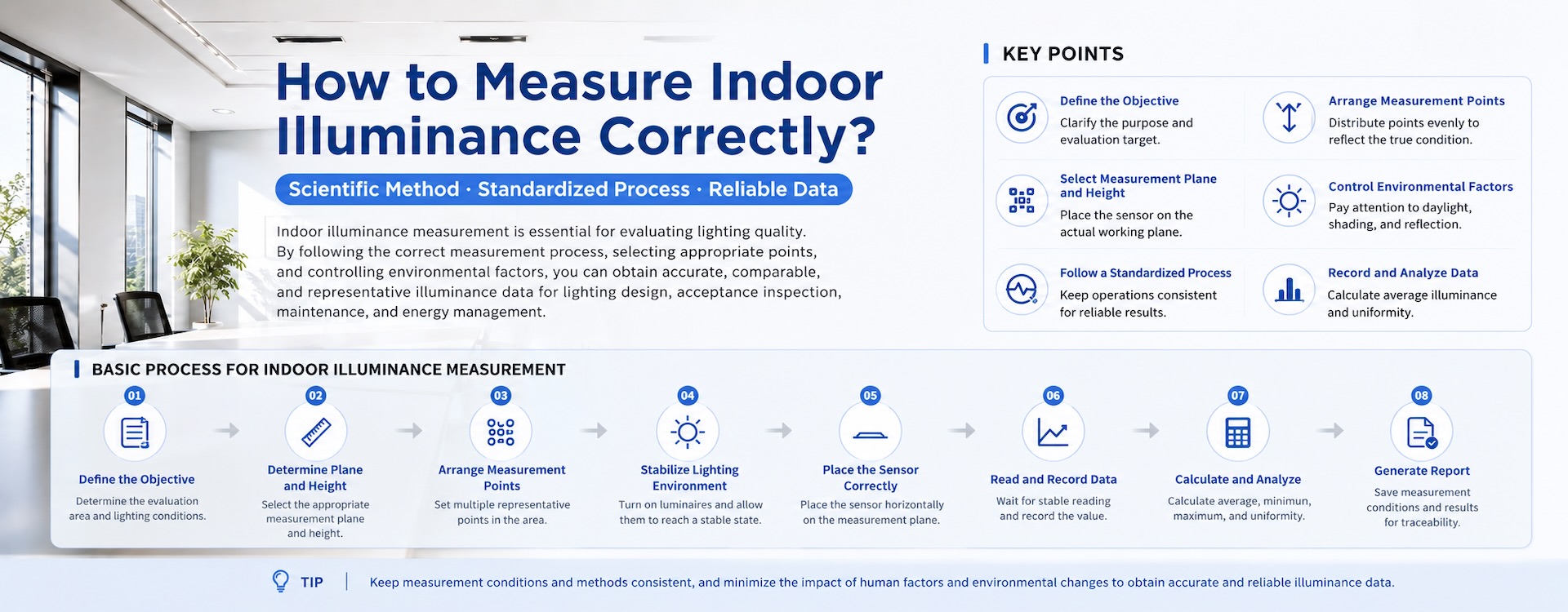
To improve consistency between different operators, measurement times, and measurement areas, a standardized indoor illuminance measurement procedure can be established.
Step 1: Define the Measurement Objective
Determine whether the objective is to evaluate artificial lighting, the combined effect of daylight and artificial lighting, or the lighting condition of a specified work area.
Step 2: Determine the Measurement Plane
Determine the measurement height based on the desk surface, laboratory bench, production work surface, floor, or other actual visual task plane.
Step 3: Check the Lux Meter
Confirm that the sensor is clean, the instrument is operating normally, the unit and range are set correctly, and the calibration status is confirmed where required by the project.
Step 4: Stabilize the Lighting Environment
Switch on the luminaires to be tested and allow the lighting system to reach a sufficiently stable operating condition for measurement.
Step 5: Arrange the Measurement Points
Establish a measurement grid based on the room size, luminaire distribution, and applicable measurement requirements.
Step 6: Position the Sensor Correctly
Ensure that the photosensitive surface is aligned with the evaluation plane and is not shaded by personnel or other objects.
Step 7: Wait for the Reading to Stabilize
Observe the display and record the measurement result once the reading is stable or representative.
Step 8: Complete All Measurement Points
Measure all designated points using the same method and avoid changing the on-site measurement conditions during the process whenever possible.
Step 9: Calculate and Analyze the Data
Calculate average illuminance, minimum illuminance, maximum illuminance, illuminance uniformity, and other parameters as required.
Step 10: Create a Measurement Record
Record the measurement conditions, instrument information, measurement point locations, and final results for subsequent analysis, comparison, and traceability.
What Information Should Be Recorded During Indoor Illuminance Measurement?
For engineering inspection, building acceptance, lighting upgrades, or long-term maintenance projects, recording only the final Lux value is usually insufficient.
It is recommended to create a complete indoor illuminance measurement record.
| Record Item | Recommended Information |
|---|---|
| Measurement Location | Building, room, or area name |
| Measurement Date | Actual inspection date |
| Measurement Time | Start and end time |
| Measuring Instrument | Lux meter brand and model |
| Instrument Status | Calibration or verification information |
| Measurement Unit | Lux / fc |
| Measurement Plane | Desk, floor, workbench, etc. |
| Measurement Point | P1, P2, P3…… |
| Light Source Status | Luminaires switched on and operating condition |
| Daylight Conditions | Present/absent and related environmental conditions |
| Measurement Result | Actual illuminance at each measurement point |
| Statistical Result | Average, maximum, minimum, etc. |
A complete measurement record allows engineers to compare data after luminaire replacement, lighting layout adjustment, or energy-saving upgrades.
What Are the Common Errors in Indoor Illuminance Measurement?
During actual inspection, even seemingly minor differences in operating procedures can affect the final measurement result.
Common errors include:
● Measuring only one point and using it to represent the entire room;
● Using a measurement height that does not correspond to the actual work plane;
● Pointing the sensor directly toward a particular luminaire;
● Shading the sensor with a hand or body;
● Measuring immediately after luminaires are switched on;
● Failing to record daylight conditions;
● Using different operating methods at different measurement points;
● Recording data before the instrument reading has stabilized;
● Ignoring dust or contamination on the sensor surface;
● Moving furniture or equipment during measurement;
● Using a lux meter for long periods without considering its calibration status.
For projects that compare different rooms, different luminaires, or lighting performance before and after renovation, maintaining consistent measurement conditions and operating procedures is especially important.
How Can Indoor Illuminance Measurement Accuracy Be Improved?
To obtain more accurate, stable, and comparable indoor illuminance data, the following basic principles can be followed:
● Use a digital lux meter that is suitable for the measurement task and is in good operating condition;
● Check that the sensor surface is clean before measurement;
● Determine the measurement plane according to the actual visual task;
● Use multiple measurement points when evaluating larger areas;
● Keep the sensor orientation consistent at all measurement points;
● Avoid shading the sensor with personnel or other objects;
● Allow the lighting system and instrument reading to reach a stable condition;
● Properly control or fully document the influence of daylight;
● Keep measurement conditions substantially consistent between measurement points;
● Use an instrument that meets applicable calibration requirements for formal inspection;
● Fully record on-site environmental conditions and all measurement data.
For offices, factories, schools, or public buildings that require periodic inspection, fixed measurement points and standardized data-recording methods can also be established to facilitate long-term comparison of lighting system performance.
How Can You Determine Whether Indoor Illuminance Meets the Requirements?
After completing the indoor illuminance measurement, the actual results should be compared with the applicable lighting requirements.
It is important to understand that there is no single target illuminance value that applies to all indoor environments.
Offices, schools, hospitals, factories, warehouses, laboratories, and commercial spaces involve different visual tasks and therefore require different lighting levels.
Even within the same building, different functional areas may have completely different illuminance requirements.
Therefore, when determining whether the measured result is acceptable, priority should be given to:
● Applicable local building lighting standards;
● Workplace lighting standards;
● Relevant national or industry standards;
● Project lighting design specifications;
● Customer technical requirements;
● Applicable regulations or engineering acceptance requirements.
For professional lighting assessment, other parameters such as minimum illuminance, illuminance uniformity, glare, color rendering performance, and additional lighting quality indicators may also need to be evaluated in addition to average illuminance.
FAQ:
At what height should a lux meter be positioned when measuring indoor illuminance?
The measurement height should be determined according to the actual object being evaluated.
In offices, measurements are generally taken on desk surfaces. In classrooms, measurements are usually taken on desktops or designated teaching work planes. In laboratories, measurements are typically taken on laboratory benches, while in industrial environments the measurement plane should correspond to the actual production or operating work surface.
For areas without a fixed work plane, the measurement plane should be determined according to the applicable lighting standard or project specification.
Can only one measurement point be used for an entire room?
If only a simple reference measurement is required, a specified single point may be measured.
However, if the objective is to evaluate the overall lighting level of an entire room, multiple representative measurement points should generally be used.
Illuminance can vary significantly between different parts of the same indoor space, so a single-point measurement usually cannot fully represent the actual lighting condition of the entire area.
Should the lux meter sensor be pointed directly at the luminaire?
Usually not.
When measuring illuminance on a horizontal work plane, the photosensitive surface of the sensor should be aligned with the actual work plane rather than pointed directly toward a particular luminaire.
This allows the instrument to measure the total light actually received by the work surface.
Why does indoor illuminance differ between daytime and nighttime measurements?
If the indoor space contains windows, glass curtain walls, or skylights, daylight directly affects the total indoor illuminance.
Daylight intensity also changes with weather conditions, time of day, and the position of the sun. As a result, illuminance measured at the same location can vary significantly at different times.
When comparing measurement data, it is important to identify whether daylight is included and to record the measurement time and relevant environmental conditions.
Why do Lux readings vary significantly at different locations in the same office?
This may be caused by differences in luminaire position, distance from the luminaire, light distribution, furniture obstruction, surface reflection, and daylight.
Indoor illuminance normally has a spatial distribution, so standardized indoor lighting assessment generally uses multiple measurement points rather than relying on a single reading.
How is the average illuminance of a room calculated?
When each measurement point represents an equal area, the illuminance values from all points can be added together and divided by the number of measurement points to obtain the arithmetic average illuminance.
If the measurement points represent different areas, the applicable measurement standard or project specification should be consulted to determine whether an area-weighted calculation is required.
Can a smartphone replace a professional lux meter for indoor illuminance measurement?
The ambient light sensor in a smartphone is primarily intended for functions such as automatic screen brightness adjustment. Its spectral response, cosine response, measurement range, calibration method, and consistency between different devices may not meet the requirements of professional illuminance measurement.
Smartphone applications may be used for simple trend observation or reference purposes, but a professional digital lux meter is recommended for building lighting acceptance, engineering inspection, standards compliance assessment, and applications that require traceable measurement data.
Does a lux meter need to be calibrated regularly?
For engineering inspection, quality management, and applications requiring measurement traceability, an appropriate calibration interval should be established according to the instrument manufacturer’s recommendations, the organization’s quality management system, and applicable measurement requirements.
Long-term use, sensor aging, contamination, exposure to intense light, and mechanical shock may affect instrument performance. Therefore, regularly verifying the measurement condition of the instrument is important.
Conclusion
The key to measuring indoor illuminance correctly is not simply obtaining a Lux value, but ensuring that the measurement conditions, measurement position, and measurement method are consistent and representative.
In actual measurement, the measurement objective and measurement plane should first be clearly defined. Measurement points should then be arranged appropriately, the lux meter sensor should be positioned correctly, and the influence of personnel obstruction, changing daylight, and variations in the surrounding environment should be minimized as much as possible.
For indoor environments such as offices, schools, hospitals, factories, laboratories, warehouses, and commercial buildings, standardized multi-point measurement can provide average illuminance, minimum illuminance, maximum illuminance, and illuminance uniformity data, allowing a more comprehensive evaluation of actual lighting conditions.
If the measurement results are to be used for engineering acceptance, standards compliance assessment, or long-term lighting quality management, the measurement method and evaluation criteria should also be determined according to the applicable local standards, project specifications, and inspection requirements, and a professional digital lux meter that meets the required accuracy and calibration criteria should be used.
Using a consistent measurement plane, consistent measurement method, consistent environmental conditions, and complete data records is essential for improving the accuracy, repeatability, and comparability of indoor illuminance measurements.