Introduction
When evaluating whether an office is sufficiently lit, whether classroom lighting is suitable for reading, or whether factories, hospitals, warehouses and commercial spaces provide adequate lighting conditions, one important photometric quantity is frequently used: illuminance.
Illuminance is sometimes understood simply as “how bright a lamp is.” In fact, it does not describe how much light a source produces. Instead, it describes how much light actually reaches a surface.
The same luminaire can produce very different illuminance levels depending on distance, angle, surrounding surfaces and obstructions.
Illuminance is therefore one of the most widely used lighting parameters in lighting design, building inspection, industrial production, occupational safety and environmental measurement. Measuring illuminance converts subjective visual impressions into objective, comparable and recordable data.
This article explains the definition of illuminance, the lux unit, basic calculation relationships, major influencing factors and practical measurement methods.
Key Takeaways
After reading this article, you will understand:
● What illuminance is;
● Why lux is used as the unit of illuminance;
● How illuminance relates to luminous flux;
● Which factors affect illuminance on a surface;
● Why illuminance changes with distance and angle;
● The differences between illuminance, luminance, luminous flux and luminous intensity;
● How to measure illuminance with a digital lux meter;
● What to consider when carrying out illuminance measurements.
What Is Illuminance?
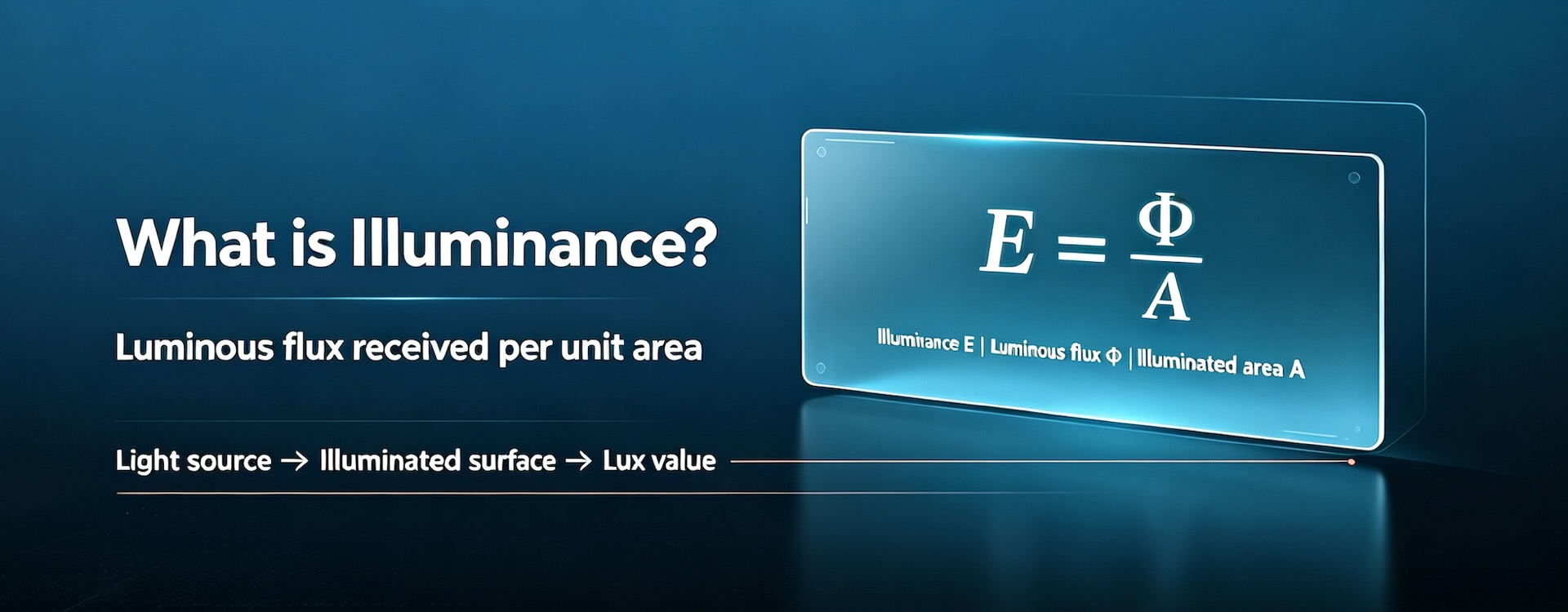
Illuminance is a photometric quantity that describes the amount of luminous flux received per unit area.
In simple terms:
Illuminance tells us how much light actually reaches a surface.
For example, if the same LED luminaire is positioned close to a desk, the desk usually receives more light and therefore has higher illuminance. If the luminaire is moved farther away, less light reaches the desk and illuminance decreases.
This means that illuminance is not a fixed characteristic of the lamp itself.
The same light source can produce completely different illuminance values at different locations.
For example:
● The working plane directly beneath a luminaire usually has higher illuminance;
● Locations farther away from the luminaire usually receive lower illuminance;
● Equipment, walls or other objects may create shadows and reduce illuminance;
● The angle at which light reaches the working plane also affects the result.
For this reason, lighting performance cannot be evaluated only from lamp wattage or luminous flux. Actual illuminance at the working plane must also be considered.
Why Is Illuminance Measured in Lux?
The SI unit of illuminance is the lux (lx).
Lux is directly related to luminous flux, which is measured in lumens (lm):
1 lx = 1 lm/m²
This means that when 1 lumen of luminous flux is distributed uniformly over an area of 1 square metre, the average illuminance is 1 lux.
For example, under ideal uniform conditions, if 1000 lm is distributed over:
● 1 m² → average illuminance of 1000 lx;
● 2 m² → average illuminance of 500 lx;
● 10 m² → average illuminance of 100 lx.
This shows that, with the same total luminous flux, a larger illuminated area generally results in lower illuminance per unit area.
In real lighting systems, however, light is rarely distributed perfectly uniformly. Luminaire optics, distance, incidence angle, surface reflections and obstructions all influence the actual illuminance.
How Is Illuminance Calculated?
Under ideal conditions where luminous flux is distributed uniformly across a surface, average illuminance can be expressed as:
E = Φ / A
Where:
● E = illuminance, in lux (lx);
● Φ = luminous flux reaching the target surface, in lumens (lm);
● A = illuminated area, in square metres (m²).
The formula describes the basic relationship between illuminance, luminous flux and area.
If the luminous flux reaching the surface remains constant:
● A smaller illuminated area produces higher average illuminance;
● A larger illuminated area produces lower average illuminance.
In real environments, luminaires have specific light-distribution characteristics and light often reaches the surface from different directions. Practical calculations may therefore also consider distance, angle of incidence, luminous intensity distribution and reflected light.
For routine field inspection, illuminance is usually measured directly at the working plane with a digital lux meter rather than calculated from multiple lighting parameters.
What Factors Affect Illuminance?
Illuminance is determined by several interacting factors rather than by lamp power or luminous flux alone.
Light Output
Under otherwise identical conditions, a light source with greater effective luminous flux can generally provide higher illuminance.
However, higher luminous flux does not mean that every point in a room will increase by the same amount. Light distribution is also important.
Distance Between the Source and the Surface
Distance has a major influence on illuminance.
As the measurement point moves farther from the source, the emitted light spreads over a larger area and illuminance normally decreases.
This is why illuminance should be measured at the actual working position. When assessing office lighting, for example, the sensor should be placed at the work plane rather than close to the luminaire.
Angle of Incidence
When light reaches a surface more directly, more of the incident light is concentrated on a given area.
As the light becomes more oblique, the same light is distributed over a larger surface area and the illuminance decreases.
This is also why professional lux meters require good cosine response.
Luminaire Light Distribution
Different luminaires distribute light differently.
For example:
● Spotlights concentrate light over a smaller area;
● Floodlights distribute light more broadly;
● Panel lights are designed for relatively uniform area lighting;
● High-bay luminaires are designed for elevated mounting in industrial environments.
Two luminaires with the same luminous flux can therefore produce different illuminance distributions.
Surface Reflections
Walls, ceilings, floors and furniture reflect part of the light and influence final illuminance within a space.
For example:
● Light-coloured surfaces generally reflect more light;
● Dark surfaces absorb more light;
● Highly reflective materials can increase overall room illuminance.
Lighting design therefore considers both luminaires and room characteristics.
Obstructions and Environmental Conditions
Machinery, shelving, partitions, people and architectural structures can all create shadowed areas.
Where daylight is involved, illuminance can also change with time of day, weather, window orientation and shading systems.
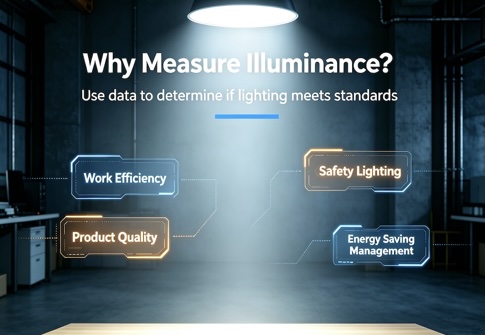
Why Is Illuminance Important?
Appropriate illuminance does not mean “the brighter, the better.” The objective is to provide suitable lighting for the visual task.
Visual Comfort
Insufficient illuminance can make text, components and fine details more difficult to see and may increase visual strain.
Excessive illuminance combined with reflections or glare can also reduce visual comfort.
Good lighting therefore requires suitable illuminance together with consideration of uniformity, glare, colour temperature and colour rendering.
Work and Learning Environments
Offices, schools and laboratories require lighting appropriate to their visual tasks.
Reading documents, using computers, performing experiments and inspecting fine objects may require different lighting conditions.
Industrial Production and Quality Inspection
In machining, electronics assembly, PCB inspection, quality control and precision manufacturing, operators often need to identify small components, markings, defects or surface features.
Insufficient working-plane illuminance can increase visual difficulty and the risk of operational errors.
Workplace Safety
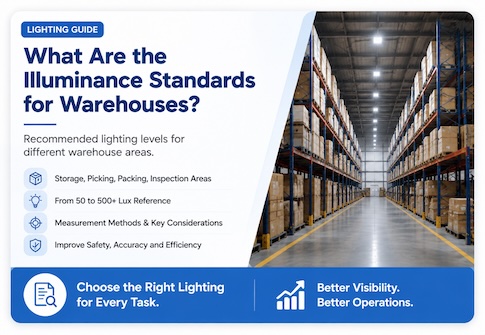
Warehouses, workshops, maintenance areas, passageways and other industrial environments require sufficient lighting so that equipment, obstacles, safety markings and working areas can be clearly identified.
Suitable illuminance is therefore an important part of workplace safety management.
Energy-Efficient Lighting
Illuminance that is too low may fail to meet operational requirements, while consistently excessive illuminance may waste energy.
Actual illuminance measurements provide useful data for luminaire adjustment, lighting retrofits and energy-management projects.
How Does Illuminance Differ from Luminous Flux, Luminous Intensity and Luminance?
These quantities describe different aspects of light.
| Parameter | What It Describes | Unit |
|---|---|---|
| Luminous Flux | Total visible light emitted by a source | lm |
| Luminous Intensity | Light emitted in a specific direction | cd |
| Illuminance | Light received by a surface | lx |
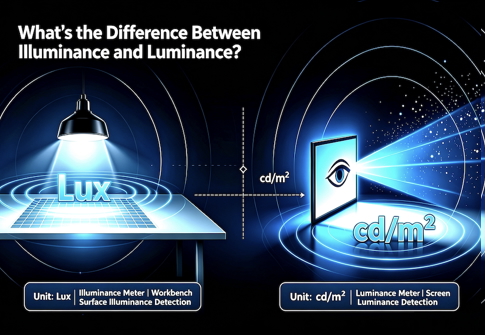
| Luminance | Light emitted or reflected by a surface in a particular direction | cd/m² |
In simple terms:
● Luminous flux: how much visible light the source emits in total;
● Luminous intensity: how much light is emitted in a particular direction;
● Illuminance: how much light reaches the target surface;
● Luminance: the directional light-emission or reflection characteristic of a surface.
A luminaire may have constant luminous flux, while illuminance on a desk decreases as the luminaire is moved farther away.
Likewise, two surfaces can have the same illuminance but different luminance because their colours and reflectance characteristics are different.
These quantities should therefore not be used interchangeably in professional lighting measurements.
How Should Common Illuminance Levels Be Interpreted?
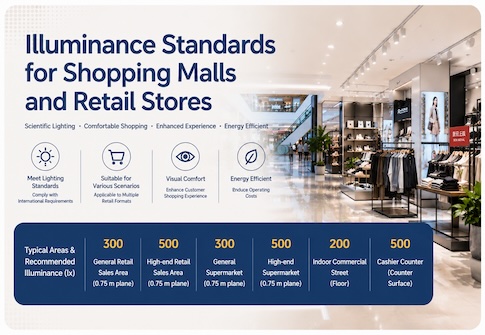
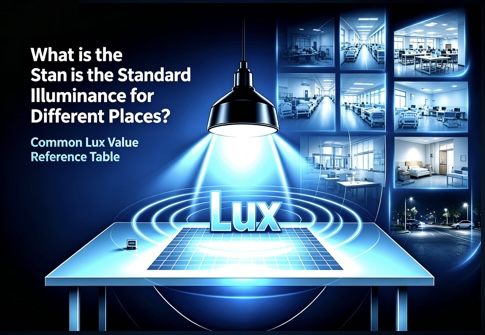
Different environments and visual tasks require different illuminance levels. The following values are provided only to illustrate typical differences and should not be treated as project design or acceptance criteria.
| Example Environment | Typical Reference Illuminance |
|---|---|
| Road at night | Approx. 5–30 lx |
| Residential living room | Approx. 100–300 lx |
| General office | Approx. 300–500 lx |
| Classroom | Approx. 300–500 lx |
| Medical examination area | Approx. 500–1000 lx |
| Precision assembly | Approx. 750–1500 lx |
| High-illuminance photography or professional tasks | May exceed 1000 lx |
Actual project requirements should be determined according to the specific space, visual task, intended use and applicable lighting standards.
Even within a factory, for example, warehousing, rough machining, general assembly and precision inspection may require very different illuminance levels.
A single lux value cannot therefore represent every application.
How Is Illuminance Measured?
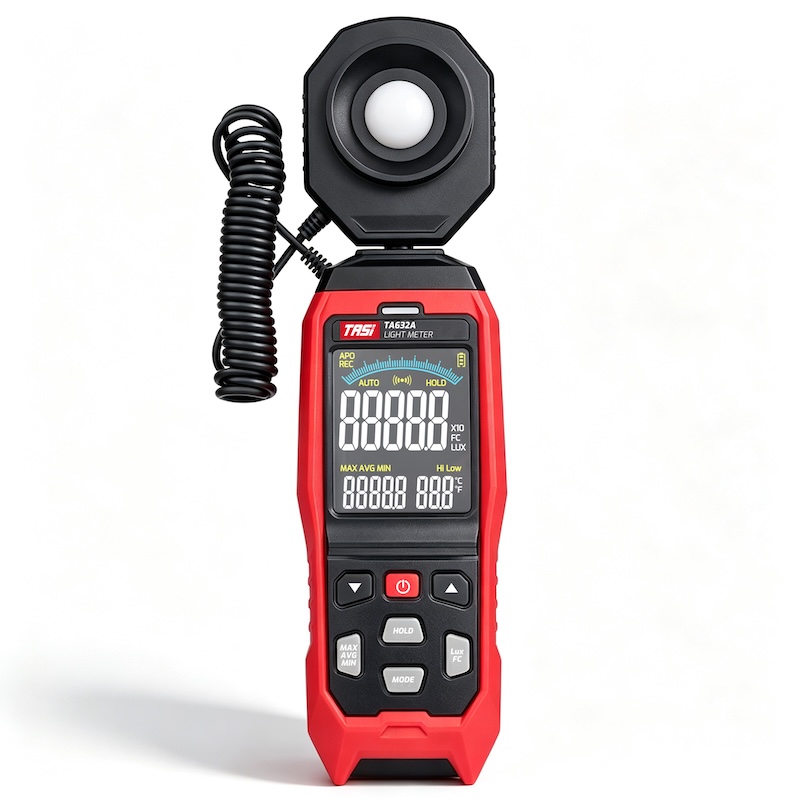
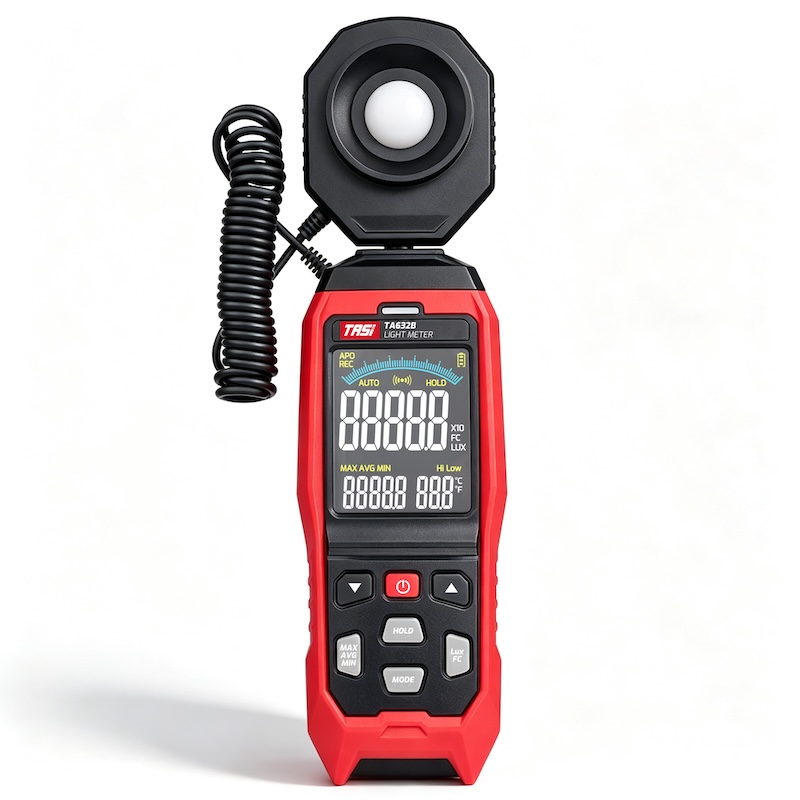
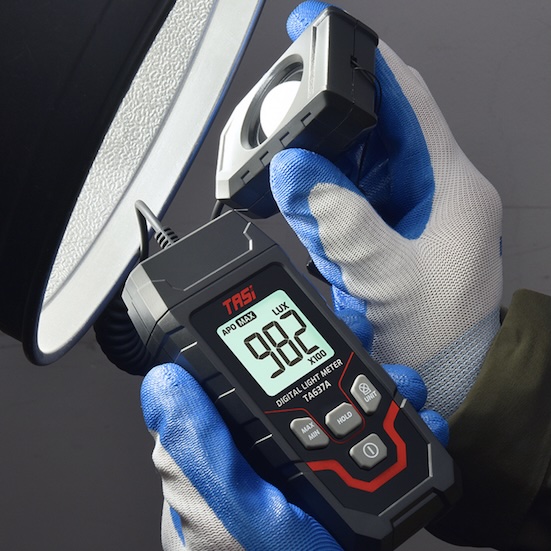
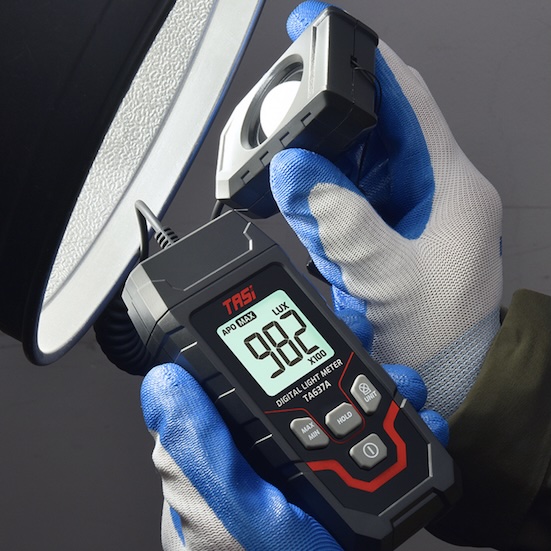
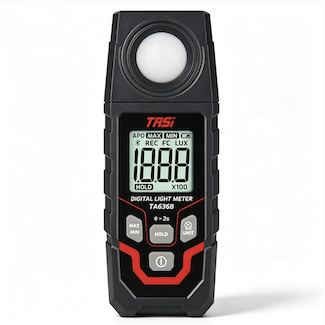
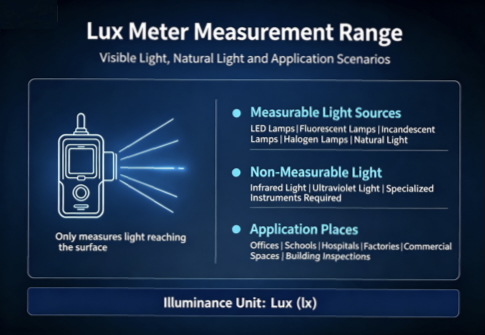
The most common instrument for field illuminance measurement is a digital lux meter.
A digital lux meter uses a light-sensitive sensor to detect visible light. The optical signal is converted into an electrical signal, processed and calibrated, and then displayed as an illuminance value in lux.
A typical measurement procedure includes:
● Place the sensor at the actual measurement location;
● Set the sensor orientation according to the required measurement plane;
● Avoid shading the sensor with the operator, instrument or nearby objects;
● Allow the reading to stabilize;
● Record the measurement;
● For large areas, measure at several representative points and calculate average illuminance when required.
Professional lux meters generally use spectral correction so that the sensor response approximates the photopic luminous efficiency function V(λ). Cosine correction is also used to improve performance for light arriving at different angles.
Depending on the model, digital lux meters may also provide:
● Auto-ranging;
● Data Hold;
● MAX/MIN recording;
● Data logging;
● USB data transfer;
● Bluetooth connectivity;
● PC software analysis.
For routine inspection, correct sensor placement and consistent measurement practice are usually more important than the number of additional functions.
What Should Be Considered When Measuring Illuminance?
Illuminance measurement appears simple, but sensor position, orientation and the surrounding environment can directly influence the result.
Measure at the Actual Working Plane
The measurement plane should match the intended use.
For example:
● Offices are generally assessed at desk or work-plane level;
● Classrooms commonly focus on student desk level;
● Industrial areas should be measured at the actual task or inspection plane;
● Vertical work surfaces require the sensor to be oriented accordingly.
Avoid Shading
The operator should avoid standing between the light source and sensor. Shadows from the body, hands or instrument can reduce the measured value.
Use a Consistent Measurement Method
When comparing different locations or measurements taken at different times, keep the measurement height, orientation, position and environmental conditions as consistent as possible.
Use Multiple Measurement Points
A single measurement cannot represent the entire space.
For offices, classrooms, workshops and warehouses, several representative points are normally required to evaluate overall lighting and its distribution.
Consider Environmental Changes
Daylight, blinds, doors, windows, other luminaires and human activity can all affect measurements.
Where repeatable comparisons are required, these conditions should be controlled or recorded.
Check and Calibrate the Instrument
For project acceptance, quality control, laboratory measurements and other applications requiring reliable results, lux meters should be inspected and calibrated according to usage frequency, quality procedures and applicable requirements.
FAQ
Is higher illuminance always better?
No. Illuminance should match the visual task and application. Too little light can impair visual recognition, while excessive illuminance combined with glare or reflections can reduce visual comfort and increase energy consumption.
What is the difference between lux and lumen?
Lumen (lm) measures luminous flux—the total amount of visible light emitted. Lux (lx) measures illuminance—the luminous flux received per unit area. 1 lx = 1 lm/m².
Why does the same lamp produce different lux readings at different positions?
Because illuminance changes with distance, incidence angle, luminaire distribution, reflections and obstructions.
Are illuminance and luminance the same?
No. Illuminance describes how much light reaches a surface, while luminance describes the light emitted or reflected by a surface in a specific direction.
Where should office illuminance be measured?
Normally at the actual working plane, such as desk height, using representative measurement points according to the applicable method or project requirements.
Can a smartphone replace a professional lux meter?
A smartphone may be useful for rough comparisons, but its sensor, spectral response, cosine response and calibration are generally not designed for professional illuminance measurement. Professional measurements should use a suitable lux meter.
Can LED lighting be measured with a lux meter?
Yes. However, LED spectra vary considerably. For demanding measurements, the spectral matching performance of the lux meter relative to V(λ) should be considered.
Can lux alone be used to evaluate plant lighting?
Lux is based on human visual sensitivity. For professional horticultural lighting, parameters such as PAR and PPFD may also be required.
Conclusion
Illuminance describes how much light actually reaches a surface and is measured in lux (lx). It depends not only on luminous flux but also on distance, incidence angle, luminaire distribution, reflections and obstructions.
Illuminance does not simply describe how “bright” a lamp is. It is used to evaluate the actual amount of useful light reaching working planes and target areas.
By using a digital lux meter at the correct measurement position and orientation—and by taking measurements at several representative points—users can objectively assess lighting conditions and obtain reliable data for lighting design, commissioning, maintenance and energy optimization.