Introduction
In offices, factories, schools, hospitals, commercial buildings, photography studios, and horticultural lighting applications, specifications such as “300 Lux,” “500 Lux,” or “1,000 Lux” are frequently used to describe required lighting levels. Lux is the unit used to quantify how much light actually reaches a particular surface.
However, Lux does not indicate how much light a lamp emits in total. The same light source can produce significantly different Lux readings depending on measurement distance, angle, and position.
Understanding Lux helps users interpret lighting specifications, assess illumination on work surfaces, and perform field measurements correctly with a digital lux meter. This article explains the definition of Lux, its relationship with lumens, the main factors that influence illuminance, and practical measurement methods.
Key Takeaways
After reading this article, you will understand:
● What Lux (lx) means;
● Why Lux is used to express illuminance;
● The relationship between Lux and Lumen;
● Why distance and illuminated area affect Lux;
● Typical Lux levels for common environments;
● How to measure Lux with a digital lux meter;
● Which factors can influence Lux readings.
What Is Lux?
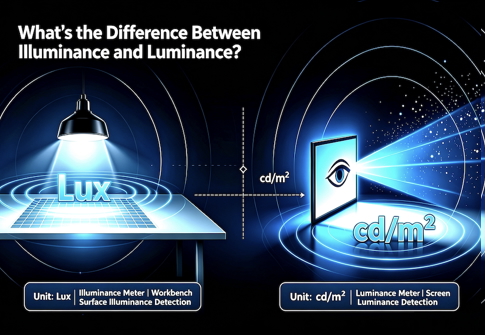
Lux, symbol lx, is the International System of Units (SI) unit of illuminance.
Illuminance describes the amount of luminous flux received by a surface. In practical terms, Lux indicates “how much light reaches this location,” rather than how much light the source emits overall.
For example, if the same lamp illuminates a desk from a relatively short distance, more light usually reaches each unit of surface area and the Lux reading is higher. As the distance from the lamp increases, the light spreads over a larger area, so less light reaches each unit area and the Lux value generally decreases.
Lux is therefore an important parameter for describing actual lighting levels on work surfaces, floors, desks, and other target areas.
What Is the Definition of Lux?
Lux is directly related to luminous flux, which is measured in Lumen (lm):
1 lx = 1 lm/m²
This means that when one lumen of luminous flux is uniformly distributed over one square meter, the average illuminance is one Lux.
Under simplified conditions where the light is evenly distributed:
Illuminance (Lux) = Luminous Flux (Lumen) ÷ Illuminated Area (m²)
For example, if 1,000 lm of luminous flux is evenly distributed over different areas:
| Luminous Flux | Illuminated Area | Average Illuminance |
|---|---|---|
| 1,000 lm | 1 m² | 1,000 lx |
| 1,000 lm | 2 m² | 500 lx |
| 1,000 lm | 5 m² | 200 lx |
| 1,000 lm | 10 m² | 100 lx |
This shows that, with the same luminous flux and uniform distribution, increasing the illuminated area reduces the average Lux level.
In real lighting environments, however, illuminance is also affected by luminaire distribution, distance, angle of incidence, reflections, and obstructions. For this reason, actual Lux values are normally measured with a lux meter rather than estimated solely from the lumen rating of a lamp.
What Is the Difference Between Lux and Lumen?
Lux and Lumen are both common photometric terms, but they describe different quantities.
| Item | Lux (lx) | Lumen (lm) |
|---|---|---|
| Quantity | Illuminance | Luminous Flux |
| Describes | Light reaching a surface | Total visible light emitted by a source |
| Depends on Measurement Position | Yes | No |
| Depends on Illuminated Area | Yes | No |
| Typical Measurement Method | Digital Lux Meter | Integrating Sphere or Photometric Equipment |
A simple way to understand the difference is:
Lumen describes how much light a source emits, while Lux describes how much of that light reaches a particular surface.
For example, two lamps may both be rated at 1,000 lm, but different mounting heights, beam angles, or optical distributions can result in very different Lux levels on the working plane.
Therefore, when evaluating whether a desk, production bench, or classroom work surface is sufficiently illuminated, Lux is generally more relevant than the lumen rating alone.
Why Does Lux Change with Distance?
As light travels away from a source, it spreads over a larger area. Measurement distance is therefore one of the main factors affecting illuminance.
Under otherwise similar conditions, moving the measurement point farther away from the light source generally reduces the amount of light received per unit area, causing the Lux value to decrease.
For a source that can approximately be treated as a point source, and where reflections are negligible, illuminance may decrease rapidly as distance increases. In real indoor environments, however, luminaire optics, wall and ceiling reflections, multiple light sources, and fixture design all affect this relationship.
This is why illuminance measurements should specify the measurement height, plane, and test position. Data collected under consistent conditions are far more useful for comparison.
What Factors Affect Lux?
In addition to the light output of the source itself, several factors influence actual illuminance.
Distance
As the measurement point moves farther from the light source, less light generally reaches each unit area and the Lux value decreases.
Angle of Incidence
Light striking a work surface directly and light arriving at an oblique angle can produce different illuminance levels. The orientation of the sensor can also directly affect the measurement result.
Luminaire Light Distribution
Even if two luminaires have the same lumen output, different beam angles and optical distributions can produce very different illuminance patterns.
Obstructions
People, equipment, furniture, or other objects may block the light and create shadows, reducing local Lux levels.
Environmental Reflections
Walls, ceilings, floors, and equipment surfaces can reflect light. Light-colored surfaces generally contribute more reflected light to the space.
Light Source Condition
Lamp aging, power fluctuations, dimming settings, and flicker can all cause changes in measured illuminance.
These factors demonstrate that Lux is closely related to both the measurement position and the actual lighting environment.
How Much Lux Is Typically Required in Different Environments?
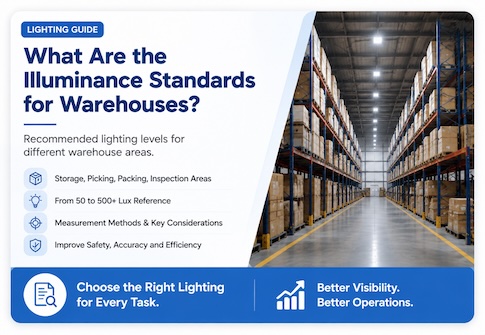
Different visual tasks require different illuminance levels. General circulation areas normally require lower levels, while reading, assembly, inspection, and precision work generally require higher illuminance.
The following values provide a general reference for understanding typical lighting levels:
| Application | Typical Illuminance Range |
|---|---|
| Corridors and Circulation Areas | 50–100 lx |
| Residential Living Rooms | 100–300 lx |
| Office Areas | 300–500 lx |
| Meeting Rooms | 300–500 lx |
| Classrooms | 300–500 lx |
| General Examination Areas | Around 500 lx |
| Laboratories | 500–1,000 lx |
| Precision Assembly | 750–1,500 lx |
| Fine Electronics Manufacturing and Inspection | 1,000 lx or higher |
| Photography and Professional Lighting | Defined according to shooting requirements |
These values are intended to illustrate typical illuminance levels and should not be treated as universally applicable mandatory limits. Actual lighting design, inspection, and acceptance criteria should follow applicable local standards, industry requirements, and the specific visual task.
How to Measure Lux with a Digital Lux Meter
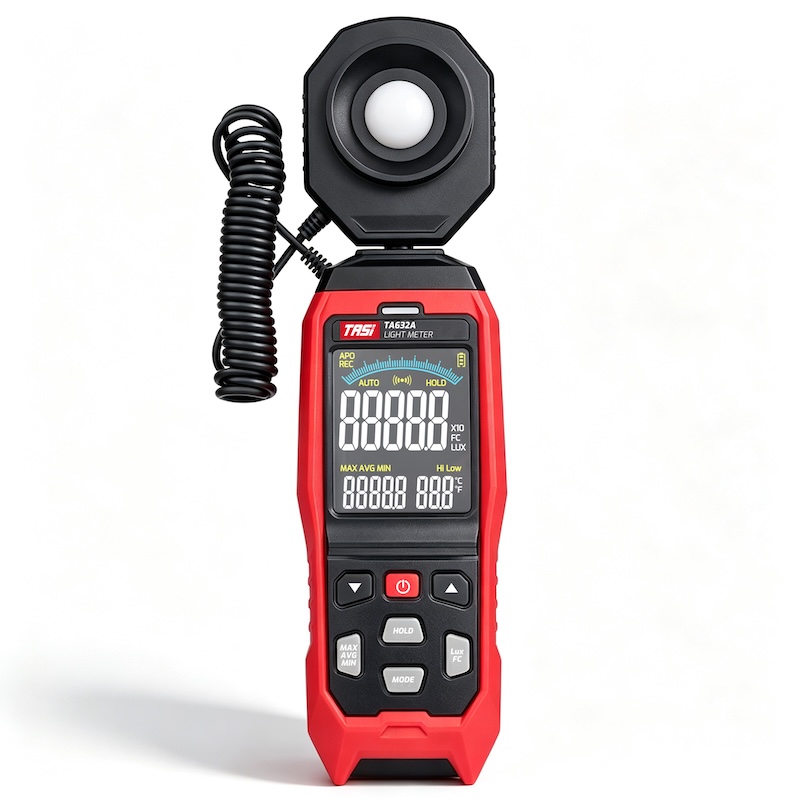
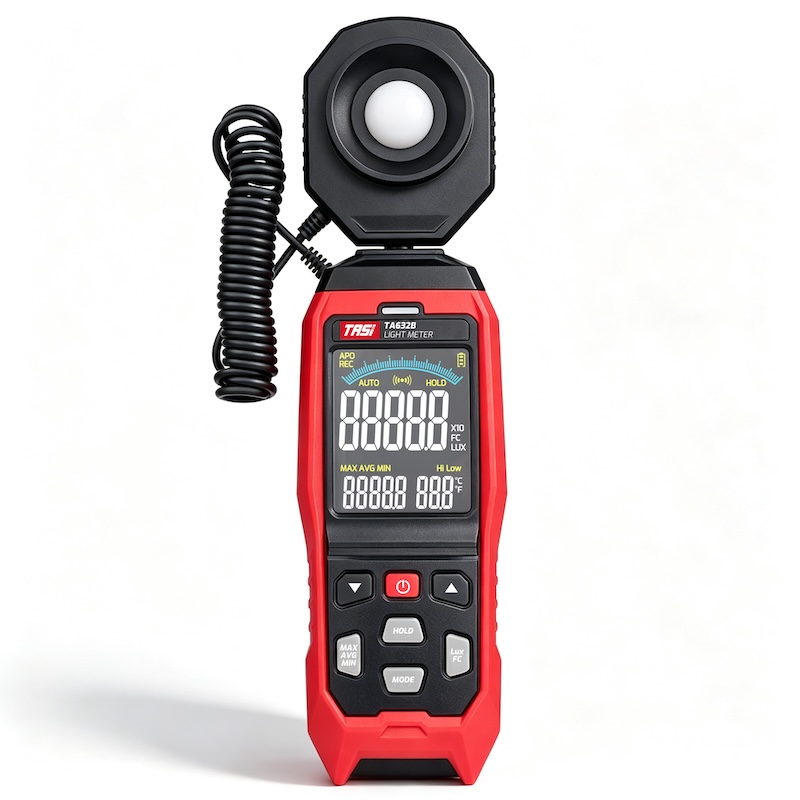
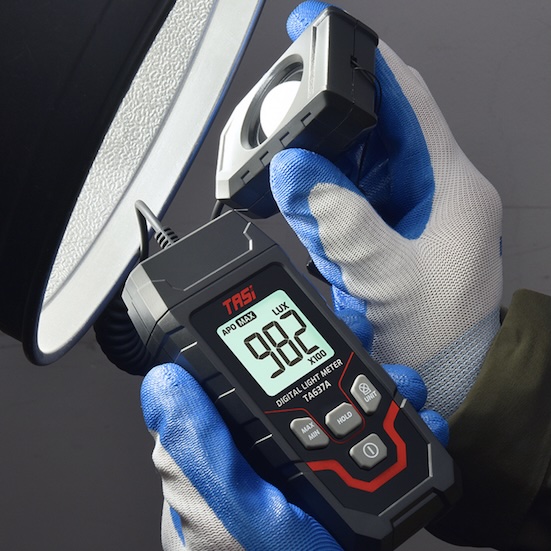
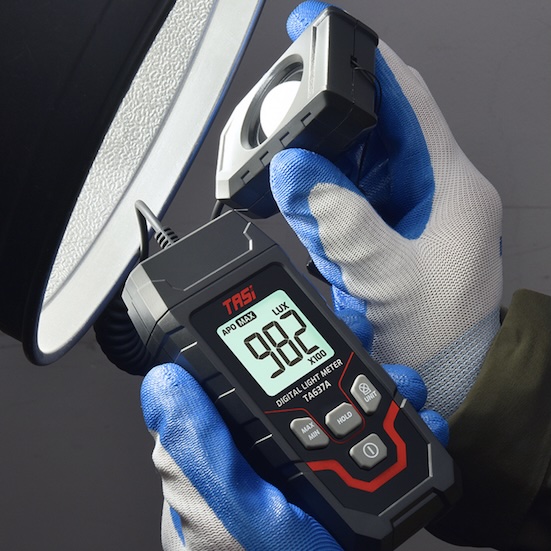
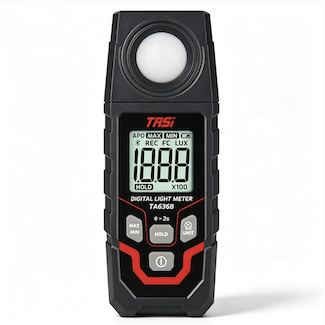
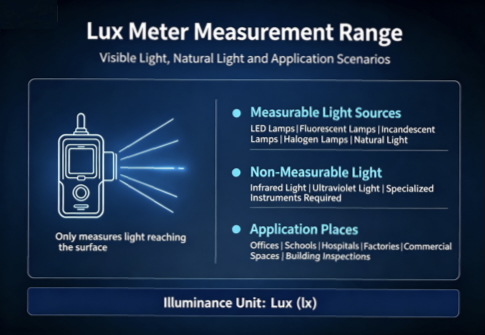
Lux is normally measured directly with a digital lux meter. The instrument uses a light sensor to detect visible light and converts the signal into an illuminance reading in Lux.
For general illuminance measurements:
● Turn on the digital lux meter and confirm that it is operating correctly;
● Select the Lux unit and an appropriate measurement range if required;
● Position the light sensor at the actual point to be evaluated;
● Align the sensor surface with the specified measurement plane—for a horizontal work surface, the sensor normally faces upward;
● Avoid blocking the light with your body, hands, or nearby objects;
● Wait for the reading to stabilize, then record the result;
● For larger areas, take measurements at multiple points and calculate average illuminance when required.
For example, when evaluating office lighting, taking only one reading directly beneath a luminaire is not sufficient. Multiple measurement points across the actual working area provide a more representative assessment of overall illumination.
Why Are Lux Readings Different Within the Same Room?
Illuminance is rarely completely uniform throughout a room.
Areas directly beneath luminaires may have higher Lux values, while locations between fixtures, near corners, behind equipment, or farther from the light sources may have lower values. Daylight from windows, reflected light from walls, and furniture or equipment can also change the illuminance distribution.
For this reason, a single Lux reading represents only the illumination at that specific measurement point and cannot fully describe the entire room.
In larger spaces such as offices, factories, warehouses, and schools, multiple measurement points are normally used. Average illuminance, minimum illuminance, and illuminance uniformity may also be considered when evaluating overall lighting performance.
Is Higher Lux Always Better?
A higher Lux value means that more light reaches the measured surface, but this does not necessarily mean that the lighting quality is better.
Each environment and visual task has an appropriate illuminance range. Insufficient illuminance may make reading, identification, and precision work more difficult, while excessive illuminance can increase energy consumption and may be associated with glare or unwanted reflections.
Good lighting design should consider more than Lux alone:
● Whether illuminance is suitable for the visual task;
● Whether lighting is sufficiently uniform;
● Whether glare is adequately controlled;
● Whether color temperature and color rendering are appropriate;
● Whether the lighting system balances visual comfort and energy efficiency.
Lux is therefore an important lighting parameter, but it is not the only measure of lighting quality.
Why Is Lux Important in Lighting Measurement?
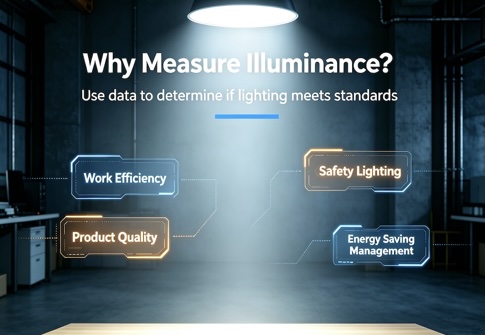
Lux directly indicates the illuminance actually available on a work surface or target area. It is therefore widely used in architectural lighting, industrial production, commercial spaces, schools, healthcare facilities, laboratories, and environmental measurement.
Lux measurements can help determine:
● Whether work-surface illuminance meets design requirements;
● The actual lighting performance after luminaires have been installed;
● Whether significant differences exist between different areas;
● How lighting performance changes as luminaires age or after system adjustments;
● Whether lighting equipment needs to be added, reduced, or repositioned.
Compared with simply checking lamp wattage or lumen output, on-site Lux measurement provides a much more direct indication of actual lighting conditions. For this reason, digital lux meters are widely used in lighting inspection and engineering maintenance.
FAQ
1. Are Lux and Lumen the same unit?
No. Lumen (lm) represents luminous flux emitted by a light source, while Lux (lx) represents illuminance received by a surface. One Lux equals one lumen per square meter.
2. How many lumens equal 1 Lux?
Lux and lumens cannot be directly converted without considering area. Under uniform illumination, one lumen distributed over one square meter produces an average illuminance of one Lux.
3. Why does the same lamp produce different Lux readings at different positions?
Distance, angle, luminaire distribution, reflections, and obstructions all affect the amount of light reaching a surface. Different measurement points can therefore produce different Lux values.
4. Does a higher Lux value mean the lamp has a higher lumen output?
Not necessarily. Lux also depends on distance, illuminated area, beam angle, light distribution, and measurement position. Lumen output cannot be determined from a Lux reading alone.
5. Can actual Lux be calculated directly from the lumen rating of a lamp?
Only as an approximation under simplified conditions such as uniform light distribution. In real installations, distribution, distance, reflections, and obstructions affect illuminance, so actual measurements are normally taken with a lux meter.
6. Must the sensor of a digital lux meter always face upward?
No. The sensor should be aligned with the measurement plane being evaluated. For a horizontal desk or work surface it normally faces upward; for a vertical surface, it should be positioned according to that plane.
7. Is one Lux measurement enough for an entire room?
Usually not when the purpose is to evaluate the lighting of the whole space. Larger areas should be measured at multiple points to assess average illuminance and lighting distribution.
8. Does higher Lux always mean better lighting quality?
No. Good lighting also depends on uniformity, glare control, color rendering, color temperature, and energy efficiency. Meeting the required illuminance level is only one part of lighting quality.
Conclusion
Lux (lx) is the international unit of illuminance and describes how much light actually reaches a unit area. It is closely related to Lumen, but the two parameters describe different quantities: Lumen represents luminous flux emitted by a source, while Lux represents the illuminance received by a target surface.
Lux is affected by light output, distance, illuminated area, light distribution, angle of incidence, obstructions, and environmental reflections. As a result, the same lamp can produce significantly different Lux values at different positions.
Understanding Lux helps users interpret lighting specifications, evaluate real lighting performance, and establish suitable measurement procedures. Multi-point measurements with a digital lux meter provide reliable illuminance data for lighting design, commissioning, maintenance, and environmental assessment.