Introduction
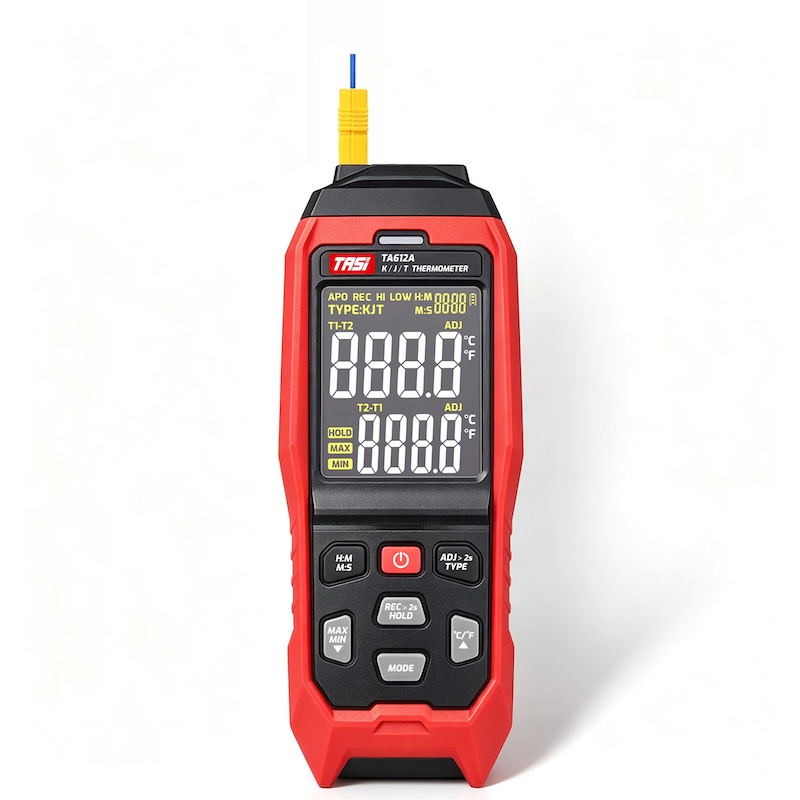
Thermocouples installed on machinery, pipes, furnaces and industrial processes are not always supplied with the exact lead length required for the application. As a result, users often ask whether thermocouple wire can simply be cut shorter or extended when it is too short.
The answer is yes, thermocouple wire can generally be shortened or extended, provided it is done correctly.
A thermocouple does not measure temperature from wire resistance. Instead, it produces a thermoelectric voltage generated by two dissimilar conductors. If the conductor materials remain appropriate for the thermocouple type, their thermoelectric characteristics remain uniform and the polarity is maintained, changing the wire length alone does not normally alter the fundamental temperature-to-voltage relationship.
Problems arise when an extension introduces the wrong conductor material, reversed polarity, poor connections or additional junctions between dissimilar metals at different temperatures. These conditions can create unwanted thermoelectric voltages and introduce measurement error.
Key Points
● Thermocouple lead wire can usually be shortened if the sensing junction, probe construction and insulation are not damaged;
● Thermocouple wiring can also be extended, but the extension or compensating cable must match the thermocouple type;
● K, J, T and E thermocouples use different conductor combinations and their extension cables are not interchangeable;
● Ordinary copper wire should generally not be used as a direct thermocouple extension;
● Correct polarity must be maintained throughout the complete circuit;
● For long cable runs, loop resistance, electromagnetic interference, insulation quality and ambient temperature should also be considered;
● Extension-grade thermocouple cable is intended to carry the thermocouple signal and should not automatically be treated as sensing-junction material.
Can Thermocouple Wire Be Shortened?
Yes.
For thermocouples with flexible lead wires, excess cable can normally be cut away and the remaining conductors connected to the instrument or fitted with an appropriate thermocouple connector.
Because thermocouple measurement is based on thermoelectric voltage rather than conductor resistance, shortening the lead wire does not normally cause a direct accuracy change as long as the conductor materials and electrical connections remain correct.
However, it is important to distinguish between the flexible lead and the actual sensing probe.
● Flexible thermocouple lead wire behind the probe can usually be shortened and re-terminated;
● Mineral-insulated or metal-sheathed probe sections should not be cut without understanding their internal construction;
● The measuring junction at the sensing end must never be removed accidentally;
● Probes with molded connectors, sealed transitions, transmitters or integrated electronics should not be modified without confirming the manufacturer's design;
● After re-termination, polarity, insulation and terminal integrity should be checked.
In other words, "shortening a thermocouple" normally means adjusting an approved lead-wire section rather than arbitrarily cutting the complete probe assembly.
Can Thermocouple Wire Be Extended?
Yes, but extending a thermocouple requires more care than shortening it.
A thermocouple produces a relatively small millivolt-level signal. Any additional cable becomes part of the measurement circuit, which means it cannot be treated in the same way as ordinary power or switch wiring.
The normal solution is to use thermocouple extension wire or compensating cable matched to the thermocouple type.
For example, a Type K thermocouple should be extended with cable intended for Type K thermocouples. Type J, T and E thermocouples likewise require the appropriate matching cable.
Thermocouple-grade wire may be used as part of the actual sensing circuit and, depending on the application, can also be used for extension. Extension-grade wire, however, is primarily designed to transmit the thermocouple signal between the sensor and the thermometer, controller, recorder or data acquisition system. Its permissible temperature range and performance specification may differ from those of thermocouple-grade sensing wire.
Why Is Ordinary Copper Wire Generally Not Recommended for Extension?
This is one of the most common thermocouple wiring mistakes.
For most thermocouple types, neither conductor is ordinary copper. Type K, for example, uses two specific nickel-based alloys, while Types J, T and E use other defined conductor combinations.
If ordinary copper wire is inserted into the thermocouple circuit, new junctions are created where the thermocouple conductors meet the copper wire.
If these new junctions are at different temperatures, they may generate additional thermoelectric voltages. The measuring instrument can then receive a signal that no longer represents only the intended sensing-junction and reference-junction temperature relationship.
For this reason, a thermocouple installation should maintain the correct thermoelectric material system by using suitable extension wire, compensating cable and thermocouple connectors.
Why Must the Thermocouple Type Be Matched When Extending the Cable?
Different thermocouple types have different thermoelectric characteristics.
Types K, J, T and E are not merely different product names. Each uses a specific pair of conductor materials and has its own voltage-versus-temperature characteristic.
If Type J or Type T extension wire is inserted into a Type K circuit, additional dissimilar-metal junctions are introduced. When these junctions are exposed to temperature gradients, measurement error can result.
Correct practice includes:
● Identify the original thermocouple type, such as K, J, T or E;
● Use extension or compensating cable specified for the same thermocouple type;
● Confirm positive and negative polarity;
● Use connectors designed for the corresponding thermocouple type;
● Operate the extension cable within its specified temperature range.
Wire color codes can also differ between IEC, ANSI and other conventions. Polarity should therefore not be identified by color alone unless the applicable color-code standard is known.
Does Shortening or Extending Thermocouple Wire Affect Accuracy?
When carried out correctly, moderate shortening or extension does not necessarily cause a significant measurement error.
The length change itself is usually less important than errors introduced during the modification.
Typical causes include:
● Using the wrong type of extension cable;
● Reversing thermocouple polarity;
● Loose, oxidized or contaminated connections;
● Creating unnecessary dissimilar-metal junctions;
● Routing the cable close to high-current conductors, motors or variable-frequency drives;
● Excessive loop resistance caused by very long or very thin conductors;
● Damaged insulation, leakage or unintended grounding;
● Multiple junctions exposed to different ambient temperatures.
For normal short-distance temperature measurement, thermocouple lead resistance is often not the primary error source. As cable length increases or conductor size decreases, however, total loop resistance rises and susceptibility to electromagnetic interference may also increase.
The acceptable cable length therefore depends on conductor size, thermocouple material, instrument input characteristics and the electrical environment.
What Should Be Considered for Long Thermocouple Cable Runs?
In industrial furnaces, process equipment, HVAC systems, manufacturing lines and remote data acquisition systems, the distance between the thermocouple and the measuring instrument may extend to tens of metres or more.
In these applications, it is not sufficient to consider only whether the cable can physically be extended.
● Use extension or compensating cable suitable for the thermocouple type and with an appropriate conductor size;
● Avoid routing thermocouple cables parallel and close to motor power cables, VFD output cables and other high-current conductors;
● In electrically noisy environments, twisted-pair or shielded thermocouple cable may be appropriate;
● Check the allowable sensor circuit resistance or input requirements of the measuring instrument;
● Minimize unnecessary intermediate junctions;
● Keep connections secure, clean, insulated and protected against moisture;
● For very long distances, severe interference or demanding accuracy requirements, consider installing a temperature transmitter close to the sensor and converting the millivolt signal to a more robust transmission signal.
There is therefore no single universal maximum thermocouple cable length. The practical limit depends on loop resistance, instrument design, electromagnetic conditions and installation quality.
Recommended Procedure for Shortening or Extending Thermocouple Wire
When modifying thermocouple lead length, follow these basic principles:
● First identify the thermocouple type, such as K, J, T or E;
● Before cutting, confirm that the selected section is an adjustable lead-wire section rather than the sensing junction or sealed probe structure;
● When extending, use extension or compensating cable specified for the original thermocouple type;
● Maintain correct positive and negative polarity throughout the circuit;
● Use suitable thermocouple connectors or appropriate terminals;
● Ensure that all joints are mechanically secure and properly insulated against moisture and damage;
● Do not use ordinary copper cable unless the measurement system has specifically been designed for that connection arrangement;
● After modification, compare the reading with a stable reference temperature or reference thermometer when practical.
For laboratory measurements, critical industrial processes or high-temperature applications, system verification after wiring modification is strongly recommended.
FAQ
● Does a thermocouple need recalibration after the wire is shortened?
Not necessarily. Correctly shortening the lead does not automatically require recalibration. However, if connectors or joints have been remade, or if the application has demanding accuracy requirements, a verification check is advisable.
● Can ordinary copper wire be connected directly to a Type K thermocouple?
It is generally not recommended. A Type K thermocouple should normally be extended with compatible Type K extension or compensating cable to avoid unwanted thermoelectric junction effects.
● Is a shorter thermocouple cable always more accurate?
No. A shorter cable may reduce some resistance and interference risks, but overall measurement accuracy also depends on thermocouple tolerance, instrument accuracy, cold-junction compensation, installation method, ambient conditions and connection quality.
● Can thermocouple cable be extended indefinitely?
No fixed universal limit applies, but unlimited extension is not practical. Increasing cable length increases loop resistance and may increase susceptibility to electrical noise. The instrument specification and installation environment should always be considered.
● Can thermocouple extension wire be used to make the sensing junction?
Generally, this should be avoided unless the cable is specifically specified for that purpose. Extension-grade cable is primarily intended for signal transmission and may have a lower allowable temperature range or different tolerance than thermocouple-grade sensing wire.
● What happens if thermocouple polarity is reversed?
Reversed polarity can cause abnormal temperature response. When the sensing junction is hotter than the reference junction, the displayed value may decrease or become clearly incorrect. Polarity should always be verified after cutting or extending the cable.
Conclusion
Thermocouple wire can generally be shortened or extended to meet installation requirements, but the two operations require different levels of care.
Shortening is normally straightforward when only an approved flexible lead section is removed and the sensing junction, probe construction and polarity remain unchanged.
Extending a thermocouple requires greater attention. Type K, J, T and E thermocouples should use compatible extension or compensating cable, correct polarity and suitable connectors. Ordinary copper wire or mismatched thermocouple materials should not be introduced casually into the measurement circuit.
For long-distance industrial temperature measurement, loop resistance, electromagnetic interference, insulation integrity and instrument input requirements must also be evaluated. The key factor is not the cable length itself, but whether the correct thermoelectric materials, polarity and circuit integrity are maintained throughout the complete measurement system.