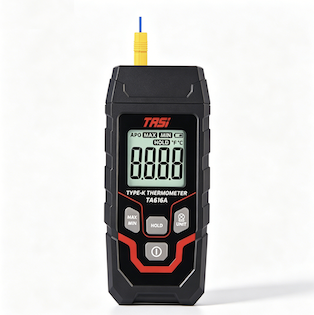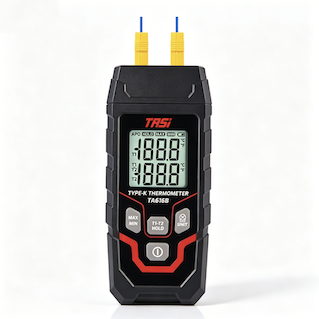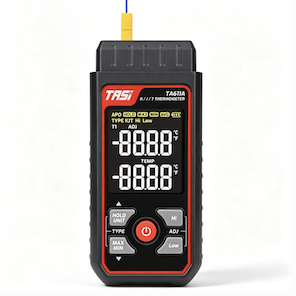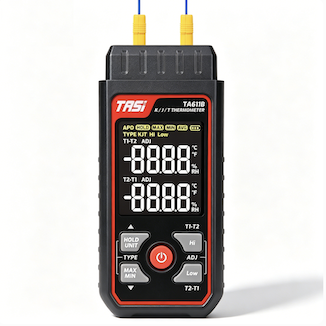
Introduction
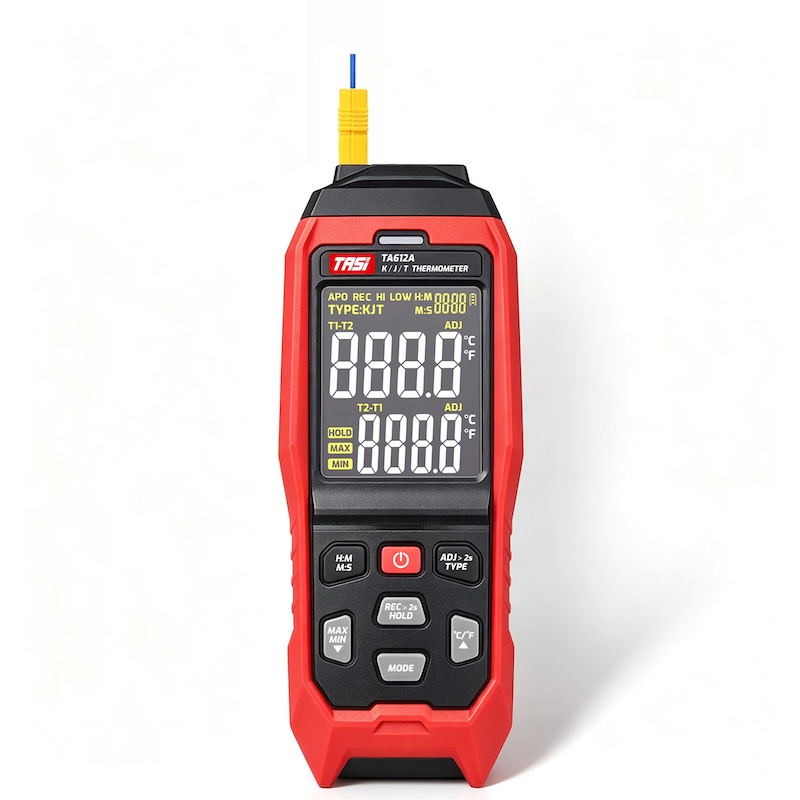
Type K thermocouples are widely used in industrial maintenance, HVAC, laboratories, equipment inspection and process temperature measurement. Because many handheld thermocouple thermometers use similar two-pin connectors, it is easy to assume that any Type K probe can simply be plugged in and used.
That is not always the case.
Whether a Type K thermocouple can be used with a particular thermometer depends on more than physical connector fit. The thermometer must support the Type K temperature–EMF relationship, and the connector format, polarity, measurement range, cold-junction compensation and temperature rating of the probe and cable must also be compatible.
In other words, “it plugs in” and “it measures correctly” are not the same thing.
Key Points
● A Type K thermocouple should not be assumed to work with every thermocouple thermometer;
● The thermometer must explicitly support Type K input or allow the thermocouple type to be set to K;
● Even when Type K is supported, the connector size, interface format and polarity must still match;
● The thermometer range, probe range, cable rating and connector temperature rating must all be suitable for the application;
● On a multi-type thermocouple thermometer, the selected input type must be set to “K” after connecting a Type K probe;
● Using the wrong thermocouple type or an incorrect connection may produce substantial measurement errors or invalid readings.
Why Type K Thermocouples Are Not Universally Interchangeable
A thermocouple thermometer does not directly measure “temperature” at the probe tip. It first measures the small thermoelectric voltage generated by the thermocouple and then converts that voltage into temperature using the characteristic relationship for the selected thermocouple type.
Type K, J, T, E, N and other thermocouples use different conductor materials and have different temperature–EMF characteristics. The thermometer must therefore apply the correct conversion for the thermocouple connected to it.
For example, if a Type K thermocouple is connected to a thermometer configured only for Type J, the connector may physically fit, but the instrument will use the wrong conversion relationship. The displayed temperature cannot then be considered reliable.
The first step is therefore to check the thermometer specification or user manual and confirm that Type K is listed as a supported thermocouple input.
First Confirm That the Thermometer Supports Type K
Thermocouple thermometers can generally be divided into models designed for a single thermocouple type and models that support multiple thermocouple types.
● Type K-only thermometers: These are designed specifically for Type K input and can normally be used with a compatible Type K probe;
● Multi-type thermocouple thermometers: These may support K, J, T, E, N, R, S or other types. After connecting a Type K probe, the instrument must be set to Type K;
● Thermometers that do not support Type K: A Type K thermocouple should not be used, even if the connector appears to fit.
For multi-channel instruments, also verify the thermocouple setting for each channel. A Type K probe connected to a channel still configured for another thermocouple type can produce incorrect readings.
A Connector That Fits Does Not Necessarily Mean the System Is Compatible
Type K thermocouples are available with standard thermocouple plugs, miniature thermocouple plugs, bare-wire terminations and proprietary connection systems.
After confirming Type K support, the mechanical interface must also be checked.
● Standard and miniature thermocouple connectors are different formats and should not be treated as interchangeable simply because they look similar;
● Some instruments use standardized thermocouple sockets, while others use proprietary connectors or adapters;
● Instruments with bare-wire inputs require correct connection of the positive and negative conductors;
● Any adapter used in the measurement chain should be suitable for Type K thermocouple measurement, not merely provide a mechanical connection.
For higher-accuracy measurements, ordinary metal connectors should not be substituted casually for thermocouple-grade connectors. Additional dissimilar-metal junctions located in a temperature gradient can introduce unwanted thermoelectric voltages and increase measurement error.
Polarity Must Also Be Correct
Thermocouples are polarity-sensitive. The positive and negative conductors must therefore be connected correctly.
If a Type K thermocouple is connected with reversed polarity, the thermoelectric voltage changes direction. When the measuring junction and reference junction are at different temperatures, the thermometer may display a clearly incorrect temperature trend or an abnormal reading.
Thermocouple connectors commonly use pin dimensions, polarity markings or colour coding to identify the conductors. However, colour conventions may differ between standards and regions, so wire colour alone should not be used as the only method of identifying polarity.
The more reliable approach is to follow the “+” and “−” markings on the probe, connector and thermometer, together with the manufacturer's documentation.
The Thermometer and Probe Temperature Ranges Must Both Be Suitable
Type K thermocouples have a broad standardized temperature–EMF reference range, but this does not mean every Type K probe can operate across that entire range.
The actual usable temperature range may be limited by:
● The Type K input range of the thermometer;
● Thermocouple wire material and wire diameter;
● Probe sheath material;
● Junction construction;
● Insulation temperature rating;
● Thermocouple cable temperature rating;
● Connector and plug temperature limits.
For example, a thermometer may offer a wide Type K input range, while the flexible probe connected to it may be rated for a substantially lower maximum temperature.
The usable range of the complete measurement system is therefore determined by its most temperature-limited component, not simply by the maximum display range of the thermometer.
Cold-Junction Compensation Is Part of Compatibility
Thermocouple measurement depends on the temperature difference between the measuring junction and the reference junction. Modern digital thermocouple thermometers therefore normally include cold-junction compensation, or CJC.
When a Type K thermocouple is connected to a correctly designed thermocouple thermometer, the instrument determines the reference-junction temperature near the input terminals and combines this value with the Type K thermoelectric voltage to calculate the measured temperature.
If the receiving device is not designed as a thermocouple input, or if an unsuitable adapter changes the intended thermocouple connection, the fact that the device can measure a voltage does not mean that it can accurately display Type K temperature.
Reliable thermocouple measurement requires both the correct Type K conversion and proper reference-junction compensation.
Probe Suitability Also Depends on the Measurement Environment
Even when the thermometer and Type K thermocouple are electrically compatible, the probe itself may not be suitable for every measurement task.
Air, liquid, pipe-surface, metal-equipment, oven, high-temperature component and fast-changing temperature measurements can require very different probe constructions.
● Surface measurements require a probe designed for effective surface contact;
● Liquid and gas measurements require suitable immersion depth and response characteristics;
● High-temperature applications require adequate sheath, insulation and cable temperature ratings;
● Measurements on electrically energized or electrically referenced equipment may also require consideration of grounded or ungrounded junction construction and the electrical safety of the instrument input.
The designation “Type K” defines the thermocouple's thermoelectric characteristics. It does not, by itself, define the mechanical construction, operating temperature, safety rating or application suitability of the complete probe.
What Happens If the Thermocouple and Thermometer Are Mismatched?
A mismatch does not always result in no reading. In many cases, the instrument still displays a temperature, but the value is incorrect.
● Incorrect thermocouple type setting: May cause a systematic error that changes with temperature;
● Reversed polarity: May produce an abnormal temperature trend or a reading significantly different from the actual temperature;
● Unsuitable connectors or adapters: May introduce additional thermoelectric voltages and measurement error;
● Probe used above its temperature rating: May damage the insulation, sheath or thermocouple itself;
● Thermometer input range exceeded: May cause an over-range indication or prevent normal measurement.
A displayed value alone is therefore not proof that the thermocouple and thermometer are correctly matched.
How to Quickly Check Whether a Type K Thermocouple Can Be Used
Before connecting a new Type K thermocouple, check the following:
● Confirm that the thermometer specification lists “Type K” or “K” as a supported input;
● If multiple thermocouple types are supported, set the instrument to Type K;
● Check that the thermocouple plug and thermometer socket use the same connector format and size;
● Verify correct polarity;
● Compare the allowable temperature ranges of the thermometer, probe, cable and connector;
● Confirm that the probe construction is suitable for the object and environment being measured;
● For higher-accuracy applications, verify the system using a known temperature point or a calibrated reference source.
Only when these conditions are satisfied can the Type K thermocouple and thermometer be considered properly compatible for practical measurement.
FAQ
● Can I use a Type K thermocouple simply because the thermometer has a thermocouple socket?
Not necessarily. The thermometer must explicitly support Type K input. Some instruments are designed only for specific thermocouple types, even when the connector looks similar.
● The Type K plug fits correctly. Why is the temperature still inaccurate?
Possible causes include an incorrect thermocouple type setting, reversed polarity, operation outside the probe's temperature range, unsuitable connectors or adapters, or probe error and ageing.
● Can I freely switch between K, J, T and E probes on a multi-type thermometer?
Usually yes, provided the thermometer supports those types. However, the thermocouple type setting must be changed whenever the probe type is changed, and connector compatibility, polarity and measurement range must also be checked.
● Can Type K thermocouples and thermometers from different manufacturers be used together?
In many cases, yes. Brand is not the primary compatibility criterion. If both follow the appropriate Type K temperature–EMF relationship and the connector, polarity, range and connection method are compatible, they can normally be used together. Overall measurement accuracy still depends on the combined uncertainty of the thermometer, probe and connection system.
● If Type K thermocouples can measure high temperatures, why are some Type K probes rated for only a few hundred degrees?
Type K identifies the thermocouple type, not the maximum temperature rating of a specific probe assembly. The sheath, insulation, cable and connector may impose lower temperature limits, so the specified operating range of the actual probe must always be followed.
Conclusion
A Type K thermocouple should not be assumed to work with every thermocouple thermometer.
The thermometer must support Type K input, and the connector format, polarity, measurement range, cold-junction compensation, probe construction and operating environment must also be suitable.
When using a multi-type thermocouple thermometer, the input must additionally be configured for Type K.
The key question is therefore not simply whether the plug fits, but whether the thermocouple type, instrument input, connection method and measurement conditions are compatible as a complete measurement system. Only then can the resulting temperature data be considered reliable.