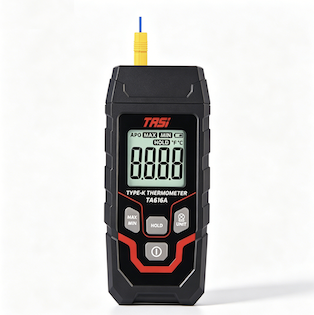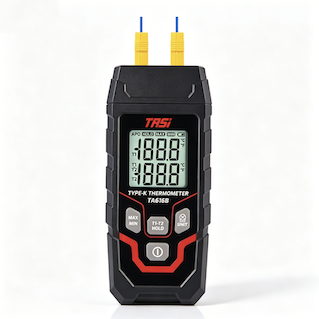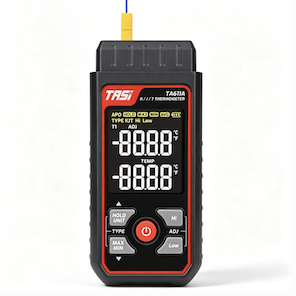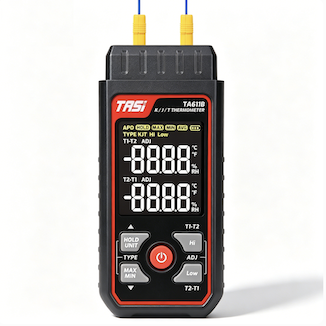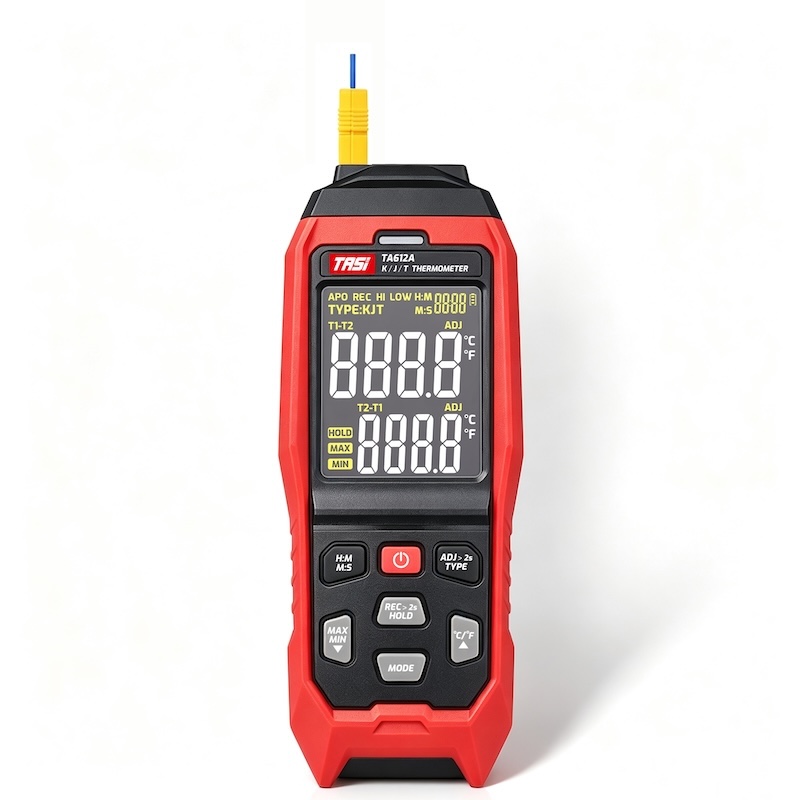
Introduction
When reviewing thermocouple thermometer specifications, it is common to see both an instrument “measurement range” and a thermocouple probe “temperature range.” Although both are expressed in °C or °F, they describe different limitations.
In simple terms, the thermometer measurement range describes the range of thermocouple signals and corresponding temperatures the instrument can process and display, while the probe temperature range describes the temperatures the probe itself is designed to withstand and measure.
Therefore, even if a thermocouple thermometer is specified for measurements up to 1300°C, this does not mean that every compatible probe can be used continuously at 1300°C.
The actual usable range of the complete system is determined by the thermometer, thermocouple type, and probe construction together.
Key Points
● A thermocouple thermometer measurement range is primarily determined by its input circuitry, supported thermocouple types, cold-junction compensation, and internal conversion algorithms.
● A thermocouple probe temperature range depends not only on the thermocouple wire material, but also on the sheath, insulation, probe head, lead wires, connectors, and other components.
● Two probes using the same K-type thermocouple can have very different allowable temperature ranges.
● The actual usable temperature range of the complete system normally cannot exceed the overlapping range supported by both the thermometer and the probe.
● Product selection should consider the probe’s continuous operating temperature and short-term maximum temperature, not only the thermometer’s maximum displayed temperature.
What Is the Measurement Range of a Thermocouple Thermometer?
The measurement range of a thermocouple thermometer is the temperature interval within which the instrument can receive, convert, and display signals from specified thermocouple types.
For example, a thermometer may specify:
● Type K: -200°C to 1372°C
● Type J: -210°C to 1200°C
● Type T: -250°C to 400°C
These specifications primarily describe the input range that the instrument electronics can process for each supported thermocouple type.
A thermocouple generates a small thermoelectric voltage related to the temperature difference between its measuring junction and reference junction. The thermometer measures this voltage, applies cold-junction compensation, and converts the result into temperature using the appropriate thermocouple voltage-to-temperature relationship.
The instrument measurement range is therefore typically influenced by:
● Supported thermocouple types;
● Thermoelectric voltage range of the input circuit;
● A/D conversion and signal-processing capability;
● Cold-junction compensation system;
● Thermocouple conversion curves or algorithms used by the instrument;
● Hardware and software operating limits specified by the manufacturer.
The key point is that an instrument being capable of calculating and displaying a given temperature does not mean that the connected probe can physically withstand that temperature.
What Is the Temperature Range of a Thermocouple Probe?
The temperature range of a thermocouple probe is the range within which that specific probe can operate properly under its specified conditions.
A complete thermocouple probe consists of more than two thermocouple wires. Depending on its design, it may also include:
● Thermocouple measuring junction;
● Metal sheath;
● Ceramic or mineral insulation;
● Probe handle;
● Compensating or extension cable;
● Connector;
● Sealing materials;
● Protective tubes or other structural components.
For this reason, the maximum usable temperature of a probe is not necessarily the same as the theoretical temperature capability of the thermocouple alloy itself.
A thermocouple alloy may be suitable for relatively high temperatures, but if the finished probe uses a plastic handle, standard cable insulation, or a lower-temperature connector, the allowable operating temperature of the complete assembly may be significantly lower.
This is why different probes labeled as “K-type thermocouple” may have temperature ranges such as -50°C to 300°C, -50°C to 500°C, 0°C to 800°C, or even higher, depending on their design.
Why Is the Thermometer Range Often Wider Than the Probe Range?
A thermocouple thermometer is an electronic measuring instrument. As long as the thermocouple signal remains within the instrument’s designed input range, the thermometer can convert it according to the corresponding thermocouple characteristic.
The probe, however, is placed directly in the measurement environment and may be exposed to heat, thermal shock, oxidation, corrosion, mechanical stress, and other operating conditions.
For example, a thermometer supporting a K-type thermocouple may have an input range of -200°C to 1372°C, while a connected surface probe may only be rated from -50°C to 500°C.
In this case, the fact that the thermometer can display 1000°C does not mean the probe may safely be used at 1000°C.
Exceeding the probe’s specified temperature range can lead to:
● Sheath oxidation or deformation;
● Reduced insulation resistance;
● Changes in thermocouple wire properties;
● Damage to cable insulation;
● Mechanical or structural failure;
● Increased measurement drift;
● Significantly shortened probe life.
In severe cases, the probe may fail completely.
How Do You Determine the Actual Measurement Range of the Complete System?
In practical use, both the thermometer and the probe must be considered.
A useful way to express this is:
Actual usable system range ≈ thermometer-supported range ∩ probe-allowable range
In other words, the usable range is limited to the overlap between the two.
For example:
● Thermometer K-type range: -200°C to 1372°C
● Connected K-type probe range: -50°C to 400°C
The complete system should therefore be used within approximately -50°C to 400°C, rather than the thermometer’s full -200°C to 1372°C range.
Another example:
● Thermometer K-type range: -200°C to 800°C
● High-temperature K-type probe range: 0°C to 1100°C
Although the probe itself can withstand higher temperatures, the thermometer only supports measurements up to 800°C. The effective upper limit of the complete system is therefore still 800°C.
Whichever component has the narrower range may become the limiting factor.
How Is the Thermocouple Type Range Different From the Probe Range?
A third concept also needs to be distinguished: the reference temperature range associated with a thermocouple type itself.
K, J, T, E, N, R, S, and other thermocouple types use different material combinations and therefore have different characteristic temperature ranges.
However, the temperature capability of a thermocouple type does not mean that every finished probe made from that thermocouple type has the same usable range.
The three concepts can be understood as follows:
● Thermocouple type range: the approximate temperature capability of the thermocouple material system;
● Thermometer measurement range: the temperature interval that the instrument can process for that thermocouple type;
● Probe temperature range: the allowable operating range of a specific finished probe.
For actual product selection, always refer to the technical specifications provided by the manufacturers of both the thermometer and the specific probe.
Why Can Two K-Type Probes Have Different Temperature Ranges?
“K-type” identifies the thermocouple material combination, but it does not fully describe the construction of the probe.
Two K-type probes may use the same thermocouple materials yet have substantially different temperature capabilities because of differences in design.
Important factors include:
● Sheath material: Stainless steel and various heat-resistant alloys differ in high-temperature strength, oxidation resistance, and corrosion resistance;
● Sheath diameter: Diameter affects mechanical strength, response time, and temperature capability;
● Insulation material: Mineral, ceramic, and conventional insulation materials have different temperature limits;
● Junction construction: Exposed, grounded, and ungrounded junctions differ in response time, electrical isolation, and suitable applications;
● Cable insulation: PVC, silicone, fiberglass, PTFE, and other materials have different operating temperature limits;
● Handle and connector: Plastic handles and standard connectors usually cannot withstand the same temperatures as the metal sensing section.
For this reason, seeing only the words “K-type thermocouple” is not sufficient to determine the maximum usable temperature of a probe.
Are Continuous Operating Temperature and Short-Term Maximum Temperature the Same?
Not necessarily.
Some thermocouple probe specifications distinguish between continuous operating temperature and short-term maximum temperature.
The continuous operating temperature is the temperature range within which the probe is designed to operate for extended periods under specified conditions. The short-term maximum temperature may indicate a higher temperature that the probe can withstand only temporarily.
Continuous operation close to or above the rated long-term temperature may accelerate:
● Oxidation of thermocouple wires;
● Changes in material composition;
● Insulation degradation;
● Thermoelectric characteristic drift;
● Sheath corrosion;
● Loss of calibration stability.
For this reason, the specified “maximum temperature” should not automatically be interpreted as a temperature suitable for continuous long-term operation.
Which Temperature Limit Applies When Only Part of the Probe Enters the Hot Zone?
This is an important consideration in practical applications.
Some probes are designed so that only the metal sensing section can enter a high-temperature area, while the handle, lead cable, and connector must remain at substantially lower ambient temperatures.
For example, the metal sheath of an insertion probe may be suitable for several hundred degrees Celsius or more, while its plastic handle must remain outside the hot chamber.
The user should therefore verify:
● Length of the probe section permitted in the high-temperature zone;
● Maximum allowable handle temperature;
● Cable operating temperature;
● Connector temperature limit;
● Any minimum immersion depth or installation requirements specified by the manufacturer.
A probe’s stated “maximum measurement temperature” should not be interpreted as meaning that every part of the probe assembly can be exposed to that temperature.
Does a Wider Measurement Range Mean Better Performance?
No.
Measurement range is only one parameter when selecting a thermocouple thermometer and probe. It does not by itself indicate overall measurement performance.
For the thermometer, other important parameters include:
● Measurement accuracy;
● Resolution;
● Supported thermocouple types;
● Cold-junction compensation performance;
● Sampling rate;
● Number of channels;
● Instrument operating temperature.
For the probe, important factors include:
● Response time;
● Probe diameter;
● Probe length;
● Junction construction;
● Sheath material;
● Corrosion resistance;
● Mechanical strength;
● Suitability for surface, air, liquid, or insertion measurements.
For example, when measuring rapidly changing surface temperatures between 0°C and 200°C, a fast-response surface probe may be much more suitable than a heavy high-temperature probe rated to 1000°C.
How Should You Select the Thermometer and Probe for the Required Temperature?
Start by determining the actual operating temperature range of the application rather than considering only one expected temperature point.
For example, if equipment normally operates at approximately 350°C but process fluctuations may reach 420°C, the probe should not be selected with 350°C as its upper limit.
Next, confirm that the thermometer supports the intended thermocouple type and that its measurement range covers the application.
Then check the specific probe specifications for:
● Continuous operating temperature;
● Short-term maximum temperature;
● Maximum allowable temperature of the sensing section;
● Handle and cable ambient temperature limits;
● Sheath material and compatibility with the measurement medium.
Whenever possible, normal operating temperatures should remain comfortably within the probe’s rated operating range rather than continuously approaching its limit. This generally improves measurement stability and probe service life.
Common Selection Mistakes
● Assuming that because a thermometer supports 1300°C, any compatible K-type probe can also measure 1300°C;
● Checking only the thermocouple type without verifying the actual probe construction and temperature rating;
● Treating the short-term maximum temperature as the continuous operating temperature;
● Considering only the metal probe stem while ignoring handle, cable, and connector temperature limits;
● Assuming that all K-, J-, or T-type probes have the same temperature range;
● Selecting the widest possible temperature range while ignoring response time, accuracy, and suitability for the measurement application.
The correct approach is not simply to choose the product with the widest temperature range, but to ensure that the thermometer, thermocouple type, probe construction, and operating environment are properly matched.
FAQ
If a thermocouple thermometer displays up to 1372°C, does the probe also have to measure up to 1372°C?
No. The 1372°C value may only represent the instrument’s specified upper input limit for a particular thermocouple type. The allowable temperature of the actual probe depends on its sheath, insulation, cable, connector, and construction.
Why can two K-type thermocouple probes have different temperature ranges?
Because K-type defines the thermocouple material combination only. Sheath material, diameter, insulation, handle, cable, and junction construction all affect the allowable temperature range of the finished probe.
If the probe range is wider than the thermometer range, can the system measure up to the probe’s maximum temperature?
No. The system cannot exceed the measurement range of the thermometer. If a probe is rated to 1100°C but the thermometer supports only up to 800°C, the complete system remains limited to 800°C.
Will exceeding the probe temperature range immediately damage the probe?
Not necessarily, but it may cause oxidation, insulation degradation, material drift, increased measurement error, or reduced service life. Operation beyond the specified range is generally outside normal operating conditions.
When selecting a thermocouple thermometer, should I choose the thermometer or the probe first?
Both must be considered. A practical approach is to first define the measurement temperature range, medium, and installation method, then select a suitable thermocouple type and probe, and finally confirm that the thermometer fully supports the required measurement range.
Conclusion
The “measurement range” of a thermocouple thermometer and the “temperature range” of a thermocouple probe describe different performance limits.
The thermometer measurement range mainly indicates the temperature interval that the instrument can receive, calculate, and display for a specified thermocouple type. The probe temperature range defines the temperatures at which the actual probe can operate safely based on its thermocouple materials, sheath, insulation, cable, and construction.
The true usable range of a thermocouple measurement system therefore cannot be determined from the thermometer specification or thermocouple type alone. It must be established by considering the thermometer-supported range, the specific probe temperature range, and the actual operating environment together.
Understanding these differences during product selection helps prevent probe overtemperature exposure and supports more stable and reliable temperature measurements.