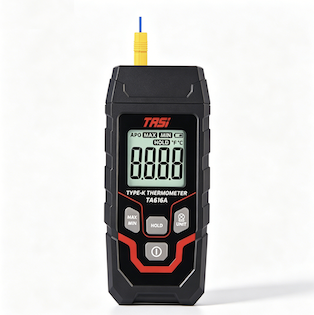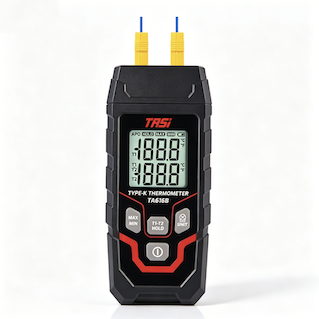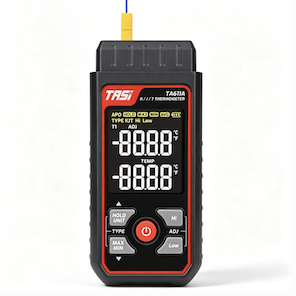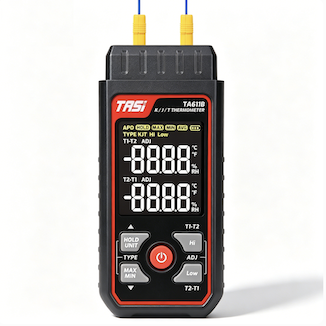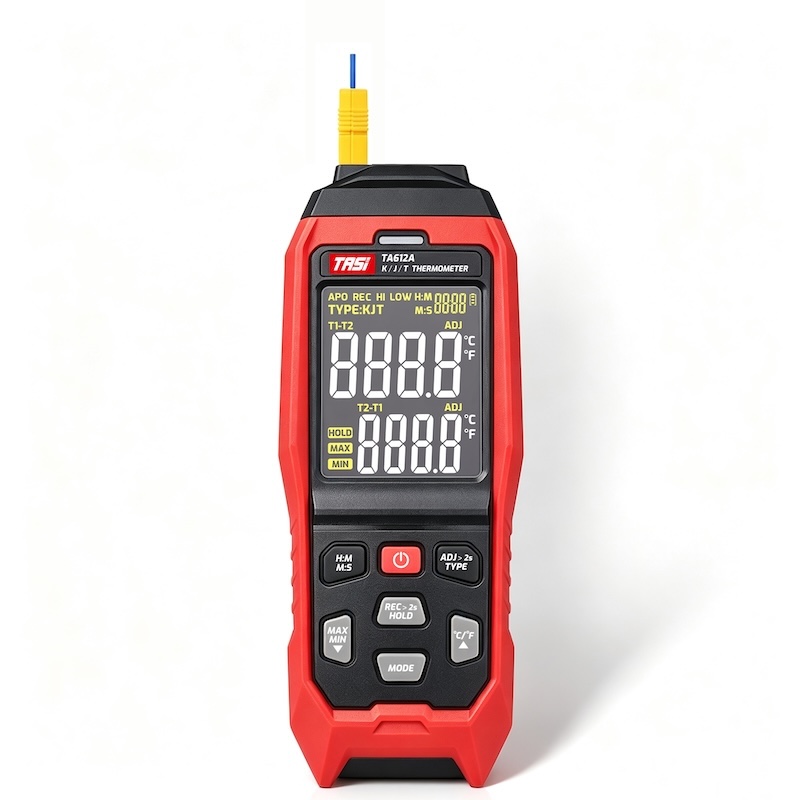
Introduction
K-, J-, T-, and E-type thermocouples all measure temperature using the Seebeck effect. However, the letters do not simply identify different product names. Each designation represents a specific combination of thermoelectric materials.
Because the conductor materials differ, each thermocouple type has its own thermoelectric characteristics, temperature limits, resistance to oxidation, long-term stability, and suitability for specific environments.
For this reason, a K-type thermocouple should not automatically be considered interchangeable with a J-type thermocouple, and T- and E-type thermocouples also have applications in which they are better suited.
Selecting the correct thermocouple type is therefore an essential part of obtaining reliable measurements with a thermocouple thermometer.
Key Points
● K-type thermocouples use nickel-chromium and nickel-aluminium alloys. They are widely used because they combine a broad temperature range with good overall environmental resistance.
● J-type thermocouples use iron and copper-nickel alloy. They are suitable for moderate temperatures, but the iron conductor makes them less suitable for prolonged exposure to humid or highly oxidising environments.
● T-type thermocouples use copper and copper-nickel alloy. They offer good stability at low and moderate temperatures and are commonly used in refrigeration, food processing, and laboratory applications.
● E-type thermocouples use nickel-chromium and copper-nickel alloy. They provide comparatively high thermoelectric output per degree of temperature change.
● Thermocouple type alone does not determine measurement accuracy. Thermocouple tolerance, probe construction, thermometer accuracy, cold-junction compensation, and operating conditions must also be considered.
Main Differences Between K-, J-, T-, and E-Type Thermocouples
The fundamental difference between these thermocouple types is the material combination used for the two thermoelectric conductors.
| Thermocouple Type | Typical Material Combination | Common Engineering Temperature Range | Typical Sensitivity | Main Characteristics |
|---|---|---|---|---|
| K | Nickel-chromium / nickel-aluminium alloy | Approx. -200 to 1200°C | Approx. 41 µV/°C | Wide range, versatile, widely available |
| J | Iron / copper-nickel alloy | Approx. -40 to 750°C | Approx. 55 µV/°C | Suitable for moderate-temperature industrial measurement |
| T | Copper / copper-nickel alloy | Approx. -200 to 350°C | Approx. 43 µV/°C | Good low-temperature stability |
| E | Nickel-chromium / copper-nickel alloy | Approx. -200 to 900°C | Approx. 68 µV/°C | High thermoelectric output |
These values represent common engineering reference ranges rather than guaranteed operating limits for every thermocouple probe.
The actual allowable temperature of a probe also depends on conductor diameter, sheath material, insulation, probe construction, exposure time, and the measurement environment.
Thermocouple sensitivity is also not constant across the entire temperature range. The values shown in µV/°C are representative figures intended to illustrate the relative differences between the thermocouple types.
What Are the Characteristics of a K-Type Thermocouple?
A K-type thermocouple is made from nickel-chromium and nickel-aluminium alloys and is one of the most widely used thermocouple types in industrial temperature measurement.
Its main advantage is its broad temperature range combined with a practical balance of cost, durability, thermoelectric output, and availability. For this reason, many general-purpose thermocouple thermometers support K-type probes.
● Common engineering temperature range of approximately -200°C to 1200°C;
● Typical sensitivity of approximately 41 µV/°C;
● Well suited to clean oxidising or inert atmospheres;
● Available in a wide variety of probe and sheath constructions;
● Commonly used in HVAC, industrial maintenance, heating equipment, moulds, pipework, machinery, and process temperature measurement.
However, a K-type thermocouple is not automatically suitable for every high-temperature application.
At elevated temperatures, particularly in low-oxygen, alternating oxidising/reducing, sulphur-containing, or other demanding atmospheres, changes in the thermoelectric materials can lead to additional drift.
Where there are no special low-temperature, atmosphere, or signal-output requirements, K type is often a practical general-purpose choice.
What Are the Characteristics of a J-Type Thermocouple?
A J-type thermocouple is made from iron and copper-nickel alloy.
Its thermoelectric output is generally higher than that of a K-type thermocouple, but its practical temperature range is narrower.
● Common engineering range of approximately -40°C to 750°C;
● Typical sensitivity of approximately 55 µV/°C;
● Frequently found in older industrial equipment and temperature-control systems;
● Suitable for certain vacuum, inert, and reducing environments;
● Appropriate for moderate-temperature industrial measurement.
A key consideration with J type is that one of the thermoelectric conductors is iron.
Iron is more susceptible to oxidation and corrosion in humid or high-temperature oxidising environments. As a result, J type is generally not the preferred choice for prolonged use in strongly oxidising high-temperature conditions.
This is one reason K-type thermocouples are more common in many modern general-purpose applications.
What Are the Characteristics of a T-Type Thermocouple?
A T-type thermocouple uses copper and copper-nickel alloy.
Its main advantages are found in low- and moderate-temperature measurement applications.
● Common engineering range of approximately -200°C to 350°C, with some configurations extending to around 400°C;
● Typical sensitivity of approximately 43 µV/°C;
● Good stability at low temperatures;
● Both thermoelectric conductor materials are non-ferromagnetic;
● Common applications include refrigeration, cold storage, food processing, low-temperature testing, environmental testing, and laboratory measurement.
When most measurements are below 0°C or are continuously performed at relatively low temperatures, a T-type thermocouple may be more appropriate than simply selecting K type because of its higher maximum temperature capability.
However, the upper-temperature capability of T type is substantially lower than that of K type, so it is not intended as a general high-temperature solution.
What Are the Characteristics of an E-Type Thermocouple?
An E-type thermocouple uses nickel-chromium and copper-nickel alloys.
One of its most important characteristics is its relatively high thermoelectric output.
Among commonly used K-, J-, T-, and E-type base-metal thermocouples, E type generally produces one of the highest thermoelectric voltages per degree of temperature difference.
● Common engineering range of approximately -200°C to 900°C;
● Typical sensitivity of approximately 68 µV/°C;
● Produces a comparatively large voltage change for a given temperature change;
● Uses non-ferromagnetic thermoelectric materials;
● Suitable for low-temperature measurement and applications where relatively high thermoelectric output is desirable.
Higher sensitivity does not mean that an E-type thermocouple is automatically more accurate than a K-, J-, or T-type thermocouple.
Overall measurement accuracy still depends on thermocouple tolerance, probe quality, thermometer input accuracy, cold-junction compensation, and calibration condition.
How Should K-, J-, T-, and E-Type Thermocouples Be Selected?
Thermocouple selection should not be based only on which type has the highest maximum temperature.
The actual measurement conditions should be considered first.
● For a versatile thermocouple covering a wide range of general applications, K type is often the first option to consider;
● If the equipment is designed for J-type input or measurement is mainly within a moderate temperature range, J type may be appropriate;
● For refrigeration, low-temperature, and moderate-temperature applications, T type is often well suited;
● Where relatively high thermoelectric output is desirable, E type may be considered;
● When measurements are performed close to the upper limit of a thermocouple type, conductor diameter, insulation, and sheath temperature ratings must also be checked;
● In corrosive, humid, vacuum, oxidising, reducing, or sulphur-containing environments, material compatibility must be evaluated separately.
Temperature range is therefore only the first step in thermocouple selection. The process medium and operating atmosphere can be equally important.
Why Must the Correct K, J, T, or E Type Be Selected on a Thermocouple Thermometer?
Different thermocouple types generate different thermoelectric voltages at the same temperature.
A thermocouple thermometer converts the measured millivolt signal into temperature using the corresponding voltage-to-temperature relationship for the selected thermocouple type.
If a K-type probe is connected while the thermometer is configured for J type, the instrument will use the wrong conversion characteristic and the displayed temperature may be significantly incorrect.
When using a multi-type thermocouple thermometer, make sure that:
● The thermocouple probe type is correctly identified;
● The thermometer input setting matches the connected probe;
● Thermocouple connectors and extension or compensating cables are compatible with the thermocouple type;
● Polarity is correct;
● The thermometer supports the selected thermocouple type and required temperature range.
Similar-looking connectors do not mean that K-, J-, T-, and E-type probes can be used interchangeably without changing the instrument configuration.
Does Thermocouple Type Determine Measurement Accuracy?
Not by itself.
K, J, T, and E identify the conductor combinations and corresponding thermoelectric characteristics. They are not accuracy classes.
Total measurement error can include contributions from:
● Thermocouple conductor tolerance;
● Thermometer measurement accuracy;
● Cold-junction compensation error;
● Long-term thermocouple drift;
● Thermal contact between the probe and the measured object;
● Incorrect extension cable or connector materials;
● Ambient temperature and electromagnetic interference;
● Probe construction, response characteristics, and heat-conduction effects.
It is therefore incorrect to state simply that “K type is more accurate than J type” or that “E type is the most accurate because it has the highest sensitivity.”
Thermoelectric sensitivity, measurement accuracy, and long-term stability are different characteristics.
Why Do Different Sources Give Different Thermocouple Temperature Ranges?
This is a common issue when comparing thermocouple specifications.
Standard thermocouple reference tables describe the defined relationship between thermoelectric voltage and temperature. Their reference ranges can extend over a very broad temperature interval.
However, whether a real thermocouple probe can operate across that full range depends on its physical construction.
Important factors include:
● Thermocouple wire diameter;
● Metal sheath material;
● Electrical insulation material;
● Probe construction and sealing;
● Continuous versus short-term exposure;
● Process medium and operating atmosphere.
For this reason, the actual operating temperature of a thermocouple probe should always be taken from the specifications of the specific probe rather than inferred solely from the thermocouple letter designation.
FAQ
Can K- and J-type thermocouples be interchanged?
Not directly. They use different conductor materials and therefore generate different thermoelectric voltages at the same temperature. Even if the connector physically fits, the thermometer must be configured for the actual thermocouple type.
Why is K type so widely used?
K type offers a broad temperature range, good overall environmental resistance, widely available probe constructions, and a practical balance between performance and cost.
Should I choose K type or T type for low-temperature measurement?
Both can cover low temperatures. However, T type is often preferred for refrigeration, cold-storage, and other applications focused mainly on low and moderate temperatures. K type offers greater versatility when higher temperatures must also be measured.
Does the higher sensitivity of E type mean it is more accurate?
No. Higher sensitivity means a larger thermoelectric voltage change for a given temperature change. Overall accuracy still depends on thermocouple tolerance, instrument accuracy, cold-junction compensation, and calibration.
Can one thermocouple thermometer use K-, J-, T-, and E-type probes?
It depends on the instrument. Some thermometers support only K type, while multi-type thermocouple thermometers may support K, J, T, E, and other thermocouple types. The input setting must always match the connected probe.
Why does the temperature become incorrect after changing to another thermocouple type?
A common reason is that the thermometer input type was not changed to match the new probe. Incorrect connectors, extension cables, or reversed polarity can also produce incorrect readings.
Conclusion
The main difference between K-, J-, T-, and E-type thermocouples lies in their conductor materials. These material differences determine their thermoelectric characteristics, practical temperature ranges, environmental suitability, and typical applications.
K type offers a broad range and strong general-purpose versatility. J type is suitable for moderate-temperature applications and is still common in certain industrial systems. T type is particularly well suited to low- and moderate-temperature measurement, while E type provides relatively high thermoelectric output.
Thermocouple selection should therefore consider more than maximum temperature. Measurement range, operating atmosphere, probe construction, long-term stability, and compatibility with the thermometer must all be evaluated.
Reliable temperature measurement depends on correct matching between the thermocouple probe, extension or compensating cable, connectors, and the thermometer input type.