Introduction
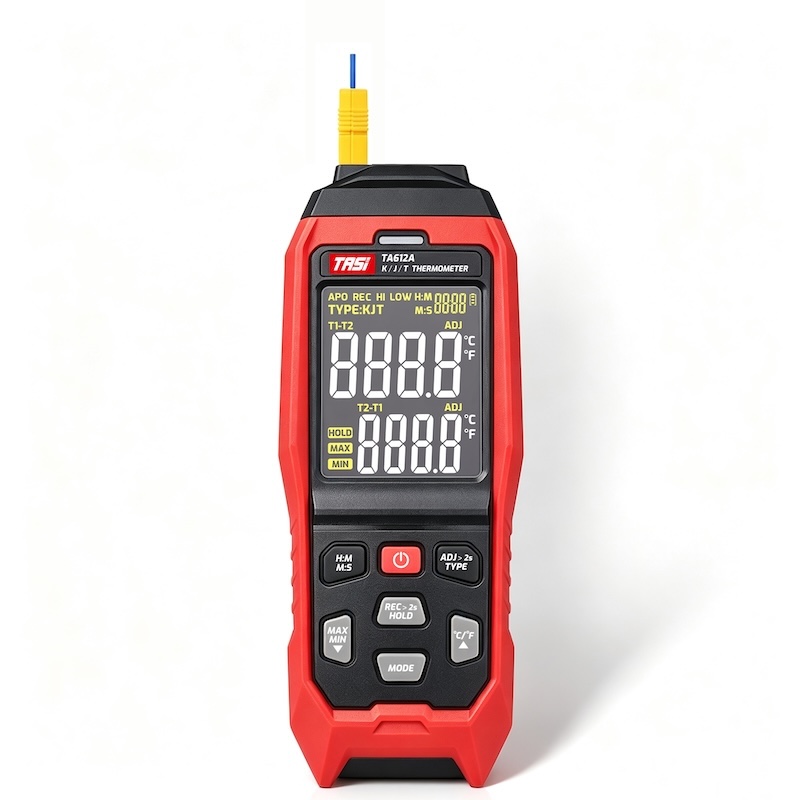
K-type thermocouples are among the most commonly used thermocouple types in temperature measurement. They are widely found in industrial maintenance, HVAC systems, heating equipment, process monitoring, and laboratory testing.
A K-type thermocouple does not directly sense an absolute temperature. Instead, it generates a thermoelectric voltage related to the temperature difference between its measuring junction and reference junction. A thermocouple thermometer or measuring instrument then converts this voltage into a temperature reading.
Because K-type thermocouples combine a broad usable temperature range, good stability, simple construction, and moderate cost, they have become a standard choice for general-purpose temperature measurement.
Key Takeaways
● K-type thermocouples are typically made from two different nickel-based alloys, commonly known as Chromel and Alumel.
● They operate according to the Seebeck effect, generating a thermoelectric voltage that varies with temperature difference.
● The standardized thermoelectric range of a K-type thermocouple is very broad, but the actual usable range depends on probe construction, insulation, sheath material, and application conditions.
● K-type thermocouples are widely used in industrial maintenance, HVAC, heating equipment, machinery, and laboratory testing.
● The thermocouple probe, connector, extension or compensation cable, and measuring instrument must all be compatible with K-type thermocouples.
● Overall system accuracy depends not only on the thermocouple itself, but also on instrument accuracy, cold-junction compensation, wiring, installation, and measurement conditions.
What Is a K-Type Thermocouple?
A K-type thermocouple is a contact temperature sensor made from two dissimilar metal conductors. In English, it is generally referred to as a K-type thermocouple.
The two thermocouple conductors are joined at the measuring end to form a sensing junction. When a temperature difference exists between this measuring junction and the reference end connected to the instrument, a small thermoelectric voltage is generated.
The measuring instrument detects this voltage and converts it into temperature using the standardized voltage-to-temperature characteristics of K-type thermocouples.
The thermocouple sensing element itself does not require an external power supply to generate its measurement signal, which contributes to its simple and robust construction.
What Materials Are Used in a K-Type Thermocouple?
A K-type thermocouple consists of two nickel-based alloys with different thermoelectric properties.
● The positive conductor is typically a nickel-chromium alloy commonly known as Chromel.
● The negative conductor is typically a nickel-based alloy commonly known as Alumel.
When the two conductors form a thermoelectric circuit and the measuring and reference junctions are at different temperatures, a voltage related to that temperature difference is produced.
Ordinary copper wire should not simply be substituted for thermocouple conductors. Introducing dissimilar, incompatible metals into the circuit can create additional thermoelectric junctions. If these junctions are exposed to temperature gradients, they may introduce additional measurement error.
How Does a K-Type Thermocouple Measure Temperature?
The operating principle of a K-type thermocouple is based on the Seebeck effect.
When two dissimilar conductors form a circuit and their junctions are at different temperatures, a thermoelectric voltage is generated. In a K-type thermocouple, this signal is typically in the millivolt range, so a thermocouple thermometer or dedicated measurement circuit is required for accurate detection.
The measurement process can be summarized as follows:
● The thermocouple measuring junction is brought into contact with the target.
● A temperature difference exists between the measuring junction and the instrument connection point.
● The K-type thermocouple generates a corresponding thermoelectric voltage.
● The thermometer measures this small voltage.
● The instrument applies the K-type thermocouple characteristic curve and cold-junction compensation.
● The calculated temperature is then shown on the display.
The thermocouple therefore produces an electrical voltage signal rather than directly outputting a temperature value.
What Is the Temperature Range of a K-Type Thermocouple?
The standardized thermoelectric characteristics of K-type thermocouples cover a very broad range. Reference tables commonly extend from approximately -270°C to +1372°C.
However, this does not mean that every K-type thermocouple probe can operate across this entire range.
The actual allowable temperature range depends on factors such as:
● Thermocouple wire diameter;
● Probe sheath material;
● Insulation material;
● Probe construction;
● Measurement medium;
● Oxidizing, corrosive, reducing, or other environmental conditions;
● Required continuous operating time;
● Input range of the thermocouple thermometer or data acquisition instrument.
For example, a K-type probe using a standard stainless-steel sheath may have a maximum continuous operating temperature significantly below the theoretical upper limit of the K-type thermocouple materials.
For practical selection, always refer to the specified operating temperature range of the actual probe, rather than relying only on the maximum temperature associated with K-type thermocouples in general.
How Accurate Is a K-Type Thermocouple?
K-type thermocouple accuracy is normally specified in terms of tolerance or accuracy class. Permissible error varies according to the applicable standard, temperature range, and thermocouple class.
Under commonly used IEC thermocouple standards, K-type thermocouples are assigned different tolerance classes with corresponding permissible deviations over defined temperature ranges. For a specific probe, the manufacturer's specified accuracy class and operating range should always be checked.
More importantly, total measurement error does not come from the thermocouple probe alone.
Potential sources of error include:
● The tolerance of the K-type thermocouple probe;
● Accuracy of the thermocouple thermometer;
● Cold-junction compensation error;
● Connector and extension or compensation cable errors;
● Insufficient thermal contact between the probe and the target;
● Heat conduction through the probe;
● Ambient temperature changes;
● Long-term thermocouple drift.
For this reason, thermocouple accuracy should not be treated as identical to the final accuracy of the complete temperature measurement system.
Why Does a K-Type Thermocouple Require Cold-Junction Compensation?
The voltage generated by a thermocouple depends on the temperature difference between the measuring junction and the reference junction rather than solely on the temperature of the measuring junction.
In modern thermocouple thermometers, the input terminals are usually at ambient temperature rather than maintained at a fixed 0°C reference temperature. The instrument therefore needs to measure the temperature near its thermocouple input terminals and compensate mathematically for the reference-junction temperature.
This process is known as cold-junction compensation (CJC).
If cold-junction compensation is inaccurate, the displayed temperature can be incorrect even when the K-type probe itself is functioning properly.
A reliable thermocouple thermometer therefore requires both accurate millivolt measurement and stable cold-junction compensation.
What Are the Advantages of K-Type Thermocouples?
K-type thermocouples are widely used because they offer a well-balanced combination of performance and cost.
● Wide temperature range: Suitable for many low-, medium-, and high-temperature applications.
● Fast response: Small-diameter and exposed-junction probes can respond quickly to temperature changes.
● Simple construction: The sensing element consists primarily of two dissimilar metal conductors.
● Flexible probe designs: Available as surface, penetration, air, needle, exposed-junction, and sheathed probes.
● Moderate cost: Suitable for large numbers of general industrial and maintenance applications.
● High compatibility: Supported by many digital thermometers, data loggers, process instruments, and data acquisition systems.
● High-temperature capability: Can operate at temperatures beyond the limits of many thermistors and semiconductor temperature sensors.
These characteristics make K-type thermocouples one of the most common general-purpose temperature sensors used in field and industrial measurement.
What Are the Limitations of K-Type Thermocouples?
Although K-type thermocouples are highly versatile, they are not suitable for every application.
● Their output signal is very small and may be affected by electrical noise and wiring problems.
● Measurement tolerance varies with temperature and is not constant across the entire range.
● Prolonged exposure to high temperatures can lead to oxidation, metallurgical changes, and thermoelectric drift.
● Certain reducing atmospheres, vacuum conditions, or chemically aggressive environments can affect stability and service life.
● Other sensor technologies may provide better performance for very low temperatures or high-accuracy measurements.
● There is often a trade-off between mechanical strength and response time: thicker probes are generally more robust but respond more slowly.
Thermocouple selection should therefore consider temperature range, medium, environmental conditions, required response time, and required accuracy—not just the thermocouple type.
What Types of K-Type Thermocouple Probes Are Available?
K-type thermocouples can be manufactured in many different probe configurations depending on the measurement task.
● Penetration probes: Used for liquids, soft materials, and internal temperature measurements.
● Surface probes: Designed for pipes, metal plates, machinery, and other surfaces.
● Air or gas probes: Used for HVAC ducts, ambient air, airflow, and gas temperature measurements.
● Needle probes: Suitable for small measurement areas or applications requiring penetration.
● Exposed-junction thermocouples: Offer low thermal mass and fast response for laboratory and transient measurements.
● Sheathed thermocouple probes: Provide mechanical protection for industrial environments and more demanding applications.
Even when two probes both use K-type thermocouples, their allowable temperature range, response time, mechanical strength, and service life can differ significantly.
What Applications Are K-Type Thermocouples Used For?
K-type thermocouples are suitable for a broad range of contact temperature measurements.
Typical applications include:
● HVAC supply-air and return-air temperature measurement;
● Air-conditioning, refrigeration, and heating system maintenance;
● Boilers, furnaces, ovens, and heating equipment;
● Motors, bearings, and mechanical equipment;
● Pipes and metal surface temperature measurements;
● Industrial process monitoring;
● Laboratory and research testing;
● Automotive maintenance and engine-related temperature measurements;
● Moulding, plastics processing, and heat-treatment processes;
● Food-processing equipment and other applications requiring contact temperature measurement.
Suitability for a particular application still depends on probe material, temperature range, safety requirements, response time, and environmental conditions.
What Is the Relationship Between a K-Type Thermocouple and a Thermocouple Thermometer?
A K-type thermocouple and a K-type thermocouple thermometer are not the same component.
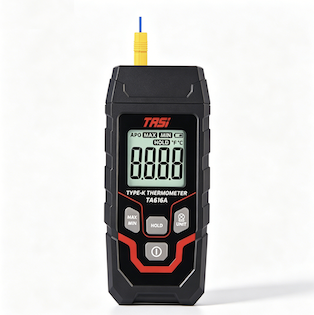
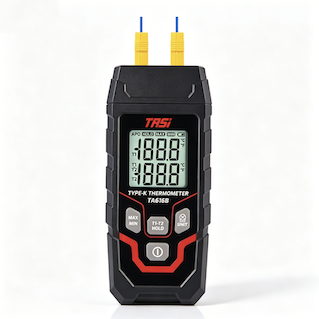
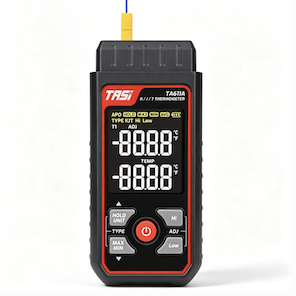
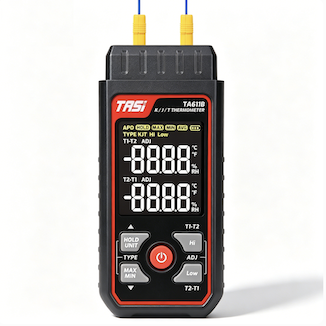
The thermocouple converts a temperature difference into a millivolt-level electrical signal. The thermocouple thermometer receives this signal, applies cold-junction compensation and nonlinear conversion, and then displays the calculated temperature.
A complete measurement system typically includes:
● A K-type thermocouple probe;
● Thermocouple connectors or compatible extension/compensation cable;
● A thermometer that supports K-type thermocouple input;
● Cold-junction compensation circuitry;
● Signal acquisition, conversion, and display electronics.
As a result, the same K-type probe connected to instruments with different accuracy specifications may produce different overall system performance.
What Should You Consider When Using a K-Type Thermocouple?
Reliable temperature measurement requires proper matching between the probe, instrument, connection system, and measurement method.
● Confirm that the thermometer supports K-type thermocouple input.
● Ensure the instrument is set to K-type mode.
● Check that thermocouple polarity is correct.
● Use connectors and extension or compensation cables compatible with K-type thermocouples.
● Do not exceed the specified minimum or maximum temperature of the probe.
● For surface measurements, ensure good thermal contact with the target.
● For penetration measurements, use sufficient insertion depth to reduce stem-conduction error.
● After prolonged high-temperature exposure, consider thermocouple drift and performance degradation.
● In electrically noisy environments, pay attention to cable routing, grounding, and shielding.
● For applications with tighter accuracy requirements, periodic performance verification or calibration is recommended.
Most importantly, a K-type connector does not mean that the probe can withstand the full theoretical temperature range of a K-type thermocouple. The actual limit is determined by the specific probe and instrument specifications.
How Does a K-Type Thermocouple Differ from Other Thermocouple Types?
Other commonly used thermocouple types include J, T, E, N, R, and S.
Each thermocouple type uses a different combination of materials and therefore has different thermoelectric characteristics, temperature ranges, environmental stability, and cost.
The main advantage of K-type thermocouples is their balanced overall performance. They are less expensive than many noble-metal thermocouples while still covering a broad temperature range, making them highly suitable for general-purpose temperature measurement.
For very low temperatures, high-accuracy applications, extremely high temperatures, or specialized chemical environments, another thermocouple type may be more appropriate.
FAQ
What is the maximum temperature of a K-type thermocouple?
Standard K-type thermocouple reference characteristics extend to approximately 1372°C. However, this does not mean that every K-type probe can operate at that temperature. The actual maximum depends on wire diameter, sheath material, insulation, and probe construction. Always follow the probe manufacturer's specification.
Can a K-type thermocouple measure temperatures below 0°C?
Yes. K-type thermocouples can measure sub-zero temperatures. Their standardized characteristics extend to very low temperatures, although actual performance depends on the probe, instrument, and measurement conditions. T-type thermocouples or other sensors may be preferred for some specialized low-temperature or high-accuracy applications.
Does a K-type thermocouple require power?
The thermocouple sensing element itself does not require external power to generate its thermoelectric voltage. However, digital thermometers, display electronics, signal-processing circuits, and data loggers normally require a battery or another power source.
Can a K-type thermocouple be connected directly to a standard multimeter?
A standard multimeter may detect the millivolt signal produced by a thermocouple, but without K-type linearization and cold-junction compensation, the voltage cannot simply be interpreted as an accurate temperature. A dedicated thermocouple thermometer or compatible measuring instrument should normally be used.
Can any K-type probe be used as a replacement?
In general, another compatible K-type probe can be used if the instrument supports K-type input and the connector, polarity, and temperature range are suitable. However, probe construction, accuracy, response time, and maximum operating temperature may differ, so specifications should be checked before replacement.
Why do two K-type thermocouples show different temperatures?
Differences can result from thermocouple tolerance, probe response time, measurement position, thermal contact, instrument accuracy, cold-junction compensation, or probe ageing. A small difference does not necessarily indicate that either probe is defective.
Conclusion
A K-type thermocouple is a contact temperature sensor made from two different nickel-based alloys. Through the Seebeck effect, it converts the temperature difference between the measuring and reference junctions into a thermoelectric voltage, which is then converted into temperature by a thermocouple thermometer.
Its broad temperature range, fast response, simple construction, moderate cost, and wide compatibility make it one of the most commonly used thermocouple types in industrial maintenance, HVAC, machinery, heating processes, and laboratory testing.
In practical applications, it is essential to distinguish between the standardized thermoelectric range of the K-type thermocouple material, the allowable operating range of the specific probe, and the measurement range of the thermometer. Reliable results depend on correct matching of the probe, connection system, cold-junction compensation, and measuring instrument.