Introduction
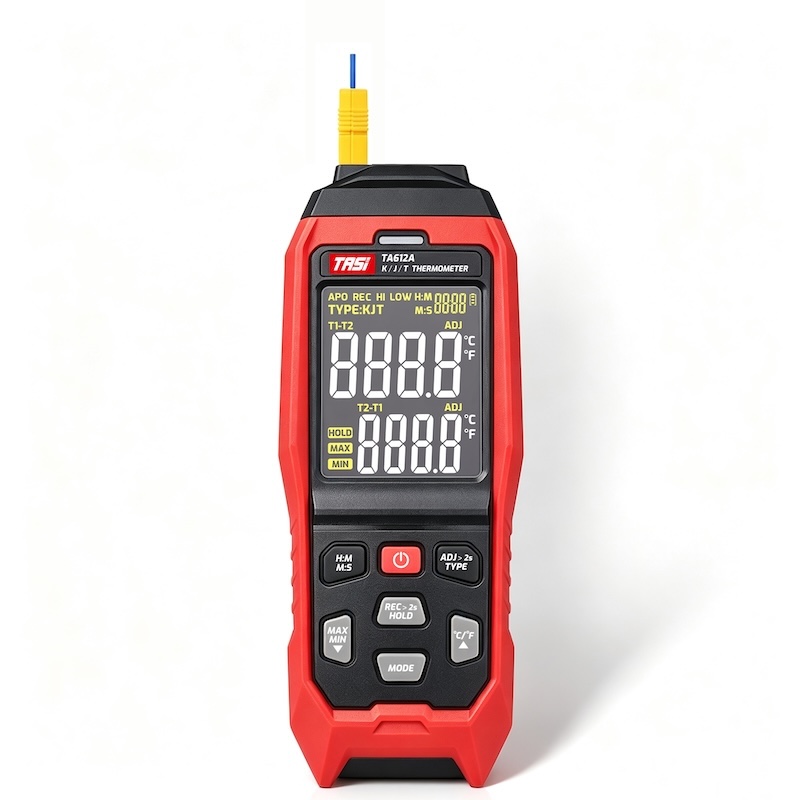
Industrial maintenance, equipment inspection, laboratory testing, and HVAC work often require direct measurement of pipes, metal surfaces, liquids, air, or temperatures inside equipment. Unlike an infrared thermometer, which measures surface temperature from emitted infrared radiation, a thermocouple thermometer normally uses a probe that comes into thermal contact with the measurement target.
A thermocouple thermometer is one of the most widely used electronic temperature measuring instruments. Its sensing element is a thermocouple, which converts a temperature difference into a small electrical voltage. The thermometer then processes this signal, applies cold-junction compensation, converts it into temperature, and displays the result.
Because thermocouples offer a wide measuring range, fast response, simple construction, and many probe configurations, thermocouple thermometers are particularly useful where different probe types or temperature ranges are required.
Key Takeaways
● A thermocouple thermometer is a contact temperature measuring instrument that uses a thermocouple as its sensing element.
● A thermocouple produces a thermoelectric voltage related to the temperature difference between its measuring and reference junctions.
● A typical thermocouple thermometer consists of a thermocouple probe, input connector, signal-conditioning circuitry, cold-junction compensation, temperature conversion, and a display.
● Type K is one of the most widely used thermocouple types, although different thermocouple types are designed for different temperature ranges and applications.
● Different probes can be selected for surface, air, gas, liquid, penetration, and high-temperature measurements.
● Overall measurement accuracy depends not only on the meter but also on probe accuracy, thermal contact, cold-junction compensation, ambient conditions, and response time.
What Is a Thermocouple Thermometer?
A thermocouple thermometer is a temperature measuring instrument that uses a thermocouple sensor and displays the resulting temperature digitally or through another readout system.
A thermocouple consists of two dissimilar metals or alloys joined to form a measuring junction. When there is a temperature difference between the measuring junction and the reference junction, a thermoelectric voltage is generated. The thermometer measures this very small voltage and uses the temperature-voltage characteristics of the selected thermocouple type to calculate temperature.
Strictly speaking, a thermocouple thermometer does not directly “read temperature.” It first measures the voltage produced by the thermocouple and then converts that voltage into a temperature value using electronic circuitry and calculation algorithms.
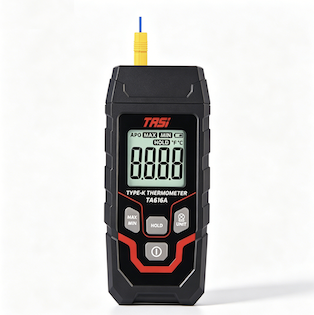
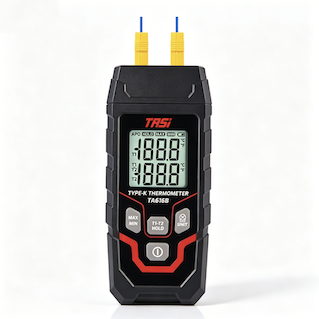
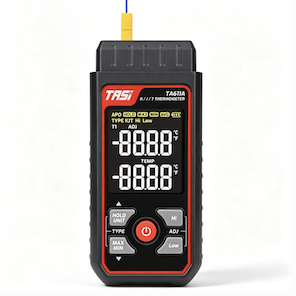
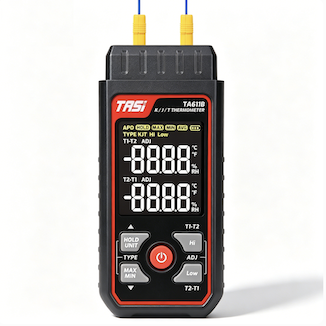
Modern digital thermocouple thermometers normally display temperature directly in degrees Celsius or Fahrenheit. Depending on the model, additional functions may include dual-channel measurement, differential temperature, minimum and maximum recording, data hold, and data logging.
What Are the Main Components of a Thermocouple Thermometer?
A typical thermocouple temperature measurement system consists mainly of the thermocouple probe and the thermometer itself.
● Thermocouple probe: The sensing component that contacts the target or is placed inside the measured environment.
● Thermocouple input: Connects the probe to the thermometer. The input and connector must be compatible with the thermocouple type.
● Signal acquisition circuitry: Measures the thermocouple's microvolt- or millivolt-level output.
● Cold-junction compensation: Compensates for the temperature at the reference junction and is essential for accurate temperature calculation.
● Linearization and processing: Converts thermoelectric voltage into temperature according to the characteristics of the selected thermocouple type.
● Display: Shows the calculated temperature value.
● Function controls: Depending on the instrument, these may include unit selection, data hold, MIN/MAX, alarms, and data logging.
Professional thermocouple thermometers may also provide two or more input channels, allowing several probes to be connected simultaneously for comparison or differential measurements.
Why Can a Thermocouple Measure Temperature?
Thermocouple measurement is based on the Seebeck effect.
When two dissimilar conductors form a circuit and the two junctions are at different temperatures, a thermoelectric voltage is generated. The magnitude of this voltage depends on the conductor materials and the temperature difference between the junctions.
The thermometer measures this voltage and calculates temperature using the characteristic relationship for the selected thermocouple type.
Because the thermocouple signal is very small, the thermometer requires sensitive signal acquisition and processing circuitry. In addition, a thermocouple fundamentally responds to the temperature difference between the measuring junction and the reference junction, so cold-junction compensation is required.
For this reason, even when the same thermocouple probe is used, differences in cold-junction compensation, electronics, and signal-processing performance can influence the final measurement result.
What Is a Thermocouple Probe?
The thermocouple probe is the part of the measuring system that directly senses temperature.
Different applications require different mechanical designs, so thermocouple probes are available in many configurations.
● Surface probes: Used for pipes, metal plates, housings, machinery, and other solid surfaces.
● Air and gas probes: Designed for measuring air, ducts, and gaseous environments.
● Immersion probes: Used in water, oil, and other liquids.
● Penetration probes: Suitable for food, soft materials, and other objects that can be pierced.
● High-temperature probes: Made with heat-resistant materials for furnaces, exhaust systems, heaters, and other high-temperature applications.
● Flexible-wire thermocouples: Lightweight and useful where space is limited or temporary attachment is required.
For this reason, selecting a thermocouple thermometer should not be based on the meter specifications alone. The probe must also be selected according to the measurement target and application.
What Are the Common Thermocouple Types?
Thermocouples are classified according to the metals or alloys used. Common types include K, J, T, E, and N, while R, S, and B thermocouples are commonly used for higher-temperature applications.
● Type K: One of the most widely used general-purpose thermocouples, offering a broad measuring range and good overall versatility for industrial maintenance, HVAC, and general temperature measurement.
● Type J: Commonly used for certain industrial processes and moderate-temperature applications.
● Type T: Frequently used for low- and medium-low-temperature measurements.
● Type E: Provides relatively high thermoelectric output and is used in selected precision temperature applications.
● Type N: Offers good stability for elevated-temperature measurements.
● Types R, S, and B: Generally used for high-temperature industrial and specialist applications.
Each thermocouple type has different materials, sensitivity, temperature capabilities, and environmental characteristics. The thermometer must therefore support the thermocouple type connected to it.
If the wrong thermocouple type is selected on the instrument, the displayed temperature can be significantly incorrect even when the probe is connected properly.
What Can a Thermocouple Thermometer Measure?
By selecting the appropriate probe, a thermocouple thermometer can measure a wide variety of targets and environments.
● Industrial equipment surfaces.
● Motors, bearings, and gearboxes.
● Supply air, return air, and duct temperatures in HVAC systems.
● Refrigeration and cold-storage equipment.
● Boilers, heaters, and high-temperature equipment.
● Pipes and heat exchangers.
● Water, oil, and other liquids.
● Internal food temperature.
● Laboratory samples and test equipment.
● Electronic components and heat sinks.
● Molds, metal parts, and manufacturing equipment.
Unlike a conventional infrared thermometer, which primarily measures surface temperature, a thermocouple thermometer can also measure internal temperatures, liquids, and air when fitted with the appropriate probe.
What Are the Main Advantages of a Thermocouple Thermometer?
Thermocouple thermometers are widely used because they provide a practical balance of temperature range, probe flexibility, and field usability.
● Wide measuring range: Different thermocouple types can cover applications from low to high temperatures.
● Fast response: Fine-wire or exposed-junction thermocouples can respond rapidly to temperature changes.
● Wide probe selection: Probes are available for surfaces, air, liquids, penetration measurements, and many specialist applications.
● Simple sensing principle: Thermocouple sensors are mature, robust, and suitable for many industrial environments.
● Suitable for contact measurement: Measurements are not directly dependent on target surface emissivity.
● Convenient for multi-point comparison: Dual- or multi-channel instruments can monitor several locations simultaneously.
However, thermocouple measurement does not provide the same accuracy under all conditions. Probe quality, installation, thermal contact, and instrument performance all affect the result.
What Is the Difference Between a Thermocouple Thermometer and an Infrared Thermometer?
Both instruments measure temperature, but they use fundamentally different methods.
A thermocouple thermometer is a contact measuring instrument. The probe must contact the surface, enter the material, or be placed in the measurement environment. Heat transfer allows the probe to approach the actual temperature of the target.
An infrared thermometer is a non-contact instrument that calculates surface temperature by detecting infrared radiation emitted by the target.
● Thermocouple thermometers can measure surfaces, internal temperatures, liquids, and air.
● Infrared thermometers primarily measure surface temperature.
● Thermocouple measurements normally require some time for thermal stabilization.
● Infrared thermometers can measure rapidly without contacting the target.
● Thermocouple measurements do not normally require surface emissivity settings.
● Infrared measurements can be affected by emissivity, measurement distance, spot size, and reflected background radiation.
Neither method is universally better. The correct choice depends on the measurement task.
What Determines Thermocouple Thermometer Accuracy?
The final measurement error of a thermocouple thermometer is normally determined by the complete measurement system rather than by a single specification.
● Meter accuracy: Signal acquisition, analog circuitry, digital processing, and cold-junction compensation influence the final result.
● Thermocouple probe accuracy: Different thermocouple grades and probe qualities have their own tolerances.
● Thermal contact: Poor contact during surface measurement can cause significant error.
● Response time: If the target temperature is changing and the probe has not reached thermal equilibrium, the displayed value may not represent the actual temperature.
● Ambient temperature: After moving the instrument between environments with substantially different temperatures, the cold-junction compensation system may require time to stabilize.
● Cables and connectors: Incorrect extension cables, compensation cables, or connectors can introduce additional error.
● Probe installation: Insufficient immersion depth, excessive exposure to ambient air, or influence from nearby heat sources can alter the measurement.
Reliable temperature measurement therefore depends not only on instrument specifications but also on correct measurement technique.
How Should a Thermocouple Thermometer Be Used Correctly?
Correct use requires attention to both the thermometer settings and the probe installation.
● Confirm that the instrument supports the thermocouple type being used.
● Select the correct thermocouple type, such as K or J, on the thermometer.
● Choose a probe suitable for the measurement target.
● Ensure stable and effective thermal contact with the target.
● When measuring liquids, use sufficient immersion depth.
● During surface measurements, minimize the influence of surrounding air on the probe.
● Allow the reading to stabilize before recording the result.
● Do not exceed the specified temperature limits of either the probe or the thermometer.
● Protect connectors, cables, and probes from unnecessary mechanical damage.
● For measurements requiring higher accuracy, perform periodic performance checks or calibration as appropriate.
For rapidly changing temperatures, probe response time is especially important. Thicker or heavily protected probes are generally more durable, but they may respond more slowly.
What Are the Limitations of Thermocouple Thermometers?
Although thermocouple thermometers are highly versatile, they also have several limitations.
First, thermocouples are contact sensors. Measurement may therefore be difficult or unsuitable for fast-moving targets, hazardous energized areas, inaccessible objects, or surfaces that must not be touched.
Second, the thermocouple output signal is very small, so measurement can be sensitive to connection quality, electrical interference, and cold-junction compensation performance.
In addition, the voltage-to-temperature relationship of a thermocouple is not perfectly linear, so the thermometer must perform appropriate linearization.
For surface measurements, air gaps, uneven surfaces, or insufficient contact pressure can cause the probe temperature to differ from the true surface temperature.
The measurement target, temperature range, response requirement, accuracy requirement, and operating environment should therefore all be considered before selecting the measurement method.
Where Are Thermocouple Thermometers Commonly Used?
Thermocouple thermometers are particularly suitable where direct contact, internal measurement, or interchangeable probes are required.
● Industrial maintenance: Motors, bearings, pipes, heaters, and mechanical equipment.
● HVAC: Supply air, return air, ductwork, refrigeration systems, and air-conditioning equipment.
● Laboratory testing: Samples, test systems, and experimental equipment.
● Food processing: Internal food temperature using penetration probes.
● Electronics testing: Heat sinks, electronic components, and internal temperature rise.
● Manufacturing: Molds, heated platforms, machinery, and process temperature.
● Equipment commissioning: Comparing temperatures and temperature differences at multiple points.
For applications requiring simultaneous comparison between two locations, a dual-channel thermocouple thermometer can be especially useful, for example when comparing HVAC supply and return temperatures or equipment inlet and outlet temperatures.
FAQ
Is a thermocouple thermometer a contact thermometer?
Yes. Most thermocouple measurements are contact measurements. The probe must contact the target, be inserted into the material, or be placed within the measurement environment.
Is Type K the most common thermocouple type?
Type K is one of the most widely used thermocouple types for general temperature measurement because of its broad temperature capability and versatility. Many handheld thermocouple thermometers therefore support Type K probes.
Can different thermocouple types be used interchangeably?
Not without changing the instrument configuration. Different thermocouple types have different voltage-temperature characteristics. The thermometer must be set to match the connected probe type, otherwise significant measurement errors may occur.
Can a thermocouple thermometer measure liquid temperature?
Yes. An appropriate immersion probe should be used, with sufficient immersion depth and with care taken to minimize the influence of the container wall and surrounding environment.
Can a thermocouple thermometer measure air temperature?
Yes. An air or gas probe can be used. Because heat transfer between air and the probe is relatively slow, response time may be longer than when measuring liquids or metal surfaces.
Does a thermocouple thermometer require cold-junction compensation?
Yes. Thermocouple measurement depends on the temperature difference between the measuring junction and the reference junction. Digital thermocouple thermometers therefore normally use an internal temperature sensor and electronic circuitry to provide cold-junction compensation.
Why does a thermocouple reading take time to stabilize?
The probe must exchange heat with the target until its sensing junction approaches the target temperature. Probe size, construction, material, and contact conditions all affect the stabilization time.
Is a thermocouple thermometer more accurate than an infrared thermometer?
Not necessarily. The two technologies use different measurement principles. Thermocouple measurements are not directly affected by emissivity, but they are affected by probe accuracy, thermal contact, and response time. Infrared thermometers measure without contact but can be affected by emissivity, reflection, measurement distance, and spot size. The appropriate method depends on the application.
Conclusion
A thermocouple thermometer is a contact temperature measuring instrument that uses a thermocouple as its sensing element. It measures the thermoelectric voltage generated by two dissimilar conductors under a temperature difference and converts this signal into temperature through cold-junction compensation, signal processing, and linearization.
With a wide measuring range, fast response, extensive probe selection, and broad application coverage, thermocouple thermometers are widely used in industrial maintenance, HVAC, laboratories, food processing, electronics testing, and manufacturing.
Reliable measurement depends not only on selecting the correct thermometer but also on choosing the appropriate thermocouple type and probe design, ensuring good thermal contact, selecting the correct measurement location, and allowing sufficient stabilization time.