Introduction
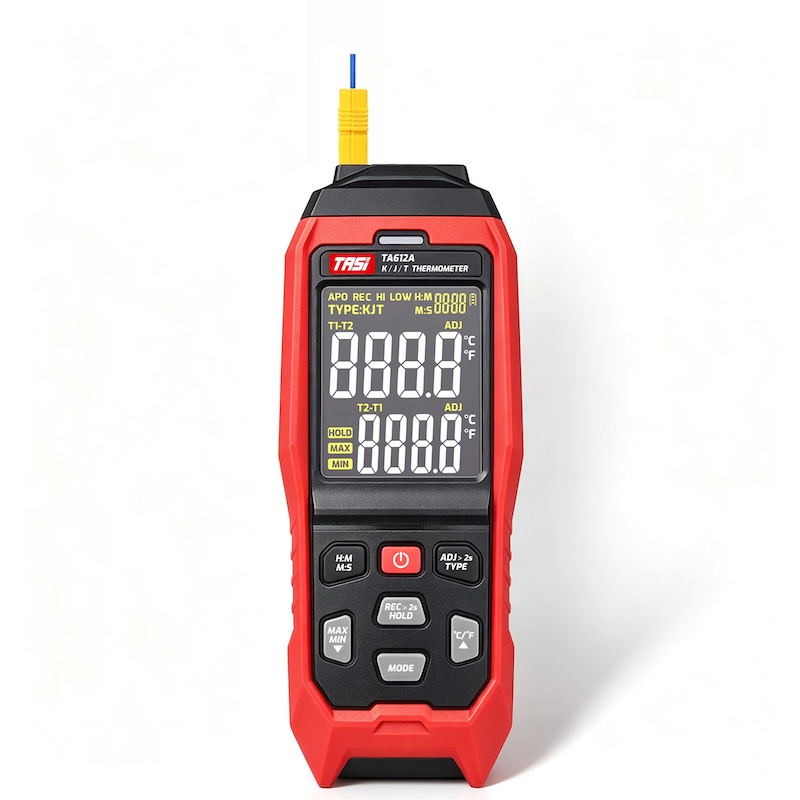
Ambient temperature can affect a thermocouple thermometer, but the magnitude of the effect depends on instrument design, cold-junction compensation performance, the rate of environmental temperature change, probe construction, and the measurement method.
A thermocouple does not directly output the absolute temperature of the measured object. Instead, it generates a thermoelectric voltage related to the temperature difference between the measuring junction and the reference junction. The thermometer measures this voltage and applies cold-junction compensation to calculate the final temperature.
For this reason, significant temperature changes around the thermometer body, input terminals, or probe can influence the measurement.
Under stable environmental conditions and within the specified operating temperature range, a properly designed thermocouple thermometer can normally compensate effectively for ambient temperature changes. However, rapid temperature transitions, strong airflow, large temperature differences, or operation outside the specified environmental range can increase measurement error.
Key Points
● Ambient temperature can influence thermocouple measurements, but an ambient temperature change does not translate directly into an equal measurement error.
● Cold-junction compensation (CJC) is one of the most important mechanisms for minimizing ambient temperature effects.
● When an instrument is moved rapidly from a hot to a cold environment, or vice versa, temporary internal temperature gradients can introduce additional error.
● The probe can also exchange heat with the surrounding air, nearby surfaces, and its mounting structure, causing the sensing junction temperature to differ from the actual target temperature.
● Allowing the thermometer, connectors, and input terminals to reach thermal equilibrium improves measurement accuracy and repeatability.
Why Can Ambient Temperature Affect a Thermocouple Thermometer?
A thermocouple consists of two dissimilar conductors. When the measuring junction and the reference junction are at different temperatures, a thermoelectric voltage is generated.
The resulting signal therefore depends not only on the temperature at the measuring junction but also on the temperature at the connection or reference end.
Modern digital thermocouple thermometers generally include a temperature sensor near the input terminals. This sensor measures the local terminal temperature, and the instrument uses that information for cold-junction compensation before converting the thermocouple voltage into a temperature reading.
For example, if a thermocouple probe is measuring an object at 100°C while the input terminal temperature is 25°C, the thermometer must compensate for the thermoelectric voltage corresponding to the 25°C reference temperature.
If the terminal temperature changes and the cold-junction compensation system does not track the change accurately or quickly enough, the displayed temperature may deviate from the true value.
Ambient temperature effects are therefore closely related to how accurately the cold-junction compensation system represents the actual temperature of the thermocouple connection point.
Why Is Cold-Junction Compensation So Important?
Standard thermocouple reference data are traditionally based on a reference junction temperature of 0°C. In practical applications, however, it is not realistic to keep the thermometer input terminals continuously at 0°C.
Digital thermocouple thermometers therefore use cold-junction compensation to mathematically correct for the actual temperature at the connection point.
When the instrument is operating in a stable environment, the connector, terminals, CJC sensor, and surrounding internal components are normally close to the same temperature, allowing compensation to work effectively.
Problems can occur when the instrument is exposed to a sudden or uneven temperature change. Examples include:
● Moving the thermometer from a cold outdoor environment into a warm room;
● Leaving the instrument in direct sunlight;
● Positioning it close to a furnace, hot pipe, or other heat source;
● Allowing cold air from an air-conditioning outlet to blow directly across the input terminals;
● Holding the instrument for an extended period near the input section and locally warming the enclosure.
Under these conditions, the temperature measured by the CJC sensor may temporarily differ from the actual thermocouple connection temperature, introducing additional measurement error.
Rapid Ambient Temperature Changes Are More Critical Than Stable Conditions
For a thermocouple thermometer, a stable ambient temperature is often more important than whether the surrounding temperature is specifically 20°C or 30°C.
As long as the instrument remains within its specified operating temperature range and has reached thermal equilibrium, the cold-junction compensation system can generally function as intended.
Rapid environmental changes are more likely to cause problems.
For example, when a thermometer is moved directly from a 5°C environment into a 30°C room, the enclosure, connector, internal electronics, and CJC sensor do not all warm at the same rate. Temporary temperature gradients develop inside the instrument.
Until the instrument reaches a new thermal equilibrium, the reading may drift.
After a significant environmental temperature transition, high-accuracy measurements should therefore be delayed until the instrument has stabilized.
The required stabilization time should be determined according to the manufacturer's instructions and technical specifications.
The Instrument Operating Temperature Range Also Matters
Digital thermocouple thermometers are normally specified for a defined ambient operating temperature range.
The manufacturer's stated accuracy is generally valid only under the specified operating conditions. At excessively high or low ambient temperatures, cold-junction compensation error may increase, and the performance of internal electronic components may also change.
Components that can be affected include:
● Analog input circuitry;
● Analog-to-digital converters;
● Cold-junction compensation sensors;
● Voltage references;
● Batteries;
● LCDs or other display components.
The thermometer should therefore be used within its specified environmental operating range whenever possible.
It is also important to distinguish between the temperature range of the thermocouple probe and the permitted ambient operating temperature of the thermometer itself.
A K-type thermocouple probe, for example, may be capable of measuring temperatures of several hundred degrees Celsius or more, while the handheld thermometer connected to it cannot be exposed to the same temperature.
Ambient Temperature Can Also Affect the Measurement Through the Probe
Ambient temperature does not affect only the thermometer electronics.
A thermocouple probe measures the temperature of its own sensing junction. The probe can accurately represent the target temperature only when sufficient thermal equilibrium is established between the sensing junction and the object being measured.
If the probe simultaneously exchanges a significant amount of heat with its surroundings, measurement error may occur.
For example, when measuring a hot metal surface, the sensing junction absorbs heat from the surface while losing heat through the probe stem and surrounding air. The indicated temperature may therefore be lower than the actual surface temperature.
Similarly, when measuring a cold object, heat from the warmer surroundings can flow through the air, probe stem, or mounting structure toward the sensing junction, causing a higher reading.
The greater the temperature difference between the target and the environment, the more important probe installation, contact area, insertion depth, and heat-conduction paths become.
Why Is Ambient Influence More Noticeable When Measuring Air Temperature?
Environmental conditions are particularly important when thermocouples are used to measure air or other gases.
Heat transfer between air and a probe is generally slower than heat transfer in liquids or through direct solid contact. The probe is therefore more susceptible to nearby heat sources, radiation, walls, the operator's body, and local airflow.
For example, when measuring air at 25°C near a hot machine, the probe may absorb thermal radiation even without touching the equipment, causing its temperature to rise above the actual air temperature.
Similarly, if the probe is directly exposed to cold air from an air-conditioning vent, the reading may represent the local air stream rather than the average temperature of the surrounding space.
Accurate air-temperature measurement therefore requires not only a thermally stable thermometer but also appropriate probe placement.
Can Different Temperatures Along the Thermocouple Wire Cause Error?
Under ideal conditions, if the thermocouple wire is homogeneous, undamaged, and made from the correct materials, different temperatures along different sections of the wire do not automatically create an equivalent additional measurement error.
Real thermocouple wires, however, are not perfectly ideal.
Long-term exposure to high temperatures, mechanical stress, oxidation, corrosion, or material inhomogeneity can alter the local thermoelectric properties of the wire.
If a non-uniform section of wire is located within a significant temperature gradient, additional thermoelectric voltages may be generated and affect the measurement.
For high-accuracy industrial measurements, aged or damaged thermocouple wire should therefore not be placed across severe temperature-gradient zones whenever possible.
Connectors and Termination Points Should Also Be Thermally Stable
Thermocouple connectors, sockets, and extension wiring can all influence measurement accuracy.
Proper thermocouple connectors are manufactured from materials compatible with the corresponding thermocouple type, or from materials with defined thermoelectric characteristics, to minimize unwanted thermoelectric voltages.
If ordinary copper wire, the wrong thermocouple wire type, or unnecessary dissimilar-metal junctions are introduced into the circuit, temperature differences between these junctions can create additional measurement errors.
Good installation practice includes:
● Using connectors matched to the thermocouple type;
● Using the correct thermocouple extension or compensating cable;
● Avoiding large temperature differences between intermediate connection points;
● Minimizing unnecessary junctions;
● Keeping connectors clean, secure, and free from significant oxidation.
How Can Ambient-Temperature Measurement Errors Be Reduced?
In most field applications, it is not necessary to eliminate every ambient temperature change. The objective is to control conditions that can introduce significant additional error.
● Allow the instrument to reach thermal equilibrium: After moving the thermometer between substantially different environments, allow sufficient stabilization time before taking critical measurements.
● Avoid localized heating or cooling of the input terminals: Keep direct sunlight, hot airflow, cold airflow, and nearby heat sources away from the thermocouple input area.
● Operate within the specified environmental range: The thermometer body should remain within the manufacturer's stated ambient operating limits.
● Use the correct thermocouple and accessories: Probes, plugs, sockets, extension wires, and compensating cables should match the thermocouple type.
● Optimize probe installation: Ensure good surface contact, adequate immersion depth in liquids, and reduced radiation or local airflow effects when measuring gases.
● Avoid strong temperature gradients at critical connection points: This is especially important around plugs, terminals, and transition junctions.
● Perform periodic verification or calibration: Applications requiring higher accuracy should regularly verify the combined performance of the thermometer and probe.
How Much Ambient Temperature Change Requires Special Attention?
There is no single ambient temperature change limit that applies to every thermocouple thermometer.
Different instruments use different CJC designs, internal layouts, sensor locations, and temperature-compensation methods. The applicable operating range and accuracy conditions should therefore always be checked in the product specifications.
In general, when environmental changes are gradual, the instrument has reached thermal equilibrium, and operation remains within the specified range, additional ambient-temperature effects are normally limited.
Greater attention is required after rapid temperature transitions or when one side of the input area is locally heated or cooled while another remains at a different temperature.
For laboratory calibration, research, or other high-accuracy measurements, ambient temperature coefficients, CJC uncertainty, and the total measurement uncertainty should also be considered.
FAQ
Does a 5°C change in ambient temperature cause a 5°C thermocouple measurement error?
No. Modern thermocouple thermometers use cold-junction compensation to correct for normal changes in ambient temperature. Significant additional error generally occurs only when compensation is inaccurate, the temperature changes too quickly, or the measurement setup is unsuitable.
Why can the reading become unstable after moving a thermometer from outdoors to indoors?
The enclosure, input terminals, internal circuitry, and CJC sensor require time to reach a new thermal equilibrium. Temporary internal temperature gradients may cause the reading to drift during this period.
If the thermocouple probe can measure very high temperatures, can the thermometer body also be exposed to high temperatures?
Not necessarily. The probe measurement range and the thermometer's ambient operating range are separate specifications. The thermometer body should always remain within its stated operating conditions.
Does a more stable room temperature always guarantee a more accurate thermocouple measurement?
No. A stable environment helps reduce errors associated with CJC and temperature gradients, but overall accuracy also depends on thermocouple type, probe accuracy, installation, contact conditions, instrument accuracy, probe aging, and calibration status.
Conclusion
Ambient temperature can affect a thermocouple thermometer, but the effect should not be interpreted as a direct one-to-one relationship between ambient temperature change and measurement error.
Cold-junction compensation is designed to correct for changes in connection temperature, so normal ambient variations can generally be compensated effectively when the thermometer operates within its specified environmental range and has reached thermal equilibrium.
The more important concerns are rapid environmental changes, localized temperature differences, temperature gradients around the input terminals, heat transfer between the probe and its surroundings, and incorrect wiring or connections.
For higher-quality temperature measurements, allow the instrument to stabilize, use the correct thermocouple probe and accessories, and carefully control probe installation, heat-transfer conditions, and terminal temperatures. These practices help achieve more stable, reliable, and repeatable thermocouple measurements.