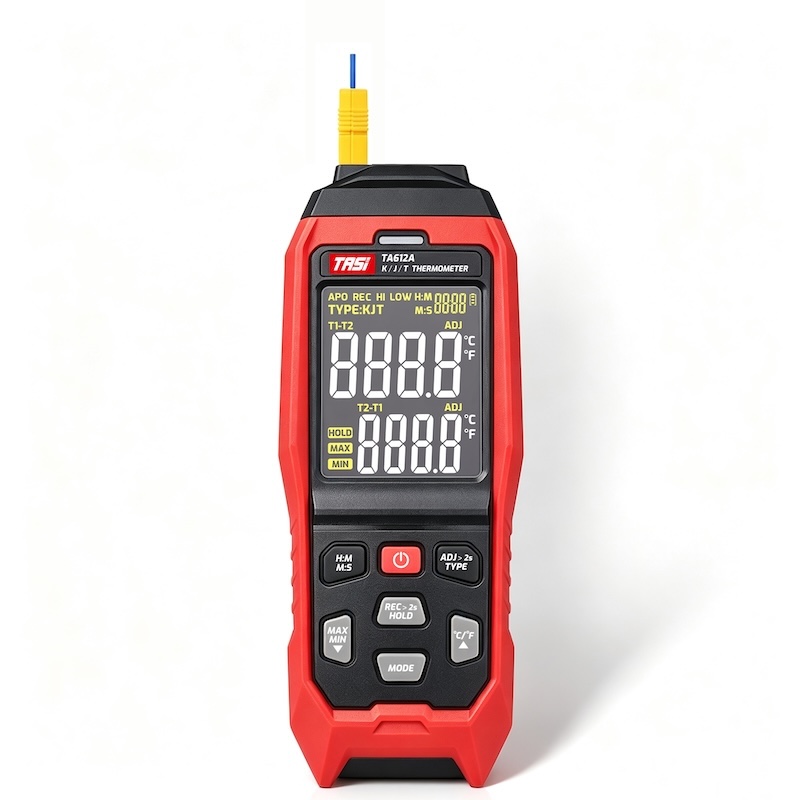
Introduction
● A J-type thermocouple is a widely used industrial temperature sensor made from two dissimilar metal conductors. It determines temperature by measuring the thermoelectric voltage generated by a temperature difference.
● The positive leg is typically made of iron, while the negative leg is made of a copper-nickel alloy, commonly known as Constantan. Its relatively high thermoelectric output makes the J type well suited to low-to-medium and medium-temperature measurements.
● Compared with the widely used K-type thermocouple, the J type can provide a higher thermoelectric output over parts of its operating range. However, because its positive conductor contains iron, long-term stability can be limited in high-temperature oxidizing environments. Selection should therefore consider not only temperature range but also the operating atmosphere.
Key Takeaways
● A J-type thermocouple consists of an iron positive conductor and a copper-nickel negative conductor.
● It operates according to the Seebeck effect, generating a millivolt-level signal related to the temperature difference between its junctions.
● Its standardized thermoelectric characteristics typically cover approximately -210°C to +1200°C, although the usable temperature range of an actual probe depends on wire diameter, insulation, sheath material, and operating environment.
● J-type thermocouples provide relatively high thermoelectric output and good sensitivity in the medium-temperature range.
● The iron conductor is susceptible to oxidation at elevated temperatures, so long-term use in oxidizing atmospheres requires careful consideration.
● The measuring instrument must be configured for J-type input and provide correct cold-junction compensation to obtain reliable temperature readings.
What Is a J-Type Thermocouple?
● A J-type thermocouple is a standardized thermocouple type defined by the thermoelectric characteristics of its two conductors: iron and a copper-nickel alloy. When the two conductors are joined to form a measuring junction and a temperature difference exists between the measuring and reference junctions, a thermoelectric voltage is generated.
● The measuring instrument detects this small voltage and converts it into temperature according to the defined temperature-versus-EMF relationship for J-type thermocouples.
● A J-type thermocouple therefore does not directly output a temperature value. It produces a voltage related to the temperature difference. A thermocouple thermometer, data acquisition system, or temperature controller measures the signal, performs cold-junction compensation, and converts the result into temperature.
● The J type belongs to the base-metal thermocouple family. Compared with K-, T-, and E-type thermocouples, it differs in conductor materials, thermoelectric output, temperature capability, and suitability for specific environments.
What Materials Are Used in a J-Type Thermocouple?
● The positive conductor of a J-type thermocouple is iron, while the negative conductor is a copper-nickel alloy. Because the two materials have different thermoelectric properties, they generate an EMF when incorporated into a measuring circuit with a temperature gradient.
● Iron is relatively economical and offers useful thermoelectric characteristics for medium-temperature measurement, but it is also responsible for one of the J type's main environmental limitations.
● In air and other oxygen-containing atmospheres, iron progressively oxidizes as temperature increases. Prolonged exposure at elevated temperatures can alter the conductor's physical and thermoelectric properties, causing measurement drift and potentially reducing service life.
● As a result, J-type thermocouples with different sheath designs, wire diameters, and operating atmospheres can have significantly different service lives.
How Does a J-Type Thermocouple Measure Temperature?
● J-type thermocouples operate according to the Seebeck effect. When two dissimilar conductors form a circuit and their junctions are at different temperatures, a thermoelectric voltage is generated.
● The measuring junction is normally positioned in or on the object or medium being measured, while the other end is connected to a thermocouple thermometer, temperature transmitter, controller, or data acquisition system.
● The instrument measures the millivolt-level thermocouple signal and determines the temperature around the instrument connection point. It then applies cold-junction compensation to correct for the reference-junction temperature.
● Finally, the instrument uses the standardized J-type temperature-EMF relationship to convert the compensated voltage into the temperature at the measuring junction.
● This is why the instrument must be configured for the correct thermocouple type. Connecting a J-type probe to an instrument set for K type can produce significant errors because the two thermocouple types have different voltage-temperature characteristics.
What Is the Temperature Range of a J-Type Thermocouple?
● The standardized thermoelectric characteristics of J-type thermocouples typically extend from approximately -210°C to +1200°C.
● However, this should not be interpreted to mean that every J-type probe can operate continuously throughout this entire range. The standardized temperature range describes the thermoelectric characteristics of the conductor pair, while the practical operating range of a probe is also limited by its construction and materials.
● PVC, PTFE, fiberglass, and ceramic insulation systems, for example, have very different temperature limits. Stainless-steel sheaths, exposed-junction designs, and different thermocouple wire diameters also have different operating capabilities.
● High-temperature oxidizing environments require particular attention with J-type thermocouples. Because the positive conductor is iron, prolonged exposure to air at elevated temperatures can accelerate oxidation. The practical continuous-use limit may therefore be lower than the upper limit of the standardized EMF tables.
● When selecting a J-type probe, always use the manufacturer's specified probe temperature rating rather than assuming the full theoretical range is available simply because the probe is J type.
What Are the Sensitivity Characteristics of a J-Type Thermocouple?
● J-type thermocouples provide relatively high thermoelectric output. Across common industrial temperature ranges, their sensitivity is typically on the order of several tens of microvolts per degree Celsius and is approximately 50–55 µV/°C around room temperature.
● Sensitivity is not constant across the entire temperature range. The temperature-to-voltage relationship of a thermocouple is nonlinear, so the change in thermoelectric voltage per degree varies with temperature.
● A relatively high thermoelectric output means that a given temperature change produces a comparatively noticeable voltage change, which can help measurement electronics resolve temperature variation.
● However, higher sensitivity does not automatically mean higher overall measurement accuracy. Actual system accuracy also depends on thermocouple tolerance, instrument accuracy, cold-junction compensation, wiring, installation, and electrical interference.
How Accurate Is a J-Type Thermocouple?
● J-type thermocouple accuracy cannot be represented by one fixed ±°C value because permissible error depends on temperature range, thermocouple tolerance class, and the applicable thermocouple specification.
● Different tolerance classes permit different levels of deviation. For precision applications, both the thermocouple probe tolerance and the measuring instrument specification should therefore be considered.
● Total system error can include thermocouple error, instrument error, cold-junction compensation error, connector and extension-wire effects, and errors introduced by probe installation.
● Even a higher-grade J-type thermocouple can therefore produce inaccurate results if the wrong extension wire is used or if the measuring junction does not make adequate thermal contact with the object being measured.
What Are the Advantages of J-Type Thermocouples?
● Relatively high thermoelectric output: J-type thermocouples generate a comparatively strong signal across common medium-temperature ranges, making small temperature changes easier to detect.
● Cost-effective construction: Because they use base-metal conductors rather than noble metals, J-type thermocouples are generally economical for widespread industrial use.
● Suitable for medium-temperature measurement: They are practical for machinery, industrial processes, and laboratory applications that do not require extremely high temperatures.
● Broad instrument compatibility: Many multichannel thermocouple thermometers, data loggers, temperature controllers, and industrial data acquisition systems support J-type inputs.
● Wide range of probe designs: J-type thermocouples can be manufactured as exposed-wire, surface, penetration, air, and metal-sheathed probes for different measurement tasks.
What Are the Limitations of J-Type Thermocouples?
● The most important limitation of a J-type thermocouple is associated with its iron positive conductor. Iron oxidizes relatively readily in high-temperature oxygen-containing atmospheres, which can reduce long-term stability.
● In humid environments, insufficiently protected iron conductors may also corrode, reducing probe life and measurement stability.
● J-type thermocouples are not necessarily the best choice for all low-temperature applications. T-type thermocouples often offer more suitable material stability and performance for lower-temperature measurement.
● For higher temperatures or general-purpose applications requiring a wider operating range, K-type thermocouples are more widely used.
● Suitability should therefore be assessed based on temperature, atmosphere, humidity, mechanical construction, and required service duration rather than temperature range alone.
Where Are J-Type Thermocouples Used?
● J-type thermocouples are commonly used for temperature measurement in industrial machinery, molds, heating equipment, motors, bearings, laboratory equipment, and general industrial processes.
● In plastics processing and mold applications, appropriately designed J-type probes can be used to monitor molds, barrels, or other heated machine components.
● For machinery maintenance, surface or contact J-type probes can be used to measure bearings, housings, pipes, and metal components.
● In laboratories and R&D applications, multiple J-type thermocouples can be connected to multichannel data loggers for continuous monitoring of several temperature points.
● In industrial control systems, J-type thermocouples can also be connected directly to compatible temperature controllers, PLC temperature modules, and data acquisition systems.
● Where prolonged operation at elevated temperatures occurs in strongly oxidizing conditions, the suitability of J type should be evaluated against alternatives such as K-type thermocouples.
What Is the Difference Between J-Type and K-Type Thermocouples?
● J-type thermocouples use iron and a copper-nickel alloy, whereas K-type thermocouples typically use nickel-chromium and nickel-based alloys. Their conductor systems are therefore fundamentally different.
● K-type thermocouples generally provide a wider practical temperature range and are consequently more widely used for general industrial temperature measurement.
● J-type thermocouples provide relatively high thermoelectric output in medium-temperature applications, but the iron positive conductor limits durability in high-temperature oxidizing atmospheres.
● When temperatures are primarily within the medium range and the environment is suitable for iron-based conductors, the J type can provide an economical and practical solution.
● If a wider temperature span or higher operating temperatures are required, the K type is generally the more versatile option.
How Do J-Type Thermocouples Differ from T-Type and E-Type Thermocouples?
● T-type thermocouples typically use copper and a copper-nickel alloy. They are particularly suitable for low and medium-low temperature measurement and are commonly used in refrigeration, laboratory, and some food-temperature applications.
● E-type thermocouples typically use nickel-chromium and copper-nickel conductors. They provide one of the highest thermoelectric outputs among common base-metal thermocouples and are useful where strong signal sensitivity is desirable.
● J-type thermocouples are more closely associated with medium-temperature industrial measurement. They offer good thermoelectric output and reasonable cost, but high-temperature oxidation of the iron conductor must be considered.
● There is no universally "best" choice among K-, J-, T-, and E-type thermocouples. Selection should be based on temperature range, environmental conditions, accuracy requirements, response time, and probe construction.
How Do You Select a J-Type Thermocouple Probe?
● First determine the actual process temperature range. The probe's rated maximum temperature should exceed the highest expected operating temperature with an appropriate safety margin.
● Select the probe configuration according to the measurement target. Immersion probes are suitable for liquids, surface probes for solid surfaces, and appropriately designed air probes for gases and ambient measurements.
● Consider probe diameter. Smaller-diameter probes generally have lower thermal mass and faster response but may provide less mechanical strength. Larger probes are typically more robust but may respond more slowly.
● Check the temperature limits of the sheath and insulation. A thermocouple type may have a high theoretical temperature capability while other probe components have substantially lower temperature ratings.
● If the thermocouple circuit must be extended, use J-type-compatible thermocouple extension or compensating cable. Ordinary copper cable or wiring intended for another thermocouple type can introduce additional measurement error.
● Confirm that the thermometer, controller, transmitter, or data acquisition system supports J-type input.
What Should You Consider When Using a J-Type Thermocouple?
● The measuring instrument must be configured for J type. K-, T-, E-, or other thermocouple settings should not be used as substitutes.
● Thermocouple polarity must be connected correctly. Reversed polarity can cause substantial measurement errors, particularly when the measuring and instrument connection temperatures differ significantly.
● The measuring junction must have adequate thermal contact with the target. For surface measurements, minimize air gaps between the probe and surface and maintain stable contact pressure where possible.
● For liquid or gas measurements, ensure adequate immersion depth to reduce errors caused by heat conduction along the probe.
● Avoid routing thermocouple cables close to high-current conductors, motors, variable-frequency drives, and other strong electromagnetic interference sources. Because thermocouple signals are only in the millivolt range, electrical noise can affect measurement stability.
● For long-term high-temperature operation, periodically inspect the probe for oxidation, corrosion, insulation damage, and measurement drift.
Why Should You Not Select a J-Type Thermocouple Based Only on Maximum Temperature?
● "What is the maximum temperature of a J-type thermocouple?" is a common but potentially misleading selection question.
● The standardized temperature range primarily describes the thermoelectric characteristics of the conductor materials. An actual probe may also contain a metal sheath, insulation, extension cable, connector, handle, and other components.
● If the thermocouple conductors can withstand a high temperature but the cable insulation has a substantially lower temperature rating, the overall probe operating temperature will be limited by the insulation.
● Similarly, a probe that tolerates a high temperature for short periods is not necessarily suitable for continuous operation at the same temperature for hundreds or thousands of hours.
● Practical selection should therefore consider the thermocouple type, sensing-tip rating, sheath rating, cable rating, and permissible continuous operating temperature separately.
FAQ
● What materials are used for the positive and negative conductors of a J-type thermocouple?
The positive conductor is normally iron and the negative conductor is a copper-nickel alloy. Polarity should be connected according to the markings on the instrument and connector.
● What temperature can a J-type thermocouple measure?
Its standardized thermoelectric characteristics typically extend from approximately -210°C to +1200°C. The usable range of a specific probe may be significantly narrower and should be confirmed from the probe specification.
● Is a J-type thermocouple suitable for high-temperature measurement?
It can be used at elevated temperatures within its specified range, but the iron positive conductor limits long-term stability in oxidizing atmospheres. For continuous high-temperature use, alternatives such as K type may be more appropriate depending on the temperature and atmosphere.
● Can J-type and K-type thermocouples be used interchangeably?
No. Their conductor materials and temperature-EMF characteristics are different. If the thermocouple type is changed, the thermometer or controller must also be configured for the corresponding type.
● Does a J-type thermocouple require cold-junction compensation?
Yes. A thermocouple generates a voltage corresponding to the temperature difference between the measuring and reference junctions. Practical measuring systems therefore use cold-junction compensation to determine the measuring-junction temperature.
● Is a J-type thermocouple more sensitive than a K-type thermocouple?
J type provides a relatively high voltage change per degree across many commonly used temperature ranges. However, higher sensitivity does not necessarily mean higher system accuracy.
● Can a standard multimeter measure temperature directly from a J-type thermocouple?
A multimeter can measure the millivolt output, but unless it provides J-type linearization and cold-junction compensation, it normally cannot display the actual temperature accurately. A thermocouple thermometer or compatible data acquisition system should be used.
● Why can a J-type thermocouple drift after long-term use?
High-temperature oxidation, corrosion, material aging, mechanical stress, and contamination can change the thermoelectric properties of the conductors and gradually shift the measurement.
Summary
● A J-type thermocouple is a base-metal temperature sensor made from iron and a copper-nickel alloy. It uses the Seebeck effect to convert the temperature difference between the measuring and reference junctions into a thermoelectric voltage.
● It offers relatively high thermoelectric output, moderate cost, good suitability for medium-temperature industrial measurement, and broad compatibility with temperature measurement instruments.
● Its standardized thermoelectric characteristics typically cover approximately -210°C to +1200°C, but this does not mean every J-type probe can operate continuously across that complete range. Probe construction, sheath material, wire diameter, insulation, and operating atmosphere all affect practical temperature capability.
● Particular attention should be paid to oxidation of the iron conductor during prolonged operation in hot, oxygen-containing environments. For wider temperature ranges or more demanding high-temperature conditions, J-, K-, T-, and E-type thermocouples should be compared according to the actual application.
● Reliable temperature measurement depends not only on thermocouple type but also on correct probe construction, polarity, cold-junction compensation, installation, and instrument configuration. The probe and measuring instrument should always be considered as a complete measurement system.