Introduction
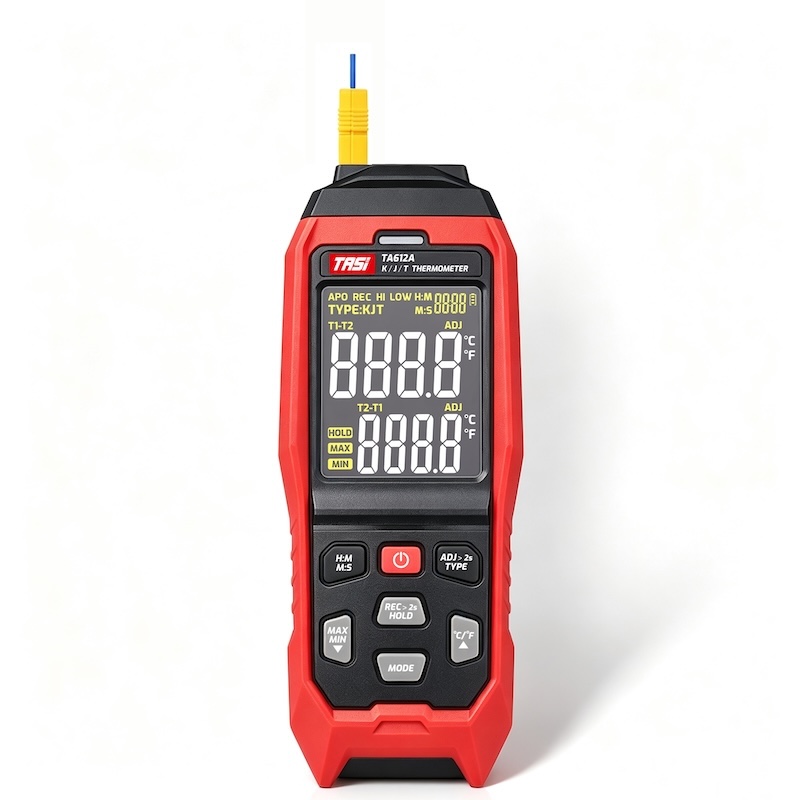
When selecting a thermocouple or thermocouple thermometer, specifications such as “Class 1,” “Class 2” or “accuracy class” are frequently encountered. These designations are sometimes interpreted as the accuracy of the complete thermometer. For example, a Class 1 thermocouple may be assumed to guarantee a total measurement accuracy of ±1.5°C.
That interpretation is not correct.
Technically, the thermocouple accuracy class is better described as a tolerance class. It specifies how far the actual thermoelectric output of a thermocouple is permitted to deviate from the standardized temperature–EMF relationship for that thermocouple type.
It therefore primarily characterizes the thermocouple element itself rather than the total measurement error of the complete thermocouple thermometer.
Key Takeaways
● A thermocouple accuracy class is essentially a tolerance classification for the thermocouple element.
● Class 1, Class 2 and Class 3 specify different permissible deviations; Class 1 generally has tighter tolerances than Class 2.
● The same class does not necessarily correspond to the same numerical tolerance for every thermocouple type or temperature.
● Thermocouple tolerances are commonly specified using a combination of a fixed temperature deviation and a percentage of the measured temperature.
● A Class 1 probe does not automatically make the complete thermocouple thermometer a Class 1 measurement system.
● Actual measurement error can also be affected by the thermometer electronics, cold-junction compensation, connectors, extension or compensating cables, installation conditions and the measurement environment.
What Is a Thermocouple Accuracy Class?
Thermocouples measure temperature using the thermoelectric voltage generated by two dissimilar conductors. Standardized thermocouple types such as K, J, T, E, N, R, S and B each have a defined relationship between temperature and thermoelectric voltage.
Ideally, every thermocouple of the same type would generate exactly the same EMF at the same temperature.
In practice, however, variations in alloy composition, manufacturing processes and material condition cause small deviations from the standardized reference values.
The tolerance class defines how large this deviation is permitted to be.
IEC 60584-1 specifies reference functions and tolerances for commonly used letter-designated thermocouples including Types K, J, T, E, N, R, S and B.
From a technical perspective, a thermocouple accuracy class can therefore be understood as:
The maximum permitted deviation of the thermocouple from its standardized temperature–EMF relationship.
The tighter the tolerance class, the smaller the permitted deviation and the higher the required consistency of the thermocouple material.
What Do Class 1, Class 2 and Class 3 Mean?
Within the IEC thermocouple system, Class 1, Class 2 and Class 3 are commonly used tolerance designations.
In general:
● Class 1: tighter tolerance and stricter requirements for thermocouple material performance.
● Class 2: a widely used industrial tolerance class with a broader permitted deviation.
● Class 3: used for certain thermocouple types over specific low-temperature ranges; it is not defined for every thermocouple type.
These classes should not be simplified to statements such as “Class 1 always means ±1.5°C” or “Class 2 always means ±2.5°C.”
The permitted tolerance depends on both the thermocouple type and the actual temperature.
For example, commonly referenced IEC 60584-1 tolerances for a Type K thermocouple are:
| Tolerance Class | Temperature Range | Permitted Deviation |
|---|---|---|
| Class 1 | -40 to +1000°C | ±1.5°C or ±0.004 × |
| Class 2 | -40 to +1200°C | ±2.5°C or ±0.0075 × |
Here, t is the measured temperature in °C. The applicable tolerance is generally the greater absolute value obtained from the two expressions.
Why Are Thermocouple Tolerances Expressed in Both °C and Percent?
Thermocouples often cover very wide temperature ranges. A Type K thermocouple, for example, can be used from low temperatures to well above 1000°C, depending on the probe construction and application.
Using only one fixed ±°C value across such a wide temperature range would not adequately represent the allowable thermoelectric deviation at higher temperatures.
For this reason, the tolerance is typically defined using two terms:
● A fixed temperature tolerance, such as ±1.5°C.
● A temperature-proportional tolerance, such as ±0.004 × |t|.
The larger of the two values applies.
For a Type K Class 1 thermocouple at 200°C:
Fixed tolerance:
±1.5°C
Temperature-proportional tolerance:
±0.004 × 200 = ±0.8°C
The applicable tolerance is therefore:
±1.5°C
At 800°C:
Fixed tolerance:
±1.5°C
Temperature-proportional tolerance:
±0.004 × 800 = ±3.2°C
The applicable tolerance becomes:
±3.2°C
Therefore, Class 1 does not represent one fixed ±°C value over its entire valid temperature range.
Does the Same Accuracy Class Mean the Same Accuracy for Every Thermocouple Type?
No.
Class 1 and Class 2 are tolerance designations, but the corresponding numerical limits are not identical for every thermocouple type.
This is because different thermocouple types use different alloy combinations and have different thermoelectric characteristics and operating temperature ranges.
For example, a Type T thermocouple can have a Class 1 fixed tolerance of ±0.5°C over part of its specified range, while Types K, J, E and N commonly use a Class 1 fixed tolerance of ±1.5°C over their relevant ranges.
When comparing thermocouple accuracy, users should therefore check:
● Thermocouple type.
● Applicable standard.
● Tolerance class.
● Temperature range covered by that class.
● Numerical tolerance at the actual measurement temperature.
The class designation alone is not sufficient to determine the allowable measurement deviation.
Is Thermocouple Accuracy Class the Same as Measurement Range?
No.
These are two different specifications.
The measurement or operating range indicates the temperature range over which the thermocouple can be used, considering the thermoelement materials, insulation, sheath and probe construction.
The valid range of a tolerance class specifies the temperature interval over which a particular standardized tolerance applies.
The two ranges do not always coincide.
A thermocouple may physically withstand temperatures beyond the specified Class 1 range, but the standardized Class 1 tolerance may no longer apply outside that interval.
This does not necessarily mean that the thermocouple immediately stops functioning. It means that its performance can no longer be evaluated using that particular Class 1 tolerance specification.
For this reason, thermocouple selection should not be based only on:
“What is the maximum temperature?”
It should also consider:
“Over what temperature range is the required tolerance class valid?”
Is a Class 1 Thermocouple Always Better Than Class 2?
From a tolerance standpoint, Class 1 generally permits a smaller deviation than Class 2 for the same thermocouple type within the applicable temperature range.
However, this does not mean that every application requires Class 1.
For general equipment inspection, HVAC measurements, industrial maintenance or temperature trending, the practical difference between approximately ±1°C and ±2°C may not affect the final decision.
In such applications, a Class 2 thermocouple may be entirely adequate.
For laboratory testing, temperature verification, precision process control or comparative measurements involving small temperature differences, a tighter tolerance class may be more appropriate.
The correct selection principle is therefore:
Choose the thermocouple tolerance class according to the operating temperature range and the maximum measurement error acceptable for the application.
Why Does Thermocouple Class Not Equal Thermocouple Thermometer Accuracy?
This is one of the most important points when interpreting thermocouple specifications.
A complete thermocouple measurement system may include:
● Thermocouple measuring junction.
● Thermocouple wires.
● Connectors or extension cables.
● Thermometer input circuitry.
● Analog-to-digital conversion.
● Cold-junction temperature sensor.
● Cold-junction compensation.
● Thermocouple linearization.
Class 1 or Class 2 primarily specifies the allowable deviation of the thermocouple itself from its standardized reference function.
The temperature displayed by the thermometer, however, is also influenced by instrument accuracy, cold-junction compensation and other system components.
A useful distinction is:
Thermocouple tolerance ≠ thermometer accuracy ≠ total system accuracy.
Connecting a Class 1 probe to a thermometer with a comparatively large instrument error does not automatically produce a highly accurate measurement system.
Conversely, a high-accuracy thermometer connected to a thermocouple with a wider tolerance will still be limited by the probe performance.
What Factors Affect Actual Thermocouple Measurement Accuracy?
In addition to the thermocouple tolerance class, several other factors can affect the final measurement result.
● Thermometer accuracy: Input circuitry, ADC performance and internal signal-processing algorithms contribute their own measurement uncertainty.
● Cold-junction compensation: The thermometer must determine the temperature at the thermocouple connection point. Errors in this measurement directly affect the final result.
● Compensating cables and connectors: Incorrect wire types, connector materials or wiring configurations can introduce additional thermoelectric voltages.
● Thermal contact: Poor contact with the measured surface can cause the probe to indicate a thermal equilibrium temperature influenced by the surrounding environment instead of the true object temperature.
● Heat conduction: Probe sheaths, wires and mounting structures can conduct heat away from the sensing point.
● Response time: If the measured temperature changes quickly, the probe may not have reached thermal equilibrium.
● Long-term drift: High-temperature exposure, oxidation, contamination and repeated thermal cycling can gradually change the thermoelectric properties of the thermocouple.
For demanding measurements, selecting Class 1 rather than Class 2 is therefore only one part of the overall accuracy assessment.
How Should a Thermocouple Accuracy Class Be Selected?
A practical selection process is:
● First determine the minimum and maximum temperatures to be measured.
● Select a suitable thermocouple type such as K, J, T, E or N according to temperature range, environment and probe construction.
● Confirm that the actual operating temperature lies within the specified range of the required tolerance class.
● Select Class 1, Class 2 or another applicable class according to the process tolerance.
● Check the accuracy specification and cold-junction compensation performance of the thermocouple thermometer.
● For higher-accuracy applications, consider the combined effects of the probe, instrument, wiring and installation method.
For routine equipment inspection, selecting the highest tolerance class is not always necessary.
When temperature directly affects process control, product quality or laboratory results, both thermocouple tolerance and total system uncertainty should be evaluated.
Can Accuracy Classes from Different Standards Be Compared Directly?
Not solely by their class names.
IEC standards commonly use Class 1, Class 2 and Class 3, while ASTM E230/E230M commonly uses designations such as Standard Limits of Error and Special Limits of Error.
The applicable temperature ranges, tolerance limits and definitions are not identical.
Therefore, a designation from one standard should not be assumed to correspond directly to a designation from another.
If a specification states:
“Type K, Class 1”
or
“Type K, Special Limits of Error”
the applicable standard should always be identified.
For technical comparison or product selection, the standard, thermocouple type, temperature range and numerical tolerance should be considered together rather than comparing only the class name.
FAQ
Is a Class 1 thermocouple more accurate than Class 2?
For the same thermocouple type, standard and applicable temperature range, Class 1 generally has a tighter tolerance than Class 2.
Does Type K Class 1 always mean ±1.5°C?
No. ±1.5°C applies only where it is greater than the temperature-proportional tolerance. At higher temperatures, ±0.004 × |t| may become the controlling limit.
Does a Class 1 thermocouple guarantee a total thermometer accuracy of ±1.5°C?
No. Class 1 refers primarily to the thermocouple element. Instrument error, cold-junction compensation and other system errors must also be considered.
Does a higher accuracy class mean a wider temperature range?
No. Tolerance class and usable temperature range are different specifications. A tighter class may actually be defined over a narrower temperature interval.
Do all thermocouple types have Class 1, Class 2 and Class 3?
No. The available tolerance classes and valid temperature ranges differ between thermocouple types.
Is accuracy class alone sufficient when choosing a thermocouple?
No. Thermocouple type, operating temperature, probe construction, response time, environment and thermometer accuracy should also be considered.
Summary
A thermocouple accuracy class describes the permissible deviation of the thermocouple from the standardized relationship between temperature and thermoelectric voltage.
Class 1, Class 2 and Class 3 are not simple fixed ±°C accuracy values. The actual tolerance depends on the thermocouple type, the applicable standard and the measurement temperature.
When selecting a thermocouple, consider:
● Whether the required class covers the actual operating temperature.
● The permissible deviation at the target temperature.
● Whether the probe tolerance meets the application requirement.
● The measurement accuracy of the thermocouple thermometer itself.
● The performance of the complete probe, wiring and instrument system.
For this reason, the accuracy of a thermocouple measurement system should not be judged by “Class 1” or “Class 2” alone. Thermocouple tolerance, instrument accuracy and real application conditions must be evaluated together.