Introduction
Although all thermocouples operate on the same thermoelectric principle, the construction of their measuring junction can vary significantly. Common junction configurations include exposed, grounded, and ungrounded designs.
An exposed junction thermocouple has a measuring junction formed by two dissimilar thermocouple conductors that is directly exposed to the measured environment instead of being fully enclosed by a metal sheath.
Because there is little material between the measured medium and the sensing junction, heat can be transferred rapidly to and from the junction. This generally gives exposed junction thermocouples a very fast temperature response.
The trade-off is reduced protection. The exposed junction is more vulnerable to mechanical damage, corrosion, oxidation, and electrical interference.
An exposed junction thermocouple should therefore not simply be regarded as a “better” thermocouple. It is a junction configuration specifically suited to applications where fast response is a priority.
Key Points
● The measuring junction is directly exposed to the surrounding medium;
● Low thermal mass generally provides a fast temperature response;
● Particularly suitable for air, gas, and rapidly changing temperature measurements;
● Mechanical protection and corrosion resistance are generally lower than with sheathed designs;
● Usually unsuitable for strongly corrosive, high-pressure, mechanically harsh, or electrically conductive environments;
● Selection should consider response time, medium compatibility, temperature range, mechanical strength, and electrical isolation requirements.
What Is an Exposed Junction Thermocouple?
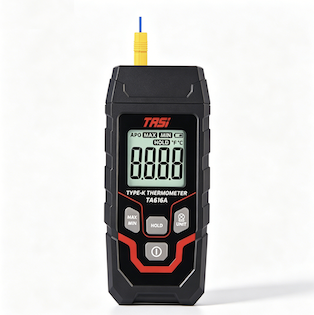
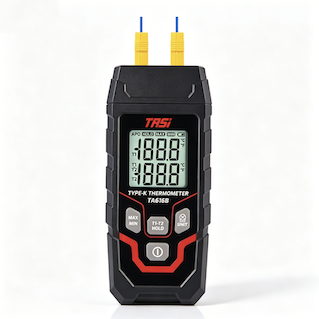
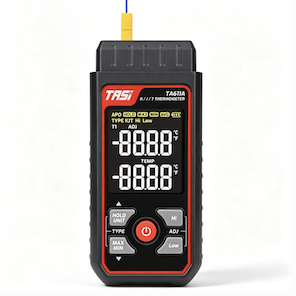
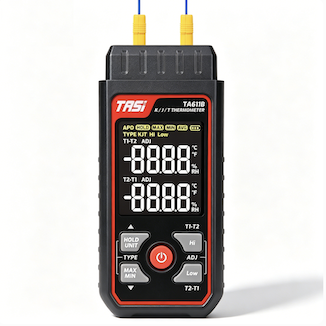
An exposed junction thermocouple is a thermocouple whose measuring junction is not completely enclosed inside a metal sheath but instead remains directly exposed to the air, gas, or other surrounding medium being measured.
A thermocouple consists of two dissimilar metals or alloys. For example, a K-type thermocouple uses two alloys with different thermoelectric properties. The two thermocouple wires are joined at the measuring end to form the sensing junction.
In a conventional sheathed thermocouple, this junction is located inside a metal protective sheath. In an exposed junction design, the junction protrudes from or remains outside the protective structure and comes into direct contact with the measured medium.
As a result, the heat-transfer path between the medium and the sensing junction is shorter.
How Does an Exposed Junction Thermocouple Measure Temperature?
The basic operating principle is the same as for other thermocouples and is based on the Seebeck effect.
When two dissimilar conductors form a thermocouple circuit and a temperature difference exists between the measuring junction and the reference junction, a thermoelectric voltage is generated.
A thermometer, data acquisition system, or temperature controller measures this small voltage and converts it into a temperature value using the appropriate thermocouple voltage-to-temperature relationship together with cold-junction compensation.
“Exposed junction” therefore does not describe a separate thermocouple type. It describes the physical construction of the measuring junction.
For example, the same K-type thermocouple can be manufactured with:
● An exposed junction;
● A grounded junction;
● An ungrounded junction.
The thermocouple materials may be identical, while response speed, mechanical performance, electrical isolation, and suitable operating environments differ.
Why Do Exposed Junction Thermocouples Respond Quickly?
A thermocouple junction must absorb or release heat until its temperature approaches that of the measured medium.
When the measuring junction is located inside a relatively thick metal sheath, heat must first pass through the sheath and internal insulation before reaching the junction.
An exposed junction removes much of this intermediate thermal mass.
Its fast response is mainly due to:
● A typically small sensing junction;
● Low thermal mass;
● Direct heat exchange with the measured medium;
● A short thermal path;
● Minimal additional thermal inertia from a protective sheath.
For this reason, when air, gas flow, or a test environment changes temperature rapidly, an exposed junction thermocouple can generally follow these changes faster than a heavily sheathed probe.
Actual response time still depends on factors such as wire diameter, junction size, fluid velocity, installation method, and the heat-transfer characteristics of the measured medium.
What Are the Advantages of an Exposed Junction Thermocouple?
The main advantage is fast response, but exposed junction designs offer several other practical benefits.
● Fast response: The sensing junction exchanges heat directly with the measured medium and can detect temperature changes quickly;
● Low thermal mass: The junction generally has minimal influence on the temperature field being measured;
● Suitable for gas measurements: It performs well in moving air, ducts, laboratory gas streams, and similar applications;
● Compact construction: Some exposed junction probes can be made extremely small for measurements in confined spaces;
● Suitable for transient measurements: It is useful for monitoring rapid heating, cooling, and short-duration temperature changes.
For these reasons, exposed junction thermocouples are frequently selected when the rate of temperature change is as important as the stabilized temperature value.
What Are the Limitations of an Exposed Junction Thermocouple?
The faster response comes at the cost of reduced environmental and mechanical protection.
● Lower mechanical strength: The exposed junction can be damaged by impact, bending, pulling, or vibration;
● Limited corrosion resistance: Direct contact with the medium makes the junction more susceptible to corrosive gases, chemicals, and high-temperature oxidation;
● Generally unsuitable for high pressure: The exposed construction does not normally provide pressure containment or robust mechanical protection;
● Possible electrical interaction: Contact with conductive surfaces may create additional electrical paths and affect the measurement system;
● Potentially reduced long-term stability: Continuous exposure to high temperature, contamination, or corrosive atmospheres may cause oxidation or material degradation.
For industrial applications, an exposed junction should therefore not be selected solely because it responds faster.
What Can an Exposed Junction Thermocouple Measure?
Exposed junction thermocouples are particularly suitable where mechanical stress and corrosion are limited and fast temperature response is required.
Typical applications include:
● Air temperature measurement;
● HVAC duct and airflow temperature testing;
● Oven and environmental chamber air-temperature measurement;
● Laboratory gas temperature measurement;
● Hot-air equipment and ventilation-system testing;
● Monitoring rapid heating and cooling processes;
● Transient temperature measurements in research and development;
● Temperature measurements in confined or localized air spaces;
● Product thermal-performance testing;
● Educational and scientific experiments.
For example, when measuring changes in hot-air outlet temperature, a high-mass metal-sheathed probe may take longer to follow the changing airflow temperature. An exposed junction thermocouple can usually respond much more quickly to the rise and fall in air temperature.
Where Should Exposed Junction Thermocouples Be Avoided?
Exposed junction thermocouples are not suitable for every application.
Careful consideration is required when:
● The measured medium is strongly corrosive;
● The environment involves significant impact or vibration;
● The probe must be inserted into a pressurized pipe or vessel;
● Molten metal or other hazardous high-temperature media are being measured;
● The measured surface is electrically conductive and the measurement system requires strict electrical isolation;
● The probe will remain continuously exposed to high-temperature oxidation;
● The application requires high mechanical strength and long-term durability.
In these environments, a thermocouple with a metal sheath, ceramic protection tube, or another appropriate protective construction is generally more suitable.
What Is the Difference Between Exposed, Grounded, and Ungrounded Thermocouples?
The principal difference between these three configurations is the relationship between the measuring junction and the protective sheath.
An exposed junction thermocouple has its measuring junction directly exposed to the environment. It usually provides the fastest thermal response but the least mechanical and environmental protection.
A grounded junction thermocouple has its measuring junction electrically and thermally connected to the inner wall of the metal sheath. Heat can be transferred efficiently through the sheath to the junction, so response is generally fast while mechanical protection remains good. However, because the junction is electrically connected to the sheath, ground loops and electrical interference may need to be considered.
An ungrounded junction thermocouple has its measuring junction inside the metal sheath but electrically isolated from it. Its response is generally slower than that of an exposed junction and many grounded designs, but it provides better electrical isolation.
In practical terms:
● For rapidly changing gas temperatures, an exposed junction may be preferred;
● For relatively fast response combined with mechanical protection, a grounded junction may be suitable;
● Where electrical isolation and resistance to ground-related interference are priorities, an ungrounded junction may be preferable.
The final selection should always be based on the actual measurement environment.
Does Wire Diameter Affect Response Time?
Yes.
For similar materials and junction constructions, thinner thermocouple wires generally have lower mass and thermal capacity, allowing them to approach the temperature of the measured medium more quickly.
Thicker wires may respond more slowly but usually offer greater mechanical strength and durability.
The design of an exposed junction thermocouple therefore involves balancing:
● Response time;
● Mechanical strength;
● Service life;
● Temperature range;
● Installation conditions;
● Measurement environment.
The thinnest possible wire is not necessarily the best choice.
What Should Be Considered When Using an Exposed Junction Thermocouple?
For reliable measurements, several practical factors should be considered.
● Protect the exposed junction from mechanical impact and excessive pulling;
● Verify that the measured environment will not rapidly attack the thermocouple materials;
● Avoid unintended contact between the junction and conductive structures that could affect the measurement circuit;
● When measuring gas temperature, consider the effect of airflow velocity on heat transfer and response time;
● Avoid strong radiant heat sources near the junction if they could cause its temperature to differ from the actual gas temperature;
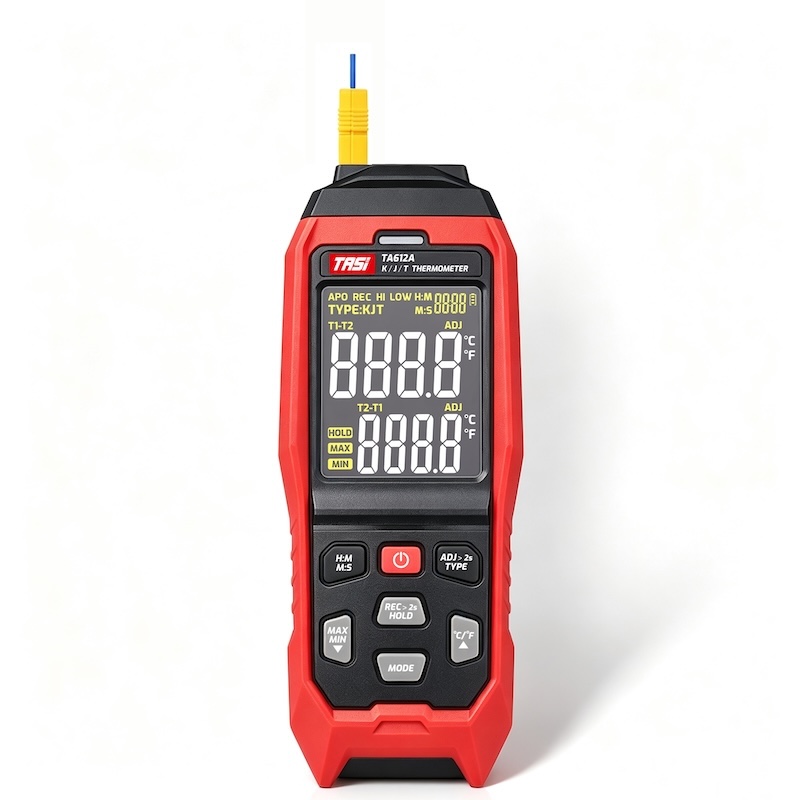
● Ensure that the thermocouple type matches the instrument input—for example, a K-type probe should be used with an instrument that supports K-type thermocouples;
● After prolonged high-temperature use, inspect the junction for oxidation, corrosion, or damage if measurement drift becomes noticeable.
For high-accuracy applications, overall measurement performance should also consider the accuracy of the thermometer, thermocouple probe, cold-junction compensation, and installation method rather than the junction configuration alone.
FAQ
Is an exposed junction thermocouple the fastest thermocouple configuration?
Among common junction configurations, exposed junction thermocouples generally provide very fast response because the measuring junction exchanges heat directly with the medium. Actual response time still depends on wire diameter, junction size, flow velocity, and installation conditions.
Can an exposed junction thermocouple measure liquids?
In principle, yes. However, suitability depends on the liquid. If the liquid is corrosive, electrically conductive, or likely to damage the junction, a protected or sheathed probe is usually more appropriate.
Can an exposed junction thermocouple be used at high temperatures?
High-temperature capability depends mainly on thermocouple type, conductor material, wire diameter, and atmosphere. Even when the thermocouple materials can withstand the temperature, oxidation and corrosion of an exposed junction may reduce service life.
Is an exposed junction thermocouple the same as a K-type thermocouple?
No. K type defines the thermocouple material combination and thermoelectric characteristics. “Exposed junction” describes the physical junction construction. K-, J-, T-, and E-type thermocouples can all be manufactured with exposed junctions where appropriate.
Why are exposed junction thermocouples often used for air-temperature measurements?
Air transfers heat relatively slowly. Because an exposed thermocouple junction has low mass and low thermal capacity and exchanges heat directly with the air, it can usually follow air-temperature changes faster than a heavily sheathed probe.
Conclusion
An exposed junction thermocouple has a measuring junction that is directly exposed to the measured environment. Its low thermal mass and short heat-transfer path provide fast temperature response.
This construction is particularly useful for air, gas, HVAC, laboratory, and transient-temperature measurements. However, because the junction lacks complete mechanical and environmental protection, its resistance to impact, corrosion, and long-term exposure is generally lower than that of a sheathed thermocouple.
When selecting an exposed junction thermocouple, response time should therefore be considered together with the measured medium, temperature range, mechanical conditions, electrical isolation requirements, and expected service life. For fast dynamic measurements in relatively benign environments, an exposed junction thermocouple is often an effective solution.