Introduction
LED lighting has become the preferred lighting solution in modern buildings due to its high efficiency, long service life, low energy consumption, and flexible design options.
However, the performance of an LED lighting system cannot be evaluated only by the rated power or visual brightness of the lamp. Professional measurement of actual illuminance is required to determine whether the lighting environment meets application requirements.
For example:
- Offices require sufficient lighting levels to reduce eye fatigue and improve working efficiency;
- Schools need appropriate illumination for reading and learning activities;
- Hospitals require safe and comfortable lighting environments;
- Industrial facilities need adequate lighting to ensure operational safety;
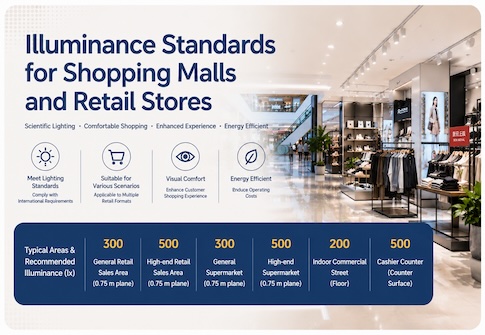
- Commercial spaces use optimized lighting to improve product presentation.
In these applications, a digital illuminance meter provides accurate measurement data to evaluate lighting conditions, verify installation quality, and optimize lighting performance.
Key Points of This Article
This article explains:
- What LED illuminance is;
- Why LED lighting illuminance measurement is important;
- What equipment is required for LED light measurement;
- How to correctly use a digital lux meter;
- Step-by-step LED illuminance testing procedures;
- Common measurement errors and how to avoid them;
- Practical methods to improve measurement accuracy.
1. What Is LED Lighting Illuminance?
1.1 Definition of Illuminance
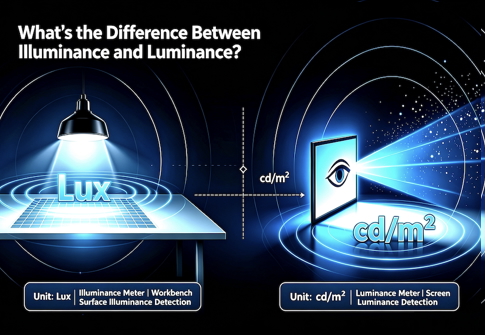
Illuminance is the amount of luminous flux received by a surface per unit area.
The formula is:
Illuminance = Luminous Flux / Illuminated Area
The measurement unit is:
Lux (lx)
Where:
1 lux = 1 lumen per square meter (lm/m²)
In simple terms, when a surface area of one square meter receives one lumen of visible light, the illuminance on that surface is one lux.
1.2 Difference Between Illuminance and LED Brightness
Many people assume that a brighter LED lamp always produces higher illuminance. However, these two concepts are different.
LED lamp brightness mainly depends on:
- Light output (lumens);
- LED power rating;
- Beam angle;
- Optical design;
- Lamp structure.
Actual illuminance is also influenced by:
- Installation height;
- Distance from the light source;
- Light distribution pattern;
- Wall and floor reflection;
- Room layout.
Therefore, the same LED fixture may produce different illuminance values depending on its installation environment.
2. Why Measure LED Lighting Illuminance?
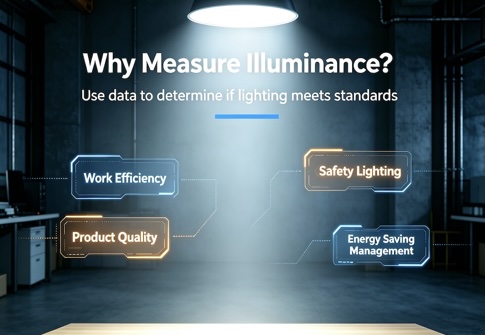
2.1 Verify Compliance with Lighting Requirements
Different environments have different lighting requirements.
For example:
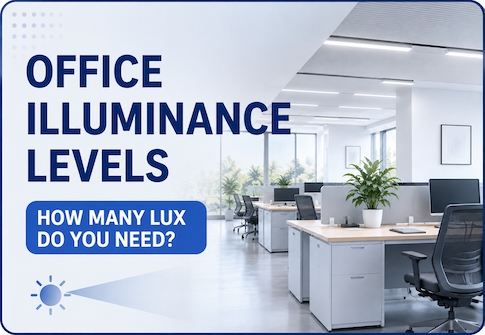
- Offices require sufficient illumination for comfortable working conditions;
- Classrooms require appropriate lighting for reading and writing;
- Industrial areas require adequate illumination for safe operation;
- Laboratories require stable and reliable lighting conditions.
Illuminance measurement helps determine whether the actual lighting level meets design requirements and applicable standards.
2.2 Optimize Lighting Design
During lighting design and installation, illuminance measurement helps engineers:
- Evaluate lighting distribution;
- Adjust fixture positions;
- Optimize the number of LED fixtures;
- Improve lighting uniformity.
2.3 Support Lighting Maintenance
Although LED fixtures have a long service life, their light output may decrease over time due to:
- LED aging;
- Driver performance degradation;
- Component deterioration;
- Reduced luminous efficiency.
Regular illuminance testing helps maintenance teams identify lighting performance changes and schedule timely replacement or adjustment.
3. What Equipment Is Required for LED Illuminance Measurement?
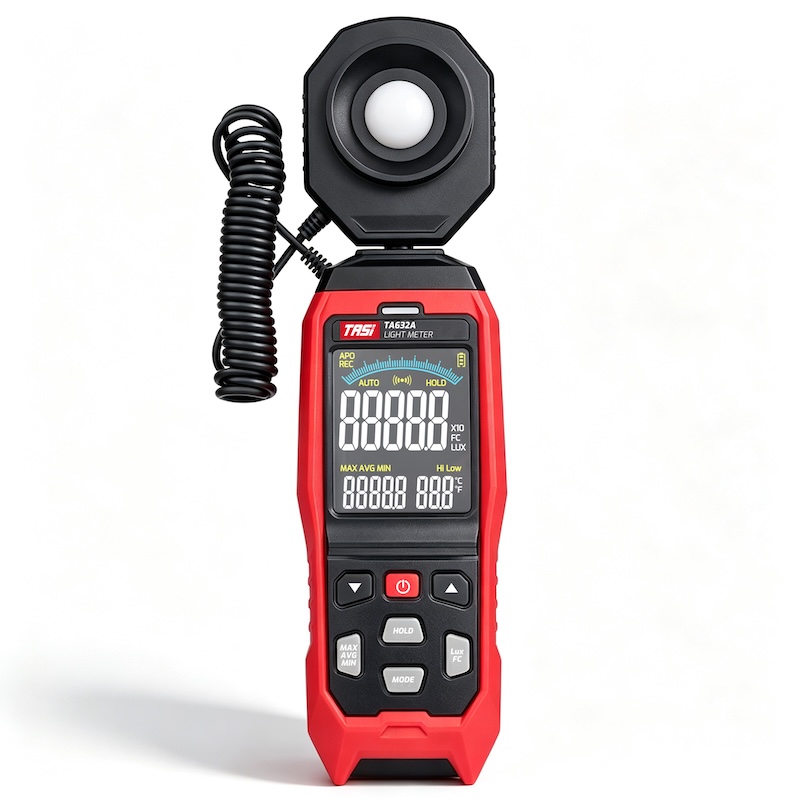
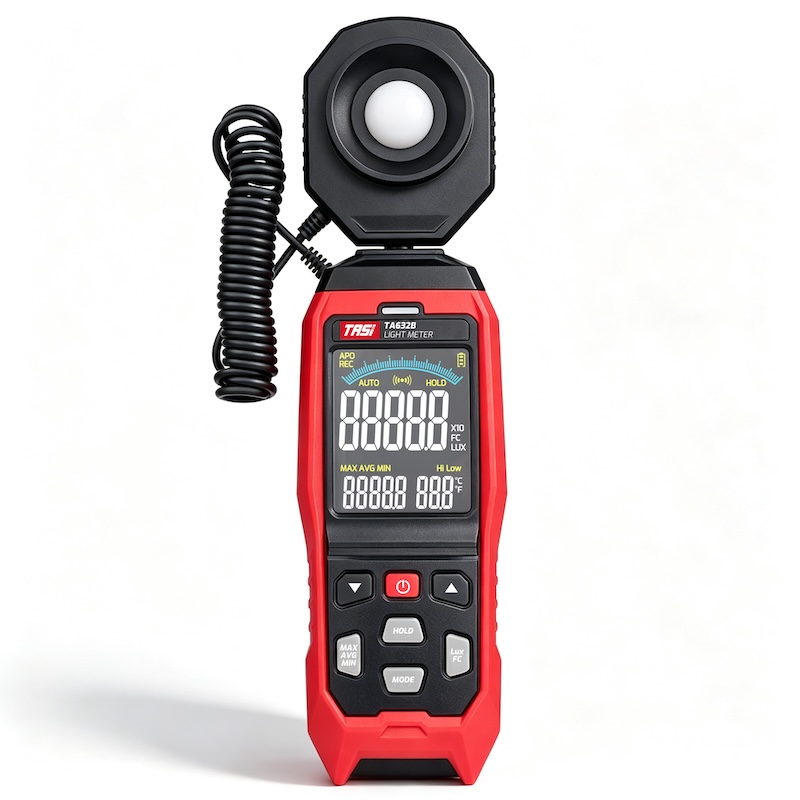
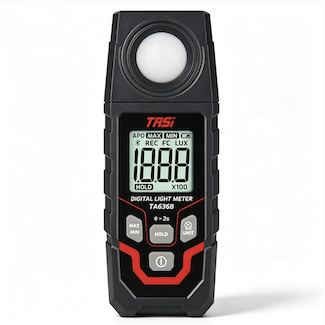
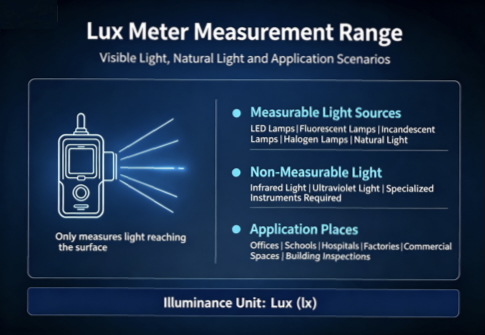
Digital Illuminance Meter (Lux Meter)
A digital illuminance meter is the standard instrument used for measuring LED lighting levels.
A professional lux meter typically consists of the following components:
3.1 Light Sensor
The sensor receives visible light emitted from the LED source.
Common sensor technologies include:
- Silicon photodiode sensors;
- Optical sensors;
- Sensors with spectral correction filters.
High-quality illuminance meters are designed to match human eye spectral sensitivity, providing more accurate measurement results.
3.2 Signal Processing Unit
The internal processing system is responsible for:
- Signal conversion;
- Data calculation;
- Measurement range selection;
- Digital display output.
3.3 Display Interface
The display shows:
- Illuminance value;
- Measurement unit;
- Battery status;
- Maximum/minimum readings;
- Data hold function.
4. Step-by-Step Procedure for Measuring LED Illuminance
Step 1: Select a Suitable Illuminance Meter
Choose an illuminance meter according to the application requirements.
Important factors include:
- Measurement range;
- Accuracy level;
- Sensor design;
- Data recording capability.
For general office lighting inspection, a standard digital lux meter is usually sufficient.
For professional lighting assessment, industrial inspection, or laboratory applications, a high-accuracy illuminance meter is recommended.
Step 2: Determine the Measurement Location
The measurement position should represent the actual working area.
Examples:
Office Lighting
Measure at:
- Desktop working height;
- Reading areas;
- Computer workstation areas.
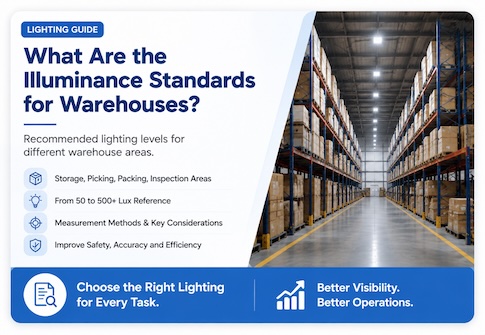
Industrial Lighting
Measure at:
- Production lines;
- Equipment operating areas;
- Inspection stations.
Commercial Lighting
Measure at:
- Product display areas;
- Customer walking areas;
- Retail counters.
Step 3: Allow the LED Light Source to Stabilize
Do not measure immediately after turning on LED lighting.
During startup, some LED fixtures may experience:
- Output fluctuation;
- Driver adjustment;
- Temporary light intensity variation.
Wait until the lighting system reaches stable operation before measurement.
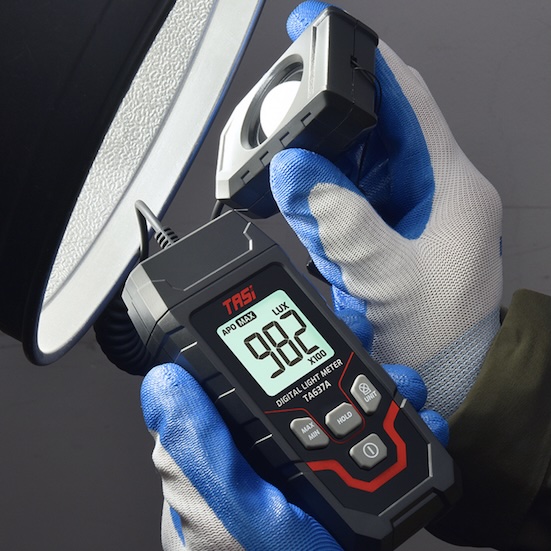
Step 4: Position the Sensor Correctly
During measurement:
- Keep the sensor surface horizontal;
- Face the sensor toward the main incoming light direction;
- Avoid blocking the sensor;
- Keep the operator away from the measurement point.
Avoid:
- Touching or covering the sensor;
- Tilting the sensor incorrectly;
- Blocking the light with your body.
Step 5: Record Measurement Results
After the reading becomes stable:
- Record the illuminance value;
- Measure multiple points if necessary;
- Record maximum, minimum, and average values;
- Document measurement locations and environmental conditions.
Multiple-point measurements provide a more complete evaluation of lighting quality.
5. Common Errors When Measuring LED Illuminance
5.1 Incorrect Measurement Position
Illuminance can vary significantly depending on location.
For example:
The area directly below an LED fixture usually has higher illuminance than areas farther away.
Solution:
Perform measurements based on actual working areas and use multiple measurement points.
5.2 Blocking Light with the Operator's Body
The operator may unintentionally affect the measurement by blocking or reflecting light.
Solution:
Maintain an appropriate distance and avoid standing between the light source and sensor.
5.3 Measuring Before LED Stabilization
Taking measurements immediately after switching on the light may result in inaccurate readings.
Solution:
Allow sufficient warm-up time before testing.
5.4 Using an Incorrect Measurement Range
An unsuitable measurement range may reduce measurement accuracy.
Solution:
Use automatic range selection or select an appropriate measurement range.
5.5 Ignoring Environmental Reflections
Surrounding surfaces can affect measured illuminance.
Examples:
- White walls reflect more light;
- Dark surfaces absorb more light.
The testing environment should be considered when analyzing measurement results.
6. How to Improve LED Illuminance Measurement Accuracy
6.1 Use a High-Quality Lux Meter
Professional illuminance meters provide:
- Higher measurement accuracy;
- Better spectral response;
- More stable measurement performance.
6.2 Calibrate the Instrument Regularly
Over time, sensor performance may change.
Regular calibration and inspection help maintain:
- Measurement reliability;
- Sensor performance;
- Long-term accuracy.
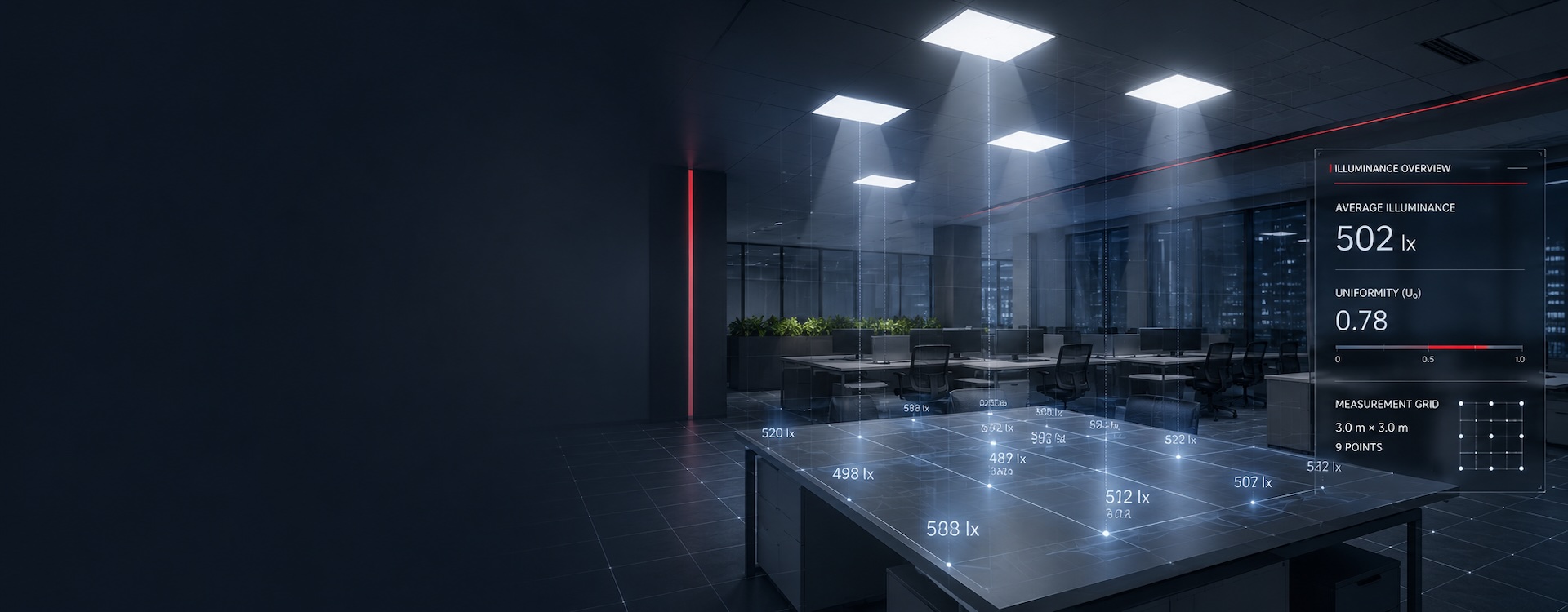
6.3 Perform Multi-Point Measurements
A single measurement point cannot fully represent overall lighting conditions.
Recommended practice:
- Divide the area into measurement zones;
- Measure multiple locations;
- Calculate average illuminance;
- Evaluate lighting uniformity.
7. LED Illuminance Measurement Applications
LED illuminance measurement is widely used in various industries and environments.
Office Buildings
Applications include:
- Workplace lighting evaluation;
- Meeting room lighting testing;
- Public area inspection.
Industrial Facilities
Applications include:
- Production line lighting;
- Equipment maintenance areas;
- Quality inspection stations.
Commercial Spaces
Applications include:
- Retail stores;
- Exhibition areas;
- Product display lighting.
Schools and Laboratories
Applications include:
- Classroom lighting;
- Laboratory workstations;
- Reading areas.
8. Conclusion
LED illuminance measurement is an essential method for evaluating lighting quality and ensuring proper lighting performance.
By using a professional digital illuminance meter, users can accurately measure actual lighting levels, verify whether LED lighting systems meet application requirements, and obtain reliable data for lighting optimization, energy management, and maintenance planning.
To achieve accurate measurement results, users should pay attention to measurement location, sensor orientation, light source stabilization, and environmental factors.
A correct measurement method combined with a reliable lux meter ensures accurate and valuable LED lighting evaluation results.