Introduction
● A thermocouple cannot provide reliable temperature measurement simply by joining any two arbitrary metals. Different metals and alloys have different thermoelectric properties and therefore generate different thermoelectric voltages under the same temperature conditions.
● K, J, T, E, R, S, and B thermocouples use different conductor materials because those materials differ in thermoelectric output, operating temperature range, stability, oxidation resistance, environmental compatibility, and cost.
● A thermocouple “type” therefore represents more than a name. It defines a standardized conductor combination together with a corresponding temperature-to-EMF relationship.
Key Points
● A thermocouple requires two conductors with different thermoelectric properties.
● Different material combinations generate different Seebeck voltages and cannot be substituted freely.
● The conductor materials influence sensitivity, usable temperature range, long-term stability, and environmental suitability.
● K, J, T, and E thermocouples mainly use nickel, iron, copper, and related alloys, while R, S, and B types use platinum and platinum-rhodium alloys.
● Thermocouple selection should consider temperature, atmosphere, accuracy requirements, response time, service life, and cost rather than maximum temperature alone.
Why Must a Thermocouple Use Two Different Metals?
● Thermocouple measurement is based on the Seebeck effect. When two dissimilar conductors form a circuit and their junction regions are at different temperatures, a thermoelectric voltage develops in the circuit.
● Different metals have different electronic structures and charge-carrier transport characteristics. As a result, they produce different thermoelectric responses to temperature.
● If both conductors were made from exactly the same material, an ideal circuit would not generate the differential thermoelectric voltage required for thermocouple temperature measurement.
● The measuring instrument detects this small voltage and, together with the standardized temperature-EMF relationship for the selected thermocouple type and cold-junction compensation, calculates the measuring-junction temperature.
Why Can’t All Thermocouples Use the Same Material Combination?
● No single thermocouple material combination provides optimum performance simultaneously at low temperature, high temperature, in oxidizing atmospheres, reducing atmospheres, humid conditions, and long-term industrial service.
● Some material combinations generate relatively high thermoelectric output but have limited high-temperature capability. Others offer excellent high-temperature stability but are significantly more expensive.
● Different thermocouple types therefore represent different engineering compromises. General industrial measurement emphasizes operating range and durability, low-temperature applications may prioritize stability, while high-temperature furnace applications require chemical stability and low long-term drift.
● Over time, material combinations with suitable repeatability, stability, and practical performance were standardized into commonly used thermocouple types such as K, J, T, E, N, R, S, and B.
Why Is the Seebeck Coefficient Important?
● Different conductor materials differ in the amount of thermoelectric voltage they develop in response to temperature. This behavior is related to the Seebeck coefficient.
● Thermocouple output depends on the difference between the thermoelectric characteristics of the two conductors. Changing either conductor changes the overall temperature-voltage relationship.
● One material pair may generate a relatively large voltage change per degree, while another produces a smaller signal. This affects sensor sensitivity and the requirements of the measurement electronics.
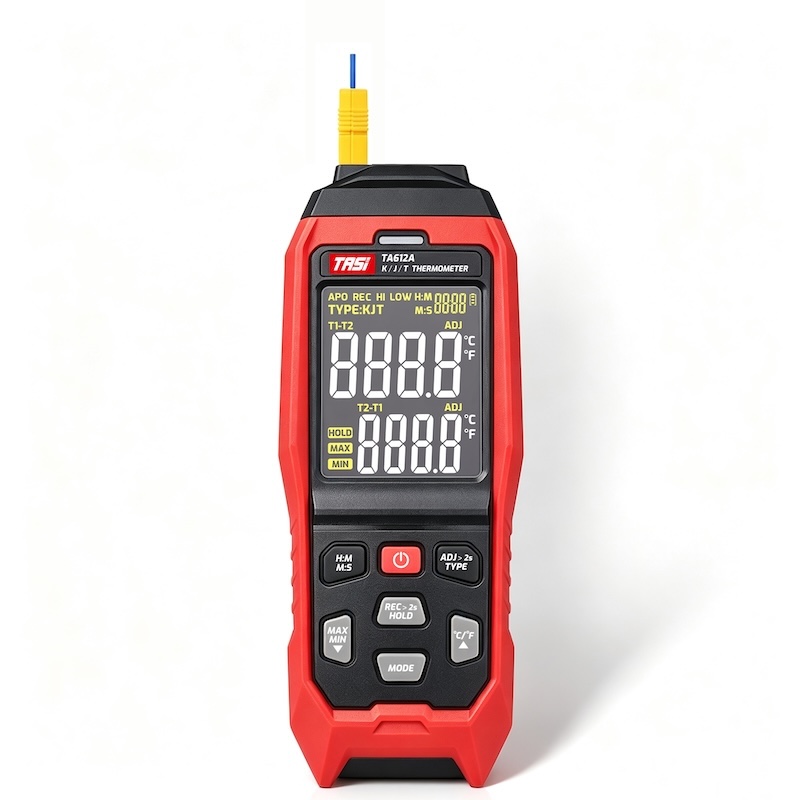
● This is why the measuring instrument must be configured for the correct thermocouple type. If a K-type probe is connected while the instrument is set to J type, the instrument applies the wrong temperature-EMF conversion and produces an incorrect temperature reading.
Why Does a K-Type Thermocouple Use Nickel-Based Alloys?
● A K-type thermocouple typically uses a nickel-chromium alloy (NiCr) and a nickel-aluminum-based alloy (NiAl).
● Nickel-based alloys retain useful mechanical and thermoelectric properties over a wide temperature range and provide good oxidation resistance in many air and oxidizing environments.
● Compared with noble-metal thermocouples, K-type materials are relatively economical. Compared with several other base-metal thermocouples, they also provide a relatively broad usable temperature range.
● This balance of performance, durability, and cost is why K-type thermocouples are widely used in industrial equipment, heating systems, HVAC, laboratories, and portable thermocouple thermometers.
Why Does a J-Type Thermocouple Use Iron and Copper-Nickel Alloy?
● A J-type thermocouple generally consists of iron (Fe) and a copper-nickel alloy (CuNi).
● Iron has useful thermoelectric characteristics and, when paired with copper-nickel alloy, provides a practical and stable thermoelectric output over its intended operating range.
● Because iron is susceptible to oxidation, J-type thermocouples are generally less suitable than nickel-based K types for prolonged operation in high-temperature oxidizing atmospheres.
● J type remains widely used for moderate-temperature industrial equipment, machinery, plastics processing, and legacy process-control systems originally designed for J-type sensors.
Why Does a T-Type Thermocouple Use Copper and Copper-Nickel Alloy?
● A T-type thermocouple typically uses copper (Cu) and copper-nickel alloy (CuNi).
● Copper provides good stability and consistency at lower temperatures, making T type particularly suitable for low- and medium-low-temperature measurement.
● T-type thermocouples are commonly used in refrigeration, food processing, laboratories, cold-chain applications, and other situations requiring stable low-temperature measurements.
● Copper is not intended for sustained service at the very high temperatures handled by certain nickel-based or noble-metal thermocouples. The primary advantage of T type is therefore low-temperature stability and repeatability rather than extremely high-temperature capability.
Why Does an E-Type Thermocouple Have a Relatively High Thermoelectric Output?
● An E-type thermocouple normally consists of nickel-chromium alloy (NiCr) and copper-nickel alloy (CuNi).
● The thermoelectric characteristics of these two materials differ significantly, giving E type a relatively high thermoelectric output per degree compared with many commonly used thermocouple types.
● A higher output means that the same temperature change produces a larger electrical signal, which can be advantageous in applications where measurement sensitivity is important.
● However, higher thermoelectric output does not automatically mean higher overall measurement accuracy. Accuracy still depends on thermocouple tolerance, material uniformity, cold-junction compensation, instrument accuracy, installation, and environmental conditions.
Why Do R-, S-, and B-Type Thermocouples Use Platinum and Platinum-Rhodium Alloys?
● R, S, and B types are noble-metal thermocouples based primarily on platinum and platinum-rhodium alloys.
● Platinum and platinum-rhodium alloys offer good chemical and thermoelectric stability at high temperatures and can operate in temperature regions where ordinary base-metal thermocouples may not provide sufficient long-term stability.
● These thermocouples are therefore used in high-temperature furnaces, heat treatment, glass and ceramic production, metallurgy, and high-temperature laboratory equipment.
● Their main disadvantage is cost. Platinum-based materials are considerably more expensive than the materials used in K, J, T, and E thermocouples and may also require greater attention to protection tubes, contamination, and installation conditions.
● The purpose of using noble metals is not simply to provide a “higher-grade” sensor, but to achieve the stability and reliability required for demanding high-temperature measurement.
Why Do Different Materials Affect the Temperature Range?
● A thermocouple’s usable temperature range is not determined only by the melting point of its conductors. High-temperature oxidation, microstructural changes, elemental diffusion, and irreversible thermoelectric drift must also be considered.
● A material may physically survive a high temperature while no longer maintaining the thermoelectric characteristics required for accurate long-term measurement.
● Iron, for example, is more susceptible to oxidation at elevated temperatures, while nickel-based alloys generally provide better high-temperature oxidation resistance. Platinum-rhodium systems offer even greater stability in suitable high-temperature applications.
● A published thermocouple temperature range should therefore be treated as an engineering specification influenced by conductor material, wire diameter, insulation, sheath or protection tube, atmosphere, and allowable error—not simply by the melting point of the metal.
Why Do Different Materials Affect Long-Term Stability?
● Ideally, both thermocouple conductors should remain homogeneous along their entire length. Oxidation, contamination, diffusion, mechanical strain, or metallurgical changes can alter local thermoelectric properties.
● Long-term exposure to elevated temperatures makes these effects more likely. If sections of the wire change their thermoelectric characteristics while located within a temperature gradient, additional thermoelectric errors can develop and appear as measurement drift.
● Different alloys resist these changes to different degrees, so material stability directly affects service life and long-term measurement reliability.
● For continuous or critical process monitoring, users should therefore consider not only the accuracy of a new sensor but also how well its materials remain stable after prolonged service.
Why Does the Atmosphere Affect Thermocouple Material Selection?
● Thermocouple materials may be directly exposed to the process environment or indirectly affected through a sheath or protection tube. Oxidizing, reducing, vacuum, corrosive, and humid conditions can all affect material performance.
● A thermocouple that performs well in air may not necessarily be suitable in a reducing atmosphere, vacuum, or chemically aggressive process.
● Chemical contamination becomes particularly important at elevated temperatures. Metal vapors, sulfur-containing compounds, and other contaminants can react with thermocouple conductors and change their composition and thermoelectric behavior.
● In demanding industrial environments, the correct thermocouple type may also need to be combined with a suitable stainless-steel, ceramic, or other protective sheath.
Why Do Thermocouple Materials Create Large Cost Differences?
● K, J, T, and E thermocouples use iron, copper, nickel, and their alloys and are generally classified as base-metal thermocouples. Their material and manufacturing costs are relatively moderate.
● R, S, and B thermocouples use platinum and platinum-rhodium alloys, resulting in substantially higher material costs.
● Price alone should not be used to judge thermocouple quality. In ordinary industrial measurement, an expensive noble-metal thermocouple may provide no practical benefit, while in high-temperature furnace service a base-metal thermocouple may not offer the required lifetime or stability.
● Correct selection means balancing operating temperature, measurement performance, environmental conditions, service life, and cost.
Can Different Thermocouple Materials Be Interchanged?
● In general, no. Each thermocouple type has a defined conductor combination and its own standardized temperature-EMF relationship.
● Even if two probes have the same physical shape or connector size, their internal materials may be different. When a K- or J-type probe is connected to a multi-input thermometer, the instrument must be set to the corresponding input type.
● Extension and compensating cables must also be compatible with the thermocouple type. Introducing unsuitable metals into the measurement circuit at locations where temperature differences exist can create additional thermoelectric voltages and measurement errors.
● When replacing probes, extension cables, connectors, or terminals, compatibility with the thermocouple type should always be verified.
What Should Be Considered When Selecting Thermocouple Materials?
● Temperature range: Determine the normal operating temperature as well as possible minimum and maximum temperatures.
● Process atmosphere: Identify whether the measurement location involves air, oxidizing conditions, reducing conditions, humidity, vacuum, or corrosive media.
● Measurement stability: For long-term continuous monitoring, pay particular attention to drift and resistance to material aging.
● Response time: In addition to material selection, wire diameter, junction design, and protective sheath strongly influence thermal response.
● Mechanical conditions: Vibration, bending, impact, and probe installation can affect the appropriate sensor construction.
● Measurement accuracy: Consider thermocouple tolerance together with instrument accuracy, cold-junction compensation error, and total system uncertainty.
● Cost and service life: General industrial measurement often prioritizes a balance of cost and performance, while critical or high-temperature applications may place greater emphasis on stability and lifetime.
FAQ
● Can any two different metals be used to make a thermocouple?
In principle, many pairs of dissimilar conductors can generate a thermoelectric voltage when exposed to a temperature difference. However, practical thermocouples require a stable, repeatable, and well-characterized temperature-EMF relationship together with suitable thermal, mechanical, and environmental properties.
● Why is K type more common than many other thermocouple types?
K type offers a useful balance of broad temperature range, oxidation resistance, mechanical robustness, cost, and general-purpose applicability.
● Are noble-metal thermocouples always more accurate than K type?
No. Their major advantage is high-temperature stability. Actual measurement accuracy also depends on thermocouple tolerance, instrumentation, cold-junction compensation, installation, and calibration.
● Can thermocouple connectors of different types be mixed?
It is not recommended. In addition to mechanical compatibility, connector materials should match the thermocouple system to avoid unwanted thermoelectric junctions or incorrect identification.
● Does thermocouple aging affect temperature readings?
Yes. Prolonged high-temperature exposure, oxidation, contamination, mechanical strain, and changes in material composition can alter thermoelectric properties and cause drift.
● When selecting a thermocouple, is the material or the temperature range more important?
They are closely related. Temperature capability is determined by the conductor materials together with wire size, insulation, protection, environment, and required accuracy. Selection should consider all of these factors.
Conclusion
● Different thermocouple types use different metals because each conductor pair has its own thermoelectric characteristics and therefore its own temperature-EMF relationship.
● K, J, T, and E thermocouples combine nickel-based alloys, iron, copper, and copper-nickel alloys in different ways to balance sensitivity, temperature range, stability, environmental resistance, and cost. R, S, and B types use platinum-based materials primarily to provide improved high-temperature stability.
● Thermocouple materials are therefore not interchangeable components. Understanding conductor combinations and their operating conditions is essential when selecting thermocouple probes, thermometer input settings, extension cables, and complete temperature-measurement systems.