Introduction
Type K and Type J are two widely used thermocouple types in industrial temperature measurement. Because their probes, connectors, and general appearance can sometimes look very similar, users often ask whether they can be substituted for one another.
In general, Type K and Type J thermocouples should not be used interchangeably.
The issue is not simply whether the connector fits. Type K and Type J thermocouples use different conductor materials and generate different thermoelectric voltages at the same temperature.
If the thermocouple type does not match the thermometer setting, the instrument may still display a temperature, but the reading can be significantly inaccurate.
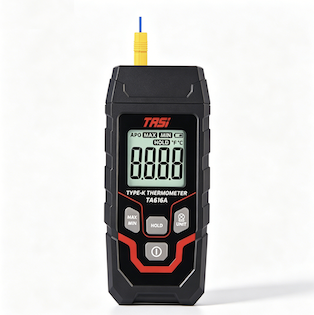
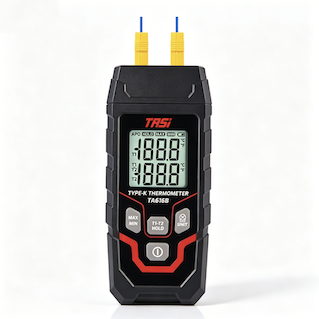
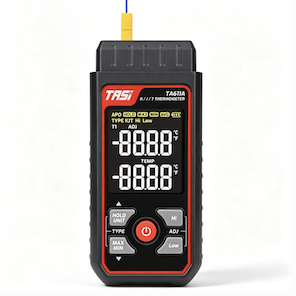
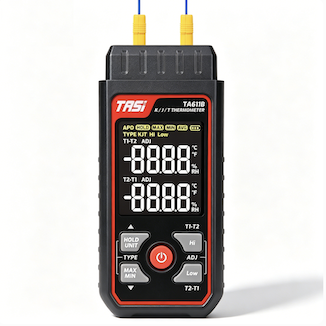
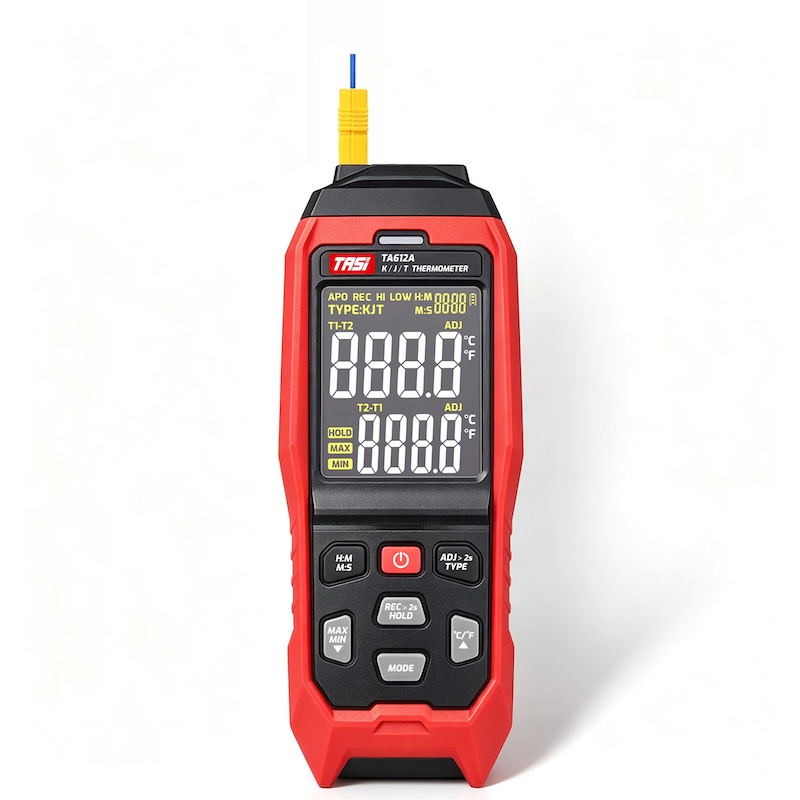
If the thermometer supports multiple thermocouple types, such as K and J, different probes may be used with the same instrument as long as the selected input type, probe, and associated connection components are correctly matched.
Key Points
● Type K and Type J thermocouples use different conductor materials and have different thermoelectric output characteristics;
● They should not be directly substituted without changing the thermocouple setting on the instrument;
● An incorrect thermocouple setting may still produce a displayed temperature, but the reading may be inaccurate;
● A multi-type thermocouple thermometer can accept Type K or Type J probes when the correct input type is selected;
● Extension wires, compensating cables, and connectors should also match the thermocouple type;
● Connector size, appearance, or wire color alone should not be used to determine whether Type K and Type J thermocouples are interchangeable.
Why Can’t Type K and Type J Thermocouples Be Used Interchangeably?
Thermocouples measure temperature using the Seebeck effect. When two dissimilar metals or alloys form a circuit and there is a temperature difference between the measuring junction and the reference junction, a small thermoelectric voltage is generated.
Different thermocouple types use different material combinations and therefore have different EMF-to-temperature characteristics.
Type K thermocouples are commonly made from nickel-chromium and nickel-aluminium alloys, while Type J thermocouples typically use iron and copper-nickel alloy.
Even at the same temperature, the millivolt outputs of the two thermocouple types are different.
A thermocouple thermometer does not simply read a voltage and display it directly as temperature. It measures the thermoelectric signal and then applies cold-junction compensation, linearization, and the appropriate thermocouple conversion data.
If a Type J thermocouple is connected while the instrument is set to Type K, the thermometer interprets the Type J signal using Type K characteristics, resulting in an incorrect temperature reading.
Why Can the Thermometer Still Display a Reading When the Types Are Mismatched?
This is one of the most common sources of misunderstanding.
Even when a Type J thermocouple is connected to a thermometer configured for Type K, the thermocouple still generates a thermoelectric voltage as long as there is a temperature difference between the measuring and reference junctions.
The thermometer can detect this signal, so it will often display a temperature value.
The problem is that the wrong conversion relationship is being used.
For example, a Type J probe produces a millivolt signal according to Type J characteristics, but a thermometer set to Type K converts that signal using the Type K curve. The displayed value can therefore be higher or lower than the actual temperature.
The resulting error is generally not constant.
As temperature changes, the difference between the Type K and Type J output characteristics also changes. This means the error cannot normally be corrected by simply adding or subtracting a fixed temperature value.
Can the Same Thermometer Be Used With Both Type K and Type J Thermocouples?
Yes, provided that the thermometer is specifically designed to support both thermocouple types.
Some digital thermocouple thermometers support several input types, such as K, J, T, and E.
With these instruments, the probe can be changed according to the measurement requirement, but the thermocouple type selected on the instrument must also be changed accordingly.
● When using a Type K probe, set the instrument input to Type K;
● When changing to a Type J probe, switch the instrument input to Type J;
● After replacing the probe, also confirm that the connector and extension cable match the selected thermocouple type.
If a thermometer is specified for Type K only, the fact that a Type J connector physically fits does not mean the instrument can measure a Type J thermocouple correctly.
Is Matching the Probe and Instrument Setting Enough?
For basic handheld measurements, the first requirement is to ensure that the probe type matches the thermometer setting.
In a complete thermocouple measurement system, however, extension wires, compensating cables, connectors, and terminal materials must also be considered.
Thermocouple circuits are sensitive to conductor materials.
If incompatible metals are introduced into the circuit and temperature differences exist at the junctions, additional thermoelectric voltages can be generated and affect the final reading.
Therefore:
● Type K thermocouples should use extension or compensating cables intended for Type K;
● Type J thermocouples should use corresponding Type J wiring;
● Ordinary wire should not be used casually as a substitute for proper thermocouple extension cable;
● For higher-accuracy measurements, the entire measurement chain should be correctly matched.
For industrial temperature measurement, laboratory work, and equipment verification, simply confirming that the probe “plugs in” is not sufficient.
Can Type K and Type J Thermocouple Connectors Be Interchanged?
Connector compatibility should not be determined by physical size alone.
Some thermocouple connectors have similar or identical mechanical dimensions, so probes of different types may appear to fit.
However, the conductive materials used inside thermocouple connectors may be selected specifically for the corresponding thermocouple type.
If the connector material does not match the thermocouple circuit, additional thermoelectric voltages may be introduced when temperature differences exist around the connection point.
Color coding can also vary between standards and regions.
For example, IEC and ANSI color conventions are not identical. For this reason, wire or connector color alone should not be used to identify a thermocouple type.
A more reliable approach is to check the K, J, or other type marking on the probe, connector, cable, or product label.
How Can Type K and Type J Thermocouples Be Prevented From Being Mixed Up?
● Check the thermocouple type marking on the probe or connector before use;
● Confirm that the thermocouple type selected on the thermometer matches the actual probe;
● Recheck the instrument setting whenever the probe is replaced;
● Use the correct extension or compensating cable when extending the measurement circuit;
● Do not identify the thermocouple type solely by connector size or color;
● For critical measurements, verify the complete measurement system at a known temperature point.
If a probe has lost its identification and its thermocouple type cannot be confirmed, it should not be used for measurements requiring reliable accuracy.
Using a clearly identified probe with known specifications is the safer choice.
FAQ
Will connecting a Type K thermocouple to a Type J thermometer damage the instrument?
Usually not.
Thermocouples generate only small millivolt-level signals, so a thermocouple type mismatch will not normally damage the thermometer.
However, the instrument will use the wrong temperature conversion relationship, which can result in significant measurement error.
Why does a Type J thermocouple still show a temperature on a thermometer set to Type K?
Because the Type J thermocouple still generates a thermoelectric voltage that the thermometer can detect.
However, the instrument interprets that voltage using Type K characteristics, so the displayed value may not represent the actual temperature.
Does every thermometer that supports Type K also support Type J?
No.
The supported thermocouple types vary by instrument. Always check the product specification or operating manual.
Only instruments specifically rated for Type J input can correctly measure a Type J thermocouple.
Can Type K and Type J thermocouples use the same extension wire?
Generally, no.
The two thermocouple types use different conductor materials, and their extension or compensating cables are also different.
Using the wrong cable can introduce additional thermoelectric voltages and increase measurement error.
Is Type K better than Type J?
Neither type is universally better.
Type K is widely used for general-purpose industrial temperature measurement and offers a broad usable temperature range. Type J is also commonly used in industrial equipment and moderate-temperature applications.
The correct choice depends on the temperature range, operating environment, equipment compatibility, and probe construction.
Is the error caused by selecting the wrong thermocouple type constant?
Usually not.
Type K and Type J have different EMF-to-temperature relationships, and the difference between them changes with temperature.
As a result, the measurement error caused by an incorrect thermocouple setting also varies with the actual temperature.
Conclusion
Type K and Type J thermocouples are both widely used industrial temperature sensors, but they use different conductor materials and have different EMF-to-temperature characteristics. They should therefore not be used interchangeably unless the instrument is configured for the correct thermocouple type.
A multi-input thermocouple thermometer can be used with either Type K or Type J probes, provided that the actual probe type matches the instrument setting and that the extension wire, compensating cable, and connector are also correctly matched.
In practical temperature measurement, physical connector compatibility or the presence of a displayed reading does not confirm thermocouple compatibility.
Correctly identifying the thermocouple type and maintaining a properly matched measurement circuit are essential for accurate and stable temperature measurements.