Introduction
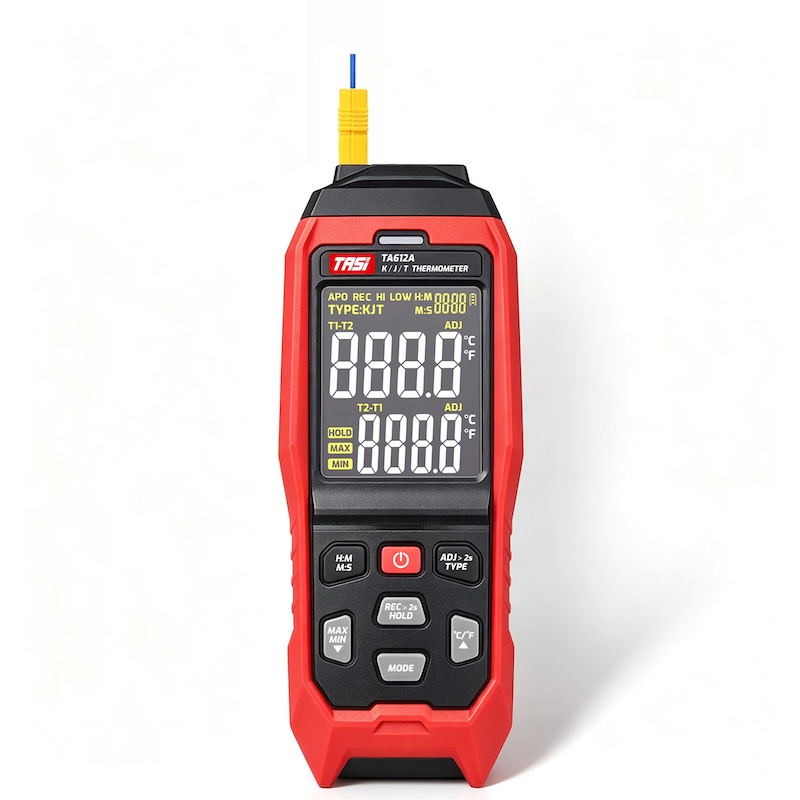
Yes. Thermocouples can be used to measure air temperature and are widely used in HVAC systems, industrial equipment, environmental monitoring, laboratories, ovens, ventilation ducts, and cold-storage applications.
Compared with liquids or metal surfaces, however, air transfers heat less effectively. A thermocouple probe may therefore require more time to reach thermal equilibrium with the surrounding air. Probe size, airflow velocity, nearby heat sources, and measurement position can also influence the reading.
The main question is therefore not whether a thermocouple can measure air temperature, but how to select and position the probe so that the reading accurately represents the air being measured.
Key Takeaways
● Thermocouples can directly measure the temperature of air and other gases;
● Air transfers heat relatively slowly, so response time is usually longer than in liquids;
● Fine-wire, exposed-junction, or low-thermal-mass thermocouples are generally better for fast air temperature measurements;
● Direct exposure to sunlight, heaters, furnace walls, and other radiant heat sources should be avoided;
● HVAC ducts and air outlets require careful consideration of airflow and probe position;
● The reading should be allowed to stabilize before it is recorded as the air temperature.
Why Can a Thermocouple Measure Air Temperature?
A thermocouple is made from two dissimilar metal conductors. When there is a temperature difference between the measuring junction and the reference junction, a thermoelectric voltage is generated. The thermometer measures this small voltage and converts it into temperature using cold-junction compensation and the temperature-voltage relationship for the selected thermocouple type.
For this reason, thermocouples are not limited to measuring solids or liquids. As long as the measuring junction can exchange heat effectively with the surrounding air and approach thermal equilibrium, it can be used to determine air temperature.
For example, when a K-type thermocouple probe is positioned inside an air duct, heat is continuously exchanged between the moving air and the sensing junction. Once the probe temperature approaches the local air temperature, the displayed value can be used to represent the temperature at that measurement point.
Why Is the Response Slower When Measuring Air?
Air has a much lower density and thermal conductivity than most liquids and metals. As a result, less heat is transferred to or from the thermocouple probe within a given period, so the probe normally requires more time to reach thermal equilibrium.
The thermal mass of the probe also has a direct effect on response time. Larger-diameter probes and probes with thick metal sheaths contain more material that must change temperature and therefore generally respond more slowly.
Under the same conditions:
● A fine-wire exposed-junction thermocouple normally responds quickly;
● A small-diameter probe generally responds faster than a larger-diameter probe;
● A heavily sheathed industrial probe provides greater mechanical protection but normally responds more slowly in air.
When fast air temperature measurement is required, probe response time should therefore be considered together with thermocouple type and temperature range.
Does Airflow Affect Thermocouple Measurements?
Yes. Air velocity affects convective heat transfer between the thermocouple and the surrounding air.
Within normal operating conditions, increased airflow generally improves heat transfer and allows the sensing junction to approach the actual air temperature more quickly. The same probe may therefore respond considerably more slowly in still air than in moving air.
This is one reason thermocouples often stabilize relatively quickly in HVAC ducts, air outlets, or industrial ventilation systems, while measurements in still indoor air may take longer.
However, temperatures may vary across different locations within a duct. Measurements taken close to duct walls, heating elements, cooling coils, or air-mixing zones may not represent the average temperature of the entire airflow.
Why Can Radiant Heat Affect Air Temperature Measurement?
A thermocouple exchanges heat not only through convection with the surrounding air but also through radiation with nearby surfaces and objects.
For example, a probe may be positioned in air at approximately 25°C but located close to a hot furnace wall, heating element, sunlit surface, or another high-temperature object. The probe can absorb additional radiant energy and become warmer than the surrounding air, producing a higher reading.
Likewise, a probe positioned close to a significantly colder surface may indicate a lower temperature.
For accurate air temperature measurement, the probe should therefore be positioned so that its temperature is determined primarily by the surrounding air rather than by radiation from nearby surfaces.
Where Should the Probe Be Positioned?
Probe position determines which part of the air volume the measurement represents. The correct location depends on the measurement objective.
● For indoor ambient temperature measurements, avoid direct sunlight, air-conditioning outlets, doors, windows, and nearby heat-generating equipment;
● In ventilation ducts, place the sensing junction within the main airflow rather than directly against the duct wall;
● Inside equipment, prevent the sensing junction from touching metal housings, motors, heaters, or other solid components;
● In ovens or high-temperature air, consider the effect of thermal radiation from surrounding walls;
● For comparative measurements, keep probe location, insertion depth, and airflow conditions as consistent as possible.
If the objective is to determine the average temperature of a large space, a single measurement point may not be sufficient. Multiple measurement locations may be required.
Which Thermocouple Probe Is Best for Measuring Air?
For air and gas temperature measurements, probes with low thermal mass and fast response are generally preferred.
An exposed-junction thermocouple places the sensing junction directly in the air without a thick protective sheath. This provides fast response and is suitable for laboratories, HVAC applications, environmental testing, and general air temperature measurements.
A small-diameter sheathed thermocouple provides a balance between response speed and mechanical protection and is often suitable for industrial environments, ventilation ducts, and equipment interiors.
Where corrosive gases, high temperatures, elevated pressure, or mechanical impact are present, probe material, protection, and safety requirements should take priority over response speed alone.
How Should a Thermocouple Be Used for Air Temperature Measurement?
For stable and representative air temperature readings:
● Select the appropriate thermocouple type and probe construction for the temperature range, environment, and required response time;
● Position the sensing junction completely within the target air volume and prevent it from touching other objects;
● Avoid direct exposure to sunlight, furnace walls, heating elements, or other strong sources of radiant heat;
● In ducts, select a position that represents the main airflow;
● Allow the reading to stabilize before recording the result;
● When comparing different locations or times, use a consistent probe position and measurement method;
● For higher-accuracy applications, consider the combined uncertainty of the thermocouple probe, thermometer, and measurement environment.
FAQ
Can a thermocouple measure indoor air temperature?
Yes. Thermocouples can measure indoor ambient temperature. However, the probe should be kept away from direct sunlight, air-conditioning outlets, doors, windows, people, and heat-generating equipment that may create localized temperature differences.
Can a K-type thermocouple measure air temperature?
Yes. K-type thermocouples have a wide temperature range and are commonly used for industrial and HVAC air temperature measurements. Actual response time depends mainly on probe construction, diameter, and measurement conditions rather than thermocouple type alone.
Why does a thermocouple take longer to stabilize in air?
Air transfers heat relatively slowly, so the probe requires time to reach thermal equilibrium with its surroundings. Larger-diameter probes and probes with thicker protective sheaths generally require more time to stabilize.
Does a thermocouple need to be in contact with the air?
Yes. A thermocouple is a contact temperature sensor. Its measuring junction must be directly exposed to the target air or gas so that heat can be transferred to or from the probe.
Is measuring air temperature with a thermocouple the same as using an infrared thermometer?
No. A thermocouple measures temperature through heat exchange with the surrounding air, while an infrared thermometer primarily measures infrared radiation emitted by a surface. A conventional infrared thermometer does not normally measure the temperature of the air itself.
Is it normal for an air temperature reading to fluctuate?
Small variations are normal because actual air temperature, airflow velocity, and local temperature distribution may continuously change. Large or irregular fluctuations may indicate a poor probe connection, incorrect thermocouple type setting, wiring problems, or electrical interference.
Conclusion
Thermocouples can be used effectively for air temperature measurements in HVAC systems, industrial maintenance, environmental monitoring, laboratories, ventilation ducts, ovens, cold storage, and many other applications.
Compared with solid or liquid temperature measurements, air measurements are more sensitive to probe response time, airflow, measurement position, and radiant heat from surrounding surfaces.
Selecting a low-thermal-mass probe with an appropriate response time and positioning the sensing junction correctly in the target airflow can significantly improve the stability and representativeness of the measurement.
For air temperature measurement, proper probe selection, installation, and measurement technique are just as important as the specified accuracy of the thermocouple itself.