Introduction
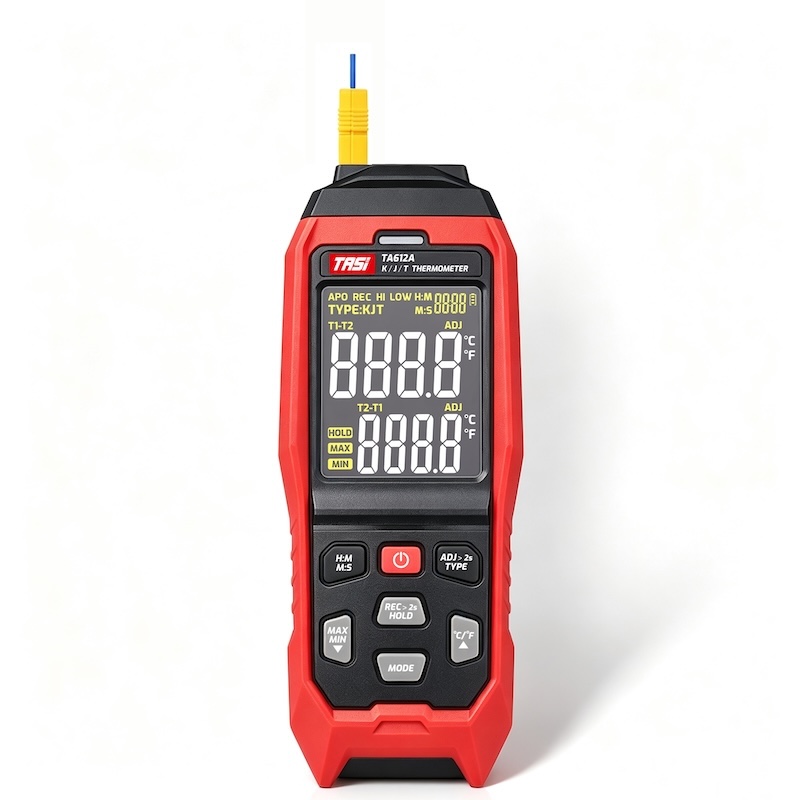
When selecting a thermocouple probe, parameters such as thermocouple type, temperature range, probe diameter, and junction construction usually receive the most attention. However, probe length is another important factor that can affect practical measurement performance.
For example, consider two K-type thermocouple probes with lengths of 50 mm and 150 mm. Even if both use the same thermocouple materials and have the same accuracy class, they may still produce different readings when measuring the temperature inside a pipe.
The reason is usually not that the longer probe is inherently more accurate. The difference is more often caused by sensing position, effective insertion depth, and heat conduction along the probe.
It is therefore useful to distinguish three concepts:
● Probe length: the mechanical length from the installation reference point to the probe tip;
● Insertion depth: the length of the probe that actually extends into the measured medium or measurement zone;
● Sensing position: the location of the thermocouple measuring junction that actually responds to temperature.
In practical applications, the latter two usually have the greater influence on measurement results.
Key Takeaways
● Thermocouple probe length alone does not determine measurement accuracy;
● A probe that is too short may prevent the measuring junction from reaching the intended sensing location;
● Insufficient insertion depth can increase heat conduction along the probe and introduce stem conduction error;
● Where temperature gradients exist, probes of different lengths may measure different physical locations;
● A longer probe is not automatically more accurate and should be selected according to the installation and sensing requirements;
● Probe length should be considered together with probe diameter, insertion depth, thermowell design, and available installation space.
Does Thermocouple Probe Length Directly Affect Accuracy?
In general, no.
If two thermocouple probes use the same thermocouple materials, construction, probe diameter, and manufacturing tolerance, and their measuring junctions are located at the same temperature point, simply changing the overall probe length does not automatically change the thermocouple accuracy class.
For example, a 100 mm K-type probe cannot be considered less accurate than a 200 mm K-type probe simply because it is shorter, provided both measuring junctions are exposed to the same uniform temperature.
In real installations, however, the temperature field is rarely perfectly uniform.
Changing probe length can affect:
● The location that the measuring junction can physically reach;
● The achievable insertion depth;
● The heat conduction path between the sensing area and the external environment;
● The position of the probe within a temperature gradient;
● The influence of thermowells, mounting threads, fittings, or equipment walls.
Probe length therefore affects measurement results mainly indirectly through the installation and thermal conditions.
Why Can a Probe That Is Too Short Cause Measurement Error?
For insertion-type thermocouples, one of the most common problems with an undersized probe is insufficient insertion depth.
Suppose the temperature of a hot fluid inside a pipe needs to be measured. If the probe is too short, the measuring junction may remain close to the pipe wall instead of reaching farther into the process medium.
Two problems can result.
First, the temperature near the pipe wall may differ from the temperature in the central flow region, so the thermocouple may not be measuring the intended process temperature.
Second, part of the metal probe may remain exposed to a cooler external environment. Heat can then be conducted along the probe between the process and the surroundings, disturbing the thermal equilibrium around the measuring junction.
This effect is commonly referred to as stem conduction error or insertion-related heat conduction error.
If the probe does not extend sufficiently into a thermally stable zone, heat may flow along the probe from the hotter region toward the cooler region, or in the opposite direction during low-temperature measurements. The sensing junction can then deviate from the actual temperature of the medium.
What Is Effective Thermocouple Insertion Depth?
Effective insertion depth means more than simply inserting a probe by a certain number of millimetres.
The objective is to position the measuring junction, together with a sufficient length of the surrounding probe, inside the measured temperature environment so that heat transfer from the external surroundings has only a limited influence.
In temperature calibration and other controlled applications, rules of thumb based on a multiple of the probe diameter are sometimes used to estimate minimum immersion or insertion depth. Values in the range of approximately 15 to 20 probe diameters, with additional allowance for the sensing element length, are commonly encountered.
This is not a universal requirement for every thermocouple. The appropriate value depends on probe construction, installation geometry, required accuracy, and the manufacturer's recommendations.
In general:
● Larger-diameter probes usually require greater insertion depth;
● Probes with more metal mass may be more susceptible to axial heat conduction;
● Larger differences between process temperature and ambient temperature increase the importance of conduction effects;
● High-accuracy measurements require more careful evaluation of insertion depth.
Simply placing the probe tip inside the medium does not necessarily mean that the insertion depth is sufficient.
Why Is Sensing Position More Important Than Overall Probe Length?
A thermocouple measures temperature at the location of the junction formed by its two dissimilar thermoelectric conductors. It does not measure the average temperature along the entire probe.
In most sheathed thermocouple probes, the measuring junction is positioned near the probe tip.
The first question when selecting probe length should therefore be:
Where exactly should the temperature be measured?
If the objective is to measure the temperature near the centre of a pipe, the probe must be long enough to position the measuring junction in that region.
If the probe is too short and only reaches the area near the pipe wall, the reading may differ from the actual temperature in the central part of the flow even when the thermocouple itself is functioning correctly.
The same consideration applies to:
● Liquid tanks;
● Industrial ovens and furnaces;
● HVAC air ducts;
● Laboratory equipment;
● Process gas piping;
● Internal machinery temperature monitoring.
A thermocouple can be accurate as a sensor while still measuring the wrong physical location.
Why Can Temperature Gradients Make Different Probe Lengths Produce Different Readings?
Real measurement environments often contain non-uniform temperature distributions.
A heated process pipe, for example, may have:
● A higher temperature in the central flow region;
● A lower temperature close to the pipe wall;
● A still lower temperature at the outer pipe surface;
● A much lower surrounding air temperature.
This is a temperature gradient.
Probes of different lengths may position their measuring junctions at different points within that gradient and therefore display different temperatures.
This does not necessarily mean that one of the thermocouples is defective. They may simply be measuring different locations within the same system.
Similar effects occur in dry-block calibrators, temperature baths, furnaces, and other environments with axial or spatial temperature gradients.
When comparing two thermocouples, inserting them by the same visible distance is not always sufficient. Their actual sensing junctions should be positioned as closely as possible within the same temperature zone.
Is a Longer Thermocouple Probe More Accurate?
No.
The main advantage of a longer probe is that it can provide sufficient reach for deeper installations and allow the measuring junction to reach the intended temperature zone.
Once the required sensing location and effective insertion depth have been achieved, increasing probe length further does not normally improve thermocouple accuracy.
An unnecessarily long probe can also create practical disadvantages:
● Insufficient installation space;
● Increased risk of bending or mechanical damage;
● Higher mechanical loading in flowing media;
● Interference with internal equipment structures;
● Positioning the measuring junction beyond the intended sensing zone;
● More difficult installation and maintenance.
The correct approach is therefore not to select the longest possible probe, but to choose a length that reaches the correct sensing position and provides adequate insertion depth.
Why Should Probe Length and Probe Diameter Be Considered Together?
Probe length should not be evaluated independently of probe diameter.
For example, a 100 mm probe with a diameter of 1 mm behaves differently from a 100 mm probe with a 6 mm metal sheath. Their thermal mass, mechanical strength, and axial heat conduction characteristics are different.
A larger-diameter probe generally contains more metal and has a greater cross-sectional area. In some applications, this makes insertion depth and stem conduction effects more important.
Probe diameter also affects:
● Response time;
● Mechanical strength;
● Required insertion hole size;
● Heat conduction characteristics;
● Heat transfer between the probe and the measured medium.
Probe length, diameter, and sensing position should therefore be considered as part of the same measurement design.
Are Length Requirements the Same for Liquids, Gases, and Solids?
Not necessarily.
For liquid measurements, the thermocouple measuring junction should normally be sufficiently immersed in the liquid and should not remain unnecessarily close to the vessel wall. If the liquid is thermally stratified, the required measurement depth must also be defined.
For gas measurements in pipes or air ducts, insertion depth should be selected according to pipe or duct dimensions, flow conditions, and the expected temperature distribution. A measurement close to the wall may not represent the bulk gas or airflow temperature.
For solid materials, the required probe length is mainly determined by the depth of the measurement hole and the intended sensing position. If the probe is too short, the measuring junction may not reach the specified internal point.
Surface thermocouples are different. In surface measurements, insertion depth is generally not the main concern. Contact quality, contact pressure, surface condition, and heat exchange with the surrounding air are usually more important.
There is therefore no single probe length that is suitable for every type of measurement.
Why Is Probe Length Especially Important When Using a Thermowell?
Industrial thermocouples are frequently installed inside a thermowell or protective tube.
In this case, the nominal probe length does not necessarily equal the actual depth of the measuring junction inside the process.
Mounting threads, flanges, fittings, pipe-wall thickness, equipment housings, and the thermowell structure can all consume part of the available mechanical length.
For example, specifying a 150 mm thermocouple does not automatically mean that its measuring junction will extend 150 mm into the process medium.
The complete installation should consider:
● The length occupied by the mounting connection;
● The actual thermowell insertion depth;
● Whether the thermocouple tip correctly reaches the bottom of the thermowell;
● The distance between the thermowell tip and the intended measurement zone.
Thermowell dimensions, material, and insertion depth can also affect thermal response and measurement performance.
For industrial installations, probe length should therefore be determined from the complete dimensional stack-up of the assembly, rather than from probe length alone.
How Can You Determine Whether the Current Insertion Depth Is Insufficient?
Where the installation allows the probe position to be adjusted safely, changing the insertion depth can provide a useful indication.
After the process temperature has become reasonably stable:
● Record the current temperature;
● Insert the probe farther into the measurement zone;
● Allow the reading to stabilise again;
● Compare the two readings.
If the indicated temperature continues to change significantly and systematically as insertion depth increases, the original measurement may have been affected by temperature gradients, incorrect sensing position, or stem conduction.
If further insertion results in progressively smaller changes and the reading becomes stable, the measuring junction is likely entering a more representative and thermally stable region.
This method should only be used where probe movement is permitted and safe. In high-temperature, high-pressure, rotating, sealed, or hazardous industrial systems, probe position must follow the approved installation design and operating procedure.
What Should Be Considered When Selecting Thermocouple Probe Length?
A practical selection process should consider the following:
● Identify the actual location where temperature must be measured;
● Determine the distance from the mounting point to the target sensing location;
● Provide sufficient effective insertion depth;
● Consider probe diameter and axial heat conduction;
● Account for the length occupied by threads, flanges, fittings, or thermowells;
● Check for possible mechanical interference inside the equipment;
● For pipe measurements, consider pipe diameter and temperature distribution;
● For large temperature differences or high-accuracy measurements, pay greater attention to insertion depth and conduction error;
● When using a thermowell, confirm that the probe tip reaches the intended position inside the thermowell;
● Follow the specific recommendations of the thermocouple and installation-system manufacturer.
The correct thermocouple probe length should therefore be determined by the required sensing position and installation geometry, not by the assumption that longer is always better.
FAQ
Is a longer thermocouple probe always more accurate?
No. Probe length alone does not improve thermocouple accuracy. Once the measuring junction reaches the correct sensing location and sufficient insertion depth is achieved, additional probe length normally provides no significant accuracy benefit.
What happens if a thermocouple probe is too short?
The measuring junction may fail to reach the intended temperature zone. Insufficient insertion depth can also increase stem conduction error and make the measurement more sensitive to ambient temperature.
Why does the reading change when the thermocouple is inserted deeper?
The measured region may contain a temperature gradient, or the original insertion depth may have been insufficient. Deeper insertion can move the measuring junction into a different temperature zone while reducing heat conduction from the external environment.
How deep should a thermocouple be inserted?
There is no single value suitable for every thermocouple. The required depth depends on probe diameter, sensing construction, medium, temperature difference, installation design, and accuracy requirement. Rules of thumb based on approximately 15 to 20 probe diameters are sometimes used, but the manufacturer's recommendations should take priority.
Which is more accurate: a 100 mm or a 200 mm thermocouple probe?
If both probes have the same construction, thermocouple type, and accuracy specification and both measuring junctions are positioned correctly in the same temperature zone, length alone does not determine which one is more accurate.
Can thermowell length affect thermocouple measurement results?
Yes. Thermowell insertion depth, diameter, material, and the position of the thermocouple inside the thermowell can all influence heat transfer and the actual sensing location.
Conclusion
Thermocouple probe length can affect measurement results, but probe length itself is usually not the direct cause of a change in sensor accuracy.
The critical questions are whether the measuring junction can reach the correct sensing location and whether sufficient effective insertion depth is available.
A probe that is too short can introduce sensing-position errors, temperature-gradient effects, and stem conduction error. Once the probe is long enough for the required installation, additional length usually does not improve accuracy and may instead create mechanical and installation difficulties.
For reliable temperature measurement, probe length, diameter, insertion depth, sensing position, thermowell design, installation geometry, and actual temperature distribution should be evaluated together.
The most representative measurement is obtained when the thermocouple measuring junction is correctly positioned in the temperature zone that actually needs to be monitored.