Introduction
A thermocouple is a temperature sensor based on the thermoelectric effect. When two dissimilar conductors form a thermocouple circuit and their junctions are at different temperatures, a thermoelectric voltage is generated. For this reason, a thermocouple does not directly measure the absolute temperature at one point. It responds to the temperature difference between the measuring junction and the reference junction.
In practical applications, the thermocouple wires are normally connected to a thermometer, data acquisition system, controller, or other measuring instrument. The temperature at this connection point is not fixed. If the instrument does not account for changes in reference-junction temperature, the calculated temperature can contain significant error.
Most modern thermocouple instruments therefore use Cold Junction Compensation (CJC). The instrument measures the temperature near the reference junction and incorporates this value into the thermocouple conversion.
Key Points
● A thermocouple voltage depends on the temperature difference between the measuring junction and the reference junction, not only on the measuring-junction temperature.
● Cold junction compensation corrects for temperature changes at the thermocouple input connection.
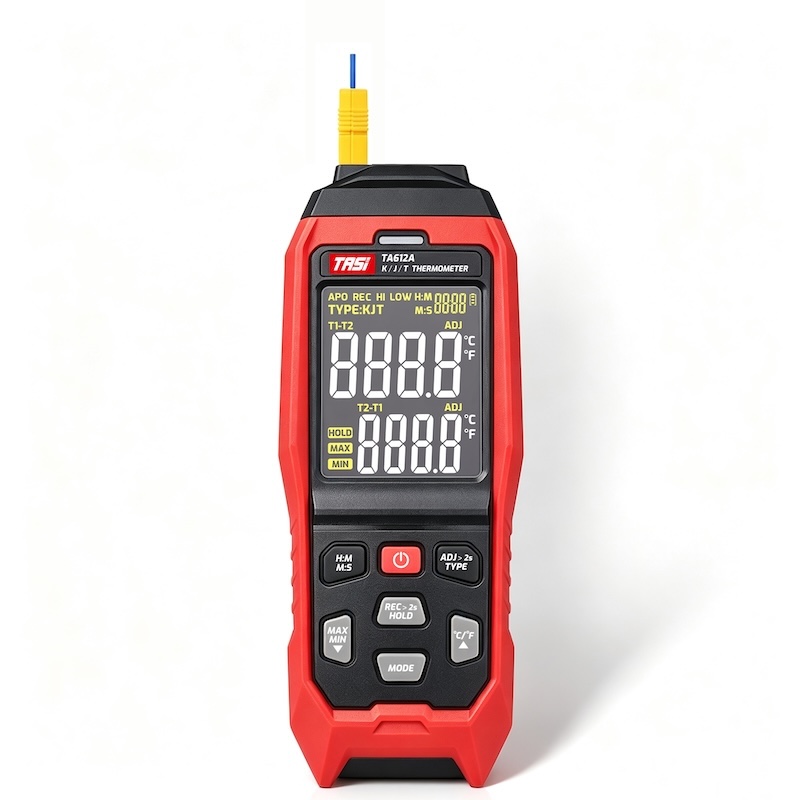
● Modern digital thermocouple thermometers usually perform CJC automatically using an internal temperature sensor.
● CJC accuracy depends on the sensor accuracy, sensor location, thermal coupling, and temperature stability inside the instrument.
● CJC cannot eliminate errors caused by the thermocouple probe, installation, environmental conditions, wiring, or instrument accuracy.
Why Do Thermocouples Need Cold Junction Compensation?
A thermocouple consists of two dissimilar conductors. When the measuring junction is at temperature T₁ and the reference junction is at temperature T₂, a thermoelectric voltage is generated.
The basic relationship can therefore be understood as:
Thermocouple output = thermoelectric voltage corresponding to the temperature difference between the measuring and reference junctions
For example, suppose the thermocouple measuring junction is exposed to a high temperature while the connection to the instrument remains near room temperature. The voltage received by the instrument represents the thermoelectric relationship between these two temperatures.
If the reference-junction temperature changes while the actual process temperature remains constant, the thermocouple voltage can also change.
Therefore, an instrument that converts thermocouple voltage directly into temperature without accounting for the reference-junction temperature can produce an incorrect result.
Cold junction compensation determines the actual reference-junction temperature and includes its effect in the temperature calculation.
What Is the “Cold Junction” of a Thermocouple?
“Cold junction” is a traditional thermocouple term. It is also commonly called the reference junction.
The term does not mean that this junction must actually be cold.
For example, the measuring junction may be at 500 °C while the instrument terminals are at 25 °C, in which case the reference junction is clearly cooler. However, when measuring a low temperature such as −50 °C while the instrument is at 20 °C, the so-called cold junction is actually warmer than the measuring junction.
For this reason, “reference junction” is technically more precise.
In a digital thermocouple thermometer, the reference junction is normally associated with the thermocouple connector, input terminals, or the transition point between thermocouple materials and the instrument's internal conductors.
How Does Cold Junction Compensation Work?
Modern digital thermocouple instruments normally do not maintain the reference junction physically at 0 °C. Instead, they use electronic compensation.
A typical CJC process can be summarized as follows:
● The thermocouple probe generates a millivolt-level signal corresponding to the temperature difference between the measuring junction and the reference junction.
● A temperature sensor inside the instrument measures the temperature near the thermocouple input terminals.
● The instrument determines the equivalent thermoelectric voltage corresponding to that reference-junction temperature for the selected thermocouple type.
● This equivalent voltage is combined with the actual thermocouple voltage.
● The resulting value is converted into temperature using the characteristic voltage-temperature relationship of the selected thermocouple type.
CJC is therefore not simply a matter of “adding room temperature” to the displayed temperature. The instrument must perform the appropriate thermoelectric conversion based on the thermocouple characteristic curve.
Why Is 0 °C Traditionally Used as the Reference Temperature?
Standard thermocouple voltage-temperature relationships are conventionally defined relative to a reference junction at 0 °C.
In traditional laboratory measurements, the reference junction can be placed in a stable ice-water mixture to maintain a temperature close to 0 °C. This provides a known and reproducible reference temperature.
For portable thermometers, industrial controllers, and data acquisition equipment, however, maintaining an ice-point reference is impractical.
Modern instruments therefore use electronic cold junction compensation. They measure the actual reference-junction temperature and mathematically convert the measured signal to the equivalent condition of a 0 °C reference junction.
This allows thermocouple instruments to operate directly under normal field and industrial conditions.
How Does a Thermocouple Thermometer Measure the Cold-Junction Temperature?
A digital thermocouple thermometer typically includes a separate temperature sensor near the thermocouple input connector.
Depending on the instrument design, this sensor may be a thermistor, semiconductor temperature sensor, or another temperature-sensing device.
Ideally, the CJC sensor should measure a temperature that closely represents the actual temperature at the transition between the thermocouple conductors and the instrument's copper circuitry.
For this reason, the CJC sensor is normally located close to the input terminals and designed for good thermal coupling.
If the temperature measured by the CJC sensor differs from the actual reference-junction temperature, additional compensation error can result.
Does Cold Junction Compensation Affect Thermocouple Thermometer Accuracy?
Yes.
The total measurement error of a thermocouple system usually consists of several components, and CJC error is one of them.
For example:
● The thermocouple probe itself has a specified tolerance.
● The instrument's millivolt measurement circuitry has measurement error.
● Thermocouple linearization and conversion introduce additional uncertainty.
● The CJC temperature sensor has its own accuracy limits.
● A temperature difference may exist between the CJC sensor and the actual reference junction.
As a result, two thermocouple thermometers connected to the same probe may show slightly different readings because of differences in CJC design, input circuitry, calibration, and internal thermal conditions.
For higher-accuracy applications, the uncertainty of the complete measurement system should be considered rather than looking only at the thermocouple probe specification.
When Can CJC Error Increase?
Cold junction compensation generally performs best when the instrument is thermally stable. If a significant temperature gradient develops around the input terminals, CJC error can increase.
Typical situations include:
● The thermometer has just been moved from a cold outdoor environment into a warm room.
● The instrument is exposed to direct sunlight for an extended period.
● The thermometer is located close to a furnace, heater, hot-air outlet, or other heat source.
● The thermocouple plug temperature differs significantly from the instrument input-terminal temperature.
● Internal heating occurs in a multi-channel data acquisition system.
● The instrument has just been powered on and has not yet reached thermal equilibrium.
● One side of the input connector is exposed directly to localized hot or cold airflow.
Under these conditions, the CJC sensor may temporarily fail to represent the actual reference-junction temperature accurately.
When measurements are made after a large environmental temperature change, allowing the instrument to reach thermal stability can improve measurement reliability.
What Is the Difference Between CJC Temperature and Ambient Temperature?
They are related, but they are not necessarily the same.
Ambient temperature generally refers to the air temperature surrounding the instrument. CJC, however, requires the temperature at the actual thermocouple reference-junction location.
For example, the room temperature may be 25 °C, but if the instrument is exposed to sunlight, the temperature around its thermocouple terminals may reach 30 °C or higher.
Using 25 °C as the reference temperature in such a case could introduce additional error.
A well-designed thermocouple thermometer therefore measures temperature as close as practical to the thermocouple input connection rather than relying on a general ambient-temperature value.
Is CJC the Same for Different Thermocouple Types?
The basic CJC principle is the same, but the compensation calculation depends on the thermocouple type.
K, J, T, E, and other thermocouple types use different conductor materials and therefore have different voltage-temperature characteristics.
The instrument must know both the reference-junction temperature and the type of thermocouple connected to the input. It then applies the appropriate thermocouple characteristic relationship during compensation and linearization.
This is why multi-input thermocouple instruments normally require the correct thermocouple type to be selected.
If a K-type thermocouple is connected while the instrument is configured for J type, the temperature reading will be incorrect even if the CJC circuit itself is functioning correctly.
Can CJC Correct Errors Caused by Extension Wires and Connectors?
Not in every case.
Cold junction compensation is intended to correct for reference-junction temperature. The materials used throughout the thermocouple measurement circuit must still be compatible with the selected thermocouple type.
Using ordinary copper wire to extend a thermocouple incorrectly, or using incompatible thermocouple connectors, compensation cable, or extension wire, can create unintended thermoelectric junctions.
Errors caused by these material mismatches cannot simply be removed by CJC.
Thermocouple systems should therefore use connectors, compensation cable, or extension wire appropriate for the thermocouple type, and polarity must be connected correctly.
Why Can a Thermocouple Still Measure Incorrectly Even with CJC?
Cold junction compensation is only one part of the thermocouple measurement chain and cannot correct every source of measurement error.
Other factors include:
● Whether the correct thermocouple type is selected in the instrument.
● Whether the probe is suitable for the required temperature range.
● Whether the thermocouple probe remains within its specified tolerance.
● Whether the probe has adequate thermal contact with the measured object.
● Whether the measuring junction has actually reached the temperature of the target.
● Whether the wiring, connectors, and polarity are correct.
● Whether the instrument is operating within its specified environmental conditions.
● Whether sufficient stabilization time has been allowed after a temperature change.
Accurate CJC therefore does not automatically guarantee that the entire thermocouple measurement system is accurate.
How Can Cold-Junction Compensation Error Be Reduced?
The following practices can improve thermocouple measurement stability:
● Keep the instrument input terminals away from strong heat sources, direct cold airflow, and direct sunlight.
● After moving the instrument between environments with significantly different temperatures, allow it to reach thermal stability before making precision measurements.
● Use connectors and extension wires that are compatible with the selected thermocouple type.
● Ensure the thermocouple plug is securely connected to the instrument.
● Avoid leaving high-temperature thermocouple connectors directly against hot equipment surfaces.
● For precision applications, evaluate the combined uncertainty of the thermocouple, instrument, CJC system, and installation method.
● Periodically check or verify the measurement performance of both the instrument and thermocouple probe.
FAQ
Does the “cold junction” always have to be colder than the measuring junction?
No. “Cold junction” is a traditional term. “Reference junction” is more technically accurate. It may be either cooler or warmer than the measuring junction.
Do all thermocouple thermometers have CJC?
Most modern digital thermocouple thermometers, data acquisition systems, and temperature controllers include cold junction compensation, but the implementation and accuracy depend on the instrument specification.
Does CJC simply add room temperature to the thermocouple reading?
No. The instrument normally converts the reference-junction temperature into the equivalent thermoelectric voltage for the selected thermocouple type and then performs the required voltage calculation and linearization.
Where is the CJC sensor located?
It is generally positioned close to the thermocouple input terminals or connector so that it can closely represent the actual reference-junction temperature.
Can ambient-temperature changes affect CJC?
Yes. Rapid environmental temperature changes or localized heating and cooling can temporarily create a temperature difference between the CJC sensor and the actual reference junction.
How large can a CJC error be?
The actual error depends on the CJC temperature-sensing accuracy, thermocouple type, instrument design, and operating conditions. For precision measurements, refer to the instrument specification for CJC accuracy or total thermocouple measurement accuracy.
Is CJC still required when thermocouple extension wire is used?
Yes. Correct thermocouple extension wire maintains the appropriate thermoelectric circuit but does not eliminate the need for reference-junction compensation at the instrument input.
Can the same CJC temperature sensor be used for different thermocouple types?
Yes. The physical sensor used to measure the reference-junction temperature can be the same, but the compensation calculation must be performed according to the characteristics of the selected K, J, T, E, or other thermocouple type.
Summary
Cold Junction Compensation (CJC) is a fundamental part of modern thermocouple measurement systems. Because thermocouple voltage depends on the temperature difference between the measuring junction and the reference junction, the instrument must know the actual reference-junction temperature to determine the measuring-junction temperature correctly.
Modern digital thermocouple thermometers generally use a temperature sensor near the input terminals to measure the reference-junction temperature and then apply compensation according to the voltage-temperature relationship of the selected thermocouple type.
CJC is only one element of the complete measurement system. Probe accuracy, wiring, input circuitry, installation, environmental temperature, and thermal stability can all influence the final result.
For applications requiring higher measurement accuracy, the thermocouple, instrument, cold junction compensation, and installation should therefore be evaluated as one complete measurement system.