Introduction
Thermocouples are widely used for temperature measurement in industrial maintenance, laboratories, HVAC systems, heating equipment, electrical testing, and manufacturing processes.
Unlike RTDs and thermistors, which measure temperature through changes in electrical resistance, a thermocouple generates a small voltage when a temperature gradient exists along a circuit made from two dissimilar conductors. A measuring instrument detects this voltage and converts it into a temperature value based on the thermocouple type and reference-junction temperature.
Understanding thermocouple measurement therefore begins with three key concepts: dissimilar conductors, temperature difference, and thermoelectric voltage.
Key Takeaways
● A thermocouple is normally made from two dissimilar conductor materials.
● Its operating principle is based on the Seebeck effect.
● A thermocouple produces a thermoelectric voltage rather than directly outputting temperature.
● The measuring instrument must use the correct thermocouple type to convert voltage into temperature.
● Thermocouple measurement depends on the relationship between the measuring junction and reference junction, so cold-junction compensation is normally required.
● Common thermocouple types include K, J, T, E, N, R, S, and B.
● Measurement accuracy can be affected by thermocouple type, wiring, extension or compensating cable, ambient temperature, probe contact, and instrument accuracy.
What Is a Thermocouple?
A thermocouple is a temperature sensor that uses the thermoelectric properties of two dissimilar conductors to measure temperature.
In its simplest form, two wires made from different metals or alloys are joined together. The sensing point is commonly called the measuring junction, hot junction, or sensing junction.
A Type K thermocouple, for example, uses a nickel-chromium alloy and a nickel-aluminium alloy as its thermoelectric conductors.
When a temperature gradient exists in the thermocouple circuit, a very small thermoelectric voltage is produced. The signal is typically in the microvolt-to-millivolt range and must therefore be measured using a suitable thermocouple thermometer, data-acquisition system, transmitter, or temperature controller.
A thermocouple does not simply produce a fixed voltage for a particular absolute temperature. Its output depends on the thermoelectric properties of the conductor pair and the temperature distribution within the circuit.
Why Can a Thermocouple Measure Temperature?
The physical principle behind thermocouple temperature measurement is the Seebeck effect.
When a conductor is exposed to a temperature gradient, the energy distribution of its charge carriers changes, producing a temperature-dependent electrical potential. Different materials have different thermoelectric properties, so when two dissimilar conductors form a thermocouple circuit, the combined effect produces a measurable thermoelectric voltage.
The measurement process can be simplified as follows:
● Two dissimilar conductors form a thermocouple.
● The measuring junction is exposed to the temperature being measured.
● The other end is connected to the measuring instrument at another temperature.
● A temperature difference exists in the circuit.
● A corresponding thermoelectric voltage is generated.
● The instrument measures this voltage.
● The instrument uses the thermocouple type and reference-junction temperature to calculate the measuring-junction temperature.
A temperature gradient is therefore fundamental to the thermoelectric signal used for measurement.
If the entire thermocouple circuit were at a completely uniform temperature, the net thermoelectric voltage would not simply represent that absolute temperature.
Does a Thermocouple Measure Temperature or Voltage?
The thermocouple itself first produces an electrical voltage.
This signal is generally referred to as thermoelectric EMF or thermoelectric voltage. Its magnitude depends on the thermocouple materials and on the temperature relationship between the measuring and reference junctions.
Each thermocouple type has its own temperature-versus-voltage characteristic.
For example, Type K and Type T thermocouples do not generate the same thermoelectric voltage under identical temperature conditions. A thermocouple thermometer must therefore know which thermocouple type is connected.
Modern instruments contain standard reference data, polynomial functions, or digital algorithms that convert the measured voltage into a temperature value.
This is why thermocouple thermometers commonly provide selectable inputs such as K, J, T, E, N, R, and S.
If a Type K probe is connected while the instrument is set to Type J, the displayed temperature may be significantly incorrect even though both the probe and instrument are functioning properly.
What Is the Measuring Junction?
The point where the two thermoelectric conductors are joined at the sensing end is called the measuring junction, sensing junction, or hot junction.
During measurement, this point must exchange heat effectively with the object or medium being measured.
For surface-temperature measurements, the sensing area of a surface probe should make stable thermal contact with the target surface. For air or gas measurements, the appropriate probe must be sufficiently exposed to the medium so that adequate heat transfer can occur.
A thermocouple therefore measures the temperature reached by its own sensing junction.
If the sensing junction has not yet approached thermal equilibrium with the target, the displayed value may temporarily be above or below the actual target temperature.
This is why thermocouple measurements require a finite response time.
Why Does a Thermocouple Need a Reference Junction?
The thermoelectric voltage produced by a thermocouple depends on temperature differences. Measuring only the thermocouple voltage is therefore not enough to determine the absolute temperature of the measuring junction.
If the measuring-junction temperature remains constant while the temperature at the instrument terminals changes, the measured thermoelectric voltage also changes.
Traditional thermocouple reference tables are based on a reference junction at 0 °C.
In practical measurements, however, the instrument terminals are normally at ambient temperature rather than 0 °C.
Modern electronic thermocouple thermometers therefore measure the actual terminal temperature and compensate for it electronically.
This process is called cold-junction compensation (CJC).
What Is Cold-Junction Compensation?
Cold-junction compensation is a fundamental part of a thermocouple measurement system.
When thermocouple conductors are connected to a measuring instrument, they eventually transition to copper or other conductors inside the instrument. These material transitions form additional junctions whose temperatures must be considered.
Modern thermocouple instruments typically place a temperature sensor close to the input terminals to measure the local reference-junction temperature.
The instrument then combines:
● the measured thermocouple voltage;
● the selected thermocouple type;
● the measured input-terminal temperature;
● the corresponding temperature-versus-EMF characteristic.
From this information, it calculates the temperature of the measuring junction.
A thermocouple thermometer therefore does much more than multiply a measured voltage by a fixed factor. It performs precision voltage measurement, cold-junction compensation, and nonlinear temperature conversion.
What Happens from Probe Contact to Temperature Display?
Using a Type K thermocouple connected to a digital thermocouple thermometer as an example, the measurement process is:
● The measuring junction contacts the target and exchanges heat with it.
● The temperature of the measuring junction changes.
● A thermoelectric voltage develops as a result of the temperature gradient and the thermoelectric properties of the two conductors.
● The millivolt-level signal reaches the thermometer.
● The instrument uses the Type K characteristic selected by the user or configured by the system.
● The reference-junction temperature near the input terminals is measured.
● Cold-junction compensation is applied.
● The signal is converted according to the Type K temperature-versus-voltage relationship.
● The calculated temperature is shown on the display.
The thermocouple converts temperature information into an electrical signal, while the thermometer performs signal measurement, compensation, linearisation, and display.
What Are the Common Thermocouple Types?
Thermocouples are available in several standard types, each based on a different pair of thermoelectric materials.
Common types include:
● Type K: Widely used for industrial maintenance, HVAC, heating systems, and general-purpose temperature measurement. It offers a broad practical temperature range.
● Type J: Common in some industrial equipment and established temperature-measurement systems.
● Type T: Frequently used for low- and medium-temperature applications and known for good performance at lower temperatures.
● Type E: Provides relatively high thermoelectric output and good sensitivity within its operating range.
● Type N: Suitable for elevated temperatures and valued in some applications for improved high-temperature stability.
● Types R, S, and B: Typically used for higher-temperature industrial, laboratory, furnace, and specialist measurement applications.
Thermocouple types are not directly interchangeable because their materials, temperature ranges, thermoelectric characteristics, and application limits differ.
Why Is the Thermocouple Voltage-to-Temperature Relationship Nonlinear?
The relationship between thermocouple voltage and temperature is generally nonlinear.
There is therefore no single fixed equation such as:
Temperature = thermoelectric voltage × constant
that remains accurate over the complete operating range.
Over a limited range, thermocouple sensitivity may be approximated in µV/°C, but this sensitivity changes with temperature.
Professional thermocouple instruments therefore use standard reference characteristics or polynomial functions to perform nonlinear conversion.
This linearisation is an important part of the signal-processing system inside a digital thermocouple thermometer.
Why Are Thermocouples Suitable for Wide Temperature Ranges?
A thermocouple sensing element has a relatively simple construction and does not require complex electronic circuitry at the sensing tip.
Depending on thermocouple type, insulation, sheath material, and probe construction, thermocouples can be designed for measurements ranging from low temperatures to very high industrial temperatures.
Typical probe designs include:
● bead-wire probes for fast air, gas, and general measurements;
● surface probes for pipes, metal plates, and machine components;
● penetration probes for liquids, soft materials, and semi-solid media;
● air and gas probes for ducts and environmental measurements;
● high-temperature probes for furnaces, heating equipment, and industrial processes.
Thermocouple technology can therefore be adapted to a wide variety of sensing structures and applications.
What Factors Affect Thermocouple Measurement Accuracy?
Thermocouple measurement accuracy depends on the complete measurement chain, not only on the thermometer itself.
● Correct thermocouple type: The probe type must match the instrument setting.
● Thermocouple tolerance: Different thermocouple grades, materials, and manufacturing quality have different permissible deviations.
● Cold-junction compensation: Errors in reference-junction temperature measurement directly affect the calculated temperature.
● Instrument accuracy: Millivolt measurement, signal processing, and conversion all contribute to measurement uncertainty.
● Probe contact: Poor thermal contact can cause significant errors in surface measurements.
● Response time: A probe may not immediately follow rapidly changing target temperatures.
● Wiring and connectors: Incorrect extension materials or inappropriate copper-wire extensions can introduce additional thermoelectric voltages.
● Ambient temperature changes: After moving an instrument between environments with very different temperatures, its reference-junction compensation system may require time to stabilise.
● Electromagnetic interference: Because thermocouple signals are very small, suitable wiring, shielding, and routing may be required in electrically noisy environments.
For higher-accuracy measurements, the probe, instrument, wiring, installation, and application conditions must therefore be considered together.
Can Thermocouple Wires Be Extended with Ordinary Wire?
Ordinary copper wire should not normally be used to extend a thermocouple arbitrarily.
Thermocouple measurement relies on the thermoelectric properties of specific conductor materials. Introducing other materials at junctions located at different temperatures can generate additional thermoelectric voltages and cause measurement errors.
When additional cable length is required, suitable thermocouple extension cable or compensating cable should be used for the corresponding thermocouple type, together with compatible thermocouple connectors.
A Type K measurement system, for example, should use wiring and connectors intended for Type K service rather than relying solely on electrical conductivity.
What Is the Difference Between a Thermocouple and a Thermocouple Thermometer?
The terms are related but do not describe the same component.
A thermocouple is the temperature sensor that converts temperature information into a small thermoelectric voltage.
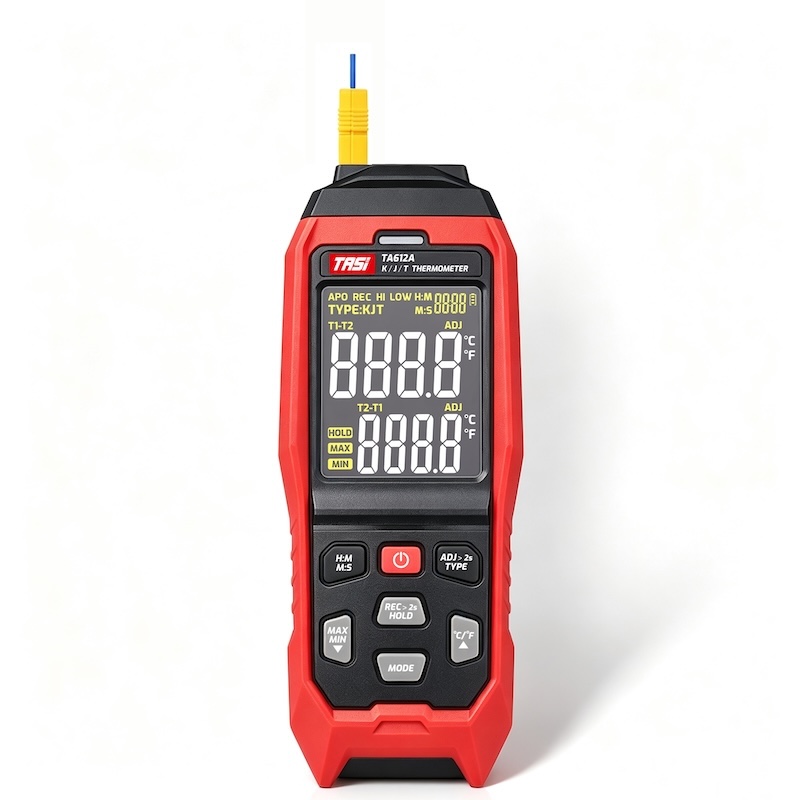
A thermocouple thermometer is the measuring instrument that acquires the signal, applies cold-junction compensation and nonlinear conversion, and displays the resulting temperature.
A complete portable thermocouple measurement system may therefore include:
● a thermocouple probe;
● thermocouple wiring and connectors;
● a thermocouple thermometer;
● a cold-junction compensation system;
● signal-conditioning and temperature-conversion electronics.
Different probes can be used for different applications, provided that the thermocouple type is compatible with the instrument input.
What Is the Difference Between Thermocouples, RTDs, and Thermistors?
Thermocouples, RTDs, and thermistors are all temperature sensors, but they operate differently.
● Thermocouples use thermoelectric voltage generated by dissimilar conductor materials.
● RTDs use the predictable change in electrical resistance of a metal element with temperature.
● Thermistors use the highly temperature-sensitive resistance characteristics of semiconductor materials.
Thermocouples are particularly useful where a broad temperature range, flexible probe construction, high-temperature capability, or relatively fast response is required.
However, no sensor technology is universally superior. Temperature range, required accuracy, response speed, probe design, environmental conditions, and cost should all be considered when selecting a temperature sensor.
FAQ
Does a thermocouple require a power supply?
The thermocouple sensing element itself does not require an external excitation supply to generate its thermoelectric voltage. The digital thermometer, display, signal-processing circuitry, and cold-junction compensation system do require power.
Does a thermocouple measure absolute temperature?
The thermocouple signal itself is related to temperature differences within the thermocouple circuit. A modern thermometer determines the reference-junction temperature through cold-junction compensation and uses it together with the thermocouple voltage to calculate the measuring-junction temperature.
Why is thermocouple output only a few millivolts?
Thermocouple Seebeck coefficients are relatively small, so their output is normally in the microvolt-to-millivolt range. This is why thermocouple instruments require accurate low-level voltage measurement.
Can a Type K thermocouple be measured with the instrument set to Type J?
No. Different thermocouple types have different temperature-versus-voltage characteristics. Selecting the wrong type can produce significant temperature errors.
What happens if the thermocouple leads are reversed?
Thermocouples are polarity-sensitive. Reversing the positive and negative conductors causes the thermoelectric signal to have the wrong polarity and can result in incorrect or abnormal readings.
Why does the temperature not stabilise immediately after the probe touches the object?
The probe has thermal mass and must exchange heat with the target. The reading approaches the target temperature only as the sensing junction moves toward thermal equilibrium. Probe size, construction, contact quality, and the measured medium all affect response time.
Can a standard multimeter be used to measure thermocouple temperature?
A multimeter may be able to measure the thermocouple's millivolt signal, but without suitable thermocouple linearisation and cold-junction compensation it cannot directly convert that voltage into an accurate temperature value. A dedicated thermocouple input is normally required.
Conclusion
A thermocouple is a temperature sensor that uses the Seebeck effect. Two dissimilar conductors generate a small thermoelectric voltage when a suitable temperature gradient exists in the measurement circuit.
The thermocouple itself does not directly output degrees Celsius or Fahrenheit. It converts temperature information into voltage. The thermocouple thermometer then measures that voltage, applies cold-junction compensation, uses the correct temperature-versus-EMF characteristic, and calculates the final temperature.
The complete measurement chain can be summarised as:
Target temperature → temperature gradient in the thermocouple → thermoelectric voltage → voltage measurement → cold-junction compensation → nonlinear conversion → temperature display.
Reliable thermocouple measurement therefore depends not only on selecting the correct thermocouple type, but also on probe construction, thermal contact, wiring, cold-junction compensation, response time, environmental conditions, and instrument performance.