Introduction
In heating, cooling, welding, heat treatment, plastics processing, electrical inspection, and machinery applications, surface temperatures can change significantly within seconds or even faster. Compared with measuring a thermally stable surface, these rapidly changing conditions place greater demands on an infrared thermometer.
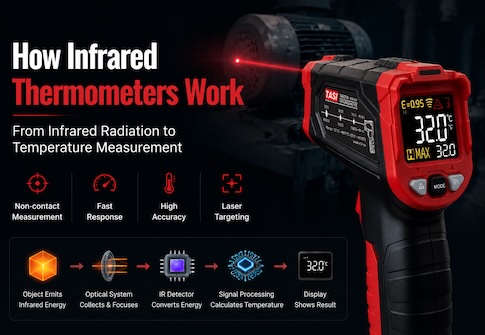
Infrared thermometers measure surface temperature without contact by detecting infrared radiation emitted from the target. This makes them well suited to monitoring dynamic temperature changes. However, the displayed temperature may not always follow the actual instantaneous surface temperature without delay. Instrument response time, signal sampling, display update rate, spot size, emissivity, and measurement stability can all affect the result.
For rapidly changing surfaces, the key question is therefore not simply whether the surface can be measured, but whether the thermometer responds quickly enough and whether the measurement conditions allow it to capture the target area correctly.
Key Points
● Infrared thermometers can measure rapidly heating or cooling surfaces, but instrument response time and display update rate are important.
● The faster the temperature changes, the greater the demand on the thermometer’s dynamic response.
● The measurement spot must remain fully within the target area. Otherwise, hotter or colder surrounding surfaces may influence the reading.
● Measuring distance, angle, and target position should remain as stable as possible during the measurement.
● Incorrect emissivity settings can produce inaccurate results even when the thermometer responds quickly enough.
● For millisecond-scale or extremely fast thermal events, a standard handheld infrared thermometer may show only the general temperature trend rather than the true instantaneous peak.
Why Are Rapid Temperature Changes More Difficult to Measure?
When measuring a stable surface, a small response delay is usually less critical because the target temperature remains approximately constant long enough for the thermometer reading to settle.
Dynamic temperature measurement is different. For example, if a metal component rises from 30 °C to 150 °C within a few seconds, the infrared radiation reaching the thermometer changes continuously. If the thermometer cannot respond as quickly as the surface temperature changes, the displayed value may lag behind the actual temperature.
The same principle applies during rapid cooling. The target may already be cooling while the thermometer output still reflects, to some extent, the higher radiation level from the preceding moment.
Two rates therefore need to be considered:
● Target temperature change rate: How quickly the surface temperature rises or falls.
● Instrument response rate: How quickly the infrared thermometer responds to a new radiation level.
If the target changes significantly faster than the instrument can respond, the thermometer may not fully capture the instantaneous temperature profile.
Response Time Is a Key Parameter in Dynamic Measurement
Infrared thermometers normally specify a response time, often expressed in milliseconds. This indicates how quickly the instrument output reacts after the detected infrared radiation level changes.
A shorter response time generally makes an infrared thermometer better suited to rapidly changing temperature processes.
For example, if a surface takes tens of seconds to change by several tens of degrees, many standard infrared thermometers can track the process effectively. If the same temperature change occurs in less than one second, response time becomes much more important.
Response time should not, however, be interpreted as a guarantee that every temperature event of a similar duration will be captured without error. Actual performance also depends on signal processing, sampling method, display refresh rate, and the characteristics of the target.
If the main objective is to capture the highest temperature during a fast heating process, a thermometer with a short response time and MAX hold or data logging capability is preferable.
Display Update Rate and Response Time Are Not the Same
When observing rapidly changing temperatures, the displayed value may appear to jump from one reading to another. It is important to distinguish the thermometer’s measurement response from the update rate of its display.
The sensor and internal electronics may sample the infrared signal relatively quickly, while the LCD updates less frequently. As a result, the user sees a sequence of discrete values rather than a continuous temperature curve.
A very short temperature peak may therefore occur between two visible screen updates.
For dynamic measurements, the following functions can be useful:
● MAX hold;
● MIN hold;
● Data logging;
● Continuous recording to a computer or mobile device.
These functions are generally more suitable for analysing fast-changing temperatures than relying only on visual observation of the live display.
Measuring Distance and Spot Size Must Be Appropriate
An infrared thermometer does not measure only the small point indicated by the laser. It receives infrared radiation from an area known as the measurement spot.
As the measuring distance increases, the spot generally becomes larger.
If the rapidly heating area is small but the measurement spot also includes cooler surrounding surfaces, the indicated temperature may be lower than the actual hotspot temperature because the instrument receives radiation from the entire field of view.
The opposite can occur during localised cooling. If the measurement spot includes a cooler target area and warmer surroundings, the reading may remain higher than the actual temperature of the cooling area.
For reliable dynamic measurements:
● Make sure the target area is clearly larger than the measurement spot.
● Reduce the measuring distance when necessary.
● Use the thermometer’s D:S ratio to estimate spot size at a given distance.
● For small hotspots, select a thermometer with a higher D:S ratio.
The laser is only an aiming aid and does not necessarily indicate the actual size of the measurement spot.
Keep Measurement Position and Angle Stable
Rapid temperature changes already cause the reading to vary. If the thermometer is moved at the same time, it may measure different parts of the target and make the result more difficult to interpret.
For example, a metal plate being heated may have a significant temperature gradient across its surface. Moving the measurement point by only a few centimetres can shift the reading from a hotter region to a cooler one.
For dynamic measurements:
● Keep the measurement position as fixed as possible.
● Maintain a consistent measuring distance.
● Measure as close to perpendicular to the target surface as practical.
● Avoid rapid hand movement.
● For continuous monitoring, consider mounting the thermometer or sensor on a fixed support.
This helps ensure that observed changes are primarily caused by actual temperature variation rather than changes in measurement position.
Emissivity Still Matters During Rapid Temperature Changes
Infrared thermometers determine temperature from the infrared radiation emitted by the target surface, and different materials have different emissivities.
Painted surfaces, plastics, rubber, wood, paper, and many non-metallic materials are generally easier to measure. Polished aluminium, copper, stainless steel, and other low-emissivity reflective surfaces can be much more difficult because reflected background radiation may significantly influence the result.
This can be particularly misleading during rapid heating.
For example, the actual temperature of a polished metal surface may be rising quickly, but because the emissivity is low, the thermometer receives relatively little radiation emitted directly by the target and more reflected radiation from the surroundings. The displayed temperature may therefore be substantially lower than the true surface temperature.
For this reason:
● Set an appropriate emissivity value when using an adjustable-emissivity thermometer.
● Pay particular attention to reflected background radiation on low-emissivity metals.
● Where appropriate, use a high-emissivity reference area on the target surface.
● Do not assume that a slowly changing infrared reading necessarily means the object itself is heating slowly.
How to Measure a Rapidly Heating Surface
The main objective during rapid heating is to observe the same target area continuously and avoid missing the temperature peak.
Recommended practice includes:
● Aim at the target before heating begins so that the measurement is already stable.
● Set the appropriate emissivity for the target surface.
● Confirm that the target fully covers the measurement spot.
● Keep distance and angle as constant as possible.
● Maintain continuous measurement during heating.
● Use MAX hold if the highest detected temperature is required.
● Use data logging when the entire heating profile needs to be analysed.
For very short heating cycles, it is not advisable to wait until the temperature has already started rising before trying to locate the measurement point, as the most important part of the temperature cycle may already have passed.
How to Measure a Rapidly Cooling Surface
The principles for rapid cooling are similar. Typical applications include components cooling after leaving a heating process, moulded parts after demoulding, and machinery cooling after shutdown.
Recommended practice includes:
● Lock onto the target area before cooling begins.
● Measure continuously instead of repeatedly stopping and restarting the measurement.
● Prevent the target from being obstructed during the cooling process.
● Keep the target position stable.
● Use MIN hold when the lowest temperature during a measurement is required.
● Use continuous data recording when the cooling rate or complete cooling curve must be analysed.
If the target is moving while it cools, target speed, spot size, measurement position, and instrument response time must all be considered.
Moving Targets Make Dynamic Measurement More Challenging
In industrial processes, rapidly changing temperatures often occur on moving targets such as products on conveyors, rotating rollers, moving metal stock, plastic film, or components on continuous production lines.
In these situations, a specific point on the target may remain within the thermometer’s field of view only briefly.
If the target passes through the measurement area faster than the thermometer can respond, the instrument may not reach the true surface temperature before the target has moved away.
The measurement spot may also include:
● The product;
● The conveyor belt;
● Background equipment;
● Adjacent products.
These factors can produce significant fluctuations.
For high-speed targets, response time, D:S ratio, target size, measuring distance, and target speed should be evaluated together. In demanding applications, a fixed infrared temperature sensor designed for high-speed processes may be more suitable.
Why MAX Hold Is Useful for Rapid Heating
During rapid heating, the most important value is often the maximum surface temperature rather than every individual reading.
A short-lived temperature peak may be difficult to read directly from the screen.
MAX hold records the highest value detected during a continuous measurement, making it useful for:
● Rapidly heating components;
● Electrical hotspot inspection;
● Short-term friction heating;
● Local temperature rise in machinery;
● Peak temperature checks during heating or heat treatment.
However, MAX hold can only retain a peak that the instrument actually detects. If the temperature peak is much shorter than the thermometer’s response capability, MAX hold cannot compensate for insufficient response speed.
When May a Standard Handheld Infrared Thermometer Be Too Slow?
Not every dynamic temperature process is suitable for a standard handheld infrared thermometer.
For processes changing over several seconds, an infrared thermometer with an appropriate response time can often provide useful trend and peak information.
Greater caution is required when:
● The temperature peak lasts for only a very short time.
● The target is moving at high speed.
● Millisecond-scale thermal events must be recorded accurately.
● High-sampling-rate temperature curves are required.
● Temperature data are used directly for high-speed process control.
● Each product remains in the measurement position only briefly.
These applications may require a high-speed fixed infrared sensor, dedicated data acquisition system, or another temperature measurement technology with higher temporal resolution.
Instrument selection should therefore consider not only temperature range and accuracy, but also whether the response time matches the speed of the thermal process.
Do Not Confuse Target Thermal Inertia with Instrument Response
A slowly changing infrared reading does not always indicate that the thermometer itself is slow. The target may simply have significant thermal inertia.
For example, a thick metal component with high thermal mass may require time for its surface temperature to change significantly after heating begins. By contrast, thin film, thin sheet metal, or small components may heat or cool much more rapidly.
When interpreting a dynamic measurement, distinguish between:
● The actual thermal response of the target;
● Heat transfer between the surface and the interior;
● The response of the infrared thermometer;
● Display and data update behaviour.
An infrared thermometer measures infrared radiation from the surface. It does not directly measure the temperature at every point inside the object.
Common Errors in Dynamic Infrared Temperature Measurement
● Aiming only after rapid heating has already started. This may miss the early temperature rise or even the peak.
● Using the laser dot as an indication of spot size. The laser is only an aiming aid; the actual measurement spot is usually larger.
● Measuring from too far away. A larger spot may include surrounding surfaces.
● Moving the thermometer continuously during measurement. Spatial temperature differences may be mistaken for time-based temperature changes.
● Ignoring emissivity. This is especially problematic on shiny metals.
● Trying to identify a short peak only by watching the display. MAX hold or data logging is more appropriate.
● Assuming response time means zero delay. Every practical measurement system has a finite dynamic response.
● Using a standard handheld thermometer for extremely fast thermal events. A specialised high-speed measurement system may be required.
FAQ
Can an infrared thermometer measure an object that is heating rapidly?
Yes. Infrared temperature measurement is non-contact and well suited to monitoring changing surface temperatures. However, faster temperature changes require better instrument response, suitable spot size, and appropriate recording capability.
Does a shorter response time always mean higher accuracy?
No. A shorter response time helps track rapid temperature changes, but overall accuracy also depends on emissivity, target size, measuring distance, reflected radiation, environmental conditions, and the thermometer’s specified accuracy.
Why does the displayed temperature continue to rise even though the object is already hot?
The surface itself may still be heating, or the effect may be related to instrument response. When the target changes rapidly, the thermometer output may lag behind the true surface temperature.
Should MAX hold be used during rapid heating?
Yes, when the objective is to identify the highest detected temperature. MAX hold reduces the risk of missing a short-lived peak when reading the display manually.
Can MIN hold be used during rapid cooling?
Yes. MIN hold can capture the lowest detected temperature during a continuous measurement. Data logging is preferable when the complete cooling curve is required.
Does measuring distance affect rapidly changing temperature measurements?
Yes. Increasing the distance normally increases the measurement spot size. If the spot extends beyond the target, radiation from surrounding surfaces can influence the reading and reduce the apparent temperature variation.
Why can a fast-moving hot object produce a low reading?
The object may remain in the field of view for too little time for the thermometer to respond fully, or the measurement spot may also include cooler background areas.
Can a standard infrared thermometer capture millisecond-scale temperature peaks?
Not necessarily. Many handheld infrared thermometers are intended for fast field measurements rather than millisecond-scale thermal analysis. Applications requiring accurate measurement of very short temperature peaks should use equipment with an appropriately specified temporal response.
Conclusion
Infrared thermometers can effectively measure rapidly heating or cooling surfaces, but dynamic temperature measurements are more demanding than measurements of stable targets.
Response time is one of the most important parameters, but display update rate, D:S ratio, measurement spot size, target dimensions, emissivity, and measurement stability must also be considered.
For typical industrial heating, cooling, maintenance, and troubleshooting applications, an infrared thermometer with a suitable response time and MAX, MIN, or data logging functions can provide useful information on temperature trends and peak values.
For high-speed moving targets, extremely short temperature peaks, or millisecond-scale thermal events, the instrument’s temporal response must be evaluated carefully. A high-speed fixed infrared measurement system may be required. Matching the speed of the thermometer to the speed of the thermal process is fundamental to reliable dynamic infrared temperature measurement.