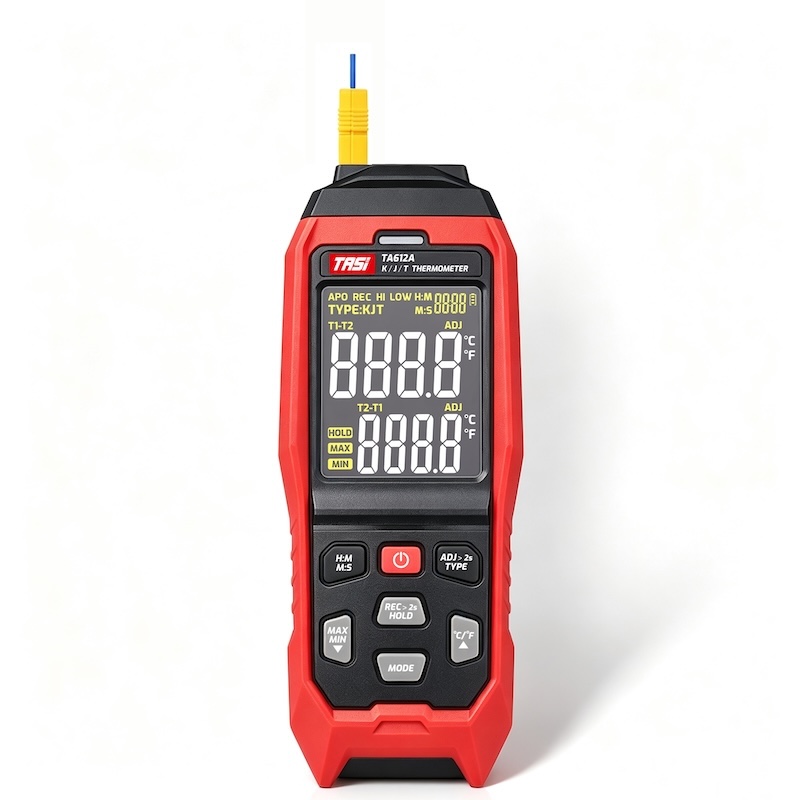
Introduction
A thermocouple is formed from two dissimilar metals or alloys. When these materials form a temperature-measuring circuit and different junctions are at different temperatures, a thermoelectric voltage is generated.
Two important terms frequently encountered in thermocouple measurement are the hot junction and the cold junction.
The names can be misleading. The hot junction does not always have to be at a high temperature, and the cold junction does not necessarily have to be cold. More precisely, the hot junction is the measuring junction, while the cold junction is the reference junction.
Understanding the relationship between these two junctions is fundamental to understanding thermocouple operation, cold-junction compensation, and thermocouple thermometer accuracy.
Key Points
● The hot junction is the point where the thermocouple senses the temperature of the target and is therefore also called the measuring junction.
● The cold junction is associated with the temperature reference used by the measuring instrument and is therefore also called the reference junction.
● A thermocouple responds to the temperature relationship between the measuring junction and the reference junction rather than directly producing an output based solely on the absolute temperature at the measuring junction.
● The cold junction does not have to be at a low temperature and does not need to remain at 0 °C.
● Modern thermocouple thermometers normally measure the reference-junction temperature and apply cold-junction compensation electronically.
● Errors in reference-junction temperature measurement or compensation can affect the final temperature reading even when the thermocouple probe itself is functioning correctly.
What Is the Hot Junction of a Thermocouple?
The hot junction is normally the point where the two dissimilar thermocouple conductors are joined together. It is the measuring junction placed in contact with, or exposed to, the object, air, liquid, or equipment whose temperature is to be measured.
For example, a K-type thermocouple uses two different alloys with the thermoelectric characteristics specified for Type K. At the tip of the probe, these conductors are joined by welding, fusion, or another suitable method to form the measuring junction.
The main purpose of this junction is to sense changes in the temperature of the measurement location. When the measuring-junction temperature changes while the reference-junction conditions are known, the thermoelectric voltage generated by the thermocouple changes accordingly. The measuring instrument converts this relationship into a temperature value.
For this reason, measuring junction is often a more technically precise term than hot junction.
Why Is the Hot Junction Also Called the Measuring Junction?
The term “hot junction” originates from common industrial applications in which thermocouples are used to measure furnaces, boilers, engines, heated pipes, moulds, and other high-temperature equipment.
However, thermocouples are not limited to high-temperature measurements.
When a thermocouple is used in a cold room, refrigeration system, low-temperature pipeline, or laboratory application, the measuring junction may actually be colder than the instrument and its reference-junction area.
The term “measuring junction” therefore describes its function more accurately. It identifies the point whose temperature is being measured rather than implying that this junction must always be the hottest part of the system.
What Is the Cold Junction of a Thermocouple?
The cold junction is the part of the measurement system associated with the reference temperature and is therefore more precisely called the reference junction.
In a practical thermocouple thermometer, the thermocouple wires eventually connect to copper conductors, terminals, or input circuitry inside the measuring instrument. The region where these thermocouple materials transition to the instrument conductors forms part of the reference-junction system.
Knowing the thermocouple voltage alone is not sufficient to determine the measuring-junction temperature. The instrument must also know the temperature of the reference junction.
The reference junction therefore provides the known temperature reference required to calculate the temperature at the measuring junction.
Why Is It Called the Cold Junction?
The term originates from traditional thermocouple measurement methods.
Historically, a stable and known reference temperature was often established by placing the reference junction in an ice-water bath at approximately 0 °C. Because this point was typically much cooler than the high-temperature measurement location, it became known as the cold junction.
Modern digital thermocouple thermometers generally do not require an ice bath.
Instead, an internal temperature sensor measures the temperature near the thermocouple input terminals, and the instrument applies cold-junction compensation (CJC) electronically.
For modern instruments, the cold junction should therefore be understood as the reference junction rather than literally as a cold point.
How Are the Hot and Cold Junctions Related?
Thermocouple operation is based on the Seebeck effect. When dissimilar conductors form a thermoelectric circuit and their junction regions are at different temperatures, a thermoelectric voltage is generated.
The measurement process can be understood as follows:
● The measuring junction senses the temperature of the target.
● The reference junction provides the temperature reference required by the measurement system.
● The thermocouple produces a small voltage related to the temperature conditions of the two junctions.
● The thermometer measures this voltage and determines the reference-junction temperature.
● The instrument applies the appropriate thermocouple temperature-voltage relationship and compensation.
● The final result is the temperature at the measuring junction.
A thermocouple therefore differs from sensors whose electrical output depends only on the absolute temperature of one sensing element. The reference-junction condition is an essential part of thermocouple temperature measurement.
Why Can the Reference-Junction Temperature Not Be Ignored?
Suppose the measuring junction remains at the same temperature while the temperature around the thermometer input terminals changes significantly.
If the reference-junction temperature is ignored, the relationship between thermocouple voltage and measuring-junction temperature changes, which can lead to an incorrect calculated temperature.
This is why thermocouple thermometers require cold-junction compensation.
Modern instruments normally use a temperature sensor close to the thermocouple input terminals. The measured reference-junction temperature is then incorporated into the conversion process for the selected thermocouple type.
A complete thermocouple thermometer therefore has to process two important quantities:
● The thermoelectric voltage produced by the thermocouple.
● The actual temperature of the reference-junction region.
Reliable measuring-junction temperature readings depend on both being measured and processed correctly.
Does the Cold Junction Have to Remain at 0 °C?
No.
A 0 °C reference is commonly used in thermocouple reference data and calibration concepts, but this does not mean that a practical thermocouple thermometer must physically maintain its reference junction at 0 °C.
Modern handheld thermocouple thermometers, data loggers, and industrial temperature modules generally use electronic cold-junction compensation. The instrument can therefore operate with its input terminals at 20 °C, 25 °C, or another temperature within its specified operating range, provided that the reference-junction temperature is measured correctly and compensated for.
In normal use, the operator does not need to create a physical 0 °C cold junction.
However, cold-junction compensation itself has a measurement uncertainty. If an instrument is moved rapidly from a very hot or cold environment into a substantially different ambient temperature, its internal temperature distribution may need time to stabilise. During this transient period, the reference-junction sensor may not yet represent the actual terminal temperature accurately, and additional measurement error may occur.
Does the Hot Junction Always Have to Be Hotter Than the Cold Junction?
No.
When measuring a furnace, engine exhaust, heated process pipe, or another high-temperature target, the measuring junction will normally be considerably hotter than the reference junction, which makes the traditional terminology intuitive.
However, consider a low-temperature measurement:
● Measuring-junction temperature: -30 °C
● Reference-junction temperature: 20 °C
In this case, the so-called hot junction is actually 50 °C colder than the cold junction.
For this reason, the terms measuring junction and reference junction are preferable when explaining thermocouple operating principles.
Where Is the Cold Junction Located?
In a typical handheld thermocouple thermometer, the reference-junction region is located around the thermocouple connector and the instrument input terminals.
For example, when a K-type probe fitted with a standard thermocouple connector is connected to a thermometer, the instrument normally measures temperature close to the input connection and uses this value for cold-junction compensation.
The reference junction should not be understood simply as one single physical point at the end of the thermocouple wire. In an actual measurement circuit, thermocouple conductors, connectors, terminals, and copper conductors form a complete connection system.
A well-designed instrument therefore aims to maintain appropriate thermal uniformity around the input region and to measure a representative reference-junction temperature accurately.
This is one reason why thermocouple input design and internal temperature compensation are important elements of thermometer performance.
Does the Hot-Junction Construction Affect Measurement Performance?
Yes.
Although all thermocouple measuring junctions perform the same basic function, their mechanical construction affects response time, durability, electrical isolation, and suitability for different environments.
An exposed junction, for example, has relatively low thermal mass and usually responds quickly, but provides less mechanical and environmental protection.
In a metal-sheathed thermocouple, the measuring junction may be grounded, ungrounded, or exposed. These constructions differ in response speed, electrical isolation, noise susceptibility, and suitability for specific applications.
Thermocouple selection should therefore consider not only the thermocouple type, such as K, J, or T, but also the measuring-junction construction.
Does Cold-Junction Compensation Affect Thermocouple Thermometer Accuracy?
Yes. It is an important part of the total measurement uncertainty and is also essential when distinguishing between thermometer accuracy and thermocouple probe accuracy.
The final error of a practical thermocouple measurement system can include several components:
● Thermocouple material tolerance.
● Thermal contact error between the measuring junction and the target.
● Errors caused by unsuitable extension wires, compensation cables, or connectors.
● Thermocouple voltage measurement error in the instrument.
● Reference-junction temperature sensor error.
● Errors caused by temperature gradients around the reference-junction region.
● Instrument linearisation and calculation error.
● Transient errors caused by rapid changes in ambient temperature.
For this reason, evaluating thermocouple measurement performance requires consideration of the complete measurement chain rather than only the probe specification or only the thermometer specification.
How Can Hot- and Cold-Junction-Related Errors Be Reduced?
● Ensure good thermal contact between the measuring junction and the target. When measuring a solid surface, poor contact, air gaps, or exposure to surrounding air can prevent the junction from reaching the true surface temperature.
● Select a probe construction appropriate for the application. Air, liquids, pipe surfaces, furnaces, and rapidly changing targets may require different probe designs.
● Use connectors, extension wires, or compensation cables that are suitable for the thermocouple type. Incorrect materials can introduce unwanted thermoelectric voltages.
● Avoid strong temperature gradients around the instrument input terminals. For example, heating one side of the input connector while the other side is exposed to cold airflow can increase cold-junction compensation error.
● Allow the instrument to thermally stabilise after a substantial ambient-temperature change, in accordance with the manufacturer's instructions.
● Make sure the thermocouple type selected on the instrument matches the actual probe. A K-type probe must be measured using the K-type setting.
● For precision measurements, consider probe error, instrument error, and cold-junction compensation error together rather than relying on only one accuracy specification.
FAQ
Is the hot junction simply the tip of the thermocouple probe?
In many common thermocouple probes, the measuring junction is located at or close to the probe tip. However, the exact position depends on the probe construction. In a sheathed thermocouple, for example, the actual junction may be located inside the metal sheath.
Is the cold junction the thermocouple plug?
Not exactly. In a handheld thermometer, the connector and input-terminal region generally form part of the reference-junction area, but cold-junction compensation also involves the instrument terminals, internal connections, and reference-junction temperature sensor.
Why does a thermocouple require two temperature points?
Because thermocouple voltage is related to the temperature conditions at the measuring and reference junctions. To determine the measuring-junction temperature, the reference-junction temperature must be known or compensated for.
Does the cold junction have to be colder than the hot junction?
No. When measuring low-temperature targets, the measuring junction may be colder than the reference junction. “Hot junction” and “cold junction” are traditional names rather than strict descriptions of their actual temperatures.
Do modern thermocouple thermometers require an ice-bath reference junction?
Normally not. Modern digital thermometers usually include electronic cold-junction compensation and automatically measure the temperature around the input terminals.
How much error can incorrect cold-junction compensation cause?
The magnitude depends on the thermocouple type, temperature range, instrument design, and reference-junction temperature error. In principle, errors in reference-junction measurement and compensation contribute directly to the overall measurement uncertainty and must therefore be considered in precision measurements.
Summary
The hot and cold junctions of a thermocouple are more accurately described as the measuring junction and reference junction.
The measuring junction senses the temperature of the target, while the reference junction establishes the temperature reference required for thermocouple conversion. Because thermocouple voltage depends on the temperature conditions at both ends of the thermoelectric circuit, the instrument must know the reference-junction temperature as well as the thermocouple voltage.
Modern thermocouple thermometers normally perform this function automatically by means of electronic cold-junction compensation. The reference junction therefore does not have to remain at 0 °C and does not necessarily have to be colder than the measuring junction.
Understanding the relationship between the measuring junction, reference junction, and cold-junction compensation is essential for understanding thermocouple temperature measurement and for identifying errors caused by probe construction, connection methods, environmental conditions, and instrument compensation.