Introduction
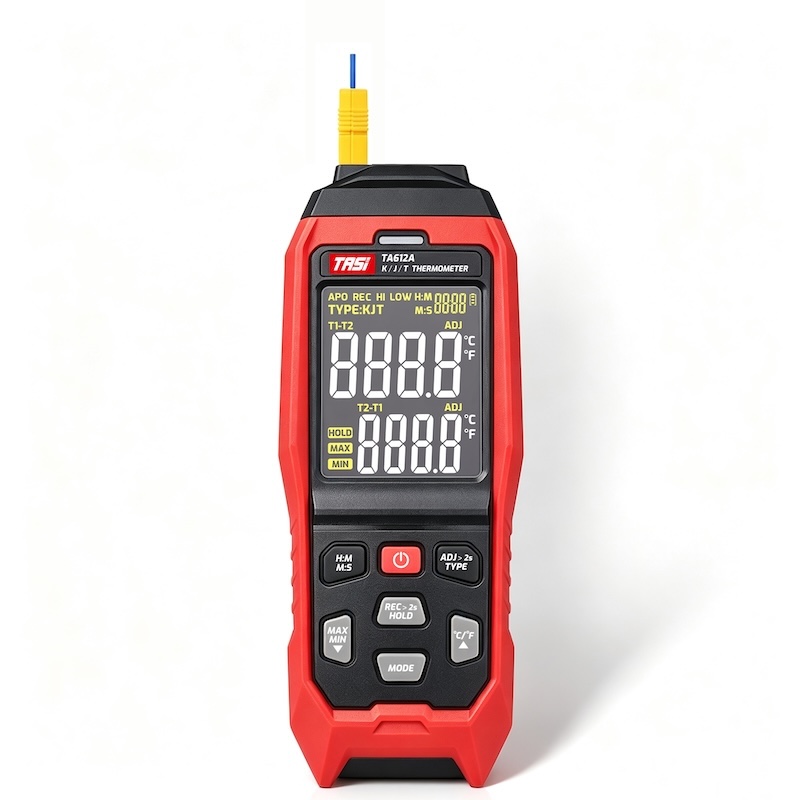
Thermocouple thermometers are widely used in industrial maintenance, HVAC systems, laboratory testing, heating equipment inspection, electrical temperature-rise measurements, and production process monitoring. Unlike infrared thermometers, thermocouple instruments normally require a probe to make direct contact with the object or medium being measured.
At first glance, thermocouple measurement appears straightforward: connect a probe to the instrument and place it in contact with the target. In practice, however, several processes take place inside the measurement system, including thermoelectric voltage generation, low-level voltage measurement, reference-junction temperature sensing, cold junction compensation, and thermocouple linearization.
Understanding these processes helps users operate thermocouple thermometers correctly and explains why probe type, ambient temperature, connection method, and thermocouple type can all influence the final reading.
Key Points
● A thermocouple thermometer does not measure electrical resistance directly. It measures the small thermoelectric voltage generated by a thermocouple.
● A thermocouple consists of two dissimilar conductors. When temperature differences exist in the thermocouple circuit, a voltage related to those temperatures is produced through the Seebeck effect.
● Thermocouple signals are typically in the microvolt-to-millivolt range, so the thermometer requires sensitive, low-noise measurement and signal-processing circuitry.
● Thermocouple measurement depends on the relationship between the measuring junction and the reference junction. The instrument therefore requires cold junction compensation (CJC).
● Different thermocouple types use different material combinations and have different temperature ranges and voltage-temperature characteristics. The thermometer must therefore be configured for the correct thermocouple type.
● The final temperature reading is calculated from the thermocouple voltage, reference-junction temperature, and the corresponding thermocouple reference function.
The Basic Measuring Principle of a Thermocouple Thermometer
The core sensing element in a thermocouple thermometer is the thermocouple itself. A thermocouple is normally made from two dissimilar metals or alloys. For example, a common Type K thermocouple uses nickel-chromium and nickel-aluminium alloy conductors.
When the two conductors are joined to form a measuring junction and the other ends are connected to the measuring instrument, a small thermoelectric voltage is produced when a temperature distribution exists along the thermocouple circuit.
This voltage is known as thermoelectric EMF, or thermoelectric voltage.
Its magnitude depends on the thermocouple materials and the temperatures associated with the measuring and reference junctions. The thermometer accurately measures this voltage and then converts it into temperature using the characteristic relationship defined for that thermocouple type.
The basic measurement sequence can therefore be understood as:
● Temperature changes occur;
● The thermocouple generates a thermoelectric voltage;
● The thermometer measures the voltage;
● Cold junction compensation is applied;
● The thermocouple reference function is used for conversion;
● The calculated temperature is displayed.
What Is the Seebeck Effect?
The physical principle behind thermocouple temperature measurement is the Seebeck effect.
When two dissimilar conductors form a thermoelectric circuit and different parts of that circuit are at different temperatures, a thermoelectric voltage is generated.
The phenomenon is named after Thomas Johann Seebeck, who observed it in the nineteenth century.
In practical thermocouple measurement, two locations are particularly important:
● Measuring junction, or hot junction: normally located at the sensing end of the thermocouple probe and placed in contact with the object or medium being measured.
● Reference junction: normally located where the thermocouple conductors connect to the thermometer input terminals.
A thermoelectric voltage results from the temperature distribution between these locations.
It is important to understand that a thermocouple cannot simply be described as producing one fixed voltage for one absolute temperature. Its output depends on the thermoelectric properties of the conductor pair and the temperature conditions across the thermocouple circuit.
Why Can a Thermocouple Convert Temperature into Voltage?
Different metals have different thermoelectric properties. When a conductor experiences a temperature gradient, charge carriers redistribute in a way that produces an electrical potential.
When two conductors with different thermoelectric characteristics are combined, their thermoelectric responses differ. The resulting difference produces a measurable net voltage in the circuit.
This voltage is very small.
Within common measurement ranges, thermocouples usually produce signals from a few microvolts to several tens of millivolts rather than the volt-level outputs associated with conventional power sources.
A thermocouple thermometer therefore requires low-noise, high-resolution measurement circuitry capable of detecting very small changes in voltage accurately.
Why Different Thermocouple Types Cannot Be Interchanged Arbitrarily
Different thermocouple types use different conductor combinations, so they do not generate the same thermoelectric voltage at the same temperature conditions.
Common thermocouple types include K, J, T, E, N, R, S, and B.
For example, Type K and Type J thermocouples produce different voltage-temperature characteristics. If a Type K probe is connected while the thermometer is configured for Type J, the instrument will use the wrong conversion relationship and can display a significantly incorrect temperature.
For reliable measurement:
● The probe type must be supported by the thermometer;
● The thermocouple type selected on the instrument must match the connected probe;
● Extension or compensating cable must be appropriate for the thermocouple type;
● Connectors and circuit materials must not be substituted arbitrarily.
Why Does a Thermocouple Thermometer Need Cold Junction Compensation?
Cold junction compensation is one of the most important concepts in thermocouple measurement.
Thermocouple voltage depends on the temperature relationship between the measuring junction and the reference junction. If the reference junction were always held at a precisely known temperature, the measuring-junction temperature could be derived from the thermoelectric voltage using that fixed reference.
Historically, laboratory measurements often used an ice-point reference close to 0 °C. A portable digital thermometer, however, cannot realistically maintain its terminals at 0 °C during normal field measurements.
Modern digital thermocouple thermometers therefore include a separate temperature sensor near the thermocouple input terminals. This sensor measures the actual temperature at the reference-junction region.
The instrument then uses this information to perform cold junction compensation.
In simplified terms, the thermometer obtains two sets of information:
● The thermoelectric voltage produced by the thermocouple;
● The actual temperature around the thermocouple input connection.
The processor combines these values with the appropriate thermocouple reference function to determine the measuring-junction temperature.
If cold junction compensation is inaccurate, the displayed temperature may also be inaccurate even when the thermocouple probe itself is functioning correctly.
How Does the Thermometer Convert a Millivolt Signal into Temperature?
The relationship between thermocouple voltage and temperature is not perfectly linear.
In other words, doubling the thermoelectric voltage does not necessarily mean that the temperature has doubled.
Each thermocouple type has its own characteristic temperature-voltage relationship, and that relationship normally includes a degree of non-linearity.
A digital thermocouple thermometer therefore contains the necessary conversion data or mathematical functions for the supported thermocouple types. During measurement, the input signal is conditioned, filtered, digitised, compensated for the reference-junction temperature, and then converted into temperature by the instrument's processor.
The process can be summarised as follows:
● The thermocouple generates a small thermoelectric voltage;
● The input circuit receives the signal;
● The signal is amplified and filtered as required;
● An analogue-to-digital converter converts the voltage into digital data;
● A cold-junction sensor determines the reference-junction temperature;
● The processor performs cold junction compensation and thermocouple linearization;
● The calculated temperature is shown on the LCD or other display interface.
A digital thermocouple thermometer is therefore more than a simple voltmeter. It is a complete temperature measurement system designed specifically to acquire, compensate, and convert thermocouple signals.
How Does the Thermocouple Probe Sense the Temperature of the Target?
Although a thermocouple ultimately produces an electrical signal, the measuring junction must first exchange heat with the object or medium being measured.
When the probe is placed in contact with an object at a different temperature, heat flows between the probe and the target until the measuring junction progressively approaches the temperature of the measurement point.
The displayed reading therefore does not necessarily stabilise instantly.
Response time can be affected by:
● The size of the measuring junction;
● Probe construction and materials;
● The presence of a protective sheath;
● Thermal conductivity of the measured object;
● Contact area between the probe and the surface;
● Whether the medium is air, liquid, or solid;
● Thermal mass of the probe.
A small exposed junction generally responds quickly but offers less mechanical protection. A sheathed probe is typically more robust, although its thermal response may be slower.
Why Should the Reading Be Allowed to Stabilise During Contact Measurement?
A thermocouple thermometer is a contact temperature measurement instrument.
When a probe first touches the target, the probe itself may still be at ambient temperature. For example, a probe at approximately 25 °C placed on a 200 °C metal surface needs time to heat up.
During this transition, the displayed reading may rise progressively from near ambient temperature until it approaches a stable value.
A reading should therefore not normally be taken immediately after contact. The user should allow sufficient time for the indication to stabilise.
When measuring rapidly changing temperatures, probe response time becomes especially important because the indicated temperature may lag behind the actual temperature of the target.
The Complete Thermocouple Measurement Process
A complete thermocouple measurement can be viewed as a continuous sequence of heat transfer, electrical conversion, and digital signal processing.
● Heat is transferred between the target and the thermocouple probe, allowing the measuring junction to approach the temperature of the measurement point.
● A temperature distribution exists between the measuring and reference junctions.
● The two dissimilar thermoelectric conductors generate a thermoelectric voltage through the Seebeck effect.
● The thermometer input circuit measures the microvolt- or millivolt-level signal.
● The internal reference-junction sensor measures the temperature at the input connection.
● The instrument applies cold junction compensation according to the selected thermocouple type.
● The processor converts the compensated voltage using the appropriate temperature-voltage relationship.
● The result is displayed in °C, °F, or another supported temperature unit.
An error introduced at any of these stages can influence the final measurement result.
What Factors Affect Thermocouple Thermometer Measurements?
The accuracy of a thermocouple measurement system depends not only on the thermometer but also on the probe, connections, and measurement conditions.
● Incorrect thermocouple type selection: Different thermocouple types use different conversion characteristics. An incorrect setting directly produces an incorrect temperature calculation.
● Probe accuracy: Thermocouple materials have defined tolerances, so different probe grades and manufacturing quality can result in different measurement errors.
● Cold junction compensation error: Rapid ambient changes or local heat sources around the input terminals can affect estimation of the reference-junction temperature.
● Poor thermal contact: During surface measurements, insufficient contact between the probe and target can cause the reading to differ from the actual surface temperature.
● Insufficient stabilisation time: Taking a reading before the probe has approached thermal equilibrium can introduce dynamic measurement error.
● Incorrect extension wire or connectors: Materials that do not match the thermocouple system can create additional thermoelectric junctions and unwanted voltages.
● Electromagnetic interference: Because thermocouple signals are very small, long cables can pick up electrical noise in environments with strong electromagnetic interference.
● Rapid ambient temperature changes: Significant environmental changes can affect both the cold junction compensation system and electronic stability.
For reliable measurement, the thermometer, probe, cable, connectors, and measurement technique should be treated as one complete measurement system.
How Is a Thermocouple Thermometer Different from a Thermistor Thermometer?
Thermocouples and thermistors can both be used for contact temperature measurement, but they operate on different physical principles.
A thermocouple uses the thermoelectric effect between dissimilar conductors to generate a voltage. It is therefore a self-generating sensor and does not require an external excitation current to create its basic measurement signal.
A thermistor works by using the change in electrical resistance of a semiconductor material with temperature. The measuring instrument normally applies a controlled current or voltage and calculates temperature from the measured resistance.
As a result, the two technologies differ in temperature range, response characteristics, probe construction, accuracy, and application suitability.
Thermocouples are particularly well suited to wide temperature ranges and industrial measurements, which is one reason they remain widely used in professional temperature measurement.
FAQ
Does a thermocouple thermometer measure temperature directly?
No. The thermocouple first converts the temperature conditions in the circuit into a small thermoelectric voltage. The thermometer measures this voltage and combines it with the reference-junction temperature and thermocouple reference function to calculate temperature.
Why can a thermocouple generate a signal without an external power supply?
Because the Seebeck effect naturally produces a thermoelectric voltage when a temperature gradient exists in a circuit made from dissimilar conductors. A thermocouple is therefore considered a self-generating sensor.
How large is the voltage produced by a thermocouple?
It is normally very small, typically in the microvolt-to-millivolt range. The exact voltage depends on the thermocouple type and the temperature conditions of the measuring and reference junctions.
Why must I select Type K, Type J, or another thermocouple type on the thermometer?
Each thermocouple type uses a different material combination and therefore has a different temperature-voltage relationship. The thermometer must use the correct reference function to calculate temperature accurately.
What does cold junction compensation do?
Cold junction compensation determines the temperature at the thermocouple reference-junction region and includes it in the temperature calculation. Without correct CJC, the instrument cannot accurately determine the measuring-junction temperature.
Why does the displayed temperature change gradually after the probe touches the target?
The probe has its own thermal mass and needs time to exchange heat with the target. Larger or more heavily protected probes generally require more time to approach the target temperature.
Can thermocouple cable be extended?
Yes, provided suitable thermocouple extension or compensating cable is used. Using incompatible ordinary wire or connector materials can create additional thermoelectric voltages and introduce measurement error.
Are thermocouple thermometers suitable for high-temperature measurement?
Thermocouples can cover very wide temperature ranges, and some types are suitable for high-temperature applications. The actual maximum operating temperature, however, also depends on the thermocouple type, probe materials, insulation, sheath construction, and application conditions rather than on the thermometer range alone.
Conclusion
A thermocouple thermometer works by using the Seebeck effect between two dissimilar conductors to convert temperature conditions into a small thermoelectric voltage.
The thermometer does more than simply read this voltage. It performs signal conditioning, analogue-to-digital conversion, reference-junction temperature measurement, cold junction compensation, and thermocouple linearization before displaying the calculated temperature.
A complete thermocouple measurement system therefore consists of the thermocouple probe, connecting cable, input circuitry, cold junction compensation system, and digital processing electronics.
In practical applications, correct thermocouple type selection, good thermal contact, sufficient stabilisation time, suitable extension wiring, and protection from rapid environmental changes are all important for obtaining reliable results.
Understanding the complete process—from temperature and heat transfer to thermoelectric voltage and finally to a digital temperature reading—helps users select and operate thermocouple thermometers correctly and identify potential sources of measurement error.