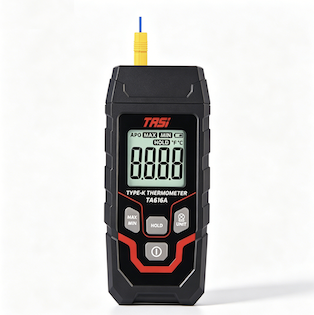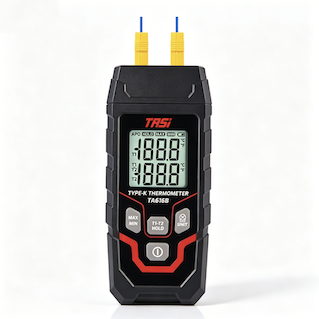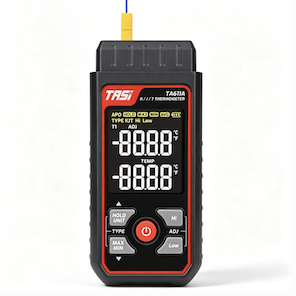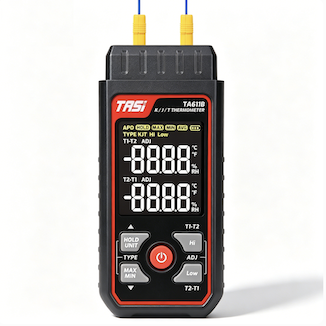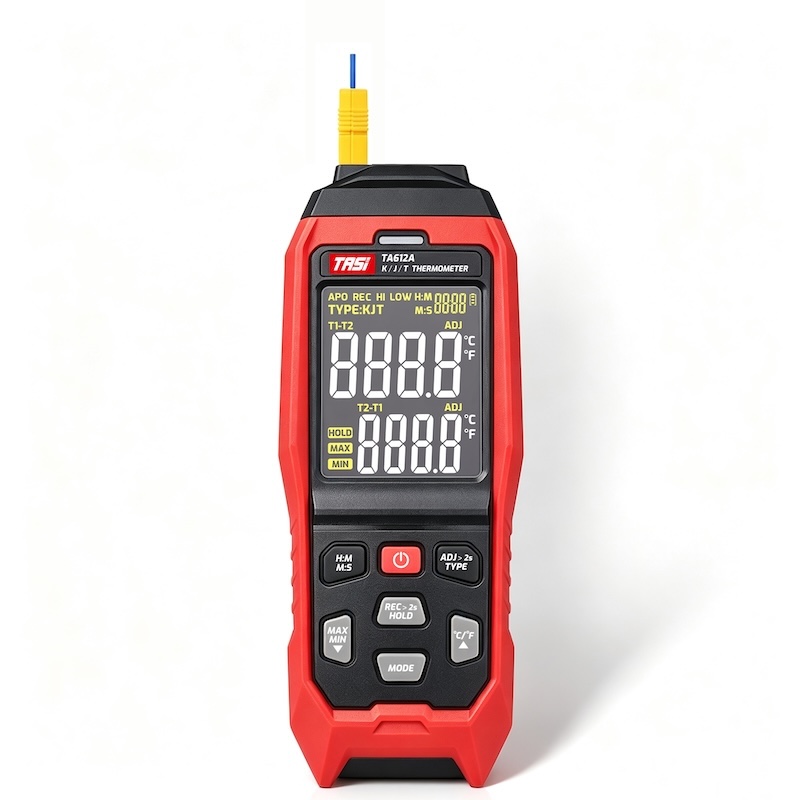
Introduction
When using a thermocouple thermometer, the process appears straightforward: connect the thermocouple probe to the instrument, place the probe at the measurement point, and read the temperature directly from the display.
However, a thermocouple does not directly produce a signal that represents an absolute temperature. Instead, it generates a very small thermoelectric voltage that depends on the temperature relationship between the measuring junction and the reference junction.
This means that even if the measuring-junction temperature remains unchanged, the thermocouple voltage can change when the temperature around the instrument input terminals changes. If the instrument does not know the reference-junction temperature, it cannot accurately determine the actual measuring-junction temperature.
For this reason, modern thermocouple thermometers normally use cold junction compensation (CJC) to measure the reference-junction temperature and include its effect in the temperature calculation.
Cold junction compensation is therefore not simply an optional temperature-correction feature. It is a fundamental part of accurate thermocouple temperature measurement.
Key Takeaways
● A thermocouple output represents the temperature relationship between the measuring junction and the reference junction, not the measuring-junction temperature alone.
● The “cold junction” usually refers to the reference junction formed where thermocouple conductors connect to the instrument's copper circuitry. It does not have to be physically cold.
● If the reference-junction temperature is unknown, thermocouple voltage alone cannot uniquely determine the measuring-junction temperature.
● Modern digital thermocouple thermometers normally use an internal temperature sensor near the input terminals for automatic electronic cold junction compensation.
● Large temperature gradients near the terminals, rapid changes in ambient temperature, or local heat sources can increase cold-junction compensation error.
● Cold-junction compensation accuracy is one of the contributors to the overall measurement uncertainty of a thermocouple thermometer.
What Does a Thermocouple Actually Measure?
A thermocouple consists of two dissimilar conductors. When junctions formed by these materials are at different temperatures, a temperature-dependent thermoelectric voltage is generated. This phenomenon is commonly known as the Seebeck effect.
A practical thermocouple measurement system can be viewed as having two important temperature locations:
● The measuring junction, also called the hot junction or sensing junction, with temperature Tₘ.
● The reference junction, traditionally called the cold junction, with temperature Tᵣ.
The thermoelectric voltage cannot be treated simply as “the voltage corresponding to the measuring-junction temperature.” Instead, it depends on the thermal state of both junctions.
A simplified relationship can be written as:
E = E(Tₘ) − E(Tᵣ)
where E is the thermoelectric voltage measured by the instrument.
Therefore, the same measuring-junction temperature can produce a different measured voltage if the reference-junction temperature changes.
For example, if the measuring junction remains at a constant elevated temperature while the reference junction rises from 20°C to 30°C, the temperature relationship between the two junctions changes, and so does the thermocouple voltage.
This is why thermocouple measurement requires knowledge of the reference-junction temperature.
What Is the Thermocouple “Cold Junction”?
The term “cold junction” can be misleading because it may suggest that the reference junction must always be kept at a low temperature.
In reality, the cold junction does not have to be cold.
In a modern digital thermocouple thermometer, the thermocouple wires eventually connect to the instrument input terminals, while the internal measurement circuitry normally uses copper conductors.
Where the thermocouple materials connect to the copper conductors, additional dissimilar-metal junctions are created. These connections form the reference-junction region of the measurement system.
For example, a Type K thermocouple uses specific thermocouple alloys, whereas the internal circuitry of the thermometer typically uses copper. Once the thermocouple connector is plugged into the instrument, thermocouple materials and copper conductors meet at the input interface.
The instrument must therefore measure not only the small thermocouple voltage but also the temperature around these reference connections.
For this reason, reference junction is technically a more precise term than “cold junction.”
Why Can't Thermocouple Voltage Be Converted Directly into Temperature?
Standard thermocouple voltage-temperature relationships are normally defined relative to a specified reference-junction condition.
Traditionally, thermocouple reference tables assume that the reference junction is maintained at 0°C. The measured thermoelectric voltage can then be related to the measuring-junction temperature.
In normal field use, however, the instrument input terminals are rarely at 0°C.
For example:
● Measuring-junction temperature: 200°C
● Reference-junction temperature: 25°C
The voltage actually received by the thermometer is determined by the relationship between the 200°C measuring junction and the 25°C reference junction. It is not the same as the standard thermoelectric voltage corresponding to 200°C relative to a 0°C reference.
If the instrument directly converted this measured voltage using a standard thermocouple table while ignoring the 25°C reference-junction temperature, the displayed temperature would contain a significant error.
The instrument must therefore determine the actual reference-junction temperature and compensate for its thermoelectric contribution before calculating the measuring-junction temperature.
This is the basic purpose of cold junction compensation.
How Does Cold Junction Compensation Work?
Modern digital thermocouple thermometers normally do not require a physical ice bath to maintain the reference junction at 0°C. Instead, they use electronic compensation.
A separate temperature sensor is typically installed close to the thermocouple input terminals to measure the temperature of the reference-junction region.
The process can be simplified as follows:
● The thermocouple generates a voltage determined by the measuring-junction and reference-junction temperatures.
● The thermometer measures this small thermoelectric voltage.
● An internal temperature sensor measures the temperature near the reference junction.
● The instrument calculates the equivalent thermocouple voltage corresponding to that reference-junction temperature for the selected thermocouple type.
● The reference-junction contribution is mathematically added to the measured voltage.
● The corrected voltage is then converted into the final measuring-junction temperature using the appropriate thermocouple characteristic.
The relationship can be expressed in simplified form as:
E(Tₘ, 0°C) = E(Tₘ, Tᵣ) + E(Tᵣ, 0°C)
The instrument first measures E(Tₘ, Tᵣ). Based on the reference-junction temperature Tᵣ, it then calculates E(Tᵣ, 0°C). The result is an equivalent voltage referenced to 0°C.
Only after this compensation can the instrument use the standard thermocouple voltage-temperature relationship to determine Tₘ.
Cold junction compensation therefore depends on three elements: accurate voltage measurement, accurate reference-junction temperature measurement, and correct thermocouple linearization.
Why Can't the Same Compensation Be Used for Every Thermocouple Type?
Different thermocouple types use different conductor materials and therefore have different thermoelectric characteristics.
Common types such as K, J, T, E, N, R, and S do not have the same voltage-temperature relationship.
As a result, even if two thermocouple types produce the same measured voltage, the corresponding temperature may be different.
Cold junction compensation must therefore also be calculated according to the thermocouple type selected on the instrument.
For thermometers that support multiple thermocouple types, selecting the correct input type is essential.
If a Type K thermocouple is connected while the instrument is configured for Type J, the final temperature calculation may be significantly incorrect even if the cold-junction temperature sensor itself is working perfectly.
What Happens Without Cold Junction Compensation?
If a thermocouple measurement system does not know the reference-junction temperature and directly converts the measured voltage using a 0°C reference curve, the displayed temperature will be strongly influenced by changes in the instrument environment.
For example, if the thermometer is moved from a 20°C environment to a 35°C environment while the actual object temperature remains unchanged, the reference-junction temperature will change and so will the thermocouple voltage.
Without proper compensation, the instrument may interpret this voltage change as a change in the object's temperature.
Typical symptoms may include:
● Different readings from the same heat source at different ambient temperatures.
● Temporary measurement errors after moving the instrument from a cold environment into a warm one.
● Reading shifts when hot air heats the input terminals.
● Significant differences when the same thermocouple is connected to different measurement systems.
Cold junction compensation is therefore essential if a thermocouple thermometer is to provide reliable measurements under changing environmental conditions.
Does the Reference-Junction Temperature Have to Remain Constant?
No.
One of the main advantages of electronic cold junction compensation is that the reference junction can operate at normal and changing ambient temperatures.
As long as the instrument can accurately determine the reference-junction temperature and the compensation sensor is thermally well coupled to the actual reference-junction region, the thermometer can continuously compensate for changes.
The key issue is not whether the reference-junction temperature changes, but whether:
● The instrument accurately knows the current reference-junction temperature.
● The temperature measured by the compensation sensor accurately represents the actual reference junction.
● There is a significant temperature gradient around the input terminals.
● The ambient temperature is changing so rapidly that the instrument has not yet reached a reasonably stable thermal condition.
This is why a thermocouple thermometer may require time to stabilize after a large change in ambient temperature.
What Factors Can Affect Cold Junction Compensation Accuracy?
Although cold junction compensation is normally automatic, its accuracy can still be affected by instrument design and operating conditions.
● Rapid ambient-temperature changes
If a thermometer is moved from a cold outdoor environment into a warm room, the housing, terminals, circuit board, and compensation sensor may change temperature at different rates. Temporary internal temperature gradients may result.
● Local heating around the input terminals
If the thermocouple connector or instrument input is close to a furnace, hot-air outlet, heated pipe, or other heat source, the actual reference junction can become significantly warmer than other parts of the instrument.
● Direct sunlight
Strong solar radiation can heat one part of the instrument more rapidly than another, creating a temperature difference between the reference junction and compensation sensor.
● Heat transferred from the operator's hand
On small handheld instruments, prolonged contact with the connector area or input section can cause local temperature changes. The effect depends on instrument construction.
● Incorrect thermocouple connectors or extension materials
Using incompatible connectors, incorrect extension wires, or unintended dissimilar-metal junctions can generate additional thermoelectric voltages and introduce further error.
High-accuracy thermocouple measurement therefore depends not only on the probe but also on the complete measurement circuit and the thermal condition of the reference-junction area.
What Is the Difference Between an Ice-Point Reference and Electronic Cold Junction Compensation?
In precision thermocouple measurement and traditional laboratory practice, an ice-water mixture can be used to establish a reference environment close to 0°C.
This provides a clearly defined reference-junction condition and can reduce uncertainty associated with electronic compensation, but the method is inconvenient for routine portable measurements.
Modern digital thermometers therefore normally use electronic cold junction compensation.
Its main advantages include:
● No need to maintain a physical 0°C reference.
● Automatic operation under normal ambient conditions.
● Better suitability for handheld, field, and multi-channel measurement.
● Easier operation.
● Compensation accuracy determined partly by the internal reference-temperature sensor and thermal design.
Electronic cold junction compensation does not simply “assume” that the reference junction is at 0°C. Instead, it measures the actual reference-junction temperature and mathematically converts the measured signal to an equivalent standard reference condition.
How Does Cold Junction Compensation Error Relate to Thermocouple Accuracy?
The total error of a thermocouple measurement system does not come from one source alone.
Important contributors may include:
● Thermocouple tolerance.
● Thermocouple ageing, oxidation, and material inhomogeneity.
● Instrument low-level voltage measurement error.
● Thermocouple linearization error.
● Reference-junction temperature sensor error.
● Temperature gradients around the reference-junction area.
● Additional errors from extension cables, compensation cables, and connectors.
● Probe installation and temperature gradients within the measured object.
Therefore, even a high-quality thermocouple probe cannot guarantee accurate system-level measurement if the cold junction compensation system is poorly designed.
For demanding applications, the performance of the complete measurement chain should be considered rather than only the nominal accuracy of the thermocouple probe.
Why May a Thermocouple Thermometer Need Time to Stabilize After Moving Between Environments?
When a thermometer is transferred rapidly from one temperature environment to another, its internal components do not all reach the new temperature at the same rate.
For example, after moving an instrument from a 10°C environment into a 25°C room:
● The housing may begin warming first.
● Metal input terminals may respond differently from the plastic enclosure.
● The circuit board may change temperature at another rate.
● The compensation sensor and the actual reference junction may temporarily be at different temperatures.
An important assumption of cold junction compensation is that the compensation sensor accurately represents the actual reference-junction temperature.
If these temperatures temporarily differ, a short-term measurement error can occur even when the compensation algorithm itself is correct.
For higher-accuracy measurements, an instrument that has experienced a substantial environmental temperature change should be allowed to reach a reasonably stable thermal state before final readings are taken.
Can Cold Junction Compensation Eliminate All Thermocouple Measurement Errors?
No.
Cold junction compensation addresses one specific and essential issue: the reference junction is not necessarily at 0°C and its temperature changes with the environment.
It does not automatically correct other sources of measurement error.
Examples include:
● An aged or degraded thermocouple probe.
● Incorrect thermocouple type selection.
● Incorrect compensation or extension cable.
● Poor thermal contact between the probe and measured surface.
● Significant temperature gradients at the measurement point.
● Reversed thermocouple polarity.
● Operation outside the specified environmental limits of the instrument.
Cold junction compensation is therefore essential, but it remains only one part of a complete thermocouple measurement system.
FAQ
Why is it called a “cold junction”? Must it always be colder than the measuring junction?
No. “Cold junction” is a historical term. “Reference junction” is more technically precise. The reference junction can even be warmer than the measuring junction without invalidating the measurement principle.
Do modern thermocouple thermometers require an ice bath?
Normally not. Digital thermocouple thermometers generally include electronic cold junction compensation using an internal temperature sensor near the input terminals.
Does the cold junction compensation sensor measure ambient temperature?
Not exactly. Its purpose is to measure, or accurately represent, the temperature at the thermocouple-to-instrument reference junction. Ambient temperature is only one factor affecting that temperature.
Why should high-accuracy measurements not be taken immediately after moving the instrument from outdoors to indoors?
Because temporary internal temperature gradients may exist, and the compensation sensor may not yet represent the actual reference-junction temperature accurately.
Can thermocouple connectors affect cold junction compensation?
Yes. Connector materials, wiring arrangements, and local temperature distribution can influence the measurement. Thermocouple-compatible connectors and extension materials should be used.
Can measurement continue if cold junction compensation is disabled?
Some laboratory systems allow automatic CJC to be disabled, but another known reference-junction temperature must then be provided and included in the data processing. Otherwise, the measuring-junction temperature cannot be determined reliably.
Does more accurate cold junction compensation always mean a more accurate thermocouple measurement?
More accurate CJC generally improves overall performance, but final measurement accuracy also depends on the thermocouple, voltage measurement circuitry, wiring, installation, and the thermal characteristics of the measured object.
Summary
Thermocouple thermometers require cold junction compensation because the thermoelectric voltage generated by a thermocouple depends on both the measuring-junction temperature and the reference-junction temperature, not on the measuring junction alone.
Modern thermocouple thermometers measure the temperature near the input reference junction and use the characteristic relationship of the selected thermocouple type to mathematically convert the actual reference condition to the standard reference condition. The actual measuring-junction temperature can then be calculated.
A complete thermocouple measurement therefore involves two key measurements: the small thermoelectric voltage generated by the thermocouple and the temperature of the reference-junction region.
In practical applications, the thermocouple type and probe accuracy are important, but the instrument input terminals should also be protected from local heat sources, rapid ambient-temperature changes, and large thermal gradients. For demanding measurements, the instrument should be allowed to reach a reasonably stable thermal condition after significant changes in its environment.
Understanding cold junction compensation is fundamental to understanding how a thermocouple thermometer can convert a thermoelectric signal of only a few millivolts—or less—into a reliable temperature reading.