Introduction
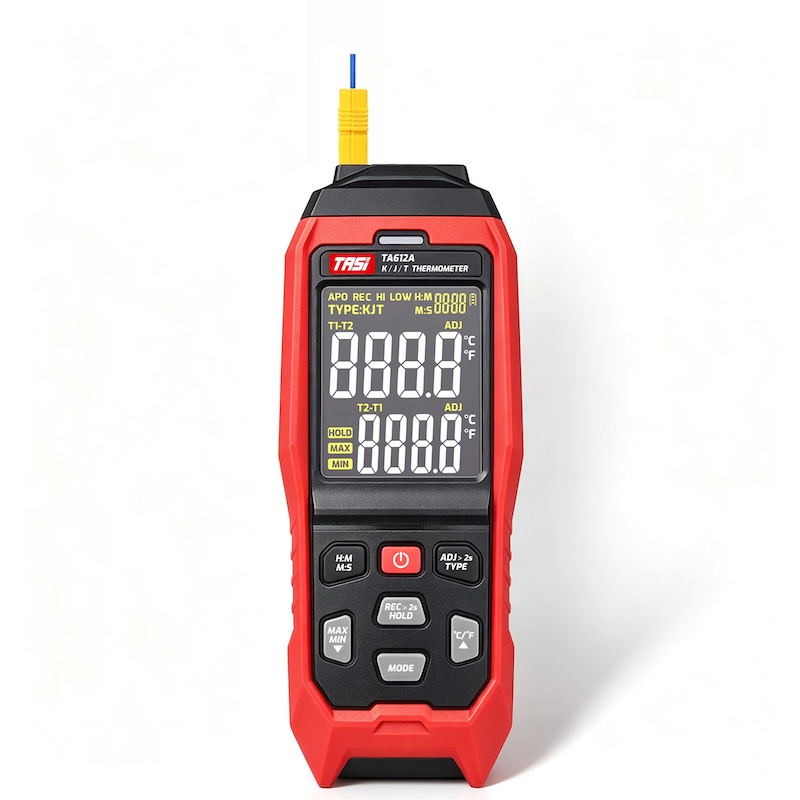
A thermocouple has only two conductors, so its wiring may appear straightforward. However, the two leads are not interchangeable. A thermocouple is a polarity-sensitive temperature sensor, and the thermoelectric voltage generated by its two dissimilar metals has a defined polarity. For this reason, thermocouple inputs are normally marked “+” and “−”.
If the positive and negative leads are reversed, the thermocouple itself and the thermometer will not normally be damaged. However, the polarity of the thermoelectric voltage received by the instrument is reversed, resulting in an incorrect temperature indication.
An important point is that a reversed thermocouple does not necessarily display the actual temperature with a minus sign in front of it. Modern digital thermocouple thermometers generally use cold junction compensation, so the final indicated temperature depends on both the reversed thermocouple EMF and the temperature at the instrument terminals.
Key Points
● Thermocouples have defined polarity, so the positive and negative leads must not be interchanged.
● Reversing the connections reverses the polarity of the thermoelectric voltage seen by the measuring instrument.
● When the measured object heats up, the indicated temperature may decrease instead of increase.
● When measuring temperatures above ambient, reversed polarity can produce unusually low or even negative readings.
● With cold junction compensation, the displayed value is normally not simply the negative of the actual temperature.
● Reversing a thermocouple usually does not damage the sensor, but it can produce serious measurement errors.
● One of the quickest checks is to observe whether the indicated temperature rises when the sensing junction is warmed.
Why Does a Thermocouple Have Positive and Negative Polarity?
A thermocouple is made from two dissimilar metals or alloys. A common Type K thermocouple, for example, uses Chromel and Alumel conductors.
When the measuring junction and the reference junction are at different temperatures, the two materials generate a thermoelectric voltage related to that temperature difference. The voltage is typically only a few microvolts to several tens of millivolts, but it has a defined polarity.
Thermocouple measurement therefore depends not only on the magnitude of the voltage, but also on its direction.
For a thermocouple thermometer:
● With correct polarity, the instrument receives the thermoelectric voltage in the intended direction.
● With reversed polarity, the magnitude may remain essentially unchanged, but the voltage presented to the instrument has the opposite sign.
The instrument then converts this reversed signal into a temperature, producing an incorrect result.
What Is the Most Common Sign of Reversed Thermocouple Wiring?
The most characteristic symptom is: the measured object becomes hotter while the indicated temperature decreases.
For example, suppose the probe is initially at room temperature and is then placed against an object that is clearly warmer than the surroundings.
With correct wiring:
● The measuring junction temperature increases.
● Thermocouple EMF changes in the expected direction.
● The displayed temperature rises.
With reversed wiring:
● The measuring junction still heats normally.
● The thermocouple still generates its normal EMF.
● The instrument receives that EMF with reversed polarity.
● The displayed temperature may move downward.
For this reason, if a thermocouple reading falls as the probe is heated, polarity should be one of the first items checked during troubleshooting.
Why Can Reversed Polarity Produce a Negative Temperature Reading?
Assume the instrument is at approximately 25 °C and the thermocouple is measuring an object significantly warmer than room temperature.
Under normal conditions, the thermocouple generates an EMF corresponding to the temperature difference between the measuring junction and the reference junction.
If the thermocouple leads are reversed, the instrument sees the same basic thermoelectric signal with opposite polarity. A digital thermometer with cold junction compensation will still apply its normal reference-junction correction, which may result in a calculated temperature far below ambient and, in some cases, below 0 °C.
For example, if a Type K thermocouple is actually measuring around 100 °C while the instrument terminals are around 25 °C, reversing the polarity may cause some instruments to indicate a temperature tens of degrees below zero rather than simply −100 °C.
The exact incorrect reading depends on:
● Thermocouple type;
● Actual measuring-junction temperature;
● Instrument terminal temperature;
● Cold junction compensation temperature;
● The instrument’s thermocouple linearization algorithm.
Therefore, “reversed thermocouple = negative actual temperature” is not a reliable rule.
Why Does Cold Junction Compensation Affect the Reading?
A digital thermocouple thermometer does not normally convert the measured millivolt signal directly into temperature without further correction.
The instrument generally performs two functions:
● It measures the thermoelectric voltage at the thermocouple input.
● It measures the temperature near the input terminals and applies cold junction compensation (CJC).
With correct wiring, the instrument combines the thermocouple EMF with the cold-junction temperature to determine the temperature at the measuring junction.
If the thermocouple polarity is reversed, the input EMF is inverted while the cold junction compensation is still applied normally.
The resulting temperature error is therefore produced by the combination of reversed thermoelectric voltage and normal cold junction compensation. This is why the displayed temperature is usually not a simple negative version of the actual temperature.
What Happens When Measuring an Object Colder Than Ambient?
The direction of the error depends on the direction of the temperature difference.
If the measuring junction is colder than the instrument terminals, the correctly connected thermocouple produces an EMF corresponding to that negative temperature difference.
If the leads are reversed, the polarity of that signal is also reversed, and the instrument may incorrectly interpret the measuring junction as being warmer than the surroundings.
Therefore, reversed polarity does not always make the reading lower.
More accurately:
Reversing the thermocouple causes the instrument to interpret the measuring-junction temperature difference in the wrong direction.
As a result:
● When measuring an object hotter than ambient, the indicated temperature usually shifts downward.
● When measuring an object colder than ambient, the indicated temperature may shift upward.
Can Reversed Thermocouple Polarity Damage the Thermometer?
Normally, no.
A thermocouple is a low-level millivolt-generating sensor. Simply reversing its positive and negative leads does not normally expose the thermocouple or a properly designed thermocouple thermometer to damaging voltage.
However, even though the equipment may remain undamaged, the measurement can become completely unreliable.
In industrial process control, HVAC service, furnaces, equipment maintenance, laboratory testing, and other temperature measurement applications, an incorrect temperature may lead to incorrect operating decisions or control actions.
Reversed thermocouple polarity is therefore a typical fault in which the equipment continues operating but the measurement is wrong.
Do All Thermometers Behave the Same Way When a Thermocouple Is Reversed?
The underlying principle is the same, but the displayed result may vary between instruments.
Possible symptoms include:
● A reading far below the actual temperature;
● A negative temperature indication;
● A temperature trend opposite to the actual change;
● An out-of-range indication;
● OL, Hi, Lo, or another overrange/underrange message;
● A seemingly plausible but incorrect temperature.
The last case can be particularly difficult to detect.
An obviously abnormal value is usually noticed quickly. A reversed connection that still produces a plausible-looking number may remain undetected and be mistaken for a valid measurement.
For this reason, newly installed or recently rewired thermocouple systems should be checked for correct response direction.
How Can You Quickly Check Whether a Thermocouple Is Reversed?
A simple temperature-change test is often sufficient for a quick field check.
● Switch on the thermocouple thermometer and allow the reading to stabilize.
● Warm the sensing end gently with your hand or another safe, controlled heat source.
● Observe the direction of the indicated temperature change.
At a room temperature of approximately 20–25 °C, holding the tip of the probe should normally cause the displayed temperature to rise gradually.
If the indicated temperature decreases as the tip becomes warmer, check:
● Thermocouple polarity;
● Plug orientation;
● Extension or compensating cable polarity;
● Intermediate terminal connections.
This is a useful functional check, but it is not a substitute for temperature calibration.
Is It Enough to Check the Wiring at the Thermometer?
No.
A complete thermocouple measuring system may include:
● Thermocouple probe;
● Thermocouple connector;
● Extension or compensating cable;
● Intermediate terminal blocks;
● Data acquisition module;
● Thermocouple thermometer or controller.
A polarity reversal anywhere in the signal path can cause an incorrect measurement.
Troubleshooting should therefore follow the entire thermocouple circuit rather than checking only the instrument terminals.
Systems using extension cable, compensating cable, terminal blocks, or multi-channel data acquisition equipment are particularly susceptible to wiring errors after installation, maintenance, or cable replacement.
How Can Thermocouple Polarity Be Identified?
Different thermocouple types use different conductor materials and have defined polarity.
For example, a Type K thermocouple normally uses:
● Positive conductor: Chromel;
● Negative conductor: Alumel.
In practice, polarity may be identified by “+” and “−” markings, conductor colors, connector geometry, or the product documentation.
However, thermocouple color codes are not identical across all countries, standards, and manufacturers. Color alone should therefore not be treated as a universal method of identifying polarity.
More reliable references include:
● Thermocouple type;
● Polarity markings on connectors or terminals;
● Product documentation;
● The color-code standard used for the installation.
Can Reversing an Extension Cable Cause the Same Problem?
Yes.
A thermocouple measuring circuit requires not only the correct probe type but also the correct polarity throughout the extension or compensating cable.
If the probe itself is wired correctly but the positive and negative conductors are crossed at an intermediate point, the signal reaching the instrument may still have the wrong polarity.
Other wiring issues to avoid include:
● Using the wrong type of extension cable;
● Mixing positive and negative conductor materials;
● Using ordinary copper cable where thermocouple extension or compensating cable is required;
● Mixing cable types intended for different thermocouples.
These errors may not only reverse polarity but may also introduce additional thermoelectric voltages and increase measurement error.
Why Can the Reading Still Be Inaccurate After the Polarity Has Been Corrected?
Correct polarity is only one requirement for accurate thermocouple measurement.
If the wiring direction is confirmed but the reading remains incorrect, check:
● Whether the thermocouple type selected on the instrument matches the probe;
● Whether the thermocouple has aged, oxidized, or become contaminated;
● Whether the extension or compensating cable is the correct type;
● Whether large temperature gradients exist around the terminal area;
● Whether cold junction compensation is operating correctly;
● Whether the probe insertion depth is sufficient;
● Whether thermal contact with the measured object is adequate;
● Whether thermal radiation or conduction from the surroundings is affecting the measurement.
An abnormal temperature indication should therefore be evaluated as part of the complete measurement system rather than attributed automatically to reversed polarity.
FAQ
Does a reversed thermocouple always display a negative temperature?
No. The indicated value depends on the measuring-junction temperature, cold-junction temperature, thermocouple type, and instrument compensation algorithm. A negative reading is only one possible symptom.
Can reversing a thermocouple damage the thermometer?
Normally not. A thermocouple produces only a very small millivolt-level signal. Reversing the leads primarily causes a measurement-direction error rather than an electrical hazard.
Why does the displayed temperature fall when the thermocouple is heated?
This is one of the classic symptoms of reversed polarity. As the measuring junction heats up, the instrument receives the thermoelectric voltage with opposite polarity and interprets the temperature change in the wrong direction.
Is the displayed temperature simply the negative of the actual temperature?
Normally not. Digital thermocouple instruments also apply cold junction compensation, so the incorrect reading cannot generally be calculated by simply multiplying the actual temperature by −1.
Why does a newly replaced thermocouple show the wrong temperature trend?
First confirm that the thermocouple type matches the instrument setting, then check the polarity of the probe, connector, extension cable, and any intermediate terminals.
Can a thermocouple plug be inserted backwards?
Standard thermocouple connectors often use unequal blade widths or keyed construction to reduce the risk of reverse insertion. However, connector designs vary, so the “+” and “−” markings should always be checked.
Can I check thermocouple polarity by holding the probe tip?
Yes, as a quick functional check at room temperature. The indicated temperature should normally rise when the sensing tip is warmed by hand. If it falls, the polarity should be inspected. This method does not replace calibration.
Conclusion
A thermocouple is a polarity-sensitive temperature sensor, and its positive and negative conductors are not interchangeable. When the leads are reversed, the measuring instrument receives the thermoelectric voltage with opposite polarity and interprets the temperature difference between the measuring junction and reference junction in the wrong direction.
In a digital thermocouple thermometer with cold junction compensation, the resulting indication is not simply the negative of the actual temperature. It is determined by the reversed thermocouple EMF, the cold-junction temperature, and the instrument’s conversion algorithm.
If a probe becomes warmer while the displayed temperature falls, or if unusually low or negative temperatures appear, thermocouple polarity should be checked first. The complete signal path—including the probe, connector, extension or compensating cable, intermediate terminals, and measuring instrument—should be inspected.
Correct thermocouple type, correct polarity, and correct interconnection materials are fundamental to accurate and reliable temperature measurement.