Introduction
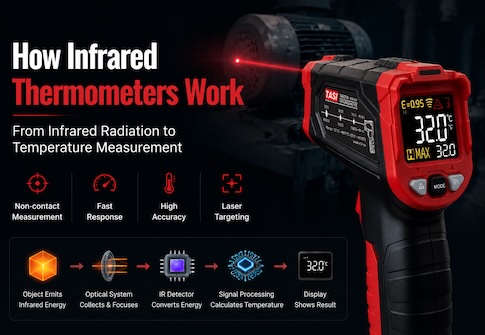
An infrared thermometer does not directly “see” temperature. It detects infrared radiation reaching the instrument from the target surface and calculates the corresponding surface temperature.
In practical measurements, the received infrared energy may contain two components: radiation emitted by the target itself and radiation from the surrounding environment that is reflected by the target surface into the instrument.
The second component is related to reflected background temperature.
For high-emissivity materials, this effect is usually relatively small. However, polished metals and other low-emissivity surfaces can strongly reflect infrared radiation from nearby furnaces, heaters, lamps, people, or cold surroundings, resulting in significant measurement errors.
Key Points
● An infrared thermometer may receive radiation that does not originate entirely from the target itself.
● The lower the surface emissivity, the greater the potential influence of reflected environmental radiation.
● A hot background can cause readings to be higher, while a cold background can cause readings to be lower.
● Polished metals and other low-emissivity materials are particularly sensitive to reflected background temperature.
● Correct emissivity settings, improved measurement conditions, and control of surrounding radiation can reduce reflection-related errors.
What Is Reflected Background Temperature?
Reflected background temperature can be understood as the equivalent radiation temperature of the surrounding environment whose infrared energy is reflected by the target surface into the infrared thermometer.
It is not necessarily the same as the ambient air temperature measured by a conventional thermometer.
For example, a workshop may have an air temperature of 25°C, while the target metal surface is positioned next to a very hot furnace. The metal may reflect a substantial amount of infrared radiation from the furnace. In this situation, the effective reflected background temperature can be much higher than 25°C.
Similarly, if the target faces a cold wall, refrigeration equipment, or another low-temperature background, it may reflect a lower level of infrared radiation.
Therefore, reflected background temperature is determined primarily by the radiative environment visible to the target surface, rather than by air temperature alone.
Why Does Reflected Background Affect Infrared Measurements?
Real surfaces can both emit and reflect infrared radiation.
Under simplified conditions, the radiation received by an infrared thermometer can be described as:
Received radiation ≈ radiation emitted by the target + reflected environmental radiation
A further simplified representation is:
Received radiation ≈ ε × target radiation + (1 − ε) × reflected background radiation
where ε represents the emissivity of the target surface.
When emissivity is close to 1, radiation emitted by the object dominates, and reflected background radiation has relatively little influence.
When emissivity is low, the proportion of radiation emitted by the object decreases, while the contribution from reflected background radiation becomes more significant.
This is why measurements on painted surfaces, rubber, plastics, and many other high-emissivity materials are generally more stable than measurements on polished aluminum, stainless steel, copper, and other low-emissivity surfaces.
Why Can a Hot Background Cause the Reading to Be Too High?
Consider a relatively cool polished metal plate located near a furnace, hot pipe, or another high-temperature object.
The hot source emits strong infrared radiation. Part of this radiation reaches the metal surface, is reflected, and then enters the infrared thermometer.
The instrument cannot simply separate:
● Radiation emitted by the metal itself;
● Radiation originating from the hot surroundings and reflected by the metal.
If the reflected component is significant and the measurement parameters do not compensate for it correctly, the instrument may interpret the additional infrared energy as being emitted by the target surface.
The indicated temperature may therefore be higher than the actual surface temperature.
This effect becomes increasingly important as surface emissivity decreases.
Can a Cold Background Also Affect the Measurement?
Yes.
Reflected background temperature can cause readings to be either higher or lower.
For example, if a warm low-emissivity metal surface faces a much colder background, the reflected radiation from that background may be weaker than the radiation emitted by the target itself.
If emissivity and reflected temperature are not handled correctly, the calculated temperature may be lower than the actual surface temperature.
As a general guide:
● A background significantly hotter than the target tends to increase the indicated temperature;
● A background significantly colder than the target tends to reduce the indicated temperature;
● The lower the target emissivity, the greater the potential influence of the background.
Why Are Shiny Metals Particularly Sensitive?
Shiny metals generally have low infrared emissivity and relatively high infrared reflectivity.
From the perspective of an infrared thermometer, a polished metal surface can behave somewhat like an “infrared mirror.”
When measuring a polished stainless-steel pipe, for example, the detected radiation may be influenced by:
● The pipe's own temperature;
● Nearby hot machinery;
● Furnaces or hot piping;
● Thermal radiation from the operator;
● Walls, ceilings, and surrounding equipment;
● Hot backgrounds created by solar exposure.
As a result, measurements taken at different positions or angles can produce different readings even when the actual target temperature has not changed significantly.
This does not necessarily indicate an instrument fault. It may simply mean that the radiative measurement conditions have changed.
What Is the Relationship Between Emissivity and Reflected Background Temperature?
Emissivity is one of the key parameters determining how strongly reflected background radiation affects an infrared measurement.
For an opaque object, a useful simplified interpretation is that the stronger the surface emits infrared radiation, the less it tends to reflect; conversely, lower-emissivity surfaces generally reflect more environmental infrared radiation.
In practical terms:
● High-emissivity surfaces: target emission dominates and reflected background effects are generally smaller;
● Low-emissivity surfaces: target emission is weaker relative to reflected radiation, so background influence becomes more important.
Correcting the emissivity setting alone does not automatically eliminate all measurement errors.
If the target has very low emissivity and the surrounding radiation sources are at temperatures substantially different from the target, reflected background radiation may still be a major source of uncertainty.
Why Can Measurement Angle Change the Reflection Error?
For reflective surfaces, changing the position or angle of the infrared thermometer can also change the amount of reflected radiation entering the instrument.
When measuring a shiny metal plate, for example, one viewing angle may cause infrared radiation from a nearby hot source to be reflected directly into the thermometer. Moving the instrument to a different position may significantly reduce that reflected contribution.
Reflection should therefore be considered when:
● The indicated temperature changes significantly with measurement angle;
● The reading changes when the operator changes position;
● The reading changes when nearby equipment is switched on or off;
● Measurements from different directions produce noticeably different results.
Such differences should not automatically be interpreted as actual temperature changes in the target.
How Can Reflected Background Errors Be Reduced?
The first step is to understand the target material and select an appropriate emissivity value.
● Set emissivity correctly. If the infrared thermometer allows emissivity adjustment, use a value appropriate to the actual material and surface condition rather than applying the same setting to every target.
● Avoid strong hot or cold backgrounds. Adjust the measurement position where possible so that the target does not directly reflect furnaces, hot pipes, heaters, refrigeration equipment, or other strong thermal sources.
● Keep measurement conditions consistent. For comparative or trend measurements, maintain similar distance, angle, position, and environmental conditions.
● Improve low-emissivity measurement surfaces. Where practical, apply high-emissivity tape, coating, or another suitable reference surface with known emissivity. Allow it to reach thermal equilibrium with the target before measuring.
● Use reflected temperature compensation when available. Some professional infrared instruments allow a reflected temperature value to be entered. For higher-accuracy work, this value should represent the actual radiative environment rather than simply being assumed to equal the ambient air temperature.
● Avoid becoming part of the reflection. When measuring highly reflective surfaces, the operator can also become a source of reflected infrared radiation. Position and measurement angle should therefore be considered carefully.
For demanding measurements involving very low-emissivity surfaces where the radiative environment cannot be controlled, a conventional infrared thermometer may not provide a highly reliable absolute temperature value.
How Can You Identify Significant Reflection Effects in Practice?
A simple repeatability check can help.
Keep the target unchanged and slightly vary the measurement position or angle within a reasonable range. If the indicated temperature changes significantly even though the target cannot realistically change temperature so quickly, reflected radiation should be investigated.
Also check whether:
● The surface is polished or highly reflective metal;
● Furnaces, heaters, hot pipes, lamps, or other warm objects are nearby;
● The operator may be reflected by the target surface;
● Changing the viewing direction significantly changes the reading;
● Applying a high-emissivity reference area produces a more stable result.
These observations can help determine whether reflected background radiation is contributing to the measurement error.
FAQ
Is reflected background temperature the same as ambient temperature?
No. Ambient air may be 25°C, but a surface facing a furnace several hundred degrees hotter can reflect much stronger infrared radiation. Reflected background temperature describes the surrounding radiative environment, not simply the air temperature.
Why are black objects usually less affected by reflected radiation?
Many black, rough, or non-metallic surfaces have relatively high infrared emissivity. Their own emitted radiation therefore represents a larger proportion of the total radiation received by the instrument. However, visible color alone should not be used to determine emissivity.
Is lowering the emissivity setting enough when measuring polished stainless steel?
Not always. Correct emissivity is important, but low-emissivity surfaces also strongly reflect environmental infrared radiation. If the background temperature differs significantly from the target temperature, considerable measurement error may remain.
Can the operator's body affect infrared temperature measurements?
Yes, especially when measuring highly reflective, low-emissivity surfaces. Human bodies emit infrared radiation, which can be reflected by the target surface into the instrument.
Can high-emissivity tape improve measurement accuracy?
Yes, where the surface and process allow it. Applying tape with a known emissivity and allowing it to reach thermal equilibrium with the target can substantially reduce reflection-related errors.
Conclusion
Reflected background temperature affects infrared measurements because the radiation received by an infrared thermometer does not necessarily originate entirely from the target itself.
When the target has low emissivity, surrounding infrared radiation is more easily reflected into the instrument. A hot background can increase the indicated temperature, while a cold background can reduce it.
Reliable infrared temperature measurement therefore requires consideration not only of measurement range, accuracy, and distance, but also of surface emissivity, reflected background temperature, measurement angle, and the surrounding radiative environment.
This is particularly important when measuring polished metals and other low-emissivity materials, where controlling reflection and measurement conditions can be more important than simply changing instrument settings.