Introduction
Infrared thermometers generally provide stable results when measuring high-emissivity materials such as matte plastics, rubber, painted surfaces, and many organic materials. Measuring aluminium, copper, stainless steel, and other shiny metals is more difficult. Even when the actual temperature remains unchanged, the displayed value may appear too low, fluctuate, or change with the measurement angle.
This does not necessarily indicate a problem with the infrared thermometer. In many cases, the main cause is the low emissivity and high reflectivity of the target surface.
A common practical method is to apply a small piece of black tape to the target, allow it to reach approximately the same temperature as the underlying surface, and then measure the tape instead of the exposed metal.
The reason this method works is not simply that “black surfaces are hotter.” The tape provides a surface with a higher and more stable infrared emissivity, making it easier for the infrared thermometer to obtain a reliable reading.
Key Points
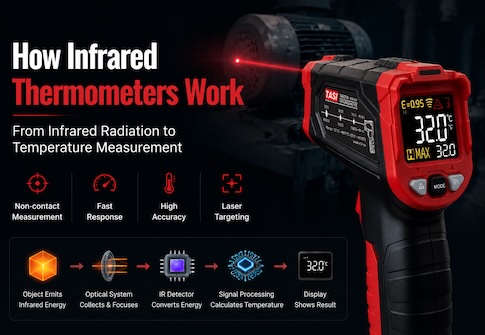
● Infrared thermometers detect infrared radiation emitted from a surface; they do not directly measure the internal temperature of an object.
● Shiny metals often have low emissivity and high reflectivity, making measurements more sensitive to reflected infrared radiation from the surroundings.
● Matte black electrical tape and similar materials often have relatively high and stable emissivity and can therefore serve as useful reference surfaces.
● The tape must be allowed to reach sufficient thermal equilibrium with the target before measurement.
● The thermometer's emissivity setting should be matched as closely as possible to the actual emissivity of the tape being used.
● The black-tape method is useful for many low-emissivity surfaces at low to moderate temperatures, but it is not suitable for every high-temperature, moving, or specialised application.
Why Are Shiny Metals Difficult to Measure Directly?
An infrared thermometer receives infrared radiation from the target surface and converts that radiation into a temperature value based partly on the selected emissivity setting.
For high-emissivity materials, a large proportion of the detected infrared energy comes from the target itself. Measurements are therefore usually relatively stable.
Shiny metals behave differently. Clean or polished aluminium, copper, stainless steel, and similar metals often have low infrared emissivity and relatively high reflectivity.
As a result, the infrared radiation reaching the thermometer may include not only radiation emitted by the metal itself, but also radiation reflected from surrounding objects such as heaters, walls, machinery, people, or other warm surfaces.
For example, the actual temperature of a metal surface may remain unchanged, yet changing the measurement angle or the operator's position may alter the reflected background radiation seen by the instrument. The displayed temperature may therefore change even though the metal itself has not.
This is why low-emissivity metals are among the more challenging targets for non-contact infrared temperature measurement.
Why Does Black Tape Improve the Measurement?
The main purpose of black tape is to create a higher-emissivity measurement area on a surface that would otherwise be difficult to measure.
Many matte black electrical tapes have relatively high emissivity in common infrared measurement bands. Compared with shiny metal, they emit a greater proportion of their own infrared radiation and are less affected by reflected background radiation.
Once the tape has reached approximately the same temperature as the surface underneath it, measuring the tape will usually produce a more stable result than measuring the bare metal directly.
The principle can be summarised as follows:
● Direct measurement of shiny metal: low emissivity + high reflectivity → greater influence from the surroundings.
● Measurement of the taped area: higher emissivity + lower reflection influence → more stable temperature reading.
The important factor is therefore the infrared emissivity of the surface, not simply its visible black colour.
Why Must the Tape Reach Thermal Equilibrium First?
Applying tape to a metal surface does not mean that the tape instantly reaches the same temperature as the metal.
When first applied, the tape may be close to room temperature while the metal is significantly hotter or colder. If the tape is measured immediately, the infrared thermometer will detect the current surface temperature of the tape, which may not yet represent the temperature of the underlying metal.
Heat is gradually transferred between the metal and the tape. Once the temperature difference becomes sufficiently small, the tape surface can be used as an approximate representation of the metal surface temperature.
There is no single waiting time that applies to every situation. The required stabilisation time depends on several factors:
● Target temperature.
● Tape material and thickness.
● Thermal conductivity of the target.
● Ambient temperature and airflow.
● Whether the target temperature itself is still changing rapidly.
In practice, it is more useful to confirm that the reading has stabilised than to rely on a fixed waiting time.
How Should Black Tape Be Used for Infrared Temperature Measurement?
A practical procedure is:
● Select a matte tape with good adhesion and a temperature rating suitable for the application.
● Clean the measurement area so that dirt, oil, dust, or loose oxidation does not interfere with thermal contact.
● Apply the tape flat against the surface, avoiding bubbles, wrinkles, and lifted edges.
● Allow sufficient time for the tape and target surface to approach thermal equilibrium.
● Set the infrared thermometer's emissivity according to the tape being used. If the tape manufacturer provides emissivity data, use that information whenever possible.
● Aim the thermometer at the taped area and make sure the entire infrared measurement spot remains within the tape.
● Measure as close to perpendicular to the surface as practical to reduce additional errors associated with large viewing angles.
● Record the value once the reading has stabilised.
If the taped area is smaller than the thermometer's actual measurement spot at the selected distance, the instrument will also receive infrared radiation from the surrounding metal. This mixed signal can significantly reduce the benefit of using the tape.
What Emissivity Value Should Be Used for Black Tape?
A value around 0.95 is commonly associated with black electrical tape in practical infrared measurement, but not all black tapes have an emissivity of exactly 0.95.
The actual infrared emissivity may depend on:
● Tape material.
● Surface gloss.
● Thickness.
● Infrared wavelength range.
● Surface ageing.
● Operating temperature.
For routine industrial inspections, the emissivity value recommended for the specific tape may be sufficient. For higher-accuracy applications, a reference material with known emissivity or an independently verified measurement method should be used.
Simply setting every black material to the same emissivity value does not guarantee accurate results.
Is Every Black Surface Suitable as a Reference Surface?
No.
A material that appears black to the human eye does not necessarily have high emissivity in the infrared spectrum.
Visible colour is determined primarily by how a material interacts with visible wavelengths. Infrared thermometers operate at infrared wavelengths, where the optical behaviour of the same material may be very different.
The relevant property for infrared temperature measurement is therefore the material's emissivity within the operating spectral range of the instrument, not its visible colour alone.
For this reason, professional infrared measurements rely on known infrared surface properties rather than simply assuming that any black surface is suitable.
Which Applications Are Suitable for the Black-Tape Method?
This method is particularly useful for low-emissivity surfaces that produce unstable readings when measured directly, including:
● Polished stainless steel.
● Aluminium plates and components.
● Copper busbars, pipes, and other copper components.
● Shiny metal housings.
● Metal pipes and equipment surfaces.
● Maintenance applications where repeated temperature comparisons are required.
For example, when inspecting a shiny copper busbar with an infrared thermometer, direct readings may be strongly influenced by reflection. Where it is safe and permissible to apply tape, a permanent or temporary high-emissivity reference point can improve repeatability between measurements.
When Is Black Tape Not Appropriate?
The black-tape method is useful, but it is not universal.
● Do not use tape when the target temperature exceeds the tape's rated operating temperature.
● If the target temperature is changing rapidly, the tape's thermal response may lag behind the actual surface temperature.
● Fast-moving production lines, rotating parts, and targets where tape cannot be applied are generally unsuitable.
● Food-processing, cleanroom, pharmaceutical, or other contamination-sensitive applications may not permit adhesive materials.
● Ordinary electrical tape may not be sufficient for high-accuracy temperature measurement.
● Poor contact, bubbles, or lifted edges can prevent the tape temperature from accurately following the target surface.
For very high-temperature metals, molten materials, or high-speed industrial processes, a specialised infrared thermometer or pyrometer and an appropriate emissivity measurement strategy are usually more suitable.
Can Black Tape Make Any Infrared Thermometer Accurate?
No.
Black tape primarily helps reduce errors associated with low-emissivity surfaces. Overall measurement accuracy is still affected by other factors, including:
● Accuracy specifications of the infrared thermometer.
● Correct emissivity setting.
● Measuring distance and D:S ratio.
● Whether the taped area is larger than the measurement spot.
● Measurement angle.
● Strong background infrared radiation.
● Whether the instrument has adapted to the ambient temperature.
● Whether the target temperature is stable.
Black tape can remove or reduce one major source of error, but it cannot eliminate every source of uncertainty in infrared temperature measurement.
Why Can the Reading Still Be Unstable After Applying Black Tape?
If the reading continues to fluctuate, check the following:
● Has the tape reached sufficient thermal equilibrium with the target?
● Is the taped area larger than the infrared measurement spot?
● Is the emissivity setting appropriate for the tape?
● Is the measurement distance too large?
● Are there bubbles, lifted edges, or poor contact between the tape and the surface?
● Is the target itself heating or cooling?
● Has the infrared thermometer been exposed to a rapid ambient-temperature change?
● Are there strong infrared sources such as furnaces or heaters near the measurement area?
If the result appears abnormal, repeatedly adjusting emissivity is not the best first response. The complete measurement setup should be evaluated first.
FAQ
Can black tape be applied directly to a hot metal surface?
Not always. The tape must be rated for the target temperature. If the temperature exceeds its allowable range, the tape may soften, detach, degrade, or create a safety risk. Higher-temperature applications require suitable high-emissivity materials or another measurement method.
Does darker tape always provide more accurate infrared measurements?
No. Visible colour does not directly determine infrared emissivity. What matters is the emissivity of the material within the infrared spectral range of the thermometer.
Can the temperature be measured immediately after applying the tape?
Usually not. Allow time for heat transfer between the tape and the target and wait until the reading becomes sufficiently stable.
Can ordinary black electrical tape be used?
It is commonly suitable for general industrial checks when temperatures are within its operating range and extremely high accuracy is not required. For more demanding measurements, the actual emissivity of the tape should be known or verified.
Why must the taped area be larger than the infrared measurement spot?
If the measurement spot includes both the tape and surrounding low-emissivity metal, the thermometer receives a mixture of infrared radiation from both surfaces, increasing measurement error.
Can this method be used on stainless steel, aluminium, and copper?
Yes. It is a common practical method for these low-emissivity metals, provided that the tape can be safely applied and that emissivity, thermal equilibrium, and spot size are properly considered.
Conclusion
Black tape improves infrared temperature measurement by creating a higher-emissivity, more stable measurement surface on a low-emissivity, highly reflective target.
When measuring aluminium, copper, polished stainless steel, and similar shiny metals, direct infrared readings can be strongly affected by reflected background radiation. Applying suitable black tape, allowing it to reach thermal equilibrium with the target, and measuring with the correct emissivity setting can significantly improve stability and reliability.
However, black tape is not a universal correction method. Reliable results still depend on tape temperature rating, actual emissivity, thermal equilibrium, measurement spot size, measuring distance, viewing angle, and surrounding infrared radiation.
Understanding these factors is more important than simply entering a fixed emissivity value into the infrared thermometer.