Introduction
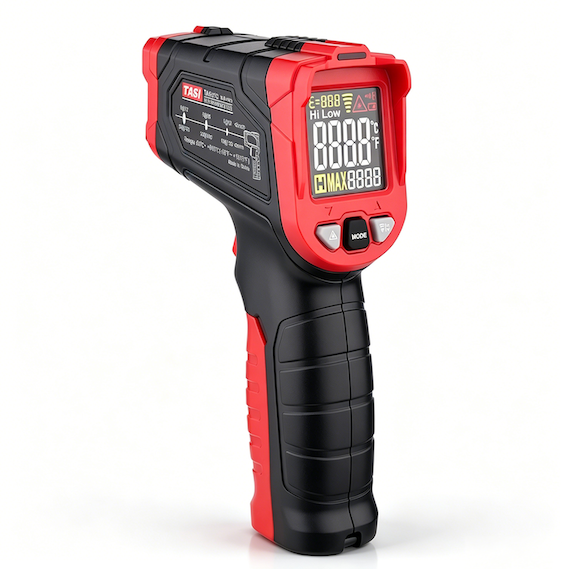
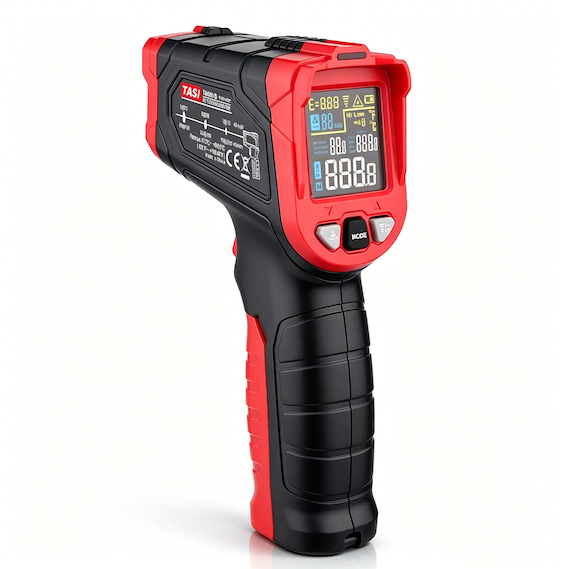
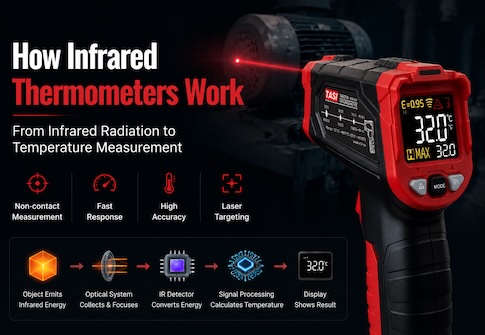
Infrared thermometers are widely used in industrial inspection, equipment maintenance, electrical troubleshooting, HVAC applications, automotive service, and laboratory testing. They measure surface temperature by detecting infrared radiation emitted from an object without physical contact.
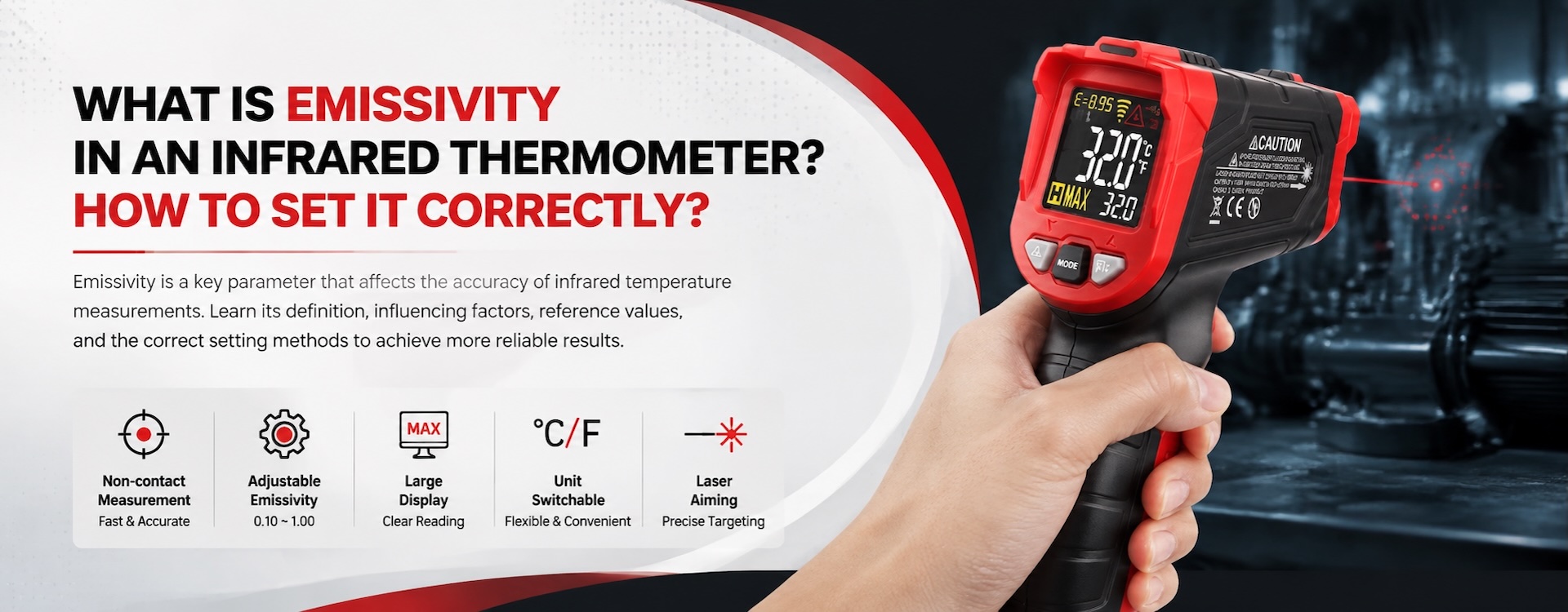
Many users may find that measuring the same object can produce different temperature readings depending on instrument settings or measurement conditions. One of the key reasons is whether the emissivity setting is correctly configured.
Emissivity determines how the infrared thermometer interprets the infrared energy emitted from a surface. If the emissivity value does not match the actual characteristics of the measured material, the displayed temperature may be higher or lower than the true surface temperature.
Understanding emissivity and setting it correctly is essential for achieving accurate infrared temperature measurements.
Key Points
● Emissivity describes a material’s ability to emit infrared radiation and is usually expressed as a value between 0.10 and 1.00;
● Different materials, surface finishes, and conditions can affect emissivity values;
● Infrared thermometers require appropriate emissivity settings to compensate for differences between materials;
● High-emissivity surfaces are generally easier to measure, while shiny metals and reflective surfaces require additional attention;
● Correct emissivity adjustment improves the accuracy and reliability of infrared temperature measurements.
What Is Emissivity in an Infrared Thermometer?
Emissivity is a parameter that describes the ability of an object’s surface to emit infrared radiation compared with an ideal blackbody.
● An ideal blackbody has an emissivity value of 1.00 and absorbs and emits the maximum amount of infrared radiation;
● Real materials usually have emissivity values below 1.00, and each material has different infrared radiation characteristics;
● An infrared thermometer calculates surface temperature by detecting infrared energy and applying the configured emissivity value.
Simply explained, emissivity represents how efficiently a surface emits infrared energy that can be detected by the instrument.
If the emissivity setting is incorrect, the thermometer may calculate an inaccurate temperature because it cannot correctly interpret the amount of infrared radiation received.
Why Does Infrared Temperature Measurement Require Emissivity Settings?
Infrared thermometers measure the infrared radiation emitted from an object’s surface rather than directly measuring internal temperature.
Different surfaces have different infrared emission characteristics:
● Dark, rough, and non-metallic surfaces usually have higher emissivity and emit stronger infrared radiation;
● Smooth metal surfaces generally have lower emissivity and can reflect infrared radiation from surrounding objects;
● Surface treatments such as polishing, oxidation, coating, or painting can significantly change emissivity.
Therefore, infrared thermometers use emissivity compensation to improve measurement accuracy and provide results closer to the actual surface temperature.
Factors Affecting Material Emissivity
Emissivity is not always a fixed value. It can be influenced by several factors:
● Material type: Different materials have different infrared radiation properties. Plastics, rubber, and ceramics generally have higher emissivity, while polished metals usually have lower emissivity;
● Surface condition: Rough, oxidized, or coated surfaces normally have higher emissivity than smooth surfaces;
● Surface color: Color may influence infrared radiation characteristics in some materials, but emissivity cannot be determined by color alone;
● Temperature range: The emissivity of some materials may change with temperature;
● Measurement environment: Reflections from surrounding heat sources and objects can affect measurement results.
For accurate measurements, material characteristics and actual operating conditions should both be considered.
Common Material Emissivity Reference Values
The following values can be used as general references when setting infrared thermometer emissivity:
| Material | Reference Emissivity |
|---|---|
| Black painted surface | 0.90–0.98 |
| Plastic | 0.90–0.95 |
| Rubber | 0.90–0.95 |
| Ceramic | 0.90–0.95 |
| Paper | 0.90–0.95 |
| Wood | 0.85–0.95 |
| Polished stainless steel | 0.10–0.30 |
| Polished aluminum | 0.05–0.20 |
| Polished copper | 0.05–0.20 |
These values are only reference ranges. Actual emissivity depends on surface finish, oxidation level, temperature, and measurement environment.
How to Correctly Set Emissivity on an Infrared Thermometer
Correct emissivity adjustment can be performed through the following steps:
● Identify the material being measured: Determine whether the target surface is metal, plastic, glass, ceramic, or another material;
● Check reference emissivity values: Select an emissivity value close to the actual material characteristics;
● Evaluate surface condition: Consider whether the surface is polished, coated, oxidized, or reflective;
● Adjust the thermometer setting: Enter the emissivity value in the instrument settings menu;
● Verify measurement results: For high-accuracy applications, compare readings with a contact temperature sensor when possible.
For example, a black painted equipment housing may use an emissivity setting around 0.90–0.95, while a bright metal surface requires a lower emissivity setting and additional measurement methods.
How to Improve Accuracy When Measuring Low-Emissivity Materials
Low-emissivity materials, especially reflective metals, can cause significant measurement errors if measured directly.
Common solutions include:
● Applying high-emissivity tape to the measurement area and measuring the tape surface temperature;
● Applying a matte black coating to the surface before measurement;
● Avoiding highly reflective areas and selecting a more stable measurement location;
● Reducing the influence of surrounding heat sources, lighting, and reflective objects.
Improving the surface radiation characteristics can greatly enhance infrared measurement reliability.
Other Important Considerations When Using an Infrared Thermometer
Besides emissivity settings, several other factors can affect measurement accuracy:
● Measurement distance: Ensure the target area is larger than the thermometer’s measurement spot to avoid including surrounding surfaces;
● Environmental conditions: Avoid interference from steam, dust, smoke, or strong airflow;
● Lens condition: Keep the infrared sensor lens clean to ensure accurate infrared signal detection;
● Measurement angle: Measure as close to perpendicular to the surface as possible to reduce reflection effects;
● Temperature stability: For rapidly changing equipment temperatures, allow sufficient time for reliable measurement.
Correct operation combined with proper emissivity adjustment ensures more accurate and repeatable temperature measurements.
FAQ
What is the default emissivity setting of an infrared thermometer?
● Many infrared thermometers use 0.95 as the default emissivity because many non-metallic materials and treated surfaces have emissivity values close to this range.
Does a higher emissivity value always mean more accurate measurement?
● No. Accuracy does not depend on whether emissivity is high or low. The correct value is the one that matches the actual surface characteristics of the measured object.
Why is temperature measurement on metal surfaces often inaccurate?
● Metals usually have lower emissivity and higher reflectivity, which makes them more affected by surrounding radiation. Proper emissivity adjustment or measurement compensation methods are required.
Does a black object always require a high emissivity setting?
● Not necessarily. Color alone cannot determine emissivity. Material type and surface condition are also important factors.
Can infrared thermometers automatically adjust emissivity?
● Some advanced infrared measurement devices support material presets or automatic compensation functions, but most handheld infrared thermometers require users to manually adjust emissivity according to the application.
Conclusion
Emissivity is one of the most important factors affecting infrared thermometer accuracy. Since different materials and surface conditions have different infrared radiation characteristics, users need to select an appropriate emissivity value according to the actual measurement target.
● High-emissivity materials such as plastics, rubber, and ceramics are generally easier to measure;
● Low-emissivity materials such as polished metals require special attention to reflection effects and measurement compensation;
● In industrial inspection and equipment maintenance, correct emissivity adjustment helps improve temperature measurement reliability and provides more accurate data for condition monitoring and fault diagnosis.
Understanding emissivity principles and adjustment methods is an essential foundation for using infrared thermometers correctly.