Introduction
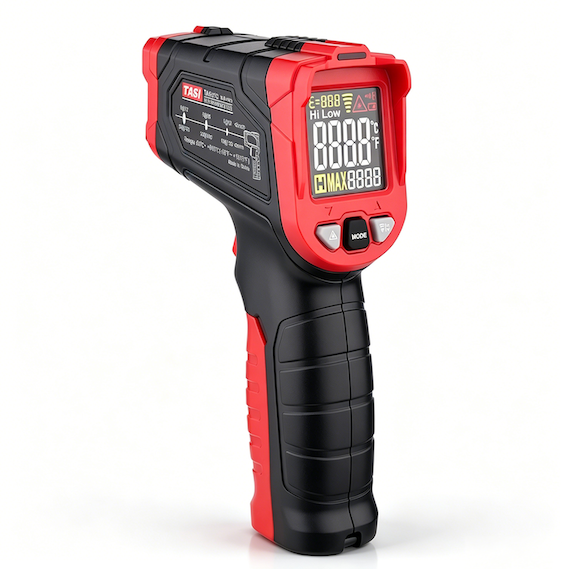
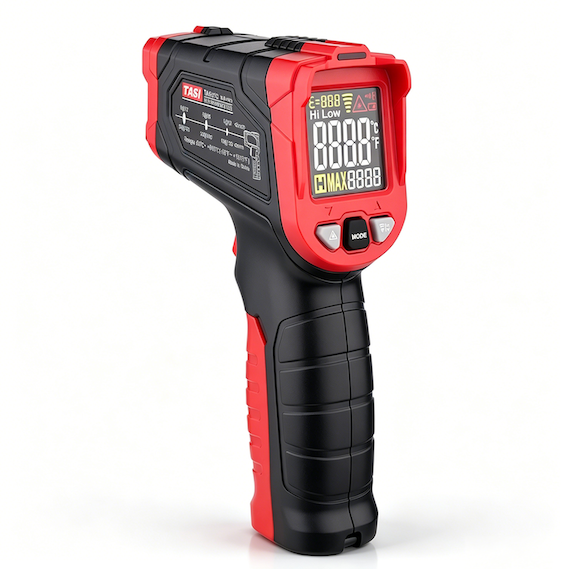
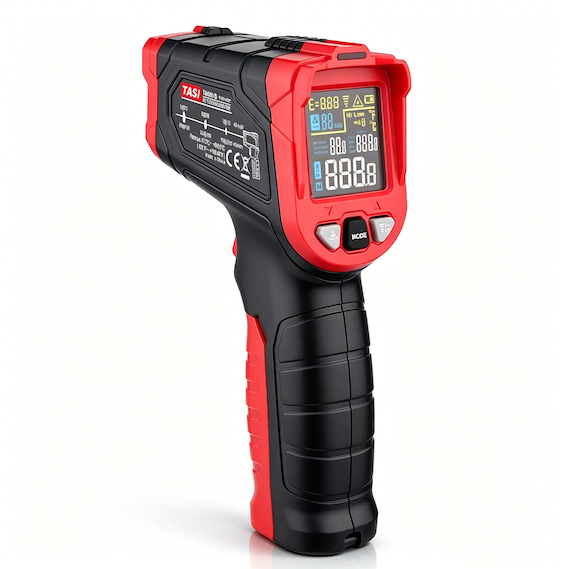
An infrared thermometer is a precision measuring instrument. If it is accidentally dropped from a workbench, toolbox, or the operator’s hand, an intact housing and a functioning display do not necessarily mean that the instrument is still measuring correctly.
Mechanical shock may affect the infrared lens, detector, internal electronics, optical alignment, or laser aiming system. If the impact was minor and the instrument passes both physical and measurement checks, it can generally continue to be used. However, if the readings become abnormal, repeatability deteriorates, the lens is damaged, or the laser alignment changes significantly, the instrument should not be relied on for critical measurements until it has been inspected or calibrated.
Key Takeaways
● An infrared thermometer is not necessarily damaged after a drop, but it should be checked before further use.
● Normal power-up and temperature display do not by themselves confirm that measurement accuracy is unchanged.
● Inspect the housing, infrared lens, display, battery compartment, controls, and laser aiming function.
● Measure a stable target repeatedly and compare the results with previous data or a reference instrument where possible.
● Stop using the instrument for critical measurements if significant errors, unstable readings, poor repeatability, or physical damage are observed.
● For applications requiring high measurement confidence, calibration or professional inspection is recommended after a significant impact.
Why Can a Drop Affect Measurement Performance?
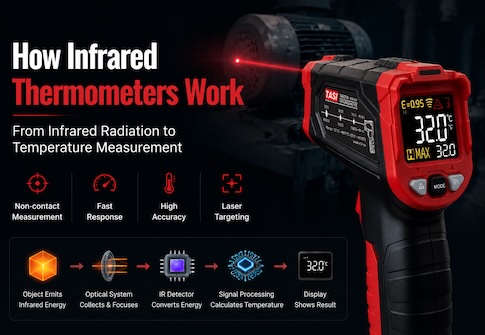
An infrared thermometer does not determine temperature from the laser point. It receives infrared radiation emitted by the target surface through an optical system, and the detector and internal electronics convert that signal into a temperature reading.
A mechanical impact can therefore affect several components.
● Infrared lens and optical system: A loose, shifted, scratched, or cracked lens can alter the amount of infrared energy reaching the detector.
● Infrared detector: A strong impact may affect the detector or its mounting position, potentially changing measurement performance.
● Internal electronics: Solder joints, connectors, battery contacts, or electronic components may loosen or develop intermittent connections.
● Laser aiming system: The laser may become misaligned, causing the indicated aiming point to differ significantly from the actual measurement area.
● Housing and mechanical structure: Deformation of the enclosure may affect the position of the lens, controls, battery compartment, or internal assemblies.
The actual level of damage depends on factors such as drop height, impact direction, floor material, and the mechanical design of the instrument. A single drop does not automatically mean that the thermometer is unusable.
What Should Be Checked First After a Drop?
After a drop, stop using the infrared thermometer temporarily and perform a visual and functional inspection before returning it to service.
● Check the housing for cracks, deformation, or loose parts.
● Inspect the infrared lens for cracks, scratches, looseness, indentation, or contamination.
● Check the display for cracks, missing segments, flickering, or other abnormalities.
● Verify that the buttons and trigger operate normally.
● Inspect the battery compartment and battery contacts for looseness or damage.
● Check whether the instrument powers on normally without unexpected error codes or random restarts.
● If the thermometer has a laser aiming function, verify that the laser activates correctly and has not shifted noticeably.
If the infrared lens is cracked, the housing is severely deformed, or loose internal parts can be heard, the instrument should not be used for formal measurements until it has been inspected.
Does Normal Power-Up Mean the Instrument Is Fine?
No.
Normal power-up only indicates that the power supply, display, and at least part of the electronics are functioning. It does not confirm that the infrared detector, optics, and measurement circuitry still perform within specification.
A dropped infrared thermometer may still display a temperature while its measurement characteristics have changed. Typical signs include:
● A noticeable difference between readings before and after the drop.
● Increased variation when repeatedly measuring the same point.
● Continuous drift while measuring a stable target.
● A persistent offset compared with a known reference instrument.
● Abnormal behavior over certain temperature ranges.
For this reason, the key question is not simply whether the instrument switches on, but whether its measurements remain reliable.
How Can You Perform a Basic Measurement Check?
If no obvious physical damage is found, perform repeated measurements on a target with a stable temperature and a surface suitable for infrared measurement.
Keep the measurement distance, angle, target location, and emissivity setting as consistent as possible.
● Measure the same target several times and observe the stability of the readings.
● Compare the results with measurements recorded before the drop, if available.
● If another infrared thermometer in known good condition is available, compare both instruments under the same conditions.
● Test stable targets at different temperature levels to determine whether any error is consistent across the range.
● Make sure the target is larger than the measurement spot at the selected distance to avoid confusing spot-size effects with instrument damage.
This type of check is useful for preliminary field assessment but does not replace formal calibration.
For laboratory work, quality inspection, industrial process control, or other applications requiring higher measurement confidence, the instrument should be verified using suitable temperature calibration equipment.
If the Laser Still Works, Does That Mean Temperature Measurement Is Normal?
Not necessarily.
The laser on an infrared thermometer is primarily an aiming aid. It is not the temperature-sensing element. Actual temperature measurement is performed by the infrared optical system and detector.
A working laser therefore does not confirm that the infrared measurement system is unaffected.
Conversely, a shifted laser does not always mean that the infrared detector is damaged. However, it can cause the operator to misjudge the actual measurement area.
This becomes particularly important when measuring small targets, where a significant difference between the laser indication and the effective measurement area can increase the risk of measurement error.
When Should the Instrument No Longer Be Used?
Stop using the infrared thermometer for formal or critical measurements if any of the following conditions are observed:
● The infrared lens is cracked, loose, severely scratched, or visibly displaced.
● The housing is badly cracked or deformed.
● The instrument powers on intermittently, shuts down unexpectedly, or restarts repeatedly.
● The display behaves abnormally or shows persistent error indications.
● Repeated measurements of the same stable target vary significantly.
● Readings show a clear and persistent deviation from a known reference.
● Measurement response becomes unusually slow or readings jump unpredictably.
● The laser aiming position has shifted significantly.
● Loose internal parts can be heard inside the housing.
● The battery compartment, trigger, or other mechanical parts are damaged.
Even if the instrument still powers on, it should not be considered a reliable temperature measurement tool when measurement abnormalities are present.
Does an Infrared Thermometer Need Recalibration After Every Drop?
Not necessarily.
If the drop was minor, there is no visible damage, all functions operate normally, and repeated measurements show no significant change, recalibration may not always be required. The decision should depend on the importance of the application and the required level of measurement confidence.
Calibration or professional inspection is recommended when:
● The instrument experienced a significant mechanical impact.
● It fell from a substantial height onto a hard surface.
● The readings changed after the drop.
● The thermometer is used for quality control, equipment condition assessment, or other important measurements.
● Measurement results directly affect process parameters or product quality.
● Field checks cannot confirm whether the instrument is still performing correctly.
Calibration does not repair the thermometer. Its purpose is to determine whether the current measurement error remains within the required tolerance. If the calibration results are outside the acceptable range, repair or adjustment may be necessary.
Can the Instrument Still Be Used If Only the Housing Is Lightly Scratched?
Usually, yes, provided that the instrument passes the necessary checks.
Minor cosmetic scratches on the housing generally do not affect temperature measurement if the infrared lens, display, controls, battery compartment, and laser system remain undamaged and the instrument continues to provide stable, consistent readings.
Special attention should be paid to the optical area at the front of the thermometer. The infrared optics directly affect how radiation from the target reaches the detector, so damage in this area can affect measurement even when the rest of the housing appears normal.
How Can Misjudgment Be Avoided After a Drop?
Do not judge the condition of an infrared thermometer from a single measurement.
● Do not rely only on whether the instrument powers on.
● Do not use normal laser operation as proof that temperature measurement is unaffected.
● Do not verify performance using a target whose temperature is changing rapidly.
● Do not compare readings while continuously changing the distance or measurement angle.
● Do not ignore the effect of emissivity settings.
● Avoid using very small targets or highly reflective metal surfaces for a simple performance check.
● For critical applications, do not use a basic field comparison as a substitute for proper calibration.
Comparisons are most meaningful when measurement conditions are kept as consistent as possible.
How Can the Risk of Drop Damage Be Reduced?
Although handheld infrared thermometers are designed for practical field use, they remain precision instruments and should be protected from repeated mechanical shock.
● Store the thermometer in a protective case, pouch, or instrument bag when not in use.
● Use a wrist strap or suitable drop-prevention method when working at height, where appropriate.
● Do not place the instrument near the edge of machinery, ladders, workbenches, or unstable surfaces.
● Avoid storing it loosely together with heavy tools that may cause impact or compression.
● Keep the optical area clean and protect it from sharp objects.
● Use adequately cushioned packaging during transportation.
Proper storage and handling not only reduce the risk of impact damage but also help maintain long-term measurement stability.
FAQ
Can I continue using an infrared thermometer after it falls from a desk?
If there is no visible damage to the housing or optics, all functions operate normally, and repeated measurements remain stable, the instrument may continue to be used. For critical measurements, comparison with a reference instrument or calibration is recommended.
If the thermometer still displays a temperature, does that mean it is undamaged?
No. A valid display does not confirm that measurement accuracy is unchanged. Repeatability and deviation from a reference value should also be checked.
Can a drop cause an infrared thermometer to read too high or too low?
Yes. If the optics, detector, or electronics are affected by the impact, the readings may shift. The problem may appear as a positive or negative error, increased instability, or reduced repeatability.
Can I still use the thermometer if the laser point has shifted?
If only the laser aiming system is misaligned, the infrared measurement system may still function. However, the indicated point may no longer accurately represent the measurement location, which is particularly important for small targets.
Does a dropped thermometer need to be sent for repair immediately?
Not necessarily after a minor drop if all inspections and measurement checks are satisfactory. If physical damage, unstable readings, abnormal measurements, or uncertainty about performance is present, the instrument should be removed from critical service and professionally inspected.
Can I calibrate a dropped infrared thermometer myself?
That depends on the instrument design and whether user calibration is supported. For measurements where traceable accuracy is important, simply changing an adjustment parameter is not an appropriate way to compensate for an unknown impact-related error. Follow the manufacturer’s instructions and use suitable calibration equipment or a qualified calibration service.
Conclusion
Whether an infrared thermometer can continue to be used after being dropped should not be judged solely by the condition of the housing or whether the instrument still powers on. Mechanical shock can affect the infrared lens, detector, optical alignment, electronics, and laser aiming system, potentially reducing measurement reliability.
After a minor drop, the thermometer can generally remain in service if there is no physical damage, all functions operate normally, and repeated measurements or reference comparisons confirm stable performance. If the optics or housing are damaged, readings show a significant offset, or repeatability deteriorates, the instrument should be removed from critical measurement tasks and inspected or calibrated.
For quality control, industrial maintenance, laboratory testing, and other applications where temperature accuracy matters, verification after a significant drop is particularly important. The objective is not simply to determine whether the thermometer still works, but whether it can still measure reliably.