Why Can’t an Infrared Thermometer Measure Transparent Objects?

Publisher: Amy Published: 2026-03-05 Last Updated: 2026-08-22 Reading Time: 6min. 0sec.
Tags: infrared thermometertransparent object temperature measurementglass temperature measurementinfrared temperature measurementinfrared transmittanceemissivity

任务 1|English Version

Article Title: Why Can’t an Infrared Thermometer Measure Transparent Objects?

Meta Description: Why can’t an infrared thermometer accurately measure through glass or other transparent materials? Learn how infrared radiation, spectral transmittance, emissivity, and reflection affect temperature readings, and how to measure glass and transparent plastics correctly.

Article Overview: Infrared thermometers determine surface temperature by detecting infrared radiation emitted from an object. Whether a transparent material can be measured accurately does not depend on how transparent it appears to the human eye, but on its infrared transmission, absorption, and reflection characteristics within the thermometer’s operating wavelength range. Standard infrared thermometers generally cannot measure objects through glass, although they can often measure the glass surface itself under suitable conditions.

SEO Tags: infrared thermometer, transparent object temperature measurement, glass temperature measurement, infrared temperature measurement, infrared transmittance, emissivity

Reading Time: Approx. 6 minutes


Introduction

A common question when using an infrared thermometer is: if glass, transparent plastic, and similar materials allow light to pass through, why can’t an infrared thermometer simply measure the temperature of an object behind them?

The reason is that an infrared thermometer does not detect visible light. It detects infrared radiation within a specific wavelength range. A material that appears transparent to the human eye is not necessarily transparent to infrared radiation.

Therefore, saying that “infrared thermometers cannot measure transparent objects” is not entirely accurate. The key is to determine whether the instrument is measuring the transparent material itself, the object behind it, or a combination of infrared radiation from several sources.


Key Points

● Infrared thermometers measure infrared radiation from a surface, not visible light.
● A material that is transparent in the visible spectrum may be opaque in the infrared spectrum.
● Standard infrared thermometers generally cannot measure an object accurately through ordinary glass.
● Under suitable emissivity and measurement conditions, they can often measure the surface temperature of glass or transparent plastic.
● If a material transmits part of the infrared radiation, the instrument may receive a combination of radiation from the material, the background object, and reflected surroundings.
● When measuring transparent or semi-transparent materials, consider the operating wavelength, emissivity, transmittance, reflectivity, and material thickness.


How Does an Infrared Thermometer Measure Temperature?

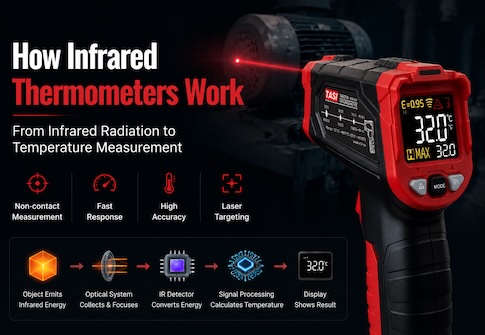
An infrared thermometer is a non-contact temperature measurement instrument. Any object above absolute zero emits electromagnetic radiation, part of which falls within the infrared spectrum.

The optical system of the thermometer collects infrared radiation from the target area and focuses it onto an infrared detector. The instrument then converts the detected energy into a surface temperature using parameters such as emissivity, ambient conditions, and internal signal-processing algorithms.

For this reason, an infrared thermometer does not “see” color or transparency in the same way the human eye does. It responds to infrared energy that reaches the detector within its specified spectral range.

Many handheld infrared thermometers operate in approximately the 8–14 µm wavelength range. A material’s behavior within this infrared band is therefore what determines whether it can be measured reliably.


Why Does Visible Transparency Not Mean Infrared Transparency?

The human eye detects visible light mainly in the approximate range of 0.4–0.7 µm, while many infrared thermometers operate at much longer wavelengths.

The same material can have very different transmission characteristics at different wavelengths.

Ordinary glass, for example, transmits visible light effectively, which is why objects behind it can be seen clearly. However, in the long-wave infrared region used by many standard infrared thermometers, ordinary glass is generally not similarly transparent.

As a result, when an infrared thermometer is pointed at a pane of ordinary glass, it normally does not “see through” the glass. Instead, it mainly detects infrared radiation emitted by the glass surface, together with some reflected radiation from the surroundings.

This is why measuring hot water, machinery, walls, or a person through glass usually does not provide the true temperature of the object behind the glass.


Can an Infrared Thermometer Never Measure Transparent Objects?

Not necessarily.

Two different applications must be distinguished:

● Measuring the surface temperature of the transparent material itself: Often possible.
● Measuring an object through the transparent material: Usually not possible with a standard infrared thermometer.

For example, a typical 8–14 µm infrared thermometer can often measure the surface temperature of ordinary glass when the emissivity is set appropriately and the measurement conditions are suitable.

However, if the goal is to measure a cup of hot water through the glass, the displayed value will usually represent the glass surface rather than the water behind it.

The common assumption that “glass is transparent, so an infrared thermometer should be able to measure through it” is therefore incorrect.


Why Can Transparent Materials Cause Measurement Errors?

From the perspective of infrared measurement, the thermal radiation received from a target can generally involve three components: emission, reflection, and transmission.

If a material transmits infrared radiation to some extent, the thermometer may receive:

● Infrared radiation emitted by the material itself;
● Infrared radiation from an object behind the material that passes through it;
● Infrared radiation from the surroundings reflected by the material surface.

The detector therefore receives a combined infrared signal.

If the instrument interprets this signal as though it came from a conventional opaque surface, the resulting temperature reading may be inaccurate.

The thinner the material, the higher its infrared transmittance, or the greater the temperature difference between the material and the background, the more significant this effect can become.


Why Can’t You Measure Through Glass with an Infrared Thermometer?

This is one of the most common practical measurement issues.

If you need to measure the temperature of an object inside a closed enclosure, vehicle, chamber, or behind a window, measuring directly through ordinary glass with a handheld infrared thermometer will generally not provide the actual surface temperature of the target.

For example:

● Target behind the glass: 35 °C;
● Glass surface: 22 °C;
● Measurement is taken from outside the glass.

The infrared thermometer may display a value much closer to the glass surface temperature than to the actual 35 °C target temperature.

If the target behind the glass must be measured, the preferred approach is to open the window or enclosure, change the measurement position, and aim the infrared thermometer directly at the target surface.


What About Transparent Plastics?

Transparent plastics are more complex than ordinary glass.

Materials such as PE, PP, PET, PC, and PMMA can have significantly different infrared transmission, absorption, and reflection properties. Material thickness, additives, surface treatment, and pigmentation can also affect their infrared behavior.

For this reason, a plastic material should not be considered suitable for infrared measurement simply because it looks transparent.

For general field measurements, if infrared spectral data for the material is unavailable, a practical approach is to compare the infrared reading with a contact temperature measurement and adjust the emissivity setting where appropriate.

For specialized applications such as plastic film extrusion, glass processing, or industrial process monitoring, an infrared thermometer or pyrometer designed for a specific wavelength band may be required instead of a general-purpose handheld instrument.


What Should Be Considered When Measuring the Surface Temperature of a Transparent Material?

If the objective is to measure the surface temperature of glass or transparent plastic rather than an object behind it, consider the following points.

● Identify the actual measurement target: Confirm that the intended target is the transparent material surface itself.
● Set the emissivity correctly: An incorrect emissivity setting can directly affect the measured temperature.
● Avoid excessive viewing angles: Aim as close to normal to the surface as practical to reduce reflection-related errors.
● Consider nearby hot objects: Heaters, lamps, furnaces, and other hot surfaces can produce infrared radiation that is reflected into the thermometer.
● Observe the D:S ratio: Make sure the measurement spot remains entirely within the target surface.
● Verify when higher accuracy is required: Compare the result with a suitable contact temperature probe when necessary.


Why Is Emissivity Especially Important for Transparent Materials?

An infrared thermometer estimates temperature from the infrared radiation it receives. Emissivity describes how effectively a real surface emits infrared radiation compared with an ideal blackbody.

If the actual emissivity differs significantly from the value set in the instrument, the displayed temperature can be incorrect.

Transparent materials may also involve significant reflection or transmission, making the measurement more complex than for typical opaque, high-emissivity surfaces.

Coated, polished, or specially treated glass can have very different infrared properties even when the base material is similar. A single fixed emissivity value should therefore not be assumed to apply to every type of glass.


How Can You Tell Whether You Are Measuring the Glass or the Object Behind It?

One practical method is to change the temperature of the object behind the glass and observe whether the infrared reading changes accordingly.

If the background object changes temperature substantially while the infrared reading remains nearly unchanged, the thermometer is mainly detecting the glass surface.

You can also measure the glass surface with a contact thermometer. If the contact measurement and infrared reading are similar, this provides additional evidence that the infrared thermometer is primarily measuring the glass.

For high-accuracy applications, however, empirical checks alone are not sufficient. The material’s spectral transmittance, the instrument’s operating wavelength, and actual calibration conditions should be considered.


When Is a Specialized Infrared Temperature Measurement System Required?

General-purpose handheld infrared thermometers are designed primarily for surface temperature measurement and are not suitable for every transparent or semi-transparent material.

Specialized wavelength-selective infrared instruments may be required for applications such as:

● Glass production and thermal processing;
● Plastic film extrusion and forming;
● Semiconductor temperature monitoring;
● Special optical materials and crystals;
● Temperature measurement through dedicated infrared windows;
● High-accuracy in-line industrial temperature monitoring.

In these applications, the sensing wavelength is selected according to the spectral properties of the material so that the instrument receives as much useful radiation from the intended target as possible while reducing errors caused by transmission and reflection.


FAQ

Can an infrared thermometer measure the temperature of glass?

Yes. Under suitable measurement conditions and with an appropriate emissivity setting, a standard infrared thermometer can measure the surface temperature of glass. It is measuring the glass surface, not the object visible behind it.

Can an infrared thermometer measure an outdoor object through a window?

Generally no. Ordinary window glass usually prevents a standard infrared thermometer from accurately detecting the surface temperature of an object behind it. Open the window and measure the target directly whenever possible.

Why is body temperature measurement inaccurate through glass?

Because ordinary glass does not transmit the long-wave infrared radiation used by many infrared thermometers in the same way it transmits visible light. The instrument therefore mainly detects the glass surface rather than the person behind it.

Can transparent plastic film be measured with an infrared thermometer?

It depends on the plastic type, thickness, and measurement wavelength. Some thin films transmit significant infrared radiation within certain wavelength bands, which can cause the thermometer to detect a combination of the film and background radiation.

If the laser passes through glass, why can’t the thermometer measure the object behind it?

The laser is only an aiming aid. It is not the signal used to determine temperature. Visible laser light passing through glass does not mean that the infrared wavelength detected by the thermometer can also pass through the glass.

Are all transparent objects unsuitable for infrared temperature measurement?

No. Measurement suitability depends on emissivity, reflectivity, and transmittance within the thermometer’s operating wavelength range. Many transparent materials can have their own surface temperature measured even though an object behind them cannot be measured accurately.


Conclusion

Whether an infrared thermometer can measure a transparent object cannot be determined simply by how transparent that object appears to the human eye. The key factors are the material’s emission, reflection, and transmission characteristics within the thermometer’s operating infrared wavelength range.

Ordinary glass is transparent to visible light but is generally not transparent in the long-wave infrared range commonly used by handheld infrared thermometers. As a result, the instrument usually measures the glass surface rather than an object behind it.

For transparent plastics, films, and other specialized materials, measurement capability must be evaluated according to the material, thickness, operating wavelength, and actual measurement conditions.

The key principle is simple: being able to see or aim at a target with the laser does not mean the infrared thermometer can measure that target’s true temperature.

Related Technical Articles
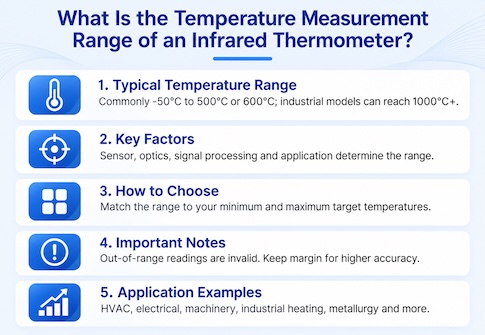
What Is the Temperature Measurement Range of an Infrared Thermometer?
How Does Target Size Relate to the Measurement Spot of an Infrared Thermometer?
Detailed Explanation of How Infrared Thermometers Work
Introduction to the Optical System of an Infrared Thermometer
Why Does Surface Roughness Affect Infrared Temperature Measurement?
What Is the Relationship Between Emissivity, Reflectivity, and Transmissivity?
What Is Emissivity in an Infrared Thermometer? How to Set It Correctly?
What Is the Difference Between an Infrared Thermometer and a Contact Thermometer?
How Do Dust and Oil Mist Affect Infrared Temperature Measurements?
What Is the Difference Between an Infrared Thermometer and a Thermal Imaging Camera?
How to Properly Use an Infrared Thermometer for Temperature Measurement?
How to Measure Surfaces That Heat Up or Cool Down Rapidly with an Infrared Thermometer
What Does the Spectral Response Range of an Infrared Thermometer Mean?
How to Evaluate the Quality of an Infrared Thermometer
What Does Measurement Uncertainty Mean in Infrared Temperature Measurement?
Why Does Reflected Background Temperature Affect Infrared Temperature Measurements?
How Does a Thermopile Sensor Work in an Infrared Thermometer?
What Objects Can an Infrared Thermometer Measure?
Infrared Thermometer Measurement Range, Response Time and Resolution Explained
Why Do Infrared Thermometers Need Laser Aiming?
What Does Resolution Mean on an Infrared Thermometer?
What Is the Relationship Between Blackbody Radiation and Infrared Temperature Measurement?
How Is Infrared Thermometer Accuracy Defined?
Why Can’t an Infrared Thermometer Measure Temperature Through Glass?
Why Do Infrared Thermometers Use Infrared Radiation to Measure Temperature?
How Does Measurement Angle Affect Infrared Thermometer Readings?
What Materials Can an Infrared Thermometer Measure?
What Factors Affect the Accuracy of Infrared Thermometers?
How to Measure Moving Objects with an Infrared Thermometer
Do Air, Steam, and Smoke Affect Infrared Temperature Measurement?
How Do Temperature Gradients Affect Infrared Temperature Measurements?
Infrared Thermometer Calibration Principles Explained
Why Doesn’t the Laser Dot on an Infrared Thermometer Represent the Actual Measurement Area?
What Is the Difference Between Repeatability and Accuracy in an Infrared Thermometer?
What Does Response Time Mean on an Infrared Thermometer?
What Does Thermal Equilibrium Mean in Infrared Temperature Measurement?
How Does Response Time Affect Temperature Measurement of Fast-Moving Objects?
How to Calculate the Measurement Spot Size of an Infrared Thermometer at Different Distances
What Does the D:S Distance-to-Spot Ratio Mean on an Infrared Thermometer?
How Do Infrared Thermometers Account for Ambient Background Radiation?
What Is an Infrared Thermometer? Working Principle and Applications
How Does Ambient Temperature Affect Infrared Temperature Measurement?
Common Functions of Infrared Thermometers
What Does Field of View (FOV) Mean on an Infrared Thermometer?
Types of Sensors Used in Infrared Thermometers
Related FAQs
Why Can’t an Infrared Thermometer Measure Transparent Objects?
Can an Infrared Thermometer Still Be Used After Being Dropped?
Why Does an Infrared Thermometer Give Different Readings on Different Colors?
Why Does Black Tape Improve the Accuracy of Infrared Temperature Measurement?
How to Calibrate an Infrared Thermometer
Why Does an Infrared Thermometer Show Different Temperatures at Different Points on the Same Object?
Common Mistakes When Using an Infrared Thermometer
Can an Infrared Thermometer Measure Objects in a Steam Environment?
Why Do Two Infrared Thermometers Give Different Readings on the Same Object?
Why Are Infrared Thermometer Readings Unstable on Stainless Steel Surfaces?
What Does “OL” Mean on an Infrared Thermometer Display?
Can an Infrared Thermometer Measure Liquid Temperature?
What Do HI and LO Mean on an Infrared Thermometer?
Why Does an Infrared Thermometer Show the Laser but No Temperature Reading?
Why Does an Infrared Thermometer Need a Stable Environment?
Does an Infrared Thermometer Need Regular Performance Verification?
Why Is the Infrared Thermometer Inaccurate?
Why Should an Infrared Thermometer Be Allowed to Stabilize After Moving from Outdoors to Indoors?
What Happens If You Measure from Too Far Away with an Infrared Thermometer?
How to Clean the Lens of an Infrared Thermometer
Does Low Battery Power Affect the Measurement Accuracy of an Infrared Thermometer?
Why Does an Infrared Thermometer Reading Fluctuate When Measuring a Moving Belt or Roller?
How to Maintain and Care for an Infrared Thermometer
Does Condensation on an Infrared Thermometer Lens Affect Temperature Measurement?
Does an Infrared Thermometer Measure the Glass Temperature or the Object Behind the Glass?
Can an Infrared Thermometer Measure Metal Surfaces?
Does an Infrared Thermometer Need Calibration?
Can an Infrared Thermometer Be Used for Continuous Long-Term Measurement?
Can an Infrared Thermometer Be Used in Bright Light or Direct Sunlight?
Can an Infrared Thermometer Measure Human Body Temperature?
Why Do Infrared Thermometers Often Read Too Low on Metal Surfaces?
Are Infrared Thermometers Accurate When Measuring Black Objects?
Why Is My Infrared Thermometer Showing the Wrong Temperature?
Can an Infrared Thermometer Measure Transparent Objects?
What Are the Common Mistakes When Using an Infrared Thermometer?
Can an Infrared Thermometer Measure Highly Reflective Metals Such as Aluminum and Copper?
What to Do If an Infrared Thermometer Is Inaccurate in Winter
What Is the Alarm Function on an Infrared Thermometer Used For?
Can an Infrared Thermometer Measure Temperature Through Plastic Film?
Related Products
TA601A TA601 Series Non-Contact Infrared Thermometers

TA601A

TA601 Series
Non-Contact Infrared Thermometers
-50 to 480°C | 12:1
Abstract:
The TA601 Series Infrared Thermometers are professional non-contact temperature measurement instruments, also known as infrared temperature guns, laser thermometers, handheld infrared thermometers, IR temperature testers, and industrial infrared temperature meters. By detecting the infrared energy emitted from the surface of an object, these devices provide fast, accurate, and safe temperature measurements without physical contact, making them ideal for measuring high-temperature, hazardous, or hard-to-reach areas. Featuring a 12:1 distance-to-spot ratio, the TA601 Series infrared thermometer combines laser targeting technology with fast response performance to accurately identify the measurement area even from a distance. The adjustable emissivity range from 0.10 to 1.00 allows the instrument to measure different surface materials including metal, plastic, rubber, glass, stone, and wood. Additional functions include high/low temperature alarms, audible alerts, data hold, maximum value recording, and ℃/℉ unit conversion, providing reliable temperature monitoring for various professional applications. With its compact design, quick measurement capability, and easy operation, the TA601 Series handheld infrared thermometer is widely used in electrical maintenance, industrial equipment inspection, manufacturing, automotive repair, HVAC systems, building inspection, food processing, cold chain management, laboratories, chemical equipment monitoring, and energy management applications. In electrical applications, it helps detect overheating issues in distribution cabinets, cables, terminals, circuit breakers, and transformers. In industrial environments, it supports temperature monitoring of motors, bearings, gearboxes, molds, production lines, and mechanical equipment. For HVAC applications, it is suitable for checking air conditioners, heating systems, pipelines, and underfloor heating systems. In automotive maintenance, it assists with temperature diagnosis of engines, exhaust systems, brake systems, and vehicle components. In food processing and cold storage industries, it helps monitor processing temperatures, refrigeration systems, and quality control procedures. The TA601 Series infrared thermometer provides maintenance engineers, technicians, and inspectors with an efficient solution for fast temperature diagnosis, preventive maintenance, and safety inspection, helping improve operational efficiency and reduce equipment failure risks.
View More ›
TA601B TA601 Series Non-Contact Infrared Thermometers

TA601B

TA601 Series
Non-Contact Infrared Thermometers
-50 to 680°C | 12:1
Abstract:
The TA601 Series Infrared Thermometers are professional non-contact temperature measurement instruments, also known as infrared temperature guns, laser thermometers, handheld infrared thermometers, IR temperature testers, and industrial infrared temperature meters. By detecting the infrared energy emitted from the surface of an object, these devices provide fast, accurate, and safe temperature measurements without physical contact, making them ideal for measuring high-temperature, hazardous, or hard-to-reach areas. Featuring a 12:1 distance-to-spot ratio, the TA601 Series infrared thermometer combines laser targeting technology with fast response performance to accurately identify the measurement area even from a distance. The adjustable emissivity range from 0.10 to 1.00 allows the instrument to measure different surface materials including metal, plastic, rubber, glass, stone, and wood. Additional functions include high/low temperature alarms, audible alerts, data hold, maximum value recording, and ℃/℉ unit conversion, providing reliable temperature monitoring for various professional applications. With its compact design, quick measurement capability, and easy operation, the TA601 Series handheld infrared thermometer is widely used in electrical maintenance, industrial equipment inspection, manufacturing, automotive repair, HVAC systems, building inspection, food processing, cold chain management, laboratories, chemical equipment monitoring, and energy management applications. In electrical applications, it helps detect overheating issues in distribution cabinets, cables, terminals, circuit breakers, and transformers. In industrial environments, it supports temperature monitoring of motors, bearings, gearboxes, molds, production lines, and mechanical equipment. For HVAC applications, it is suitable for checking air conditioners, heating systems, pipelines, and underfloor heating systems. In automotive maintenance, it assists with temperature diagnosis of engines, exhaust systems, brake systems, and vehicle components. In food processing and cold storage industries, it helps monitor processing temperatures, refrigeration systems, and quality control procedures. The TA601 Series infrared thermometer provides maintenance engineers, technicians, and inspectors with an efficient solution for fast temperature diagnosis, preventive maintenance, and safety inspection, helping improve operational efficiency and reduce equipment failure risks.
View More ›
TA601C TA601 Series Non-Contact Infrared Thermometers

TA601C

TA601 Series
Non-Contact Infrared Thermometers
-50 to 880°C | 12:1
Abstract:
The TA601 Series Infrared Thermometers are professional non-contact temperature measurement instruments, also known as infrared temperature guns, laser thermometers, handheld infrared thermometers, IR temperature testers, and industrial infrared temperature meters. By detecting the infrared energy emitted from the surface of an object, these devices provide fast, accurate, and safe temperature measurements without physical contact, making them ideal for measuring high-temperature, hazardous, or hard-to-reach areas. Featuring a 12:1 distance-to-spot ratio, the TA601 Series infrared thermometer combines laser targeting technology with fast response performance to accurately identify the measurement area even from a distance. The adjustable emissivity range from 0.10 to 1.00 allows the instrument to measure different surface materials including metal, plastic, rubber, glass, stone, and wood. Additional functions include high/low temperature alarms, audible alerts, data hold, maximum value recording, and ℃/℉ unit conversion, providing reliable temperature monitoring for various professional applications. With its compact design, quick measurement capability, and easy operation, the TA601 Series handheld infrared thermometer is widely used in electrical maintenance, industrial equipment inspection, manufacturing, automotive repair, HVAC systems, building inspection, food processing, cold chain management, laboratories, chemical equipment monitoring, and energy management applications. In electrical applications, it helps detect overheating issues in distribution cabinets, cables, terminals, circuit breakers, and transformers. In industrial environments, it supports temperature monitoring of motors, bearings, gearboxes, molds, production lines, and mechanical equipment. For HVAC applications, it is suitable for checking air conditioners, heating systems, pipelines, and underfloor heating systems. In automotive maintenance, it assists with temperature diagnosis of engines, exhaust systems, brake systems, and vehicle components. In food processing and cold storage industries, it helps monitor processing temperatures, refrigeration systems, and quality control procedures. The TA601 Series infrared thermometer provides maintenance engineers, technicians, and inspectors with an efficient solution for fast temperature diagnosis, preventive maintenance, and safety inspection, helping improve operational efficiency and reduce equipment failure risks.
View More ›
TA601D TA601 Series Non-Contact Infrared Thermometers

TA601D

TA601 Series
Non-Contact Infrared Thermometers
Abstract:
The TA601 Series Infrared Thermometers are professional non-contact temperature measurement instruments, also known as infrared temperature guns, laser thermometers, handheld infrared thermometers, IR temperature testers, and industrial infrared temperature meters. By detecting the infrared energy emitted from the surface of an object, these devices provide fast, accurate, and safe temperature measurements without physical contact, making them ideal for measuring high-temperature, hazardous, or hard-to-reach areas. Featuring a 12:1 distance-to-spot ratio, the TA601 Series infrared thermometer combines laser targeting technology with fast response performance to accurately identify the measurement area even from a distance. The adjustable emissivity range from 0.10 to 1.00 allows the instrument to measure different surface materials including metal, plastic, rubber, glass, stone, and wood. Additional functions include high/low temperature alarms, audible alerts, data hold, maximum value recording, and ℃/℉ unit conversion, providing reliable temperature monitoring for various professional applications. With its compact design, quick measurement capability, and easy operation, the TA601 Series handheld infrared thermometer is widely used in electrical maintenance, industrial equipment inspection, manufacturing, automotive repair, HVAC systems, building inspection, food processing, cold chain management, laboratories, chemical equipment monitoring, and energy management applications. In electrical applications, it helps detect overheating issues in distribution cabinets, cables, terminals, circuit breakers, and transformers. In industrial environments, it supports temperature monitoring of motors, bearings, gearboxes, molds, production lines, and mechanical equipment. For HVAC applications, it is suitable for checking air conditioners, heating systems, pipelines, and underfloor heating systems. In automotive maintenance, it assists with temperature diagnosis of engines, exhaust systems, brake systems, and vehicle components. In food processing and cold storage industries, it helps monitor processing temperatures, refrigeration systems, and quality control procedures. The TA601 Series infrared thermometer provides maintenance engineers, technicians, and inspectors with an efficient solution for fast temperature diagnosis, preventive maintenance, and safety inspection, helping improve operational efficiency and reduce equipment failure risks.
View More ›
TA606B+ TA606 Series Non-contact Infrared Thermometer

TA606B+

TA606 Series
Non-contact Infrared Thermometer
-32 to 550℃ | 10:1
Abstract:
The TA606 Series Infrared Thermometer is a professional non-contact temperature measurement tool, also known as an infrared temperature gun, laser thermometer, infrared temperature meter, industrial thermometer, or handheld infrared thermometer. It measures surface temperature by detecting infrared energy emitted from target objects, providing fast, safe, and accurate temperature readings without physical contact, reducing risks when measuring hot surfaces, moving equipment, or energized components. The TA606 Series includes two models: TA606A+ with a temperature range of -32℃ to 400℃, and TA606B+ with an extended range up to -32℃ to 550℃, meeting various industrial temperature inspection requirements. Equipped with a 10:1 distance-to-spot ratio and laser aiming guidance, the infrared thermometer allows users to quickly identify measurement areas and improve inspection efficiency. The fixed 0.95 emissivity setting enables direct measurement on most common solid materials without complicated configuration. Featuring ℃/℉ temperature unit switching, data hold function, and a compact handheld design, the TA606 infrared thermometer is easy to operate and suitable for daily field temperature testing. It is widely used in electrical inspection, industrial maintenance, HVAC systems, automotive repair, food processing, building inspection, facility management, and engineering applications. In electrical and industrial environments, the infrared temperature gun can be used for checking switchgear, cables, terminals, circuit breakers, motors, bearings, and mechanical equipment, helping technicians quickly identify abnormal heat conditions. In HVAC applications, it supports temperature inspection of air conditioners, refrigeration systems, heating pipes, and underfloor heating systems. For automotive maintenance, it enables temperature diagnosis of engines, exhaust systems, brake components, and vehicle parts. It is also suitable for food production temperature monitoring, cold chain management, building insulation inspection, and energy efficiency testing, making it an ideal handheld infrared thermometer for professional field measurements.
View More ›
Related Technical Articles
Related FAQs