Introduction
An infrared thermometer can measure surface temperature quickly without making physical contact with the target. One of the key elements that makes this possible is its optical system, which is specifically designed to collect infrared radiation emitted by the measured object.
In practice, an infrared thermometer does not measure the temperature of a single mathematical point. Instead, it receives infrared radiation from a defined area of the target surface. The size of this area, the maximum practical measurement distance, and whether surrounding surfaces enter the measurement field are all closely related to the instrument's optical design.
Understanding the optical system therefore helps users correctly interpret important parameters such as field of view, measurement spot size, D:S ratio, and optical resolution, while reducing errors caused by unsuitable target size or measurement distance.
Key Points
● The optical system collects infrared radiation from the target surface and directs it toward the infrared detector.
● An infrared thermometer measures an area rather than the visible laser point alone.
● Infrared lenses or windows, apertures, filtering elements, and associated optical components determine which infrared radiation reaches the detector.
● Field of view and spot size determine how large an area is measured at a given distance.
● The D:S ratio is an important indicator of optical resolution. A higher D:S ratio generally allows smaller targets to be measured from greater distances.
● The laser is primarily an aiming aid and is not the radiation used to determine temperature.
What Is the Optical System of an Infrared Thermometer?
The optical system can be regarded as the infrared thermometer's “eye.”
Any object above absolute zero emits electromagnetic radiation, including infrared radiation. An infrared thermometer detects this energy through its optical system. The infrared detector then converts the received radiation into an electrical signal, which is processed to determine the target surface temperature.
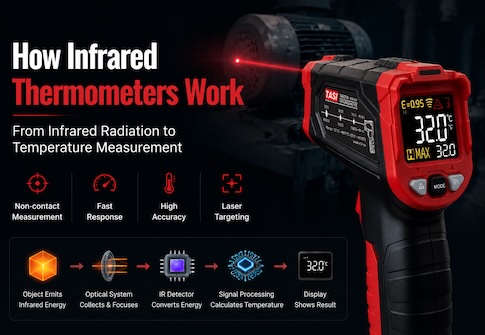
The basic measurement process can be summarized as follows:
● The target surface emits infrared radiation.
● The optical system collects radiation from a defined target area.
● Optical components direct or focus the infrared energy onto the detector.
● The detector converts the received infrared energy into an electrical signal.
● The signal-processing electronics calculate temperature using emissivity, compensation, and calibration parameters.
● The measured temperature is shown on the display.
The optical system therefore forms the link between the target and the detector. It determines where the instrument measures, how large the measured area is, and how measurement distance affects the spot size.
What Are the Main Components of the Optical System?
The exact optical design varies between infrared thermometer models, but common elements include an infrared lens or window, apertures, spectral filtering structures, and optical components positioned in front of the detector.
Infrared Lens or Window
Its primary function is to allow infrared radiation within the required wavelength range to enter the instrument and to transmit or direct this energy toward the detector.
Materials that are transparent to visible light are not necessarily transparent within the infrared wavelength range used for temperature measurement. For this reason, infrared thermometers require optical materials suited to their intended spectral range. The specific material depends on the measurement range, wavelength band, optical design, and product requirements.
Apertures and Field-of-View Limiting Elements
Apertures restrict the direction and extent of incoming infrared radiation so that the detector mainly receives energy from the intended field of view.
Without suitable optical limitation, infrared radiation from surrounding objects could enter the detector and influence the measurement.
Spectral Filtering Elements
Infrared thermometers are normally designed to respond within a specific infrared wavelength range. Optical filtering elements, together with the spectral response of the detector, determine the effective operating wavelength band.
Many general-purpose infrared thermometers operate in the long-wave infrared region, often around 8–14 μm, although the actual spectral range varies by product and should always be confirmed in the manufacturer's specifications.
Infrared Detector
Strictly speaking, the detector belongs to the sensing system, but it works closely with the optical assembly. Infrared radiation collected by the optical system ultimately reaches the detector, where it is converted into a signal that can be processed electronically.
As a result, even infrared thermometers using similar detector technologies can provide different measurement distances, spot sizes, and optical resolutions because of differences in optical design.
How Does the Optical System Work?
When an infrared thermometer is aimed at a target surface, its front optical system receives infrared radiation from within a defined field of view.
This infrared energy passes through the lens, window, aperture, filtering elements, and related optical structures before reaching the detector. Changes in the infrared radiation received by the detector produce corresponding changes in its output signal.
However, infrared temperature measurement is not simply a matter of converting “more infrared radiation” directly into a temperature value.
The instrument also takes into account detector characteristics, internal temperature compensation, target emissivity, calibration data, and signal-processing algorithms to determine the target surface temperature.
A complete infrared temperature measurement system therefore includes:
● Optical system — determines which area contributes infrared radiation.
● Infrared detector — converts infrared radiation into a measurable signal.
● Signal-processing electronics — amplify, compensate, and process the signal.
● Emissivity setting — compensates for differences in surface radiation characteristics.
● Display system — presents the calculated temperature.
The optical system is the first stage in defining exactly which area of the target contributes to the measurement.
What Is the Field of View?
Field of view, commonly abbreviated as FOV, describes the spatial area from which an infrared thermometer receives infrared radiation.
As the distance between the instrument and the target changes, the corresponding measurement area also changes.
An infrared thermometer can therefore be thought of as having a defined infrared viewing cone. At shorter distances, the measured area is generally smaller. As the measurement distance increases, the viewed area and measurement spot usually become larger.
If the target is small and the thermometer is positioned too far away, the field of view may include both the intended target and surrounding background surfaces.
For example, when measuring a narrow heated pipe from too great a distance, the field of view may also include the wall or equipment behind it. In this situation, the thermometer receives infrared radiation from multiple surfaces, and the displayed temperature may not accurately represent the intended target.
What Is the Measurement Spot?
The measurement spot is the target area from which an infrared thermometer receives infrared radiation at a specific measurement distance.
Although the term “spot” is commonly used, it does not refer to the visible laser dot. It describes the actual area covered by the infrared optical measurement system.
The spot size generally increases with measurement distance.
At a short distance, an infrared thermometer may measure a relatively small area. As the distance increases, the diameter of the measurement area also increases.
When measuring small components, narrow pipes, electrical connection points, or localized hot spots, it is therefore important not only to aim correctly but also to ensure that the actual measurement spot is smaller than the intended target area.
If the target is smaller than the measurement spot, infrared radiation from surrounding surfaces can influence the reading.
How Is the D:S Ratio Related to the Optical System?
D:S stands for Distance-to-Spot Ratio and is commonly used to describe the optical resolution of an infrared thermometer.
Where:
● D represents the distance between the thermometer and the target.
● S represents the approximate measurement spot size at that distance.
For example, a thermometer with a D:S ratio of 12:1 can be understood, under specified conditions, as measuring an approximately 100 mm diameter spot at a distance of around 1200 mm.
At the same distance:
● A 12:1 instrument measures approximately a 100 mm area at 1200 mm.
● A 30:1 instrument can measure a smaller area from the same distance.
● A 50:1 or higher optical ratio is better suited to relatively small targets at greater distances.
A higher D:S ratio therefore generally means that the thermometer can measure a smaller area from the same distance, or measure a given target size from farther away.
The D:S ratio should be used as a practical guide to optical measurement capability. For precise spot dimensions, users should refer to the manufacturer's distance-to-spot diagram, because a real optical system does not behave as a perfectly ideal geometric cone.
Why Should the Target Be Larger Than the Measurement Spot?
This is one of the most important principles when using an infrared thermometer.
The instrument receives infrared radiation from its entire field of view. If the target does not fully cover the measurement area, infrared radiation from surrounding surfaces may also reach the detector.
For example, suppose a small metal component is at 80°C while the wall behind it is at 25°C. If the measurement distance is too great and the spot covers both the component and the wall, the infrared thermometer is no longer receiving radiation exclusively from the metal component.
The displayed temperature may therefore be significantly lower than the actual surface temperature of the intended target.
For reliable measurement:
● The target area should fully cover the measurement spot.
● For higher measurement confidence, the target should be noticeably larger than the spot.
● Move closer when measuring small targets whenever conditions permit.
● If the measurement distance cannot be reduced, select a thermometer with a higher D:S ratio.
A laser dot falling on the target does not necessarily mean that the thermometer is measuring only that target.
Is the Laser Pointer Part of the Temperature Measurement Optics?
Many handheld infrared thermometers use a single laser, dual lasers, or multiple laser indicators to assist with aiming. This sometimes leads users to assume that temperature is measured using the laser itself.
That is not the case.
The laser is primarily an aiming aid. Temperature is determined from infrared radiation naturally emitted by the target surface.
In practical terms:
● The laser assists with aiming.
● The infrared optical system collects thermal radiation.
● The infrared detector senses the received energy.
● The electronic system calculates and displays the temperature.
On some products, the laser point is positioned near the center of the measurement area. Other designs use two or more laser points to help indicate the approximate measurement area. The relationship between the laser indication and the true measurement spot should always be confirmed in the instructions for the specific model.
For this reason, D:S ratio and distance-to-spot diagrams are more important than the apparent laser dot size when evaluating whether a target can be measured correctly.
Why Is Optical Resolution Important?
Optical resolution determines how effectively an infrared thermometer can measure small targets or targets at greater distances.
Large targets such as walls, floors, large machinery housings, or broad pipe surfaces generally do not require extremely high optical resolution because they can easily fill the instrument's field of view.
Higher optical resolution becomes more important for applications such as:
● Measuring high-temperature equipment from a safer distance.
● Measuring narrow pipes.
● Inspecting electrical terminals or connection points.
● Measuring localized areas on PCBs, motors, or mechanical components.
● Measuring inaccessible hot or moving objects.
● Measuring specific components in confined spaces.
For the same 20 mm target, an instrument with a higher D:S ratio can generally be used from farther away, while an instrument with a lower ratio may need to be positioned much closer.
When selecting an infrared thermometer, users should therefore evaluate not only temperature range and accuracy, but also optical resolution according to the expected target size and working distance.
Does an Infrared Thermometer Have a Fixed Focus?
Different infrared thermometers use different optical designs.
Many general-purpose handheld infrared thermometers use a fixed optical system and require no manual focusing. The user simply follows the specified D:S ratio and the manufacturer's distance-to-spot diagram to determine a suitable working distance.
Some instruments intended for small-target or specialized industrial measurements may use close-focus, adjustable-focus, or other specialized optical designs that provide a smaller measurement spot at a specific distance.
For very small targets, a high D:S ratio alone may therefore not be sufficient. The minimum achievable spot size at the intended working distance should also be checked.
What Factors Can Affect Optical Measurement?
In addition to the optical design itself, environmental conditions and measurement technique can affect how infrared radiation reaches the detector.
Excessive Measurement Distance
As distance increases, the measurement spot becomes larger. If the spot exceeds the size of the target, surrounding surfaces can influence the reading.
Target Too Small
If the target does not completely fill the field of view, the thermometer may measure radiation from both the target and its surroundings.
Contaminated Lens or Infrared Window
Dust, oil, moisture, or other contamination on the optical surface can reduce effective infrared transmission. The optical area should therefore be kept clean.
Obstructed Optical Path
If an object blocks the line of sight between the thermometer and the target, infrared radiation from the intended surface may not reach the optical system correctly.
Measurement Through Ordinary Glass
Glass that is transparent to visible light is not necessarily transparent within the infrared wavelength band used by the thermometer. In most cases, an infrared thermometer cannot simply measure the true surface temperature of an object through ordinary glass.
Smoke, Steam, or Heavy Dust
Dense smoke, steam, or airborne particles may absorb, scatter, or otherwise alter the infrared radiation traveling between the target and the instrument.
Excessive Measurement Angle
Infrared measurements are generally more reliable when the thermometer is aimed as close to perpendicular to the target surface as practical. Large angles can change the effective measurement area and may increase the influence of reflected radiation.
How Should an Infrared Thermometer Be Used According to Its Optical Characteristics?
To make proper use of the instrument's optical performance:
● Check the D:S ratio before measurement.
● Refer to the distance-to-spot diagram in the product documentation.
● Ensure that the target area is larger than the actual measurement spot.
● Reduce the measurement distance when measuring small targets.
● Use a higher optical resolution for small targets at greater distances.
● Do not use laser dot size as an indication of the true measurement area.
● Keep the infrared lens or optical window clean.
● Avoid measuring through glass, heavy smoke, steam, or similar media.
● Aim as close to perpendicular to the target surface as practical.
● Set the correct emissivity for the target material.
The final point is especially important. The optical system determines which area is being measured, while emissivity influences how the received radiation is converted into temperature.
Reliable infrared temperature measurements require appropriate target size, measurement distance, optical conditions, and emissivity settings.
FAQ
What is the purpose of the optical system in an infrared thermometer?
Its primary function is to collect infrared radiation from a defined target area and direct it toward the infrared detector while limiting the instrument's field of view.
Does an infrared thermometer measure the temperature at the laser dot?
No. The laser is mainly an aiming aid. The actual measurement is based on infrared radiation received from the area covered by the optical field of view.
Why does the measurement area become larger as the distance increases?
Because the infrared thermometer has a defined field of view. As working distance increases, the physical area covered by that field generally becomes larger.
Is a higher D:S ratio always better?
A higher D:S ratio provides greater optical resolution and is advantageous when measuring smaller targets from greater distances. However, selection should also consider temperature range, accuracy, response time, emissivity adjustment, and the intended application.
What happens if the target is smaller than the measurement spot?
Infrared radiation from surrounding surfaces may be included in the measurement, causing the displayed temperature to differ from the actual target surface temperature.
Can an infrared thermometer measure through ordinary glass?
Generally not. Ordinary glass is not transparent to many infrared wavelength bands used by infrared thermometers, so the reading may be dominated by the glass itself and reflected radiation rather than the object behind it.
Can a dirty optical window affect the measurement?
Yes. Dust, oil, moisture, and other contamination may reduce infrared transmission. The optical window should be kept clean according to the manufacturer's instructions.
Conclusion
The optical system is a critical link between the target and the infrared detector. Its primary function is to collect infrared radiation from a defined area and deliver this energy effectively to the detector.
The optical design directly determines the instrument's field of view, spot size, D:S ratio, and optical resolution, which in turn determine how large a target can be measured from a given distance.
In practical use, users should not rely only on whether the laser appears to be aimed at the target. The actual measurement spot must remain fully within the intended target area. For small or distant targets, the D:S ratio and the manufacturer's distance-to-spot diagram become particularly important.
A correct understanding of infrared thermometer optics helps users select suitable measurement distances and target sizes, minimize background influence, and obtain more stable and reliable non-contact temperature measurements.