Introduction
When using an infrared thermometer, it is common to notice that two objects at nearly the same actual temperature may produce different readings simply because one surface is black while another is white, silver, or otherwise differently finished.
This can create the impression that an infrared thermometer determines temperature based on color.
In reality, an infrared thermometer does not measure visible color. It detects the infrared radiation emitted from the target surface and calculates its temperature from that energy. When different colors produce different readings, the underlying cause is usually a difference in material, coating, surface finish, oxidation, reflectivity, or emissivity.
The key is therefore not whether the surface is black or white, but how that surface behaves in the infrared spectrum.
Key Points
● An infrared thermometer detects infrared radiation, not visible color.
● Differences between colored surfaces are most often related to emissivity.
● Material, coating, roughness, oxidation, and gloss are generally more important than color alone.
● A black surface does not automatically have high emissivity, and a white surface does not automatically have low emissivity.
● Shiny metals are generally more difficult to measure accurately than paint, rubber, plastics, and many other high-emissivity surfaces.
● Correct emissivity adjustment can significantly improve measurement reliability when using an adjustable-emissivity infrared thermometer.
What Does an Infrared Thermometer Actually Measure?
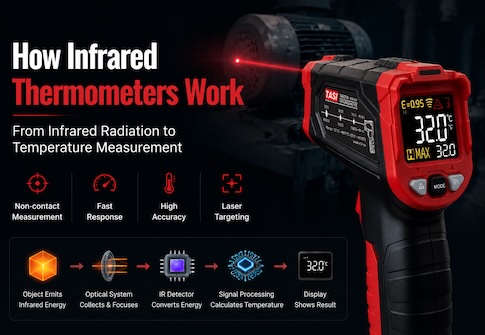
All objects above absolute zero emit thermal radiation, including infrared radiation. An infrared thermometer collects this energy through its optical system, converts it into an electrical signal with an infrared detector, and calculates the corresponding surface temperature.
It therefore does not determine temperature by identifying visible colors such as red, yellow, black, or white.
One of the most important parameters affecting the result is emissivity.
Emissivity describes how efficiently a real surface emits infrared radiation compared with an ideal blackbody. It is generally expressed as a value between 0 and 1.
Different materials and different surface conditions can have significantly different emissivity values. If the emissivity setting of the thermometer does not match the actual emissivity of the target surface, the displayed temperature can deviate from the true surface temperature.
Why Can Different Colors Appear to Produce Different Temperatures?
In real-world objects, color rarely changes independently of other surface properties.
For example, a black section of a metal panel may be painted, while a nearby silver section may consist of bare polished metal. These areas differ not only in visible color but also in coating, surface structure, reflectivity, and emissivity.
A difference in infrared readings may therefore result from:
● Whether the surface is painted or coated;
● Whether it is polished or rough;
● Whether the underlying materials are identical;
● Whether an oxide layer is present;
● Differences in surface texture;
● Differences in emissivity.
In many cases, “different colors give different temperatures” is only the visible symptom. The actual cause is the different infrared properties of the surfaces.
Are Black Surfaces Always Better for Infrared Temperature Measurement?
Not necessarily.
In visible-light applications, black surfaces generally absorb more visible light, which can lead to the assumption that black surfaces always have higher infrared emissivity.
However, visible light and infrared radiation occupy different wavelength ranges.
A surface appearing black to the human eye only describes its behavior in the visible spectrum. It does not, by itself, define its emissivity in the infrared wavelength range used by an infrared thermometer.
Many black paints, rubber materials, plastics, and oxidized surfaces do have relatively high emissivity and are therefore easier to measure. However, dark appearance alone is not sufficient to determine an accurate emissivity value.
Emissivity should therefore not be selected solely from visible color.
Does a White Surface Always Have Lower Emissivity Than a Black Surface?
No.
Some white paints, ceramics, plastics, paper, and similar materials strongly reflect visible light while still having relatively high emissivity in the infrared spectrum.
A white painted surface and a black painted surface made from similar coating materials can therefore have much more similar infrared properties than their visible appearance suggests.
For infrared temperature measurement, material and surface condition are generally more relevant than visible color.
Why Are Silver or Shiny Metal Surfaces Particularly Difficult to Measure?
Shiny metals are among the most challenging surfaces for non-contact infrared temperature measurement.
Unoxidized or polished aluminum, stainless steel, copper, and similar metals commonly have relatively low emissivity and high infrared reflectivity.
As a result, the energy reaching the thermometer may include not only radiation emitted by the metal itself, but also infrared radiation from surrounding walls, machinery, hot objects, or even the operator reflected by the metal surface.
This can lead to effects such as:
● Different readings when the measurement angle changes;
● An unexpectedly high reading near hot equipment;
● Noticeable differences between polished and oxidized areas;
● Different readings between painted and bare metal sections.
The problem is therefore not simply that the surface is silver. The main issue is its low emissivity and high reflectivity.
Why Does Surface Gloss Affect the Reading?
Even surfaces of the same material and color can produce different infrared readings if their finish is different.
For example, stainless steel can have very different infrared characteristics depending on its surface condition:
● Polished stainless steel is highly reflective;
● Rough or oxidized stainless steel can have a different emissivity;
● Painted stainless steel behaves differently again.
This is why equal color does not guarantee equal emissivity, and different colors do not necessarily mean a large emissivity difference.
Why Can Different Areas of the Same Object Show Different Temperatures?
If an object is expected to have a nearly uniform actual temperature but different areas produce noticeably different infrared readings, the surface condition of those areas should be checked.
A motor housing, for example, may include:
● Black painted surfaces;
● A metallic nameplate;
● Bare screws or bolts;
● Oxidized metal;
● Areas covered with oil, dust, or contamination.
Although these areas may be at similar actual temperatures, they can produce different indicated temperatures because their emissivity differs.
For routine equipment inspections, measurements should therefore be taken from consistent locations with similar surface conditions.
What Happens If the Emissivity Setting Is Incorrect?
If an adjustable-emissivity infrared thermometer is set to a value that differs significantly from the actual emissivity of the target, the resulting temperature can contain substantial error.
Particular care is required when:
● Measuring polished metals;
● Measuring aluminum, copper, stainless steel, or other low-emissivity surfaces;
● High measurement accuracy is required;
● Comparing temperatures across different surface materials;
● The target temperature differs substantially from ambient temperature.
Many common non-metallic materials, paints, rubbers, and coated surfaces have relatively high emissivity and are generally easier to measure.
For low-emissivity targets, however, simply pointing the thermometer at the surface and reading the display does not guarantee an accurate surface temperature.
How Can Measurement Errors Caused by Surface Color or Finish Be Reduced?
First identify the target material and surface condition rather than selecting measurement settings based only on visible color.
If the instrument allows emissivity adjustment, use appropriate material data, equipment documentation, or a reliable reference temperature method to determine a suitable setting.
For shiny, low-emissivity metals, it may be preferable—where practical and permitted—to measure a stable high-emissivity area or an appropriately prepared reference surface.
Other good practices include:
● Compare temperatures only at locations with similar surface conditions;
● Avoid directly measuring highly polished metal when possible;
● Prevent strong nearby heat sources from reflecting into the instrument’s field of view;
● Keep measurement distance and angle consistent;
● Ensure the target area is larger than the thermometer’s actual measurement spot;
● Use the same measurement location and conditions when monitoring temperature trends.
If I Only Need to Compare Temperature Changes, Does Surface Color Still Matter?
Yes, but consistency is more important than color itself.
For example, during preventive maintenance, repeatedly measuring the same black painted area of a machine can provide useful trend information even if the exact emissivity is not known with laboratory-level precision, provided that the distance, angle, environment, instrument settings, and measurement point remain consistent.
In contrast, comparing a painted housing during one inspection with a bare metal bolt during another can produce misleading results because the emissivity of the two surfaces may be very different.
For trend monitoring, consistent measurement locations are therefore essential.
What Other Factors Can Cause Different Readings?
Not every difference between differently colored surfaces is caused by emissivity.
Other possible causes include:
● The surfaces actually have different temperatures;
● The thermometer is too far from the target and the measurement spot includes surrounding areas;
● The measurement angle changes significantly;
● The lens is contaminated by dust, oil, moisture, or condensation;
● A reflective surface is reflecting infrared energy from nearby heat sources;
● The thermometer has recently been moved between very different ambient temperatures and has not yet stabilized;
● The target is covered by glass, transparent plastic film, or another material that affects infrared transmission.
Infrared measurement problems should therefore be evaluated as a complete measurement-system issue rather than attributed to surface color alone.
FAQ
Do objects of different colors always give different infrared readings at the same temperature?
No. If their material, coating, surface condition, and infrared emissivity are similar, the readings may also be very similar. Color alone does not determine the result.
Can an infrared thermometer detect the color of an object?
A standard infrared thermometer primarily detects infrared radiation from the target surface. It does not calculate temperature by identifying visible color.
Are black surfaces always the easiest to measure accurately?
Not always. Many black coatings do have relatively high emissivity and are easy to measure, but accuracy still depends on the actual emissivity, instrument settings, distance, angle, and measurement environment.
Why can black painted metal and bare metal show very different readings?
Because painted surfaces and bare metals can have very different emissivity. Shiny bare metal can also reflect infrared radiation from the surrounding environment.
What should I consider when measuring stainless steel?
Check whether the surface is polished, oxidized, rough, or coated. Polished stainless steel is particularly difficult to measure accurately using infrared methods because of its low emissivity and high reflectivity.
Can I set emissivity based on color alone?
No. Emissivity should be determined primarily from the material, surface treatment, and actual surface condition rather than from whether the surface looks black, white, silver, or another color.
Conclusion
Different infrared thermometer readings on differently colored surfaces do not mean that the instrument is directly affected by visible color.
The important factors are emissivity, material, coating, surface roughness, oxidation, and infrared reflectivity. Color may change together with these properties, which is why it can appear to be the cause of the measurement difference.
Painted surfaces, plastics, rubber, and many other high-emissivity materials are generally easier to measure, while polished aluminum, stainless steel, copper, and other low-emissivity reflective surfaces require greater care.
Understanding emissivity and maintaining consistent measurement location, distance, angle, and surface condition are key to obtaining reliable infrared temperature measurements.