Introduction
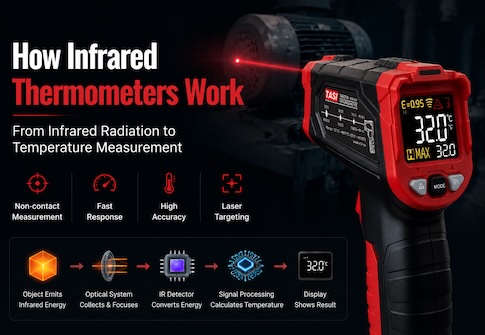
An infrared thermometer does not directly “see” the true temperature of an object. Instead, it detects infrared radiation within a defined spectral range and calculates surface temperature from the received radiant energy.
When infrared radiation reaches a material, part of the energy may be absorbed, part may be reflected, and part may pass through the material. At the same time, any object above absolute zero emits thermal radiation of its own.
For this reason, understanding infrared temperature measurement requires three important parameters: emissivity ε, reflectivity ρ, and transmissivity τ.
These parameters are not independent of one another. Under defined wavelength, direction, temperature, and surface conditions, they are governed by an energy balance that directly affects infrared temperature measurement.
Key Points
● Emissivity describes a surface's ability to emit thermal radiation.
● Reflectivity describes its ability to reflect incident radiation.
● Transmissivity describes the proportion of incident radiation that passes through a material.
● For radiation incident on a material, absorptivity α, reflectivity ρ, and transmissivity τ satisfy: α + ρ + τ = 1.
● Under thermal equilibrium, Kirchhoff's law of thermal radiation states that, at the same wavelength and direction, emissivity ε equals absorptivity α.
● Under these conditions: ε + ρ + τ = 1.
● For most opaque materials encountered in infrared temperature measurement, τ≈0, so the relationship can usually be approximated as: ε + ρ ≈ 1.
● Low-emissivity surfaces generally have high reflectivity and are therefore more susceptible to reflected radiation from the surroundings.
What Is Emissivity?
Emissivity ε describes how effectively a real surface emits thermal radiation compared with an ideal blackbody at the same temperature.
The emissivity of an ideal blackbody is defined as:
ε = 1
For real materials, emissivity generally falls within:
0 ≤ ε ≤ 1
Many non-metallic materials, coatings, and oxidized surfaces have relatively high infrared emissivity, while clean or polished metallic surfaces often have much lower emissivity.
Emissivity is particularly important for infrared thermometers because the instrument must estimate how much of the detected radiation originates from the target surface itself.
If the actual emissivity of a surface is 0.30 but the infrared thermometer is set to 0.95, the resulting temperature reading may contain a significant error.
Emissivity should not be regarded as a single permanent value for a material. It may vary with wavelength, temperature, surface roughness, oxidation, coatings, and viewing angle.
What Is Reflectivity?
Reflectivity ρ is the fraction of incident radiation that is reflected by a surface.
A surface with high reflectivity reflects a larger proportion of infrared radiation originating from its surroundings.
Polished metals, for example, often have high reflectivity in the infrared region. When such a surface is measured with an infrared thermometer, the detector may receive not only radiation emitted by the metal itself but also infrared radiation reflected from walls, machinery, heaters, or even the operator.
This is why low-emissivity, highly reflective surfaces are more difficult to measure accurately using infrared methods.
Infrared reflectivity should not be confused with visible appearance. A surface that appears shiny or dull to the human eye does not necessarily have the same reflective behavior within the operating wavelength range of an infrared thermometer.
What Is Transmissivity?
Transmissivity τ is the fraction of incident radiation that passes through a material.
Many solid materials used in infrared temperature measurement, including metals, wood, walls, ceramics, and sufficiently thick plastics, can usually be treated as opaque within common infrared thermometer spectral ranges. In such cases:
τ ≈ 0
However, certain materials may have significant transmission within specific infrared wavelength bands. Examples include some thin films, selected plastics, and specially engineered infrared optical materials.
This is why visible transparency does not necessarily mean infrared transparency.
Ordinary glass transmits visible light well, but it is generally not transparent within the long-wave infrared range commonly used by handheld infrared thermometers. Consequently, measuring through ordinary glass usually does not provide the actual surface temperature of the object behind it.
How Are Emissivity, Reflectivity, and Transmissivity Related?
From the principle of energy conservation, radiation incident on a material has three primary destinations:
● Part is absorbed by the material.
● Part is reflected by the surface.
● Part is transmitted through the material.
Therefore:
α + ρ + τ = 1
Where:
● α = absorptivity;
● ρ = reflectivity;
● τ = transmissivity.
According to Kirchhoff's law of thermal radiation, under thermal equilibrium and at the same wavelength and direction:
ε = α
Therefore:
ε + ρ + τ = 1
This relationship is fundamental to understanding the infrared radiative behavior of materials.
In practical applications, these properties are wavelength-dependent. Strictly speaking, emissivity, reflectivity, and transmissivity should therefore be considered within the relevant infrared spectral range rather than treated as fixed values across all wavelengths.
Why Can Opaque Objects Usually Be Described by ε + ρ ≈ 1?
Many objects encountered in infrared temperature measurement have negligible infrared transmission and can therefore be treated as opaque:
τ ≈ 0
Substituting this into:
ε + ρ + τ = 1
gives:
ε + ρ ≈ 1
For an opaque surface, this means that high emissivity is generally associated with low reflectivity, while low emissivity corresponds to high reflectivity.
Conceptually:
● If ε = 0.95, ρ is approximately 0.05.
● If ε = 0.80, ρ is approximately 0.20.
● If ε = 0.20, ρ may be approximately 0.80.
These values illustrate the energy relationship and should not be interpreted as fixed properties of every real material.
This relationship also explains why high-emissivity surfaces are generally easier to measure with an infrared thermometer: a larger proportion of the detected radiation originates from the target itself, while the influence of reflected ambient radiation is reduced.
Why Are Low-Emissivity Surfaces More Difficult to Measure Accurately?
Consider an opaque metal surface with an emissivity of only 0.20. Under simplified conditions, its reflectivity may be close to:
ρ ≈ 0.80
The surface itself is therefore a relatively weak emitter but a strong reflector of surrounding infrared radiation.
If nearby heaters, furnaces, machinery, or other high-temperature objects are present, their infrared radiation may be reflected by the metal surface into the thermometer.
Conversely, if the target is hot while its surroundings are much cooler, reflected environmental radiation can also influence the measurement.
The difficulty with low-emissivity surfaces is therefore not simply that they “emit less infrared radiation.” The more important issue is that reflected environmental radiation becomes a much larger proportion of the total signal detected by the instrument.
For this reason, polished aluminium, stainless steel, copper, and similar surfaces require particular care during non-contact temperature measurement.
Does Higher Emissivity Always Mean More Accurate Measurement?
Not necessarily.
High-emissivity surfaces are generally easier to measure because a larger proportion of the detected signal originates from the target itself and the influence of reflected radiation is lower.
However, total measurement accuracy still depends on several other factors:
● Correct emissivity setting;
● Target size relative to the measurement spot;
● Appropriate measurement distance;
● Suitable measurement angle;
● Clean optical components;
● Steam, smoke, or strong infrared radiation sources in the measurement path;
● The instrument's specified accuracy and spectral response range.
Emissivity is therefore an important factor, but it is not the only factor affecting infrared temperature measurement.
Why Can Transparent Materials Not Be Described Simply by ε + ρ = 1?
If a material transmits a significant amount of radiation within the operating wavelength range of the infrared thermometer:
τ ≠ 0
The simplified relationship:
ε + ρ = 1
is no longer valid.
The full relationship must be considered:
ε + ρ + τ = 1
For an infrared-transmitting material, the detector may simultaneously receive radiation emitted by the material itself, radiation reflected from the surroundings, and radiation transmitted from objects behind the material.
The measurement therefore becomes more complex than for an opaque target.
When measuring through a window, film, or other transparent medium, its spectral transmission must be verified specifically within the operating wavelength range of the infrared thermometer. Visible transparency alone is not sufficient.
Are Visible Color and Infrared Emissivity the Same Thing?
No.
Visible color is determined mainly by how a material absorbs and reflects light within the approximate 380–780 nm visible spectrum, whereas infrared thermometers operate at much longer wavelengths.
Therefore:
● A black object does not necessarily have the same high emissivity across all infrared wavelengths.
● A white object does not necessarily have low infrared emissivity.
● A visibly transparent material may be opaque in the infrared.
● A surface that does not appear reflective to the eye may still have significant infrared reflectivity.
Infrared temperature measurement should therefore be based on radiative properties within the actual operating wavelength range of the instrument rather than on visible appearance alone.
What Do These Parameters Mean in Practical Infrared Temperature Measurement?
Understanding the relationship between ε, ρ, and τ helps explain many common infrared measurement errors.
● High-emissivity, low-reflectivity, low-transmissivity surfaces are generally the easiest targets for non-contact infrared temperature measurement.
● Low-emissivity, highly reflective surfaces are more strongly affected by infrared radiation from the surroundings.
● Infrared-transmitting materials may cause the detector to receive radiation from both the material itself and objects behind it.
● Measuring polished metals accurately may require more than simply aiming the infrared thermometer at the target.
● Before measuring through glass or another transparent material, its transmission within the thermometer's operating infrared range must be confirmed.
● With an adjustable-emissivity infrared thermometer, the emissivity setting should be selected according to the actual material and surface condition.
For low-emissivity, highly reflective surfaces, the thermal environment around the target should also be considered, especially when nearby hot objects or strong infrared radiation sources are present.
FAQ
Do emissivity and reflectivity always add up to 1?
No. The approximation ε+ρ≈1 applies only when the material is effectively opaque within the relevant infrared wavelength range, meaning τ≈0. If the material has significant transmission, the full relationship ε+ρ+τ=1 must be considered.
Does low emissivity mean the object has a low temperature?
No. Emissivity describes how effectively a surface emits thermal radiation, not its actual temperature. Two objects at the same temperature can produce very different infrared radiation levels if their emissivities differ.
Why does high reflectivity affect infrared temperature measurement?
Because the infrared thermometer may detect radiation from the surrounding environment reflected by the target surface. The higher the reflectivity, the greater the potential influence of ambient radiation on the measurement.
Does a transparent material always have high transmissivity?
No. Transparency is wavelength-dependent. A material transparent to visible light may be opaque to infrared radiation, while another material that appears opaque in visible light may transmit radiation within a specific infrared band.
Why are polished metals difficult to measure with an infrared thermometer?
Polished metals typically have low infrared emissivity and high reflectivity. As a result, reflected environmental radiation can represent a significant portion of the detected signal and lead to substantial measurement errors if emissivity and surrounding conditions are not properly considered.
Conclusion
Emissivity, reflectivity, and transmissivity describe the primary ways in which a material interacts with radiant energy.
For incident radiation:
α + ρ + τ = 1
Under thermal equilibrium, Kirchhoff's law gives:
ε = α
Therefore:
ε + ρ + τ = 1
For the opaque materials most commonly measured with infrared thermometers, τ≈0, so the relationship can usually be approximated as:
ε + ρ ≈ 1
This relationship explains why high-emissivity surfaces are generally easier to measure reliably, whereas low-emissivity, highly reflective surfaces are more strongly influenced by surrounding infrared radiation.
In practical measurements, material type, surface condition, instrument spectral response, viewing angle, and surrounding thermal conditions should all be considered. Emissivity, reflectivity, and transmissivity should not be determined solely from material names, visible color, or apparent transparency.