Introduction
Infrared thermometers measure surface temperature without physical contact, providing fast readings and making them suitable for hot, moving, inaccessible, or hazardous targets. However, long-term use may introduce measurement deviations caused by sensor drift, contamination of the optical system, electronic component ageing, or changes in operating conditions.
For applications where measurement accuracy is important, an infrared thermometer should therefore be checked and calibrated at appropriate intervals.
It is important to understand that calibration is not simply a comparison between an infrared thermometer and an ordinary thermometer. Professional calibration normally requires a stable blackbody radiation source with known emissivity and a sufficiently large effective radiating area.
Key Points
● The purpose of calibration is to determine the difference between the infrared thermometer reading and a known reference temperature.
● Professional calibration normally uses a blackbody radiation source rather than an ordinary wall, hot water, or bare metal surface.
● The thermometer, blackbody source, and surrounding environment should be thermally stable before measurements are taken.
● Measurement distance, D:S ratio, emissivity setting, and viewing angle can all affect calibration results.
● Calibration determines measurement error, while adjustment changes internal parameters to correct that error. The two processes are not identical.
● For applications with strict accuracy requirements, calibration should be carried out by the manufacturer or a suitably equipped calibration laboratory.
What Is Infrared Thermometer Calibration?
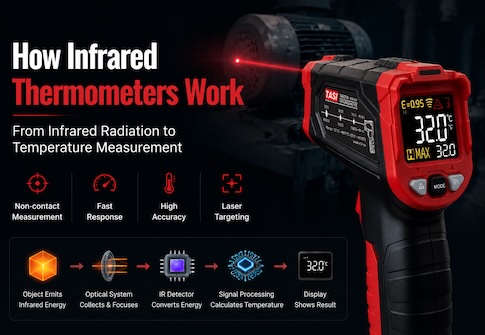
An infrared thermometer detects infrared radiation emitted from a target surface and converts the detected energy into a temperature value based on its sensor response, emissivity setting, optics, and internal processing algorithms.
Calibration is the process of comparing the thermometer reading with a known reference under specified conditions in order to determine the indication error.
For example, if a blackbody source is stabilised at 100.0°C and the infrared thermometer indicates 100.8°C, the indication error under those test conditions is approximately +0.8°C.
However, one measurement at one temperature does not fully describe instrument performance. Professional calibration normally uses several test points across the relevant measurement range to determine how the thermometer performs at low, medium, and high temperatures.
Why Is a Blackbody Source Used for Calibration?
Infrared thermometers respond to thermal radiation emitted by the target surface. Because different materials have different emissivities and reflective characteristics, measurements taken from ordinary metal, plastic, painted surfaces, walls, or liquids can introduce additional uncertainty.
A blackbody calibration source provides a stable and controlled infrared radiation environment with known emissivity, making it much more suitable as a temperature reference for infrared instruments.
A suitable blackbody calibrator typically provides:
● Stable temperature control;
● A defined effective radiating area;
● High and known emissivity;
● Good temperature uniformity and stability;
● A reference temperature with appropriate metrological traceability.
Using an appropriate blackbody source helps minimise uncertainties caused by the test target itself.
What Should Be Checked Before Calibration?
Before calibration begins, both the instrument and the test environment should be checked.
● Inspect the optics. Dust, oil, condensation, or other contamination on the infrared lens can reduce the amount of radiation reaching the detector and cause measurement errors.
● Check the battery condition. Low battery voltage may affect normal operation on some instruments.
● Allow the instrument to reach ambient temperature. If the thermometer has just been moved from a cold warehouse, hot vehicle, or outdoor environment into a laboratory, it should be allowed sufficient time to stabilise.
● Confirm the emissivity setting. For adjustable-emissivity infrared thermometers, the setting should match the blackbody source and calibration procedure.
● Confirm the measurement distance. Based on the instrument's D:S ratio, the measurement spot must remain fully within the effective radiating area of the blackbody source.
● Allow the blackbody to stabilise. Reaching the set temperature does not necessarily mean that the source is already thermally stable. Measurements should only be taken after sufficient stabilisation time.
Many apparent calibration errors are actually caused by incorrect test conditions rather than a fault in the thermometer itself.
How Is an Infrared Thermometer Calibrated with a Blackbody Source?
A common calibration method is to compare the infrared thermometer with a standard blackbody radiation source at several temperature points.
First, set the blackbody source to the required calibration temperature and allow it to stabilise completely.
Position the infrared thermometer so that it faces the effective radiating area of the blackbody source. The instrument should be held steadily and, where practical, approximately perpendicular to the target surface rather than at a large viewing angle.
The measurement spot must remain entirely within the active blackbody area. If the thermometer is positioned too far away and the spot becomes larger than the blackbody opening, radiation from the surrounding area may enter the field of view and distort the reading.
Once the test conditions are stable, take several readings and record the results. Compare the measured values with the reference temperature of the blackbody source.
After completing the first calibration point, change the blackbody temperature and repeat the procedure at additional representative points.
Depending on the intended operating range, these may include low-, mid-, and high-temperature points rather than only a single test temperature.
How Do You Determine Whether Adjustment Is Required?
After calibration, compare the infrared thermometer reading with the reference temperature at each calibration point.
The basic indication error can be expressed as:
Measurement Error = Infrared Thermometer Reading − Reference Temperature
For example:
● Blackbody reference temperature: 200.0°C
● Infrared thermometer reading: 202.1°C
● Indication error at this point: +2.1°C
Whether this result is acceptable depends on the accuracy specification of the particular instrument.
Many infrared thermometers do not use one fixed ±°C accuracy value across the entire range. Their specifications may combine a fixed temperature tolerance with a percentage of reading. The manufacturer's stated specification should therefore be used when evaluating the result.
If all test points remain within the specified tolerance, the instrument can generally be considered to meet its stated measurement performance.
If the error exceeds the allowable range, the cause should be investigated further.
What Is the Difference Between Calibration and Adjustment?
Calibration and adjustment are related but different processes.
Calibration determines the current difference between the instrument reading and a reference standard.
Adjustment changes internal calibration parameters so that the instrument reading more closely matches the reference.
An infrared thermometer can therefore be calibrated without any internal adjustment being performed.
On some industrial infrared thermometers, internal parameters can only be changed through dedicated software, a service interface, a factory calibration mode, or specialised production equipment. Users should not modify hidden service parameters unless specifically authorised to do so, because incorrect changes may invalidate the original calibration.
If measurement errors clearly exceed the specification, the instrument should normally be inspected and, if necessary, adjusted by the manufacturer or a qualified calibration provider.
Can You Calibrate an Infrared Thermometer at Home?
Users can perform basic performance checks at home, but this is different from professional calibration.
Ice water, hot water, boiling water, or another thermometer are sometimes used as simple reference points. These methods can be useful for some contact temperature instruments, but they have significant limitations for infrared thermometers.
An infrared thermometer measures surface temperature and is also affected by emissivity, reflected radiation, measurement spot size, ambient conditions, and surface condition.
For example, when measuring hot water in a shiny metal container, the infrared thermometer is primarily measuring the container surface rather than the internal water temperature. Comparing that reading directly with an immersion thermometer is therefore not a rigorous calibration method.
Simple checks can help identify major abnormalities, but they should not be treated as a substitute for blackbody calibration.
What Can Cause Inaccurate Calibration Results?
Even when a blackbody source is used, incorrect test conditions can produce misleading results.
● Excessive measurement distance. If the measurement spot extends beyond the effective blackbody area, radiation from surrounding surfaces can affect the reading.
● Insufficient blackbody stabilisation. A source that has just reached its setpoint may still be thermally settling.
● Incorrect emissivity setting. The instrument emissivity setting should be consistent with the calibration conditions.
● Contaminated optics. Dust, oil, or moisture on the lens can reduce the infrared energy reaching the detector.
● Rapid ambient temperature changes. Infrared thermometers normally include ambient compensation, but the instrument body may require time to reach thermal equilibrium.
● Incorrect viewing angle. Large angles can change the effective measurement area and radiation conditions.
● Poor repeatability. If repeated readings at the same point fluctuate significantly, the setup and instrument condition should be checked before any adjustment is attempted.
Reliable infrared calibration depends not only on the reference source, but also on correct test methodology.
How Often Should an Infrared Thermometer Be Calibrated?
There is no single calibration interval suitable for every infrared thermometer or application.
The appropriate interval depends on the instrument's use, frequency of operation, required accuracy, environmental conditions, and the user's quality management procedures.
For general measurements, periodic performance checks may be sufficient. For industrial quality control, maintenance, laboratory work, or applications where measurement records are important, a defined calibration schedule is normally recommended.
Calibration or inspection should also be considered after:
● Significant impact or dropping;
● Prolonged use in high-temperature, high-humidity, dusty, or harsh environments;
● Unexpected deviation from historical measurements;
● Persistent disagreement with a trusted reference instrument;
● Repair or replacement of critical measurement components;
● A requirement from the organisation's quality system or customer.
Where temperature measurements directly influence product quality or equipment safety decisions, instrument condition should be considered in addition to a fixed calibration interval.
FAQ
Can an infrared thermometer be calibrated using ice water?
Ice water may provide a simple reference condition for some temperature instruments, but for infrared measurement, surface condition, emissivity, reflections, the container, and environmental radiation can all affect the result. It is therefore unsuitable as a substitute for professional infrared calibration.
Can another infrared thermometer be used as the calibration reference?
Generally, this is not recommended. Any error in the reference thermometer will be transferred directly to the comparison. Professional calibration should use a reference source with a known value and appropriate traceability.
Why can readings be inaccurate immediately after moving the thermometer indoors from outside?
The instrument body may still be at a different temperature from the indoor environment, so its ambient-temperature compensation may not yet be stable. Allow the thermometer sufficient time to reach thermal equilibrium before precision measurement or calibration.
Can the laser pointer be used to calibrate temperature?
No. The laser is primarily an aiming aid and does not perform the infrared temperature measurement. The actual measurement area is determined by the infrared optical system and the instrument's D:S ratio.
Why can readings still be inaccurate after calibration?
Measurement performance in actual applications also depends on target emissivity, measurement distance, target size, surface reflectivity, optical cleanliness, and ambient conditions. Passing calibration does not mean the instrument will produce identical accuracy on every material under every measurement condition.
Conclusion
Professional calibration of an infrared thermometer is fundamentally a comparison between the instrument reading and a stable, known, and traceable infrared radiation temperature reference. A blackbody radiation source is therefore one of the most commonly used calibration tools.
Accurate calibration requires control not only of the reference temperature, but also of emissivity settings, measurement distance, D:S ratio, spot size, ambient temperature, instrument stabilisation time, and optical cleanliness.
For general users, carefully controlled comparison checks can help identify obvious problems. For industrial quality control, professional inspection, or other applications requiring high measurement confidence, calibration should be performed with an appropriate blackbody source by the manufacturer, calibration laboratory, or another qualified provider.
Understanding the difference between calibration, error evaluation, and adjustment helps ensure that infrared thermometers remain stable and reliable over long-term use.