Introduction
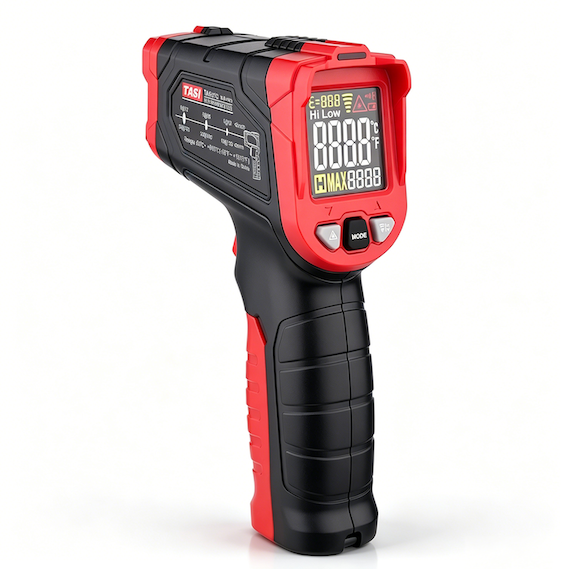
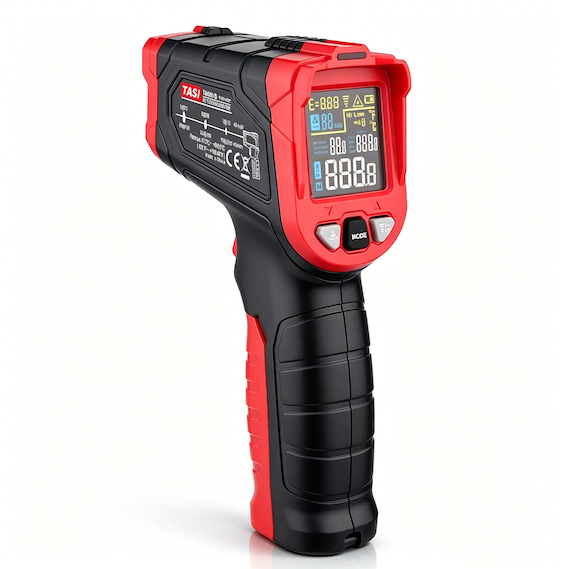
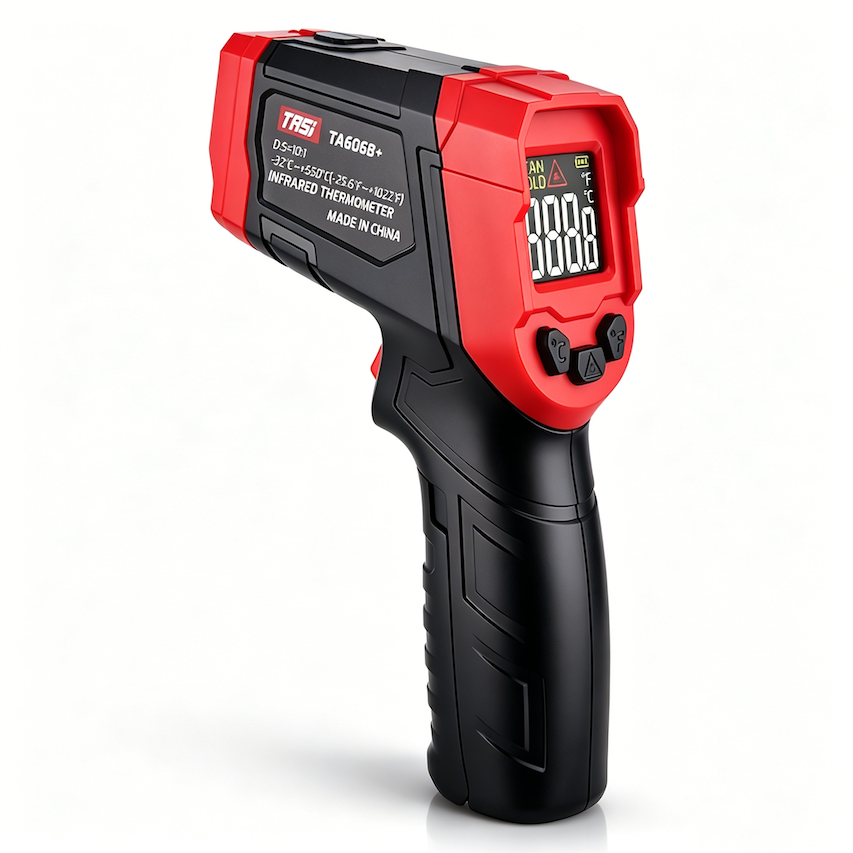
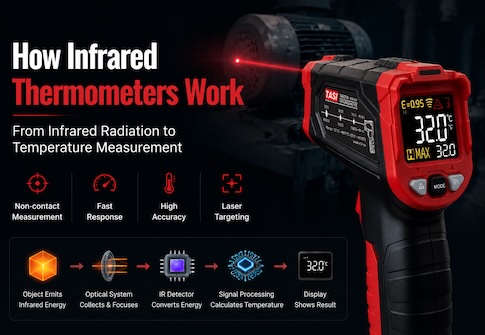
An infrared thermometer is a non-contact temperature measurement device that determines surface temperature by detecting infrared energy emitted from an object. Compared with traditional contact thermometers, infrared thermometers can measure temperature quickly without touching the target surface, making them widely used in industrial inspection, equipment maintenance, electrical testing, HVAC applications, automotive repair, and laboratory environments.
With the increasing variety of application requirements, infrared thermometers are now available with different measurement ranges, accuracy levels, distance-to-spot ratios (D:S), emissivity settings, response times, and additional functions. Selecting an unsuitable model may result in inaccurate measurements and reduced testing efficiency.
Therefore, the selection of an infrared thermometer should be based on the actual measurement environment and application requirements rather than focusing only on price or maximum temperature range.
Key Points
● Select the appropriate temperature range according to the actual measurement target to avoid insufficient capability or unnecessary performance costs;
● Consider the distance-to-spot ratio (D:S) to ensure accurate measurement at the required distance;
● Adjust emissivity according to the surface characteristics of different materials to improve measurement accuracy;
● Select suitable accuracy, protection level, and functions according to the working environment;
● Different applications such as industrial inspection, equipment maintenance, and daily temperature measurement require different types of infrared thermometers.
Selecting the Appropriate Temperature Measurement Range
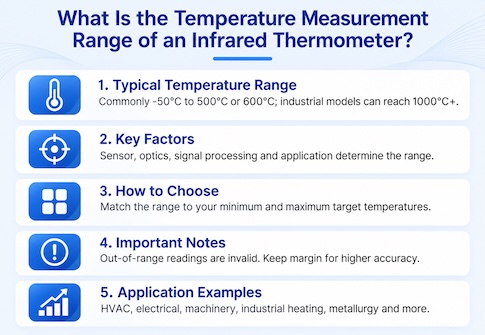
The first factor to consider when choosing an infrared thermometer is the required temperature range.
Different applications have different temperature requirements:
● General inspections, electrical checks, and daily measurements usually require a moderate temperature range;
● HVAC maintenance and equipment servicing require temperature measurement of pipes, motors, bearings, and mechanical components;
● Industrial production, furnace monitoring, and high-temperature equipment inspection require a wider measurement range.
It is recommended to select a thermometer with a measurement range slightly above the actual application requirements to ensure stable operation and measurement reliability.
Understanding Distance-to-Spot Ratio (D:S)
The distance-to-spot ratio (Distance to Spot Ratio, D:S) is one of the most important specifications of an infrared thermometer.
It represents the relationship between the measurement distance and the diameter of the measurement area.
For example, a thermometer with a 12:1 D:S ratio can measure an area approximately 1 meter in diameter when positioned 12 meters away from the target.
A higher D:S ratio allows the instrument to measure smaller targets from greater distances.
● For general HVAC inspection and close-range measurements, a 10:1 ratio is usually sufficient;
● For electrical inspection and industrial equipment maintenance, a higher D:S ratio provides better target accuracy;
● For small components and precision applications, a higher D:S ratio is recommended.
If the target area is smaller than the measurement spot, surrounding temperatures may affect the result and reduce accuracy.
Choosing the Right Measurement Accuracy
Accuracy directly affects the reliability of infrared temperature measurements.
Different applications require different accuracy levels:
● Routine equipment inspection mainly focuses on temperature changes and trends;
● Industrial quality control and electrical fault detection require higher measurement accuracy;
● Laboratory and research applications require higher precision instruments.
It is important to understand that infrared thermometer accuracy depends not only on the instrument itself but also on factors such as material properties, distance, ambient temperature, measurement angle, and operating method.
Considering Emissivity Adjustment
Emissivity is a key factor affecting infrared measurement accuracy.
Different materials emit different levels of infrared radiation.
For example:
● Metal surfaces usually have lower emissivity and may produce measurement errors if measured directly;
● Plastic, rubber, and painted surfaces generally have higher emissivity and are easier to measure accurately;
● Oxidized metal surfaces may have different emissivity values depending on surface conditions.
For industrial inspection or applications involving multiple materials, selecting an infrared thermometer with adjustable emissivity helps improve measurement accuracy.
Selecting Functions According to Application
Different working environments require different infrared thermometer features.
Industrial maintenance:
● Requires stable measurement performance;
● Benefits from wide temperature range and higher D:S ratio;
● Should consider durability and reliable operation.
Electrical inspection:
● Requires fast identification of abnormal temperature increases;
● Benefits from laser targeting and fast response;
● Improves inspection efficiency.
HVAC maintenance:
● Requires measurement of pipes, equipment surfaces, and systems;
● Should consider portability and practical measurement functions.
Daily measurement:
● Focuses on simple operation and convenient reading;
● Basic models are usually sufficient.
Considering Response Time and Efficiency
Response time refers to how quickly an infrared thermometer provides a stable temperature reading after measurement begins.
For applications requiring frequent inspections, such as production lines and electrical equipment checks, a faster response time improves working efficiency.
For targets with rapidly changing temperatures, a fast-response infrared thermometer can provide more timely measurement results.
Evaluating Operating Environment and Reliability
The working environment can significantly affect infrared thermometer performance.
When selecting a product, consider:
● Whether the operating temperature range matches the application environment;
● Whether dust, moisture, or oil contamination may exist;
● Whether a higher protection level is required;
● Whether continuous inspection is needed.
Industrial environments are often more demanding, so reliable construction and stable performance are important factors.
Common Selection Mistakes
Some common mistakes may affect measurement performance:
● Choosing only based on maximum temperature range while ignoring actual requirements;
● Assuming a higher distance ratio is always better without considering application needs;
● Ignoring differences in material emissivity;
● Using general-purpose models for precision small-target measurements;
● Ignoring the influence of environment and operating methods.
A suitable infrared thermometer should be selected according to the complete application requirements.
FAQ
What objects can be measured with an infrared thermometer?
Infrared thermometers can measure the surface temperature of many objects, including machinery, electrical components, pipes, engines, building surfaces, and industrial products.
Does a shorter measuring distance always provide better accuracy?
A shorter distance can help when the target area is sufficiently large, but measurement accuracy also depends on D:S ratio, emissivity, and environmental conditions.
Why are metal temperatures sometimes inaccurate when measured with infrared thermometers?
Metal surfaces often have low emissivity and reflect surrounding infrared radiation, which may cause measurement errors. Proper emissivity adjustment is recommended.
Do infrared thermometers require calibration?
For long-term use or high-accuracy applications, regular calibration is recommended to maintain reliable measurement results.
What is the difference between household and industrial infrared thermometers?
Household models focus on simplicity and convenience, while industrial models emphasize accuracy, wider measurement capability, target identification, and reliability in demanding environments.
Conclusion
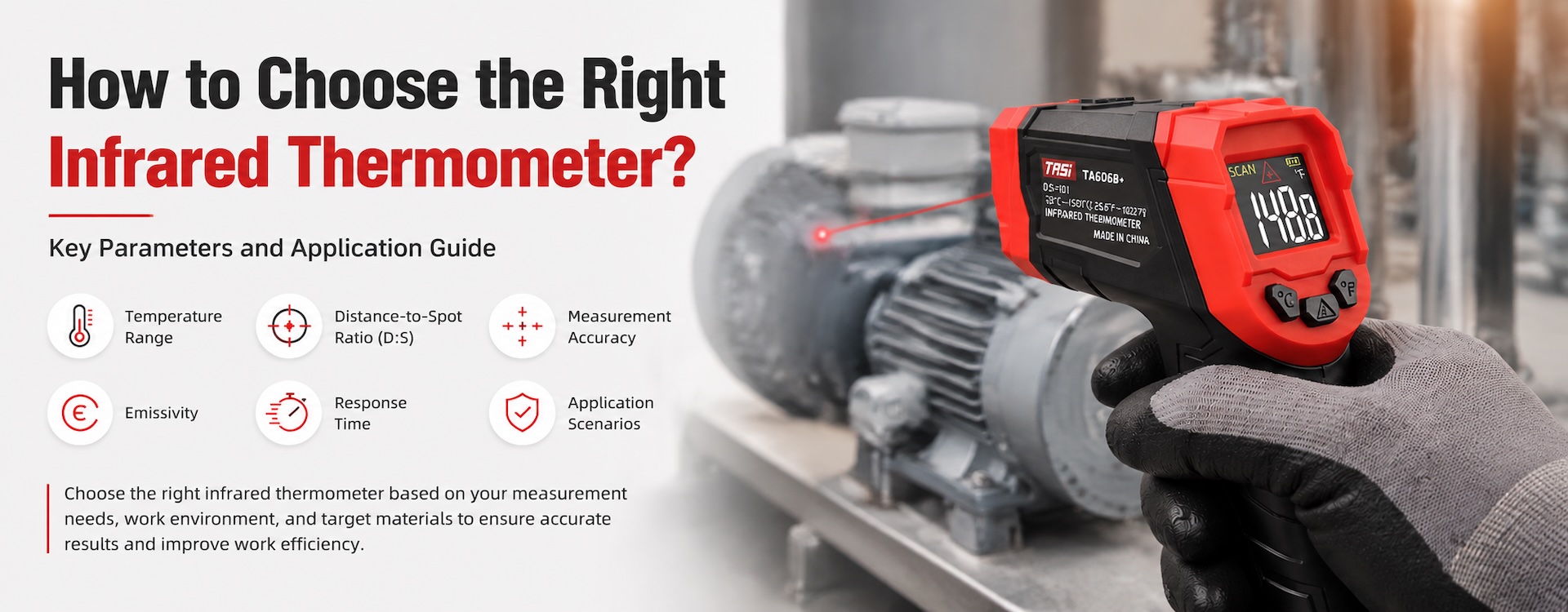
Choosing the right infrared thermometer requires comprehensive consideration of measurement range, distance-to-spot ratio, accuracy, emissivity adjustment, response time, and operating environment.
For general temperature checks, a simple and reliable model may be sufficient. For industrial maintenance, electrical inspection, and equipment monitoring, greater attention should be paid to accuracy, target measurement capability, and long-term reliability.
Selecting the correct infrared thermometer according to actual application requirements ensures more efficient inspections and more accurate temperature measurement results.