Introduction
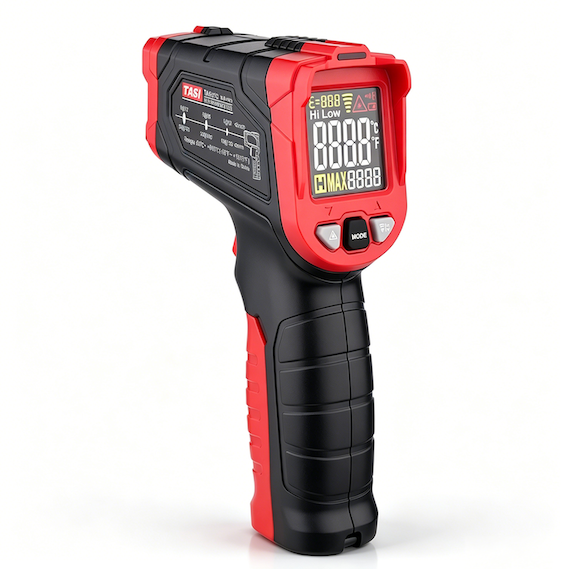
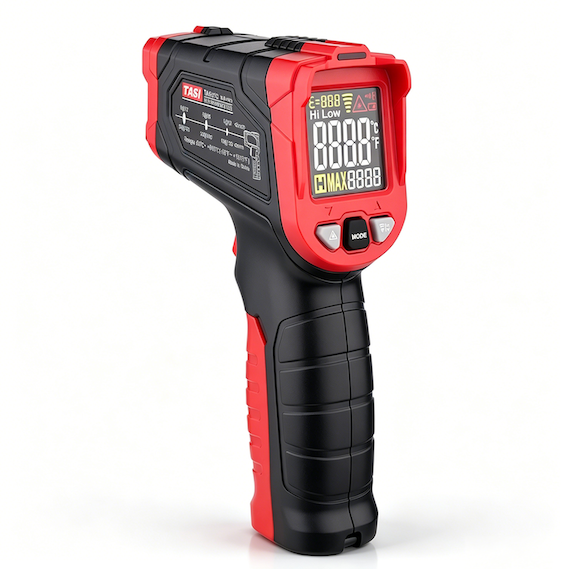
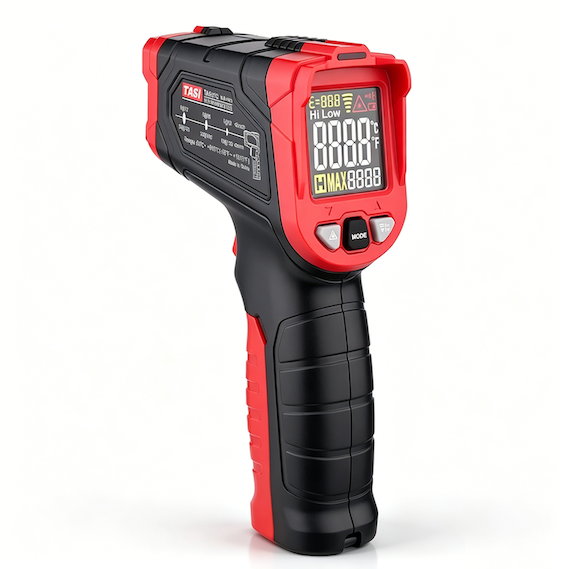
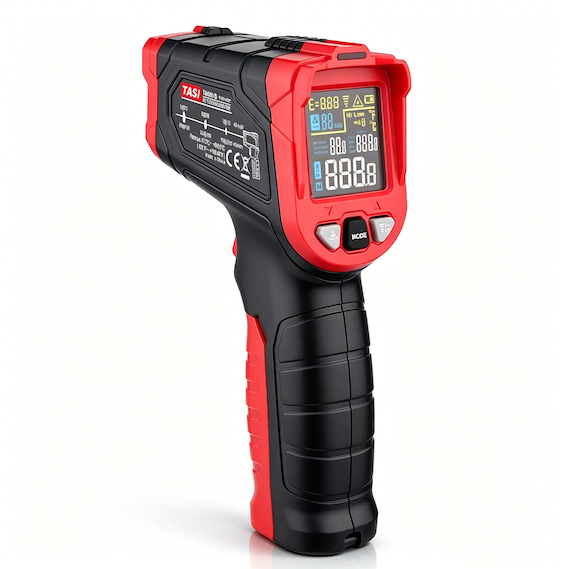
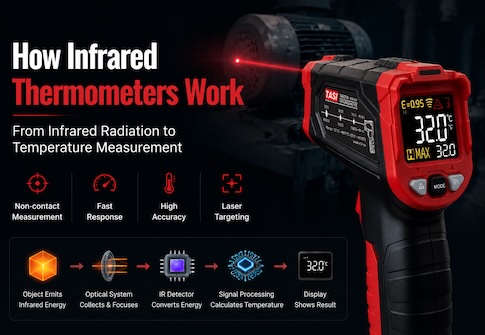
An infrared thermometer measures surface temperature without contact by detecting infrared radiation emitted by the target. Although an individual reading may take only a few seconds, the thermal condition of the instrument itself can directly affect measurement accuracy.
For example, when an infrared thermometer is moved from a cold outdoor environment into a warm room, or from a hot environment into a cooler space, the instrument temperature cannot adjust instantly. Its detector, optics, and temperature-compensation system may still be responding to the environmental change. For this reason, precision measurements should generally not be performed immediately after a major temperature transition.
Key Points
● An infrared thermometer needs time to reach thermal stability after being moved between environments with different temperatures.
● Rapid changes in instrument temperature can temporarily affect the infrared detector and internal temperature compensation.
● Moving a cold instrument into a warm, humid environment may cause condensation on the lens or infrared optical window.
● Measurements taken before the instrument has stabilized may show offset, drift, or reduced repeatability.
● Required acclimation time depends on the temperature difference, instrument design, and manufacturer instructions.
Why Do Environmental Changes Affect an Infrared Thermometer?
An infrared thermometer does not respond only to radiation from the target surface. Its infrared detector, optical system, and electronic components also have their own temperatures, so the measurement system must compensate for effects associated with the instrument itself.
If the thermometer has remained outdoors in cold conditions for an extended period, much of the instrument may approach the outdoor ambient temperature. Once it is brought into a warm room, the housing begins to warm first, while the detector, circuit board, and optical components may change temperature at different rates.
During this transition, temporary internal temperature gradients may develop, and the compensation system needs time to adapt to the new conditions. The instrument may therefore not yet be in a fully stable measurement state immediately after relocation.
What Does Thermal Equilibrium Mean for an Infrared Thermometer?
In this context, thermal equilibrium does not mean that every component inside the instrument must be at exactly the same temperature. It means that the instrument has sufficiently adapted to the surrounding environment and that internal temperature changes have slowed enough for normal measurement performance.
For example, if an infrared thermometer has been stored at 5°C outdoors and is then brought into a 25°C room, its internal temperature will not immediately become 25°C. Instead, it will rise gradually.
After sufficient time, the temperatures of the internal components become more stable, allowing the internal temperature sensing and compensation functions to operate under more consistent conditions.
Therefore, allowing an infrared thermometer to rest after a major environmental change is essentially a process of waiting for the instrument to reach a new thermally stable state.
Why Is Internal Temperature Compensation Important?
The infrared energy detected by an infrared thermometer can be relatively small, and changes in the instrument's own temperature can influence the sensing system. Infrared thermometers therefore commonly use internal temperature sensors and compensation algorithms to correct for these effects.
However, temperature compensation does not mean that the instrument can maintain its best specified accuracy immediately under all rapidly changing environmental conditions.
During a sudden ambient temperature change:
● The housing and internal components may be at different temperatures.
● The infrared detector temperature may still be changing.
● Optical components may not yet have stabilized.
● Temporary temperature differences may exist between the internal temperature sensor and critical measurement components.
These conditions can temporarily reduce the effectiveness of compensation and increase measurement error.
Why Is Moving from a Cold Outdoor Environment into a Warm Room Particularly Important?
When moving from a cold environment into a warmer one, the instrument must not only warm up but may also be exposed to condensation.
If the surface temperature of the infrared thermometer is below the dew point of the indoor air, moisture can condense on the colder surfaces. This can include the infrared lens or optical window.
A thin layer of moisture can absorb, scatter, or otherwise alter the infrared radiation entering the instrument, changing the amount of radiation that reaches the detector.
As a result, the display may appear to operate normally even though the temperature reading is not yet reliable.
If fogging or condensation is visible on the infrared window or lens, allow it to disappear naturally and wait until the instrument has adequately acclimated before taking critical measurements.
What Can Happen If You Measure Immediately?
Using an infrared thermometer immediately after moving it between substantially different environments will not necessarily cause a large error every time, but it generally increases measurement uncertainty.
Typical effects may include:
● Readings from the same target gradually changing over time.
● A noticeable difference between the initial reading and measurements taken several minutes later.
● Reduced repeatability between consecutive measurements.
● Systematic measurement offset when the environmental temperature difference is large.
● Abnormal readings when condensation is present on the lens.
For general temperature trend checks, these effects may not always be significant. However, they become more important in equipment inspection, quality control, laboratory testing, or applications involving relatively small temperature differences.
How Long Should You Wait?
There is no single acclimation time that applies to every infrared thermometer and every environmental condition.
The required time depends mainly on:
● The temperature difference between the previous and new environments.
● How long the instrument remained in the previous environment.
● Instrument size and internal construction.
● Thermal mass of the housing and internal components.
● Air movement around the instrument.
● Indoor temperature and humidity.
● The acclimation time specified by the manufacturer.
A larger temperature difference generally requires a longer stabilization period.
For measurements where accuracy is important, always follow the operating environment and acclimation requirements stated in the instrument manual rather than relying on a universal fixed waiting time.
How Can You Tell Whether the Infrared Thermometer Has Stabilized?
If the manufacturer does not specify a particular acclimation time, several practical checks can help assess instrument stability.
● Confirm that the lens or infrared window is free from fogging and condensation.
● Allow the instrument to rest naturally in the actual measurement environment.
● Keep it away from heaters, air-conditioning outlets, and other localized hot or cold airflow.
● Take repeated measurements of a thermally stable target with a uniform surface.
● Begin critical measurements only after consecutive readings have become reasonably stable.
Stable readings are only an additional indication. If the manufacturer specifies a particular acclimation period or operating-temperature requirement, those instructions should take priority.
What Is the Recommended Procedure?
When an infrared thermometer is transferred between environments with a substantial temperature difference, the following practices are recommended:
● Allow the instrument to rest in the actual measurement environment before use.
● Do not use heaters, hot air, or other methods to force rapid temperature adjustment.
● If the instrument is inside a sealed bag or carrying case, allow it to acclimate gradually before fully exposing it to the new environment where appropriate.
● Check the infrared optical window for moisture, dirt, or condensation.
● Wait until the instrument is thermally stable before performing precision measurements.
● During measurement, keep the instrument away from direct sunlight, hot airflow, or strong cold drafts that could change its temperature again.
These practices reduce measurement errors caused by rapid changes in the instrument's own temperature.
Does Acclimation Guarantee an Accurate Measurement?
No. Thermal stabilization is only one requirement for reliable infrared temperature measurement.
Other important factors include:
● Correct emissivity settings for the target surface.
● A measuring distance appropriate for the instrument's distance-to-spot ratio (D:S).
● Ensuring that the measurement spot is fully contained within the target area.
● Special consideration when measuring highly reflective metal surfaces.
● A suitable measurement angle.
● Clean infrared optics.
● Minimal interference from steam, smoke, or other materials in the optical path.
Acclimation addresses whether the instrument itself is in a stable operating condition. It does not eliminate other sources of infrared measurement error.
FAQ
Can I switch on an infrared thermometer immediately after bringing it indoors?
Usually yes, but switching it on does not mean it is immediately ready for high-accuracy measurement. If the indoor and outdoor temperatures differ significantly, allow the instrument to acclimate before taking critical measurements.
Do I also need to wait when moving the thermometer from a warm room into cold outdoor conditions?
Yes. Whether moving from cold to warm or from warm to cold conditions, a substantial change in ambient temperature requires the instrument to establish a new thermally stable state.
Why can the reading slowly change after I first start measuring?
One possible reason is that the instrument temperature is still changing and its detector and internal temperature compensation have not fully stabilized. Changes in the target temperature, emissivity, measuring distance, and other factors should also be considered.
Can I simply wipe condensation off the lens and start measuring immediately?
This is not recommended for precision measurement. Visible condensation usually indicates that the instrument is still significantly colder than the surrounding environment. Allow the optical surface to dry and give the entire instrument additional time to acclimate.
Can I use a hair dryer to warm up the infrared thermometer more quickly?
No. Localized rapid heating can create greater temperature gradients between the housing, optics, detector, and internal electronics, making thermal stabilization more difficult.
Does waiting longer always improve measurement accuracy?
No. The purpose of waiting is to allow the instrument to reach an adequately stable condition. Once the required environmental stabilization conditions have been met, additional waiting normally does not continue to improve measurement accuracy.
Conclusion
An infrared thermometer should be allowed to acclimate after moving from outdoors to indoors because the instrument itself needs time to adapt to the new ambient temperature.
During rapid environmental changes, the infrared detector, optical system, and electronic components may be at different stages of thermal adjustment, while the internal temperature-compensation system may not yet be operating under stable conditions. Moving a cold instrument into a warm, humid environment can also cause lens condensation and further affect the infrared signal reaching the detector.
When there is a substantial temperature difference between environments, avoid performing critical measurements immediately. Allow the thermometer to stabilize naturally in the actual measurement environment and confirm that the lens is free of condensation and that readings have become stable. For specific acclimation requirements, always follow the instructions and technical specifications provided by the instrument manufacturer.