Introduction
In industrial production, equipment maintenance, building inspection, and daily temperature monitoring, obtaining accurate temperature data quickly is essential for improving safety and operational efficiency.
Unlike traditional contact temperature measurement methods that require direct contact with the measured object, infrared thermometers measure temperature by detecting infrared radiation emitted from the object's surface. They provide fast response, safe operation, and wide application flexibility, making them an important tool for modern temperature inspection.
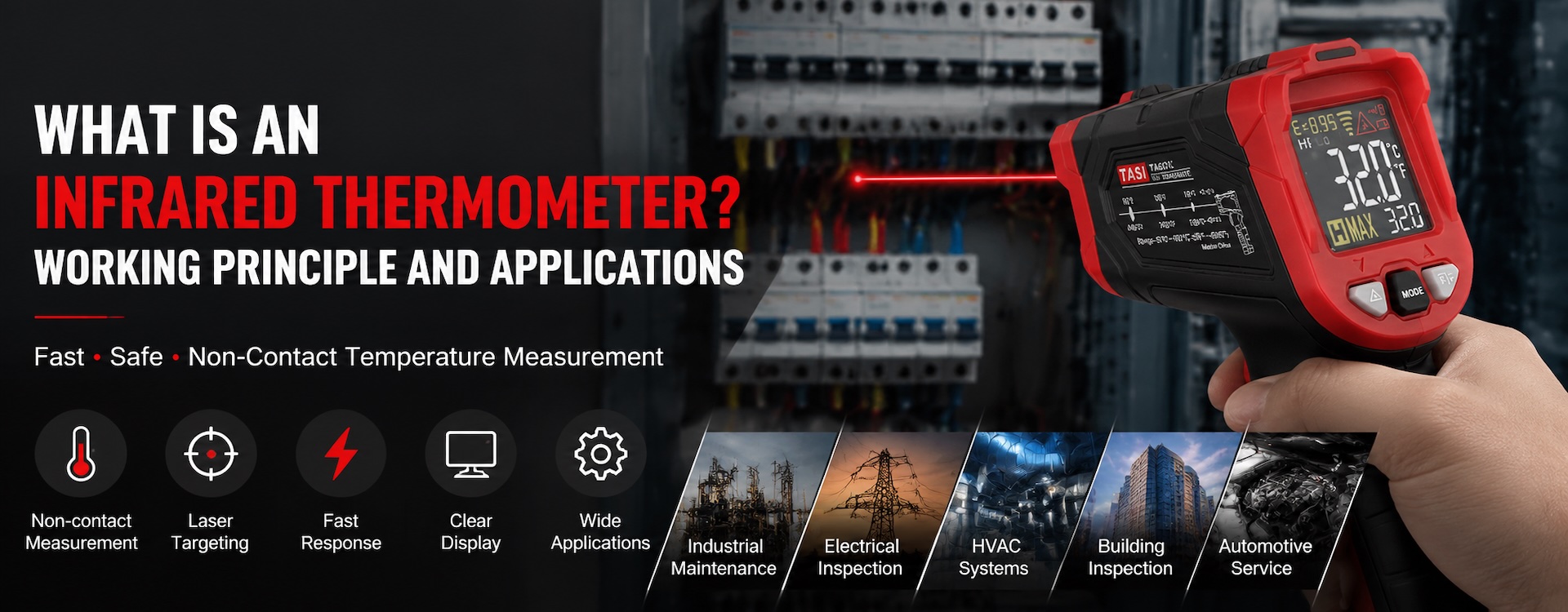
With continuous development of infrared sensing technology, infrared thermometers are now widely used in electrical inspection, industrial maintenance, HVAC systems, automotive service, laboratory testing, and building energy management.
Key Points
● Understand the basic concept and working principle of infrared thermometers.
● Learn about the main components and measurement process.
● Understand the advantages of non-contact temperature measurement.
● Explore applications in industrial inspection, electrical systems, HVAC, and building testing.
● Learn about key factors affecting infrared temperature measurement accuracy.
What Is an Infrared Thermometer?
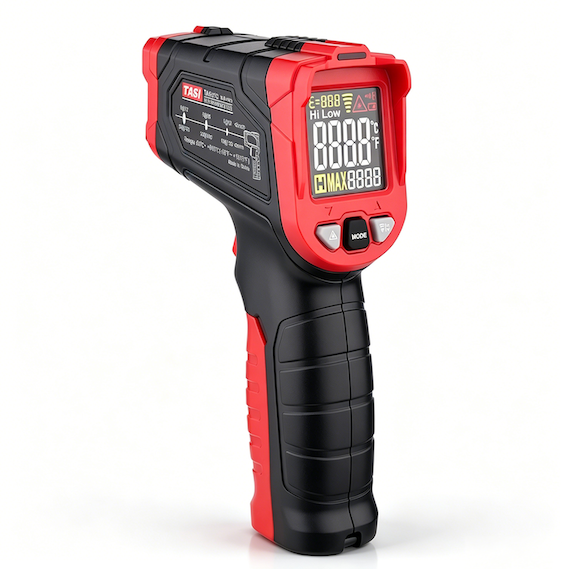
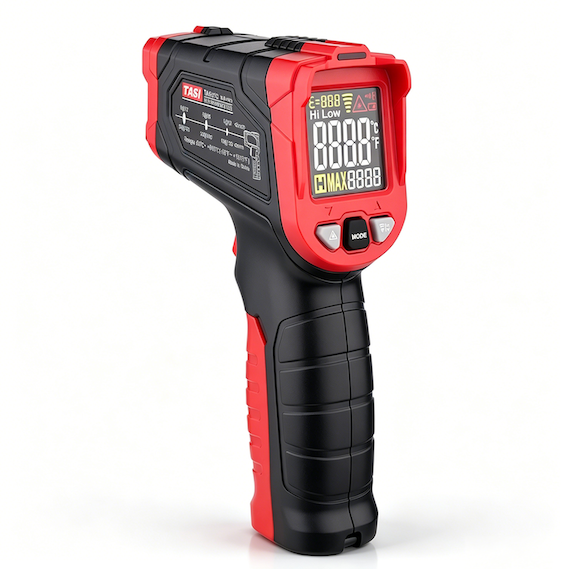
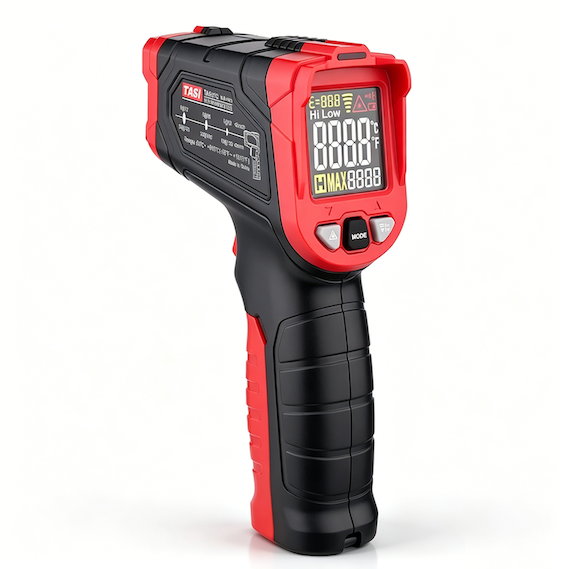
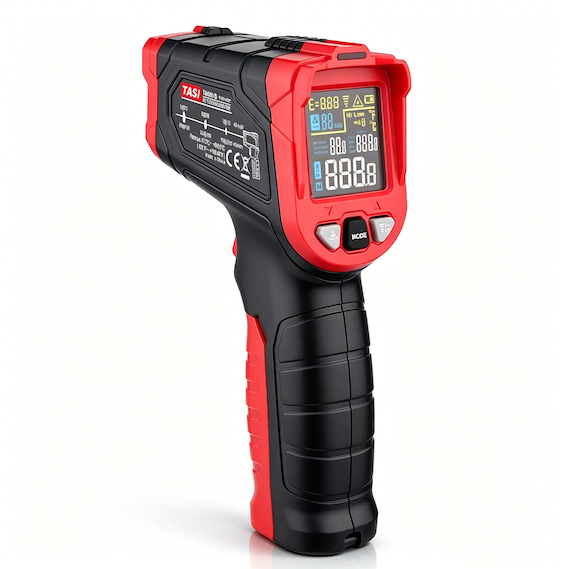
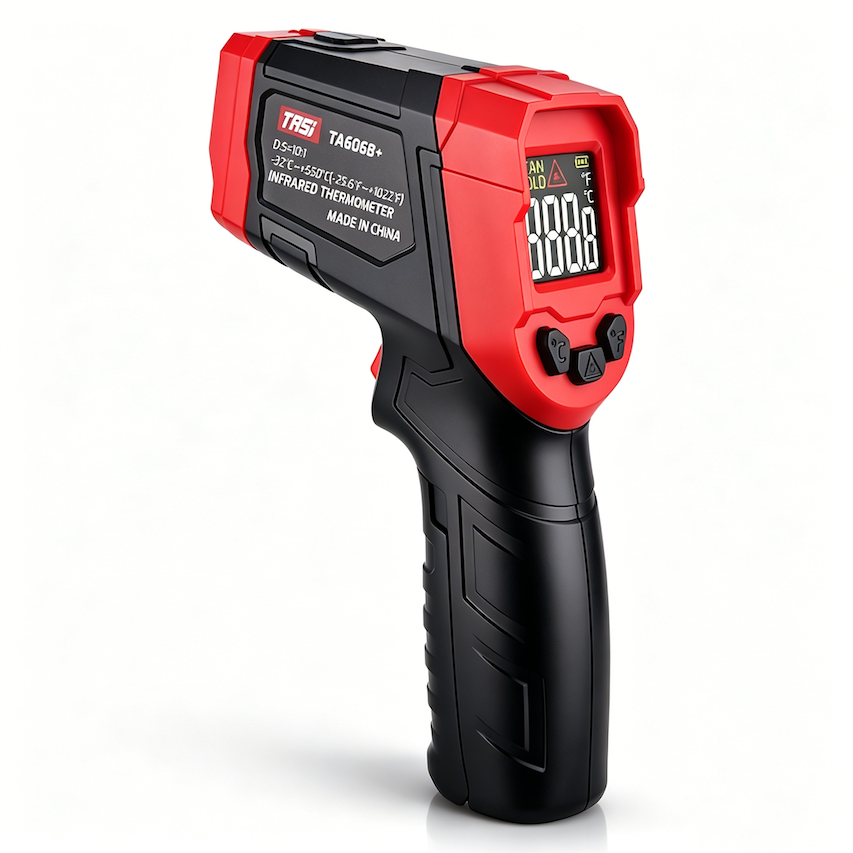
An infrared thermometer is a non-contact temperature measurement instrument that determines the surface temperature of an object by detecting infrared radiation.
All objects with a temperature above absolute zero (-273.15°C) emit infrared radiation. The amount of radiation emitted is related to the object's temperature. An infrared thermometer collects this radiation through an optical system, converts it into an electrical signal through an infrared detector, and calculates the temperature value using internal processing algorithms.
Compared with traditional contact thermometers, infrared thermometers do not require physical contact with the target object. This makes them suitable for measuring high-temperature, moving, or difficult-to-access areas.
Working Principle of Infrared Thermometers
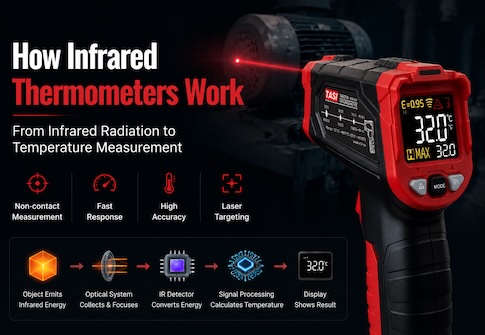
Infrared thermometers operate based on infrared radiation measurement technology. The process mainly includes infrared energy collection, signal conversion, and temperature calculation.
● The target object emits infrared radiation according to its temperature. Higher temperatures generally produce stronger infrared radiation.
● The optical system inside the instrument collects and focuses the infrared energy onto the infrared detector.
● The infrared detector converts the received radiation energy into an electrical signal.
● The processing circuit analyzes the signal and calculates the temperature based on infrared radiation intensity, emissivity settings, and environmental compensation data.
Emissivity is one of the most important factors affecting infrared measurement accuracy. Different materials have different infrared radiation characteristics, so proper emissivity adjustment is required for accurate measurement.
Main Components of an Infrared Thermometer
Although infrared thermometers are compact devices, they contain several key components that work together to complete temperature measurement.
● Infrared detector: Receives infrared radiation from the target object and converts it into an electrical signal.
● Optical system: Collects and focuses infrared energy to improve measurement efficiency and accuracy.
● Signal processing unit: Processes measurement data and converts signals into temperature values.
● Display screen: Shows temperature readings, measurement modes, and device status information.
● Laser targeting system: Helps users accurately identify the measurement area on some models.
● Housing and control buttons: Provide protection and allow convenient operation.
Features and Advantages of Infrared Thermometers
Compared with traditional contact temperature measurement methods, infrared thermometers offer several advantages.
● Non-contact measurement: Allows temperature inspection of high-temperature, hazardous, or inaccessible areas without physical contact.
● Fast response: Provides temperature readings within seconds or less, improving inspection efficiency.
● Easy operation: Users can quickly obtain temperature readings by simply aiming at the target and pressing the measurement button.
● Wide application range: Suitable for industrial equipment, electrical systems, HVAC inspection, automotive maintenance, and building applications.
● Convenient for routine inspection: Portable designs make them ideal for field engineers and maintenance technicians.
Applications of Infrared Thermometers
Infrared thermometers are widely used across various industries due to their fast and flexible measurement capability.
Electrical Equipment Inspection
In electrical systems, infrared thermometers can be used to check temperatures of distribution panels, electrical connections, motors, transformers, and other equipment. Abnormal temperature increases may indicate potential issues such as loose connections or overload conditions.
Industrial Equipment Maintenance
During continuous operation, mechanical equipment may experience temperature increases caused by friction, insufficient lubrication, or component wear. Infrared thermometers help maintenance personnel monitor bearings, motors, and other critical components.
HVAC System Inspection
In HVAC applications, infrared thermometers can measure temperatures of pipes, air outlets, heat exchangers, and other components to help engineers evaluate system performance.
Building Inspection
Infrared thermometers can assist in checking walls, windows, insulation structures, and heating systems to identify heat loss and improve energy efficiency.
Laboratory and Research Applications
Due to their rapid measurement capability, infrared thermometers are also used in laboratory testing, material research, and temperature monitoring applications.
Important Considerations When Using Infrared Thermometers
To achieve reliable measurement results, several factors should be considered.
● Maintain an appropriate measurement distance: Different models have different distance-to-spot ratios (D:S). Excessive distance may increase the measurement area and reduce accuracy.
● Set the correct emissivity value: Different surface materials require appropriate emissivity settings.
● Avoid environmental interference: Smoke, steam, dust, and strong reflections may affect infrared signal detection.
● Ensure sufficient target area: The measurement spot should fully cover the target surface.
● Maintain instrument performance: Regular inspection or calibration helps ensure reliable measurement results.
Infrared Thermometer vs. Contact Thermometer
Infrared thermometers and contact thermometers use different measurement methods and are suitable for different applications.
● Measurement method: Infrared thermometers measure surface temperature without contact, while contact thermometers require direct contact with the target.
● Measurement speed: Infrared models generally provide faster readings, while contact methods require thermal equilibrium.
● Application environment: Infrared thermometers are suitable for hazardous, high-temperature, or inaccessible locations.
● Measurement object: Infrared thermometers mainly measure surface temperature, while contact probes can measure temperatures of liquids, gases, or internal materials depending on the probe type.
How to Choose the Right Infrared Thermometer
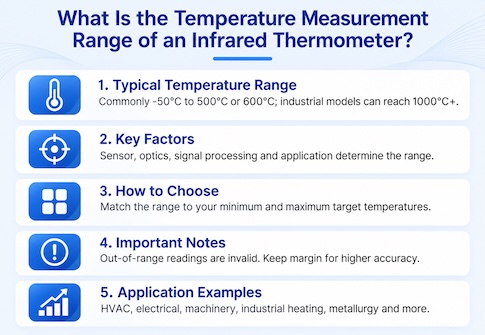
When selecting an infrared thermometer, users should consider the following parameters.
● Temperature range: Select a model suitable for the expected minimum and maximum temperatures.
● Distance-to-spot ratio (D:S): Higher D:S values are suitable for longer-distance measurements.
● Adjustable emissivity: Useful when measuring different surface materials.
● Response time: Important for fast industrial inspections.
● Environmental durability: Choose a model suitable for the working environment.
● Additional functions: Features such as laser targeting, data storage, Bluetooth communication, and alarms can improve efficiency.
FAQ
Does an infrared thermometer measure the internal temperature of an object?
● No. Infrared thermometers mainly measure surface temperature by detecting infrared radiation emitted from the object's surface.
Why does an infrared thermometer require emissivity adjustment?
● Different materials emit different levels of infrared radiation. Correct emissivity settings improve measurement accuracy.
Can an infrared thermometer measure glass temperature accurately?
● Standard infrared thermometers may not accurately measure transparent glass surfaces because infrared characteristics differ from opaque materials.
Can infrared thermometers measure human body temperature?
● Some specialized infrared devices are designed for body temperature measurement, while industrial infrared thermometers are mainly used for object surface temperature measurement.
Is a closer measurement distance always more accurate?
● Not necessarily. The correct distance depends on the instrument's D:S ratio and the size of the target area.
Summary
An infrared thermometer is a non-contact temperature measurement instrument based on infrared radiation technology. With advantages including fast response, safe operation, and convenient use, it has become an essential tool in industrial inspection, electrical maintenance, HVAC testing, building analysis, and research applications.
To ensure accurate measurement results, users should understand infrared measurement principles, correctly adjust emissivity settings, select appropriate measurement distances, and choose instruments according to specific application requirements.
With continued advancement in infrared sensing technology, infrared thermometers will play an increasingly important role in predictive maintenance, smart manufacturing, and energy management.