Introduction
Many plastic films are transparent to visible light. This can create the impression that an infrared thermometer should also be able to “see through” the film and measure the temperature of an object behind it.
In practice, transparency to visible light does not mean transparency to infrared radiation. Whether an infrared thermometer can measure through plastic film depends mainly on the film material, thickness, surface condition, and the spectral response range of the thermometer.
For most general-purpose handheld infrared thermometer applications, measuring directly through ordinary plastic film should not be assumed to provide an accurate target temperature.
Key Points
● A plastic film that is transparent to visible light may not be transparent to infrared radiation.
● Infrared thermometers detect thermal radiation within a specific wavelength range rather than measuring through visible-light transparency.
● Plastic film may absorb, reflect, and transmit infrared radiation, changing the signal received by the detector.
● If the film has low infrared transmittance within the thermometer’s operating wavelength range, the reading will often be closer to the film’s own surface temperature.
● Even when some infrared radiation passes through the film, the displayed temperature may not represent the true surface temperature of the object behind it.
● For measurements where accuracy is important, direct measurement of the target surface is generally preferred.
Why Can a Transparent Plastic Film Block Infrared Radiation?
Human vision depends on visible light. Transparent plastic films allow a relatively high proportion of visible light to pass through, which is why objects behind them can be seen clearly.
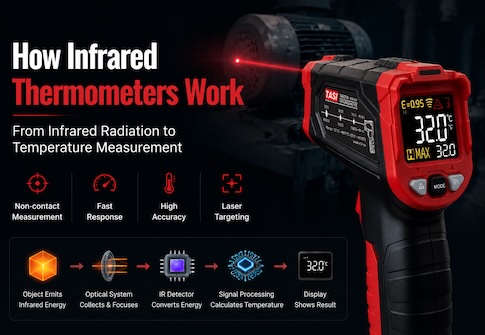
An infrared thermometer works differently. Its optical system collects infrared radiation emitted from a target surface and converts the detected radiation into a temperature reading.
For infrared temperature measurement, the important factor is therefore the material’s optical behavior within the actual operating wavelength range of the thermometer, rather than its transparency to visible light.
A film may appear completely transparent to the human eye while strongly absorbing infrared radiation within the wavelength range used by the thermometer. In this situation, the target remains visible, but its thermal radiation may not reach the infrared detector effectively.
What Does an Infrared Thermometer Actually Detect Through Plastic Film?
When infrared radiation reaches a plastic film, three main processes may occur:
● Part of the infrared radiation is absorbed by the film.
● Part is reflected by the film.
● Part may be transmitted through the film.
At the same time, the plastic film itself emits infrared radiation according to its own temperature and emissivity.
As a result, an infrared thermometer positioned outside the film may receive a combination of radiation transmitted from the target, radiation emitted by the film itself, and reflected background infrared radiation.
The displayed temperature is calculated from this combined radiation signal and may therefore differ from the actual temperature of the object behind the film.
Will the Thermometer Mainly Measure the Plastic Film Temperature?
Yes, this is possible and is common in general infrared temperature measurement.
If the plastic film has low transmittance within the thermometer’s operating infrared band, most of the thermal radiation emitted by the object behind the film will be blocked.
The detector will then receive mainly infrared radiation emitted by the film itself together with reflected background radiation. Under these conditions, the displayed temperature will generally be closer to the surface temperature of the film than to the temperature of the object behind it.
The effect becomes more noticeable when there is a large temperature difference between the target and the plastic film. For example, if a hot object is located behind a relatively cool film, the infrared thermometer may display a temperature significantly lower than the actual target temperature.
Does a Thinner Film Always Produce a More Accurate Measurement?
Not necessarily.
Film thickness can influence infrared transmittance. For the same material, a thinner layer may allow more infrared radiation to pass within certain wavelength ranges. However, thickness alone is not sufficient to determine whether reliable temperature measurement is possible.
Other important factors include:
● The specific polymer material.
● Film thickness.
● Pigments, fillers, coatings, or other additives.
● Moisture, oil, dirt, or contamination on the film surface.
● The spectral response range of the infrared thermometer.
● The temperature difference between the target and the film.
● Whether the instrument can compensate for transmission and reflected background effects.
Therefore, even a very thin and visually transparent film cannot automatically be considered negligible in infrared temperature measurement.
Do Different Types of Plastic Film Affect Infrared Measurements in the Same Way?
No. Different polymers can have significantly different infrared spectral properties.
Materials such as polyethylene, polypropylene, PVC, PET, and other polymers may have different absorption and transmission characteristics at different infrared wavelengths. Even films made from the same base polymer can behave differently depending on thickness, color, additives, coatings, and surface treatment.
For this reason, knowing only that a material is a “transparent plastic film” is not enough to determine whether accurate measurement through it is possible.
In general field measurements, if no reliable infrared spectral data or practical validation is available, the film should be treated as a material that may affect the measurement.
When Is the Measurement Error More Likely to Become Significant?
● When there is a large temperature difference between the film and the target.
● When the target is hot but the film remains relatively cool, which may cause the indicated temperature to be too low.
● When the plastic film has low transmittance within the thermometer’s operating infrared range.
● When moisture, dust, oil, or condensation is present on the film surface.
● When the film surface reflects infrared radiation from nearby hot equipment, people, or other heat sources.
● When the measurement distance is too great or the target is too small, causing the measurement spot to include surrounding areas.
What Should Be Done If Measurement Through the Film Is Unavoidable?
If the plastic film cannot be removed, the first step is to determine whether it has sufficient infrared transmittance within the operating wavelength range of the thermometer.
If the film manufacturer provides spectral transmission data, this information can help determine whether the material is suitable for measurement in the relevant infrared band. However, transmittance data alone may still not guarantee an accurate reading with a general-purpose handheld infrared thermometer because radiation emitted by the film, reflected background radiation, and instrument compensation algorithms also affect the result.
A practical comparison test can be useful:
● Measure the target surface directly.
● Cover the same measurement area with the film and repeat the measurement.
● Compare the two readings for a consistent difference.
● Repeat the test at several target temperatures.
If the measurement error changes significantly with temperature, a single fixed correction value should not be used as a general compensation factor.
How Can More Reliable Measurement Results Be Obtained?
For general industrial maintenance, HVAC inspection, electrical inspection, and equipment troubleshooting, the most reliable method is to measure the target surface directly.
● Remove plastic film, glass, or other covering materials from the optical path whenever possible.
● Make sure the target is larger than the thermometer’s measurement spot at the selected distance.
● Set the emissivity appropriately for the target material.
● Minimize reflected infrared radiation from hot surroundings.
● If measurement must be made through a dedicated infrared window material, verify that its transmission characteristics match the thermometer’s operating wavelength range and apply the required transmission and reflected-temperature compensation.
FAQ
● Can an infrared thermometer measure directly through cling film or food wrap?
It should not be assumed that it can. Although cling film is transparent to visible light, it may absorb a significant amount of infrared radiation. The displayed value may therefore be strongly influenced by the temperature of the film itself rather than representing the true temperature of the object behind it.
● Can I measure the temperature of an object inside a plastic bag?
Direct measurement through the bag is generally not recommended. The thermometer may measure mainly the plastic surface temperature or a combined radiation signal from the bag and the object inside.
● Can the effect be ignored if the film is extremely thin?
Not necessarily. The effect depends mainly on the film’s infrared transmittance within the thermometer’s operating wavelength range, not on thickness alone.
● Why can I see the object through the film but the infrared thermometer cannot measure it accurately?
Human eyes detect visible light, while infrared thermometers detect thermal radiation within specific infrared wavelength bands. A material can be transparent to visible light while being highly absorptive in the infrared.
● Is it normal for the measured temperature to be too low when measuring through plastic film?
Yes. If infrared radiation from a hot target is strongly absorbed by a cooler film, the displayed temperature may be considerably lower than the target’s actual surface temperature.
Conclusion
Whether an infrared thermometer can measure through plastic film cannot be determined from the film’s visible transparency. The key factors are the film’s transmission, absorption, and reflection characteristics within the thermometer’s operating infrared wavelength range.
With most ordinary plastic films, measuring through the film can introduce significant uncertainty. The thermometer may primarily detect the film temperature or a combined radiation signal influenced by the film, the target, and reflected background radiation.
Unless the infrared transmission characteristics are known and the measurement method has been validated, a temperature reading taken through ordinary plastic film should not be treated as the true surface temperature of the object behind it. For accurate measurements, direct access to the target surface is recommended.