Introduction
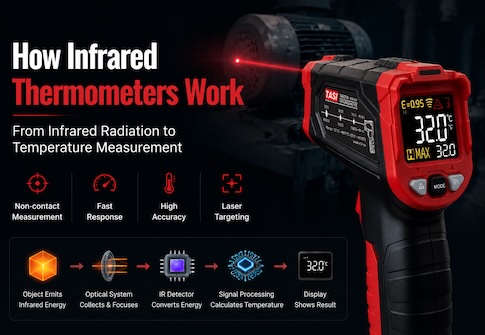
Infrared temperature measurement is a non-contact method. An infrared thermometer does not directly measure the internal temperature of an object. Instead, it detects infrared radiation emitted from the target surface and converts that radiation into a temperature value based on parameters such as emissivity.
Any condition that interferes with the transmission of infrared radiation between the target and the instrument can therefore affect the result. Dust, airborne particles, smoke, and oil mist commonly found in industrial environments can all influence the amount and characteristics of radiation reaching the detector.
It is important to recognize that dust and oil mist can affect measurements in several different ways. They may be suspended in the optical path, deposited on the target surface, or accumulated on the infrared lens or optical window. For this reason, the resulting error is not always in the same direction.
Key Points
● Dust and oil mist in the measurement path may absorb, scatter, or emit infrared radiation, changing the effective target radiation reaching the detector.
● Dust or oil deposits on the target can change surface emissivity and reflectivity, meaning the instrument may no longer be measuring the same surface characteristics.
● Dust and oil contamination on the infrared lens can reduce optical transmission and cause abnormal readings, slower response, or gradual drift.
● The effect generally becomes more significant as contamination increases, measurement distance becomes longer, or the target becomes smaller.
● A single fixed temperature correction is rarely suitable for all dusty or oily environments. Improving measurement conditions is usually more reliable than applying an arbitrary offset.
Why Does Dust Affect Infrared Temperature Measurement?
An infrared thermometer must receive sufficient radiation from the target. When the optical path contains a high concentration of airborne dust or particulate matter, the radiation may be partially absorbed or scattered.
● Absorption: Part of the infrared energy may be absorbed by suspended particles, reducing the amount of radiation from the target that reaches the detector.
● Scattering: Particles may redirect some radiation away from its original path, further reducing the useful target signal.
● Self-emission: Dust particles at elevated temperatures also emit infrared radiation, meaning the detector may receive radiation from both the target and the surrounding particulate matter.
In heavily contaminated environments, the thermometer may therefore receive a combined signal consisting of target radiation plus the effects of the intervening medium, rather than radiation from the target alone.
Why Can Oil Mist Also Cause Measurement Errors?
Oil mist consists of small liquid droplets suspended in air. It is commonly found around machining processes, lubrication systems, spraying operations, compressed-air systems, and other industrial equipment.
Like dust, oil mist can absorb and scatter infrared radiation. When the concentration is low and the optical path is short, the effect may be limited. However, measurement uncertainty may increase when the oil mist becomes dense, the measurement distance is long, or the temperature difference between the target and the mist is large.
For example, when measuring a hot surface through a dense oil mist, part of the infrared radiation from the target may be attenuated. At the same time, the oil mist itself may emit infrared radiation toward the instrument.
The resulting reading may therefore be either higher or lower than the actual target temperature, depending on target temperature, mist temperature, concentration, optical path length, and the spectral response of the thermometer.
For this reason, it is incorrect to assume that oil mist always causes infrared readings to be too low.
Dust on the Target Surface Can Change Emissivity
Airborne contamination is not the only concern. Dust deposited directly on the target surface can also affect infrared measurements.
An infrared thermometer responds to radiation from the outermost visible surface. If a previously clean or polished metal surface becomes covered with dust, the instrument is no longer measuring the same surface condition.
The effective emissivity may change significantly.
Many clean, polished metals have relatively low emissivity and reflect a substantial amount of surrounding infrared radiation. A dust layer can increase effective surface emissivity and reduce the relative influence of reflected background radiation.
As a result, the displayed temperature may change even when the actual object temperature remains nearly unchanged.
For long-term trend monitoring, the condition of the measurement surface should therefore remain as consistent as possible.
An Oil Film Changes the Effective Measurement Surface
Oil contamination on a target can also modify its infrared characteristics.
From the perspective of an infrared thermometer, the instrument receives radiation from the outermost surface. If a layer of oil covers the material, the thermometer is effectively measuring a surface whose radiative properties have been modified by that oil layer.
An oil film may affect:
● Surface emissivity;
● Infrared reflectivity;
● Surface heat transfer;
● Surface thermal response time.
If the oil layer is relatively thick, or if there is a temperature difference between the oil film and the underlying material, the measured surface temperature may not directly represent the temperature of the substrate or the original bare surface.
Dust and Oil on the Lens Can Cause More Persistent Errors
In practical industrial use, some measurement problems are caused less by temporary airborne contamination and more by deposits that gradually accumulate on the infrared lens or optical window.
The lens is a critical part of the optical path. Dust, oil, or condensed oil mist on its surface can reduce infrared transmission.
Typical symptoms include:
● Gradual change in readings from the same target;
● Abnormal readings when measuring high-temperature objects;
● Slower response than previously observed;
● Reduced repeatability when measuring the same reference target at different times;
● Noticeable recovery after cleaning the lens.
Unlike temporary dust in the air, lens contamination can remain in place and continuously affect the instrument. Regular inspection of the optical window is therefore particularly important in dusty or oily industrial environments.
Why Are Readings Sometimes Low and Sometimes High?
The direction of the measurement error is not fixed because the detector receives a combination of several radiation components.
If radiation from a hot target is strongly attenuated by cooler dust or oil mist, the indicated temperature may be lower than the actual target temperature.
If the target is relatively cool but the optical path contains hotter particles, hot oil mist, or another thermal radiation source, additional radiation reaching the detector may cause the reading to be higher.
When dust or mist concentration fluctuates continuously, the amount of effective infrared energy reaching the detector also changes, which can result in unstable temperature readings.
For troubleshooting, it is therefore not sufficient to observe only whether the reading is high or low. The measurement environment and optical path must also be examined.
When Is the Effect More Significant?
The extent to which dust and oil mist influence infrared measurements depends strongly on the application conditions.
● High contamination concentration: Greater particulate or mist concentration generally increases attenuation and interference.
● Long measurement distance: Infrared radiation travels through a longer contaminated path, increasing the opportunity for absorption and scattering.
● Small targets: A weak target signal is more easily influenced by surrounding radiation and intervening contamination.
● Large target-to-environment temperature difference: The effect of the intervening medium may become more noticeable.
● Long-term lens contamination: Deposits on the optical window can create persistent measurement errors.
● Low-emissivity surfaces: Reflected background radiation, changing emissivity, and surface contamination may all contribute to measurement uncertainty.
How Can Dust and Oil Mist Effects Be Reduced in Practice?
In general industrial applications, measurement reliability can be improved by controlling distance, optical path conditions, surface condition, and instrument maintenance.
● Reduce the measurement distance where practical, while ensuring that the measurement spot remains fully within the target area.
● Avoid measuring through visibly dense dust, smoke, or oil mist whenever possible.
● For long-term monitoring, keep the target surface condition consistent and avoid comparing measurements from a clean surface with measurements from a heavily contaminated surface.
● Regularly inspect the infrared lens or optical window for dust, oil, condensation, or other deposits.
● Clean optical components only according to the instrument manufacturer's instructions to avoid damaging infrared materials or optical coatings.
● For critical monitoring points, use a fixed measurement position with stable and repeatable optical conditions.
● Where dust or oil mist cannot be avoided, verify the infrared measurement against a reference temperature source or another suitable temperature measurement method.
Can a Fixed Compensation Value Be Used for Dust or Oil Mist?
In most cases, applying one fixed temperature compensation value is not recommended.
The error caused by dust or oil mist is not constant. It depends on particle or droplet concentration, path length, target temperature, medium temperature, target emissivity, infrared wavelength range, and lens contamination.
For example, the same oil mist may have a different effect when measuring a 50°C target than when measuring a 500°C target. Increasing the measurement distance from a few centimeters to several meters may also change the result substantially.
Improving the optical path and maintaining consistent measurement conditions are therefore more reliable than applying an arbitrary correction such as +5°C or −10°C.
How Can You Determine Whether Dust or Oil Mist Is Causing the Problem?
Several simple field checks can help identify whether contamination is affecting the measurement.
● Reduce the measurement distance while measuring the same target and observe whether the reading changes significantly.
● Repeat the measurement after dust or oil mist concentration has temporarily decreased.
● Inspect and properly clean the infrared lens, then measure the same stable target again.
● Check whether the target surface is covered with visible dust, oil film, or other contamination.
● Where possible, compare the result with a contact temperature sensor or another verified temperature measurement device.
● If abnormal readings occur only in contaminated environments while repeatability remains normal under clean conditions, investigate the optical path and contamination before assuming that the instrument itself is defective.
FAQ
Does dust always cause infrared temperature readings to be too low?
No. Dust can absorb or scatter target radiation, but it can also emit infrared radiation itself. The resulting error depends on target temperature, particle temperature, dust concentration, and measurement distance.
Does a small amount of dust affect infrared temperature measurement?
A small amount of suspended dust may have limited influence over a short measurement distance. However, for higher-accuracy measurements, a clean optical path is still preferable.
Can I continue measuring a surface after dust has accumulated on it?
Yes, but the dust layer may have changed the effective emissivity of the surface. For trend measurements, the surface condition should remain as consistent as possible.
Can an oil film change emissivity?
Yes. An oil layer can change both infrared emission and reflection characteristics. The emissivity value used for the original bare material may therefore no longer be appropriate.
Can an infrared thermometer still be used if the lens is oily?
It should not be relied upon for demanding measurements until the optical surface has been cleaned according to the manufacturer's instructions.
Can temperature be measured through dense oil mist?
A reading may still be displayed, but its accuracy and representativeness may be significantly reduced. For important measurements, avoid dense oil mist or use a more suitable measurement location or installation method.
Conclusion
Dust and oil mist affect infrared temperature measurement primarily by changing infrared transmission conditions and the radiative properties of the target surface.
Airborne dust and oil mist may absorb, scatter, or contribute additional infrared radiation. Deposits on the target may change emissivity, while contamination on the thermometer lens may reduce optical transmission.
Reliable infrared measurement in dusty or oily industrial environments therefore depends not only on the stated accuracy of the instrument, but also on measurement distance, optical path conditions, surface condition, and cleanliness of the optical window.
For critical temperature monitoring, maintaining stable and repeatable measurement conditions is generally more reliable than applying a simple empirical temperature offset.